Monstera Potting Soil: Recipe, Pot Size, and When to Repot
The best soil for a monstera mixes 2 parts orchid bark mix with 1 part potting mix. Learn the recipe, the right pot size, when to repot, and how to fix soggy soil.
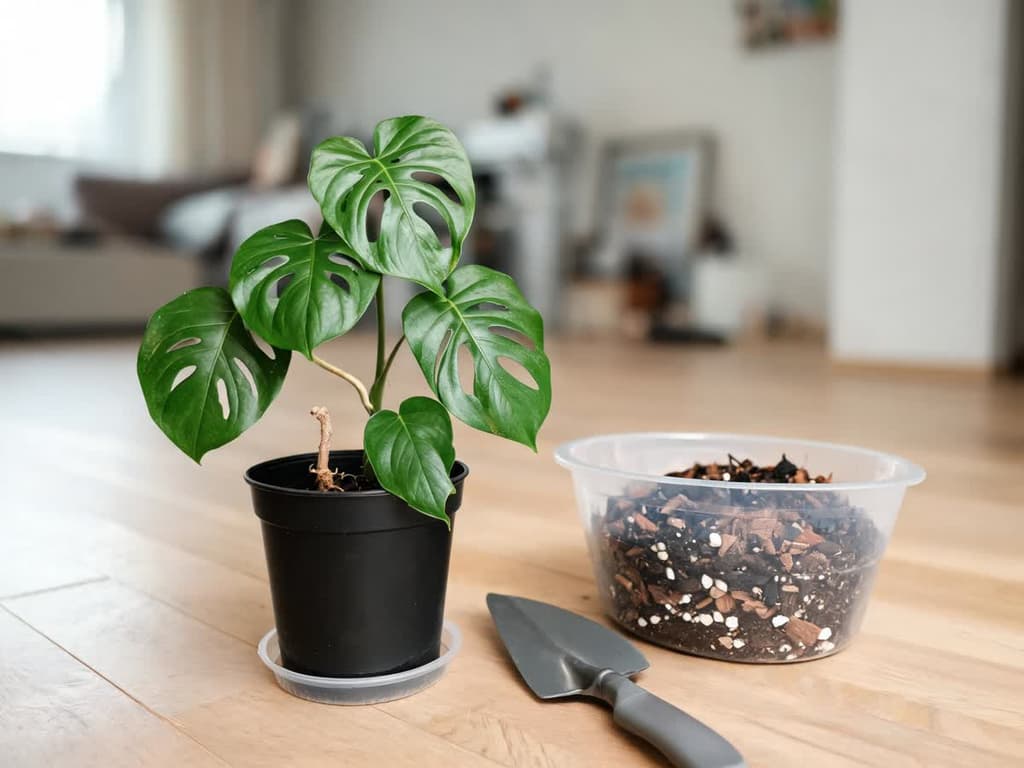
The best potting mix for Swiss cheese plant (Monstera deliciosa, the monstera) is a loose blend that drains water quickly while still retaining some moisture. The simplest recipe comes from the Royal Horticultural Society (RHS), the British horticultural society. It consists of 2 parts orchid mix (pine bark pieces, sold for orchids) to 1 part potting mix. Both items can be bought at garden centers in Brazil.
Potting mix is the container's soil: the blend that supports the root system in place of garden dirt. Monstera requires a mix with plenty of air because, in nature, its roots grow clinging to tree trunks. Garden soil compacts in a pot and introduces pests and diseases, according to Penn State Extension.
Quick summary:
Recipe: 2 parts orchid mix (pine bark) to 1 part potting mix. Charcoal or perlite (lightweight white grains of volcanic rock) is optional: 1 handful per quart (liter) of mix.
Pine bark is the base. According to Purdue University, foliage plant growers use 50% to 60% coarse bark in pots of 1 gallon (4 liters) or larger.
Choose a pot only 1 to 2 inches (2.5 to 5 cm) wider than the old one, always with a drainage hole.
A taller pot holds more air with the exact same mix. In a Montana State University trial, air space rose from 13% in a 4-inch (10 cm) tall pot to 20% in a 6-inch (15 cm) pot.
Change the potting mix when roots grow out of the drainage hole or when the plant wilts right after watering. The best time is spring, from September to November in Brazil.
What is the best potting soil for a monstera?
The best mix for a monstera is pine bark blended with a smaller portion of potting mix to retain water. The bark creates space for air to reach the roots. Potting mix retains moisture between waterings. Garden soil stays out.
According to the NC State Extension plant profile, monstera begins life on the ground. When it finds a tree, it climbs the trunk and lives attached to it. A plant that lives this way is called a hemiepiphyte. Aerial roots, which emerge from the stem, cling to the tree bark and remain constantly exposed to the air.
Indoors, monsteras typically grow 6 to 8 feet (1.8 to 2.4 m) tall, according to NC State. The root system expands along with the plant.
In the pot, the roots still need air. A greenhouse management course from the University of Arkansas recommends that 10% to 20% of the substrate consists of air after watering. With less air than that, the risk of root rot increases.
Three similar plants are sold under the name monstera or split-leaf philodendron. Monstera adansonii is smaller and features leaves perforated with holes without splits along the edges. The "mini monstera" (Rhaphidophora tetrasperma) belongs to a different genus and features small split leaves. The tree philodendron (Thaumatophyllum bipinnatifidum) has deeply split leaves extending close to the center and no holes in the middle of the leaf. All three thrive in the same type of mix: moist and well-drained, according to NC State plant profiles. If you are unsure which one you have, Bloom identifies plants from a photo (iOS app).
Standard mix, rich mix, or bark blend: what experts recommend
Technical sources agree on the core rule: the potting mix must drain well and contain no garden soil. The divergence lies in how loose or organic-rich the blend should be.
The RHS calls for an open, free-draining, slightly acidic potting mix. Its recipe uses 2 parts orchid bark mix to 1 part peat-free ericaceous compost.
Penn State Extension calls for a potting mix free of garden soil, well-draining, and rich in organic matter (plant and bark debris). It suggests adding charcoal, bark, or perlite to store-bought mix.
University of Wisconsin-Madison Extension calls for a "rich" potting mix with plenty of space for root growth.
Retailers also disagree with each other. One seller of pre-bagged monstera soil recommends only a small fraction of organic matter. A commercial potting brand instructs growers to use its standard indoor potting mix straight from the bag, unmixed.
This guide follows the RHS recipe because two university extensions point down the same path. Penn State advises blending bark, charcoal, or perlite into store-bought mix, and Purdue University notes heavy bark usage in large containers of foliage plants. The RHS is the only one providing an exact ratio for monsteras. The potting mix in the recipe supplies the moisture retention that Penn State and Wisconsin require.
Monstera potting mix recipe
The recipe below adapts the RHS ratio. Instead of ericaceous compost, it uses standard indoor potting mix, which is easier to find. Both serve the exact same water-holding purpose. Measure the parts using the same container, such as a bucket or a small container. For an 8-inch (20 cm) wide pot, each part works out to roughly 1 quart (1 liter).
Ingredient | Amount | Function |
|---|---|---|
Pine bark-based orchid mix | 2 parts (the bulk of the blend) | Creates air pockets and resists decomposing |
Houseplant potting mix, garden-soil free | 1 part | Holds moisture between waterings |
Horticultural charcoal pieces or perlite | 1 handful per quart (liter) of mix, optional | Keeps the blend lighter and looser |
Using bark as the primary ingredient also matches commercial growing standards. According to Purdue University, container blends for foliage in 1-gallon (4-liter) pots or larger contain 50% to 60% coarse bark.
Moisten the mix before blending and before filling the pot. Penn State recommends pre-wetting the mix so it absorbs water evenly. Dry peat moss (decomposed dark moss common in bagged potting mixes), for example, repels water until pre-moistened, according to Purdue University.
Adjust the recipe for your home conditions and your watering habits:
You water frequently, the pot is large, or your home is humid: stick with 2 parts bark and mix in charcoal or perlite.
Your home is dry, air-conditioned, or you forget to water: use equal parts bark and standard potting mix.
The recommended pH (acidity level) also varies by source. The RHS suggests a pH of 5 to 6, while Penn State suggests 6.0 to 8.0. Neither measured monsteras in container trials. Therefore, the safest approach is to avoid altering store-bought potting mix with lime or vinegar.
Potting mix ingredients available in Brazil
American recipes call for "orchid bark." In the United States, this bark is usually fir (fir bark), a bark that is rarely found in Brazil. In Brazil, orchid substrate is made from pine bark. Both are barks from needle-leaf trees, such as pine, and take a long time to decompose. The recipe works because of the material type and piece size, not the tree species.
Ingredient | What it does in the mix | Can be swapped with |
|---|---|---|
Medium pine bark | Creates air space and adds structure | Coconut husk chips |
Potting mix | Retains water and nutrients | Coco coir |
Perlite | Opens air pockets and does not decompose | Expanded clay pebbles |
Horticultural charcoal chunks | Lightens the mix | Perlite |
Vermiculite | Holds water and nutrients | Does not substitute for perlite |
Purdue University lists coco coir as an alternative to peat moss. The same publication lists expanded clay pebbles (the small brown ceramic balls) as a substitute for perlite. Pine bark also shrinks less than peat over years in long-term foliage containers.
Vermiculite creates the most confusion. It resembles perlite and holds water. According to the University of Arkansas course, vermiculite is fragile. Over time, it compresses in the container and loses its air space. For this reason, it does not provide effective drainage in a monstera mix.
Use horticultural charcoal chunks sold at garden centers or orchid suppliers. Avoid quick-light barbecue charcoal, which contains chemical fire accelerants.
Bagged monstera soil: what to check on the label
The closest ready-made bag to this recipe is an indoor plant mix based on pine bark or coco coir. Read the ingredient list on the back: the plant name on the front does not guarantee what is inside.
Acceptable: the first ingredient is pine bark, coco coir, or peat moss, and you can see visible chunky pieces in the bag. Use this as the potting mix portion of the recipe.
Usable only as the fine component: the contents are fine-textured and uniform, resembling ground coffee. Maintain 2 parts orchid bark to 1 part of this bag.
Do not use: the first ingredient is topsoil, black dirt, or "soil". Penn State warns that garden soil in containers introduces diseases and pests.
Cactus and succulent mix is also not the best option. It is formulated to dry out quickly, whereas monstera requires a moist, well-draining medium, according to NC State.
Pots for monsteras: diameter, height, and drainage
The new container should be only slightly larger than the old one: 1 to 2 inches (2.5 to 5 cm) wider. Clemson Cooperative Extension advises this exact range, and NC State Extension notes "no more than 2 inches". The RHS writes "a few centimetres larger", warning that an oversized pot stays wet too long and rots the roots.
Wisconsin calls for plenty of root space to promote larger leaves. Both recommendations work together. Give the plant more room gradually, moving up one small pot size at repotting time rather than taking a massive leap.
Pot height also changes drainage dynamics. At the bottom of every container sits a saturated layer of mix that stays waterlogged after irrigation. In a shallow pot, that wet layer takes up a larger proportion of the overall mix.
Montana State University measured the air content of a peat and vermiculite blend across containers of different heights. It held 13% air in a 4-inch (10 cm) pot and 20% in a 6-inch (15 cm) pot. For this reason, choose a pot at least as tall as it is wide. While no study tested this specifically with pine bark or monsteras, added height consistently increases container air content.
A drainage hole is mandatory, regardless of pot size. A plastic pot with drainage holes can sit inside a cachepot, which is a decorative outer pot without holes. Empty any water that pools in the bottom of the cachepot after watering. The RHS notes that leaving a pot sitting in a saucer of standing water rots the roots.
A large plant climbing a moss pole (a moss-covered stake that supports the vine) can tip over in a lightweight plastic pot. Switch to a heavier terracotta or ceramic pot for stability. Philodendrons are close relatives of the monstera. To weight the pot down, the University of Florida recommends commercial growers add 10% to 20% coarse sand to the mix when moss stakes exceed 3 feet (90 cm).
Gravel layer at the bottom of the pot: does it help or hurt?
A layer of stones at the base does not replace a drainage hole and wastes volume that roots could use. Authoritative sources disagree on how stones affect moisture flow.
Extension specialist Linda Chalker-Scott of Washington State University (WSU) wrote that a drainage layer only impedes the movement of water. Water does not move from the fine mix into the coarse stone until the mix above is saturated. NC State and Clemson extensions echo this conclusion.
A 2025 study published in the scientific journal PLOS ONE measured the opposite. In substrates made only of organic material without soil, like that of Monstera, almost every drainage layer reduced the water retained in the pot. Less standing water at the bottom is the desired effect. The best was a 60 mm layer of coarse sand. The test itself was conducted only with the pot waterlogged and draining, without a plant growing in it.
This guide follows the 2025 study because it provides published empirical measurements, whereas the WSU publication is a literature review. Neither tested pine bark mixes or living root systems. Therefore, a bottom layer is optional: prioritize a functional drainage hole and elevate the pot on feet or empty its saucer. If you include a bottom layer, use 60 mm of coarse sand, and never use it to replace a drainage hole.
When to repot a monstera and refresh the potting mix
Repot and refresh the mix when you observe any of these signs:
roots growing through the drainage hole at the bottom of the pot;
roots forming a dense mat around the root ball, with almost no visible mix in the lower third;
water running straight through the drainage hole while the mix dries out rapidly even in cool weather;
the plant wilting shortly after being watered;
the container tipping over when the mix dries because top growth has become too heavy for the base.
The first four signs come from Penn State and Clemson extensions. The final sign comes from the University of Arkansas Extension.
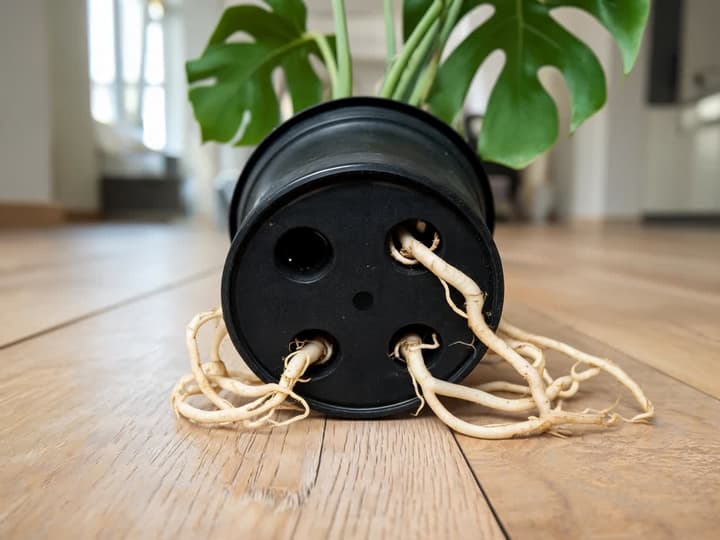
The RHS notes that a monstera can stay in its original pot for 1 or 2 years. After that, a mature plant goes into a larger pot every few years. Compacted media also lose air space. Montana State University notes that compaction can cut media aeration in half, or eliminate it entirely. Medium that is dark, fine, and mud-like has already lost its air space, and replacing it is worthwhile even without roots poking through the hole.
The best time to repot is spring, when the plant resumes growth. In Brazil, spring runs from September to November. NC State and Penn State recommend this season.
The soil is waterlogged: repot right now or wait?
Repot immediately if the top 1 to 2 inches (2.5 to 5 cm) of mix remain soggy by the time the next watering is due and emit a sour, foul smell. In that situation, waiting simply gives root rot more time to spread. Penn State notes that excess moisture leads directly to root rot. The RHS states that roots rot rapidly in poorly draining media.
Wait if the plant arrived from the store less than 4 weeks ago and the only symptom is a single yellowing lower leaf. The University of Florida recommends avoiding repotting or fertilizing philodendrons, close relatives of monsteras, during their initial adjustment indoors. Changing environments already stresses the plant. In the meantime, water only when the top 1 to 2 inches (2.5 to 5 cm) feel dry, as Penn State advises.
Potting mix that stays too wet also attracts the small black gnats that fly around the container. Their larvae live in wet organic matter, and treating fungus gnats starts by letting the potting mix dry out.
How to repot a monstera, step by step
You will need the new pot with drainage holes, the pre-moistened mix, clean shears, and gloves. Monstera contains calcium oxalate crystals, which irritate the mouths of dogs and cats, according to the ASPCA. The RHS recommends gloves for anyone handling the plant. Keep dogs and cats away from the plant and the trimmed roots during repotting:
Pre-moisten the fresh potting mix. It should feel damp to the touch without dripping water when you squeeze a handful.
Remove the plant from its container. Squeeze the sides of a flexible plastic pot or slide a dull knife along the inner rim. Support the main stem near the base of the mix.
Loosen compacted root balls. If the old mix is packed hard like concrete, submerge the root ball in a bucket of water until bubbles stop rising. Then, gently work the old media loose with your fingers.
Inspect the roots. Healthy roots are firm and pale. Use your clean shears to trim off any mushy, blackened, or sour-smelling roots. NC State instructs growers to cut and untangle roots that circle the root ball.
Add a base layer of mix to the new pot. Add enough so that the top of the root ball sits about 1 inch (2 cm) below the rim. This lip retains water during irrigation.
Center the plant and fill the sides. Work the mix between the root crevices using your fingers, avoiding packing it down hard so you do not crush the air pockets.
Direct the aerial roots. Tuck any aerial roots that reach the pot down into the potting mix. Secure the remaining roots to a moss pole, which Wisconsin recommends to support vertical growth.
Water thoroughly until water drains freely. Let the pot drain completely and empty the saucer. Withhold the next watering until the top 1 to 2 inches (2.5 to 5 cm) dry out.
The same repotting procedure applies to other tropical jungle plants with aerial roots, such as philodendrons climbing a moss pole. Cup-forming bromeliads differ: their roots primarily anchor the plant, and bromeliad potting mix relies on almost pure bark.
Frequently asked questions
Can I plant a monstera in regular dirt?
Not in garden dirt. It compacts inside containers, holds excessive moisture, and can harbor pests and pathogens, according to Penn State. Standard bagged houseplant potting mix works well as a base. Combine 2 parts orchid bark mix with 1 part standard mix, following the RHS recipe, to preserve air pockets around the roots.
Can I grow a monstera in 100% orchid bark?
It is not ideal. Water drains too quickly through pure bark for a monstera, which NC State classifies as a plant needing moist, well-drained media. That is why the RHS blends 1 part standard potting mix into every 2 parts orchid mix. Pure bark works better for true epiphytes that grow solely on trees, such as cup bromeliads and holiday cactus.
Do monsteras prefer deep pots or wide pots?
Choose a pot that is at least as tall as it is wide. With the same mix, a taller container retains more air after watering. Montana State University measured 20% air content in a 6-inch (15 cm) tall pot compared to 13% in a 4-inch (10 cm) pot. Increase pot width gradually, stepping up 1 to 2 inches (2.5 to 5 cm) per repotting.
Does hydrogen peroxide or cinnamon cure monstera root rot?
None of the university extensions or horticultural societies consulted for this guide recommend hydrogen peroxide or cinnamon for root rot. Experts direct growers to prune away dark, soft roots, discard all old potting mix in favor of fresh medium, and pot into a container with drainage holes. Afterward, water only when the top 1 to 2 inches (2.5 to 5 cm) become dry.
Conclusion
The ideal potting mix for a monstera is 2 parts pine orchid bark to 1 part indoor potting mix. Select a pot with drainage holes that is only 1 to 2 inches (2.5 to 5 cm) wider than the previous container. If your plant's soil feels dense like concrete, purchase both bags and repot this spring. If the mix remains waterlogged for days and smells sour, repot it today.
Related articles
How to Care for a Maidenhair Fern: Light, Water, and Revival Tips
Learn how to care for a maidenhair fern indoors: bright indirect light, consistently moist soil, high humidity, and how to revive it if it dries out completely.
How to Propagate Spider Plants: Root the Pup Before Cutting
The safest spider plant cutting comes from a pup still attached to the mother plant: rest the plantlet on soil in a small pot, wait for roots to establish, and only then cut the stolon. Learn when the pup is ready, whether rooting in water is worth it, how to divide the clump, and why plants fail to produce babies.
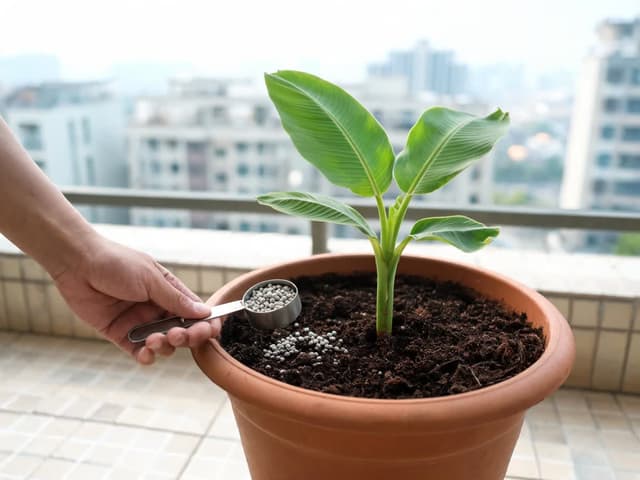
Banana plant fertilizer: fertilizing potted and backyard plants
Banana plant fertilizer needs more potassium than nitrogen, in a 3-1-6 ratio. For a potted plant on a balcony, use the label dose in spring and summer. In the backyard, fertilize every 2 months, adjusting the amount by mat age. Learn the formula, timing in Brazil, and signs of deficiency or excess.