Fungus Gnats: How to Identify and Get Rid of Soil Gnats for Good
Those tiny black bugs flying around your soil aren't coming from your plants—they're coming from your watering habits. Here is how to confirm what they are, hit them on 3 fronts, and break their cycle for good.
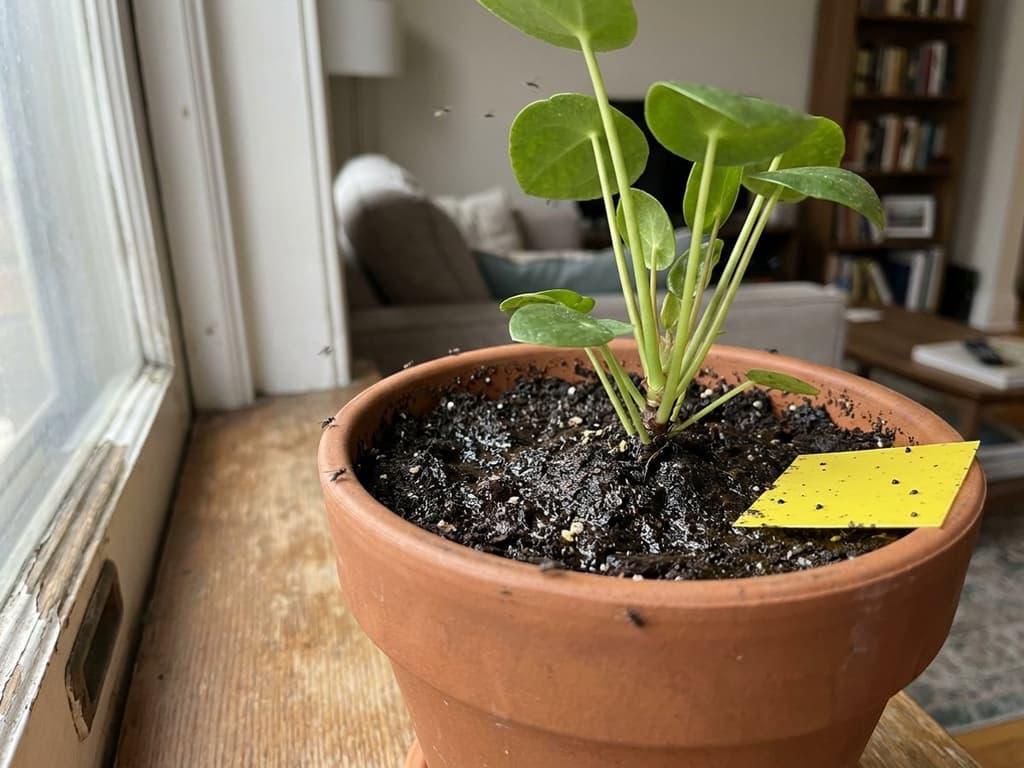
Those tiny black bugs, about 2 to 3 mm long, that flutter up from the soil whenever you water are fungus gnats. Technically, they are dark-winged fungus gnats from the Sciaridae family. They aren't actually eating your plant: the flying adults are just an annoyance, while the real culprits are the larvae living in the top 2 inches of your soil, thriving on constant moisture. To get rid of them, you have to attack on three fronts at the same time—drying out the soil, killing the larvae, and trapping the adults—for three to four consecutive weeks, which is how long it takes to break their entire life cycle.
This guide is for indoor houseplant parents. Most of the information out there was written either for commercial greenhouses or to sell products that aren't easy to find or use at home.
Quick summary:
The adults only live about a week, are completely harmless to you and your plant's leaves, and mostly just serve as a warning sign. It's the larvae in the soil that can nibble on roots—though even that is rare for established houseplants (Wisconsin Horticulture).
A single female can lay up to 200 eggs in moist soil (Colorado State University Extension), and their life cycle from egg to adult takes just 17 days at 24 °C (UC IPM) or about 3 to 4 weeks at typical room temperatures.
The single most effective thing you can do is let the top 1 to 2 inches of soil dry out completely between waterings. Without this step, no other treatment will work.
What fungus gnats are
Fungus gnats is the common name for tiny flies in the Sciaridae family (mainly Bradysia and Orfelia species). These are dark, delicate pests about 2 to 3 mm long that develop inside the potting soil of houseplants. The adults have long, slender legs, antennae that are longer than their heads, and a distinct Y-shaped vein pattern on the tips of their wings.
The larvae are translucent, worm-like creatures up to 6 mm long with a shiny black head, and they are the ones actually living in your soil.
Adult gnats are weak fliers: they hover lazily around the pot, crawl over the soil surface, and hang out near windows because they are drawn to light. If you see a tiny fly darting quickly across the room straight to your fruit bowl, it's probably not a fungus gnat.
Are they really fungus gnats?
This is the question that changes everything, and it's where most plant parents waste weeks of effort. There are four common types of tiny flies that show up indoors, but only one of them lives in your soil. If you actually have fruit flies from the kitchen or drain flies from your bathroom plumbing, treating your soil for a month won't do a thing—because your plants were never the breeding ground.
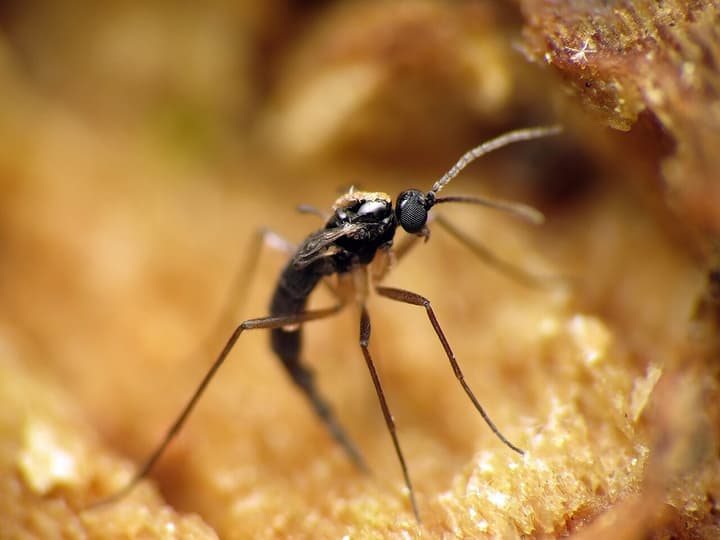
Sign | Fungus gnat | Fruit fly | Drain fly | Shore fly |
|---|---|---|---|---|
Appearance | Black, slender, long-legged—looks like a tiny mosquito | Tan to brownish-yellow, round body, bright red eyes | Gray, fuzzy, moth-like wings—looks like a tiny moth | Dark and stocky, looks like a miniature common housefly |
Where it breeds | Potting soil | Overripe fruit, rotting garbage, empty bottles | Sink drains, pipes, sewer lines | Algae on wet trays and waterlogged pots |
Flight | Weak, short, hovers near the pot or windows | Direct, flies straight to fruit and the kitchen | Short, hop-like flights; often rests flat on walls | Runs and scurries more than it flies |
Antennae | Long, longer than the head | Short | Fuzzy, feather-like | Short, bristle-like |
What lures it | Yellow color and moisture | Vinegar, fermenting scents | Nothing—clearing the drain is the only fix | Algae and standing water |
Zoomed-in photo check | Y-shaped vein on the wing tip | Red eyes, smooth wings | Fuzzy, moth-like wings | Smooth wings, bristle-like antennae |
These distinctions in antennae and body shapes come from pest sheets by the UC IPM and Purdue Entomology, which catalog household flies by their breeding sites.
If you're still not sure, try the potato slice test, which is the same method universities use to monitor these pests: cut a raw potato into slices about a quarter-inch thick and place them flat on the soil surface, cut-side down. After three to four days, lift the slices and look underneath. If you have gnats, you'll see the clear, black-headed larvae happily feeding on the potato. Simply throw the potato slices (and the larvae) away and start treatment that day.
Another sign of a heavy infestation: shiny, silvery trails on the soil surface, similar to snail trails. These are left behind by crawling larvae.
Where they came from (and why they showed up suddenly)
Fungus gnats don't spontaneously generate from your plants. They find their way into your home through three main routes: bringing home a new plant with infested soil (the most common), using bagged potting soil that was poorly composted or stored outdoors, or simply flying in through an open window.
But getting inside isn't enough for them to take over. Moisture is what seals the deal. Females choose where to lay eggs by sniffing out damp soil rich in organic matter, and peat-rich potting mixes kept constantly wet are their absolute favorite (Colorado State). That's why the question "why did they show up all of a sudden?" almost always points to a change in watering, not the plant itself.
Two classic triggers:
The soil has broken down. Potting soil degrades over time, losing its structure and holding onto water much longer than it used to. A pot that used to dry out in five days might now stay wet for nine, turning it into a perfect nursery without you changing a single thing.
The weather cooled down. With less sunlight and lower temperatures, plants drink less. If you keep watering on your summer schedule, the soil stays soggy—which is why gnat complaints peak in autumn and winter.
Ultimately, fungus gnats are a symptom of overwatering—and overwatering can cause much worse damage to your plants than a few tiny flies.
Do they harm your plant? Or you?
Adult gnats don't bite, sting, transmit diseases, or harm your plants—they are purely a nuisance. The larvae can nibble on delicate root hairs when their population gets out of hand, which can stunt your plant's growth. This is a serious threat to seedlings, cuttings, and young plants, but for established houseplants, damage is rare, according to Wisconsin Horticulture.
A crucial warning from UC IPM worth repeating: if your houseplant is wilting, it is far more likely due to overwatering, underwatering, poor drainage, or root rot than gnat larvae. Don't treat gnats expecting it to cure a wilting plant.
Why they come back a week later
This is where the frustration sets in—and it's a matter of simple math, not bad luck.
Look at the life cycle numbers tracked by university extension offices: eggs hatch in 3 to 6 days; larvae feed and grow through four stages over 1 to 2 weeks; pupae take 4 to 5 days to mature; and adults live for about 7 days, during which a single female lays up to 200 eggs. Added up, a full generation takes about 17 days at 24 °C (UC IPM) and about 3 to 4 weeks at typical room temperatures of 18 to 24 °C (Colorado State, Wisconsin).
Now connect that to the piece of information most guides leave out: what you kill today has nothing to do with what will hatch next week. Yellow sticky traps only catch flying adults, leaving larvae untouched. Bti kills larvae but doesn't affect eggs, pupae, or adults. Contact insecticides like insecticidal soaps, neem oil, or pyrethrins only kill the bugs they touch directly and have no lasting effect, meaning you'd have to spray every couple of days to make a dent (Colorado State).
In other words, on the day you treat your plant, there are still eggs and pupae waiting in the soil that nothing can touch. They will hatch over the next 5 to 10 days. Your one-time treatment didn't fail because it was weak. It failed because it was a one-time thing.
How to get rid of them: the three fronts
To get started, you'll need: three to four weeks of patience, yellow sticky traps, and coarse sand or fine gravel to cover your soil. Time per pot: 10 minutes. Difficulty: easy.
The three fronts target different stages of the gnat's life cycle. Skipping any of them is why most DIY treatments fail.
Front 1 — the soil (take away the nursery). This is the most critical step, and it won't cost you a dime.
Let the top 1 to 2 inches of soil dry out before watering again. Stick your finger into the soil up to your second knuckle: if it feels damp or soil clings to your skin, hold off on watering. Dry surface soil makes it hard for eggs to survive and stops attracting egg-laying females.
Water from the bottom. Set your pot in a tray of water for 20 to 30 minutes, then dump out any leftover water. The roots will drink from the bottom while the top layer stays dry—right where the larvae live.
Empty the drainage trays. Standing water in saucers invites pests and can create a breeding ground for shore flies.
If your soil is old and waterlogged, repot the plant using fresh, well-draining soil mixed with plenty of perlite or coarse sand. Degraded soil holds too much water, and no amount of careful watering can fix it.
Front 2 — the larvae (cut off the next generation).
Create a physical barrier: Cover your soil with a 1.5 to 2.5 cm (½ to 1 inch) layer of coarse sand or fine gravel. This layer dries out almost instantly, preventing females from reaching the soil to lay eggs and stopping mature larvae from climbing out. This is highly recommended by Wisconsin Horticulture and is the cleanest, easiest method for apartment living.
Keep checking with the potato test every week during treatment to monitor the larval population in your soil.
Bti — look for the active ingredient, not the brand. Bacillus thuringiensis israelensis is a bacterium that kills fly and mosquito larvae and does nothing against the rest of the pot's fauna. It is the larvicide that all three extensions recommend. The trade name changes from country to country: in the United States, it is sold in garden centers as Mosquito Bits and Gnatrol; in Brazil, the existing registration is for public health, for Aedes larvae — VectoBac (Sumitomo Chemical) —, and not an off-the-shelf gardening product. That is why the rule that works anywhere is to read the label for "*Bacillus thuringiensis israelensis*", instead of hunting for a brand. If you find it, use it to water the surface and repeat every 5 to 7 days, three times — the interval that Wisconsin Horticulture recommends —, because it does not target eggs or pupae. If you cannot find it, the treatment still works without it: fronts 1 and 3 are what sustain the result.
The professional route, if you have many pots: the nematode Steinernema feltiae is a microscopic worm that enters the larva and kills it in 3 to 4 days, and it is the most effective species against this pest (Colorado State, UC IPM). It is sold by biological control companies to growers, not in flower shops, and it is a live, perishable product — it arrives by order and must be applied immediately. Brazilian research has already tested nematodes against the fungus gnat for this purpose (SciELO). For 6 pots in a living room, it is not worth it; for a small greenhouse, it is.
Front 3 — the adults (stop the egg-laying).
Lay yellow sticky traps flat on the soil surface, sticky-side up, using one per infested pot. Laying them flat is much more effective than propping them up on stakes because adult gnats spend most of their time crawling on the soil. The bright yellow color is what attracts them—which is why apple cider vinegar traps, which work for fruit flies, won't do anything here.
Replace them when full. Sticky traps serve as both a treatment and a progress report: if your weekly catch drops, you're winning. If it doesn't, you have an untreated pot nearby or an outdoor source.
Isolate infested plants and avoid moving them to different rooms, or you'll just spread the problem around.
The four-week schedule
This timeline is based on the pest life cycles detailed above, not guesswork. It's designed to help you know exactly when your treatment is complete.
Day | What to do | Why |
|---|---|---|
D0 | Run a potato test, add sand to the soil, set up sticky traps, and start watering from the bottom | Stops new eggs from being laid and catches active flying adults |
D5 | Apply your second round of larvicide (if using) and swap out full sticky traps | Targets the eggs that have hatched since Day 0 |
D10 | Apply a third round of larvicide and run another potato test | Catches the wave of larvae that hatched after Day 5 |
D15–D21 | Maintain the routine: water from the bottom and keep traps in place | Catches the last wave of adults emerging from pupae that existed on Day 0 |
D28 | Final check: inspect your sticky traps | Almost zero gnats caught = problem solved. High numbers = you missed a pot or have an external source |
If your traps are still full on Day 28, the treatment didn't fail: you likely missed a pot in another room, or you are dealing with a different type of fly. Double-check our identification table.
What doesn't work (and why you see it everywhere)
Pouring hydrogen peroxide on the soil. This is a very popular online remedy, but it has two major flaws: none of the major university extension guides (UC IPM, Colorado State, or Wisconsin) list hydrogen peroxide as an effective control method, and peroxide is purely a contact treatment. It fizzes, turns into water and oxygen, and its job is done. With no residual effect, it won't touch eggs or pupae, meaning it can't break the life cycle on its own. It won't hurt your plants, but it won't solve your gnat problem either.
Vinegar traps. Apple cider vinegar traps rely on fermentation to attract fruit flies. Fungus gnats aren't interested in fermenting fruit; they want soil. Use yellow sticky traps instead. If your vinegar traps are full of bugs, you actually have fruit flies, and your plants are likely not the problem.
Sprinkling cinnamon on the soil. Cinnamon is sometimes used as a mild home remedy for damping-off in seedlings, but it isn't listed in any official pest management guides for fungus gnats. Gnat larvae feed on all kinds of decaying organic matter, not just fungi, so trying to eliminate soil fungus won't starve them out. If you start seeds indoors, Small Footprint Family's guide explains how fungus gnats spread damping-off in seedling trays and what to use when the soil can't dry out.
Spraying insecticide in the air. Wisconsin Horticulture explicitly advises against using aerosol bug sprays for gnats: you end up breathing in the chemicals, and the actual pests are buried safely in the soil where the spray can't reach them.
Only targeting the adults. Swatting them, vacuuming them up, or spraying them with insecticidal soap won't work long-term. Adults only live a week and have already laid their eggs. As long as your soil stays wet, a new generation is always on the way.
Replacing all the soil and calling it a day. This can help if your potting mix is old and compacted, but it's highly stressful for your plant, often leaves larvae tucked inside the root ball, and fresh bags of soil can easily carry gnat eggs of their own. Repotting is a helpful step, but it's not a shortcut.
How to keep them from coming back
Quarantine new plants: Keep any new additions away from your other plants for two weeks, and place a yellow sticky trap in the pot on day one. The trap will alert you to any pests before they spread.
Water based on observation, not a calendar. Watering "every Wednesday" is the easiest way to keep soil constantly wet. Testing the soil with your finger is the best preventative tool you have.
Store potting soil bags sealed and dry. Soil stored in open, damp bags outdoors is highly likely to have gnat eggs in it by the time you use it.
Keep trays clean and remove fallen leaves from the soil surface—decaying leaves are prime food for gnat larvae.
Add a permanent layer of coarse sand to the top of pots for plants that prefer to stay moist, like Peace Lilies. This acts as a permanent shield against pests.
If you aren't sure what kind of plant you have—and how much dry soil it can tolerate—you can take a quick photo with Bloom. The app identifies your plant and gives you a customized care guide, including the perfect watering schedule. The app is available on iPhone.
Frequently asked questions
What kills fungus gnats instantly?
Nothing kills them instantly, and you should be wary of any remedy that promises to. Only the adults are exposed—and they only live a week and have already laid up to 200 eggs. The eggs, larvae, and pupae are all protected underground. Real results take three to four weeks to match their full life cycle.
Why did gnats suddenly show up in my plant?
It almost always means your soil is staying wet longer than usual. This happens when potting soil breaks down and holds onto water, or when cooler weather sets in and your plants drink less. Female gnats are drawn to the scent of damp, organic soil. When soil moisture stays high, gnats appear.
Is it normal to have tiny bugs in potting soil?
Some soil life is completely normal and even beneficial—springtails and earthworms help break down organic matter and won't harm your plants. A small number of fungus gnats is also common and harmless. They only become a problem when their numbers explode, which is a clear sign your soil is too wet and risks developing root rot.
How do I get rid of gnats in plant soil without buying anything?
You can absolutely do it for free, as it's the core of the treatment: let the top 2 inches of soil dry out between waterings, switch to bottom-watering for 20 to 30 minutes, empty the drainage saucer, and cover the soil surface with a layer of coarse sand. Keep this routine up for four weeks.
Do fungus gnats bite or harm people?
No. Adult fungus gnats do not bite, sting, or carry diseases. They are purely an annoyance because they tend to fly around your face and computer screens. The only potential damage is to plant roots from the larvae, which is rare for mature houseplants.
Are fungus gnats the same as mosquitoes?
No. They belong to entirely different insect families. Fungus gnats belong to the Sciaridae family and breed in damp soil, not standing water, and they cannot bite. Aedes aegypti mosquitoes require standing water to reproduce. However, keeping your plant saucers dry is a great habit for preventing both.
In short
Fungus gnats are a watering issue before they are a pest issue: they show up when soil stays wet for too long and disappear when it dries out. Fight them on three fronts—dry out the surface, block the soil with sand, and catch adults with sticky traps—for four weeks to fully break their cycle.
The most important next step is simple: today, stick your finger in the soil of every plant in your home before you water them. It is the easiest way to prevent your next infestation.
If you find pests crawling on the leaves of your plant rather than in the soil, you are likely dealing with a different issue—such as aphids, which cluster on new growth and leave a sticky residue—which require a different treatment approach.
Related articles
How to Care for a Maidenhair Fern: Light, Water, and Revival Tips
Learn how to care for a maidenhair fern indoors: bright indirect light, consistently moist soil, high humidity, and how to revive it if it dries out completely.
How to Propagate Spider Plants: Root the Pup Before Cutting
The safest spider plant cutting comes from a pup still attached to the mother plant: rest the plantlet on soil in a small pot, wait for roots to establish, and only then cut the stolon. Learn when the pup is ready, whether rooting in water is worth it, how to divide the clump, and why plants fail to produce babies.
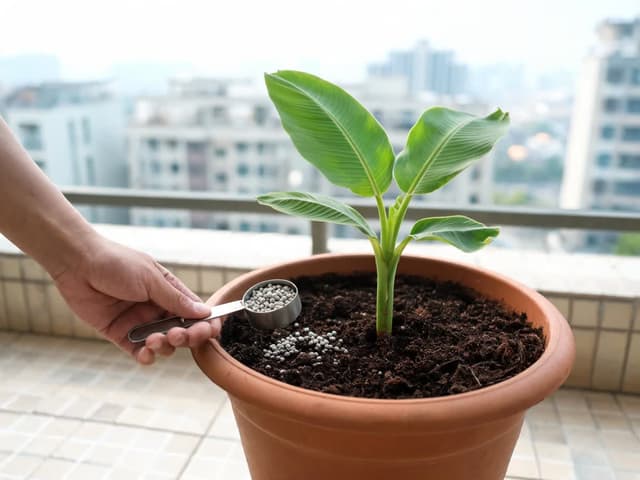
Banana plant fertilizer: fertilizing potted and backyard plants
Banana plant fertilizer needs more potassium than nitrogen, in a 3-1-6 ratio. For a potted plant on a balcony, use the label dose in spring and summer. In the backyard, fertilize every 2 months, adjusting the amount by mat age. Learn the formula, timing in Brazil, and signs of deficiency or excess.