How to Propagate Roses from Cuttings: Which Branch to Cut and Which Month
The right branch is the one that just finished blooming and is already firm at the base. See where to make the cut, why cuttings turn black and die in a week, and the two times of year that work in Brazil.
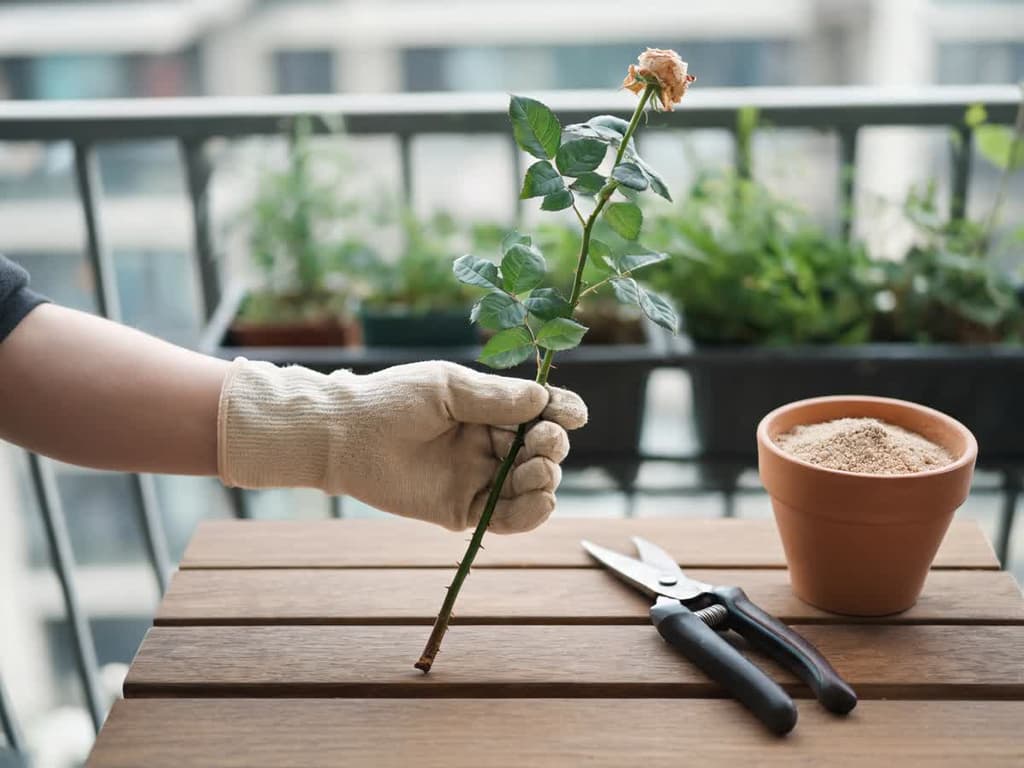
To propagate roses from cuttings, cut a 15 to 20 cm branch that just finished blooming and is already firm at the base. Strip the leaves from the bottom half and make the base cut right below a node, that swollen point where leaves emerge. Bury 5 cm of this branch in coarse sand or moist perlite, without any fertilizer, cover the pot, and place it in a bright spot away from direct sun. The roots on this piece of branch, which is called a cutting, take 6 to 8 weeks.
Two things decide whether it works: the condition of the branch and the month. A soft, green branch wilts before rooting. An old, hard branch does not produce roots. And in Brazil, there are two windows in the year, because these are two different types of cuttings.
Quick summary:
The right branch bends into an arch without breaking and without feeling rubbery. The visual cue is the spent flower or the fruit starting to form at the tip.
The cut that matters is at the base, right below a node. The angle of the blade is a detail; the node is not.
The rooting substrate, the material that fills the cutting's pot, contains no fertilizer, worm humus, or manure. Coarse sand, perlite, or carbonized rice hulls.
A cutting that turns dark from the base upward in a few days did not die of thirst: it is fungus, and it must come out of the pot immediately.
Which rose branch to cut
The stem that roots is semi-hardwood: one that grew this season, has stopped growing, and sits halfway between a soft shoot and a hard, gray cane.
Iowa State University Extension describes this stage through three signs: the material must be firm, with full-sized leaves, and newly woody. North Carolina State University Extension provides the clue you can spot from across the yard: the right branch usually has a faded flower or a fruit beginning to form at the tip.
The branch that just finished blooming is the branch for the cutting. The new shoot that has yet to bloom and the two-year-old cane down below will not work.
Test by hand, without any tools. Bend the branch into an arch:
If it bends and springs back like rubber, and your fingernail indents the bark effortlessly, it is still a soft shoot. The University of Georgia uses this fingernail test to separate softwood from semi-hardwood. A soft shoot loses water faster than it can replace it and wilts before pushing roots.
If it snaps, cracks, or will not bend at all, it is old wood. The bark is already thick, and the cells that form roots are too deep beneath the surface.
If it forms a firm arch and springs back intact, that is your cutting.
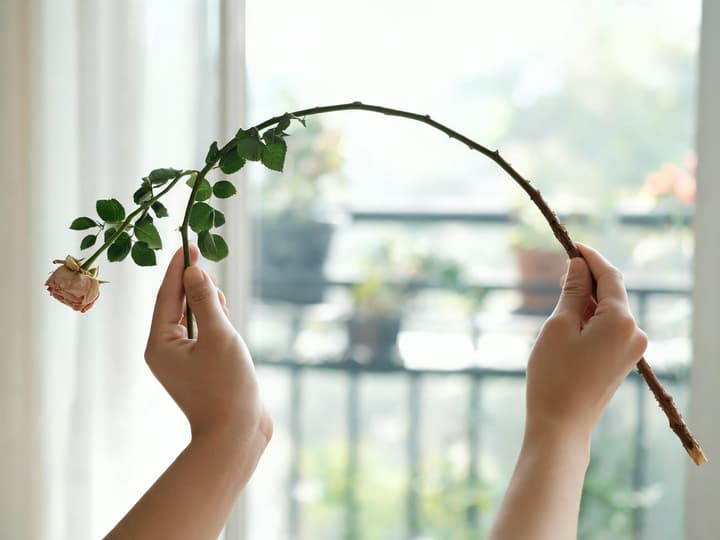
Pencil thickness is a good reference for garden roses. On miniature roses, the right branch is thinner than that, and the arch test still applies.
There is Brazilian data on which part of the plant to take. Zanão and colleagues tested tip cuttings against middle cuttings on potted roses of the Yellow Terrazza variety, using three substrates and ten replications, and published the result in the journal Ornamental Horticulture (v. 22, n. 1, 2016). The tip cutting produced better quality plantlets than the middle cutting. So, on the same branch, choose the tip.
Step-by-step rose propagation from cuttings
Cut early in the morning before the sun hits the plant. This is a North Carolina recommendation and has a purpose: the branch holds its highest water reserve of the day, and the cutting will spend the coming weeks without roots to replace lost moisture.
Set out pruners, a pot with drainage holes, substrate, and a clear plastic bag beforehand. A cutting left drying on the work surface before potting up already starts off losing water.
Put on gloves. Rose prickles, commonly called thorns, tear skin easily, and an injured hand makes everything that follows difficult.
Remove the branch by cutting right above a node. This cut is for the mother plant, not the cutting: by cutting flush to the node, you avoid leaving a dead stub behind.
Trim the base of the cutting right below a node, with the blade angled. An angled cut increases the water absorption area. What you must not omit is the node, because that is where roots emerge.
Keep the cutting at 15 to 20 cm and remove the spent bloom down to the first set of leaves.
Strip the leaves from the lower half and leave one or two leaves at the top. The remaining leaves supply the hormones that initiate rooting; leaves buried in the substrate will rot.
Scrape 1 to 2 cm of the base, on the side opposite the lowest node, removing only the outer bark layer. The layer exposed underneath is what generates roots.
Apply rooting hormone to the base. If using a powder product, dip the base into it and shake off the excess; if liquid, dip for a few seconds. For semi-hardwood cuttings, Georgia recommends auxin, the hormone that triggers root formation, between 1,000 and 3,000 ppm concentration, with a maximum of 5,000. That is the range found in powdered garden products. Brazilian cut-rose nurseries routinely use auxin talc on cuttings.
Bury 5 cm deep in substrate that has been pre-moistened and drained, firming it around the base.
The same cutting logic applies to other semi-hardwood plants. In wax plant, the cutting point is also the node, and hormone changes the timing, not the outcome.
One cutting per small pot keeps an issue in one stem from contaminating its neighbors. If using a larger pot, leave space between them for air to circulate.
What is the best time of year to propagate roses from cuttings in Brazil
There are two windows per year, and each calls for a different branch. All the literature on the subject comes from the Northern Hemisphere, so the months below are already converted to the Brazilian calendar.
Cutting type | Branch condition | When, in Brazil |
|---|---|---|
Semi-hardwood | Grew this season, stopped growing, with foliage and a spent flower | Mid-January through April, late summer to early autumn |
Dormant hardwood | From the previous year's growth, leafless, dormant plant | May through August, autumn and winter |
Semi-hardwood cuttings are the easiest way for home propagators, according to the Iowa extension. The source there takes these stems from mid-July to early fall, which in Brazil corresponds to mid-January through April.
A hardwood cutting is taken from the previous year's growth, with the plant dormant. North Carolina is the most direct on this: you can take cuttings from roses at any time, but the best success rate comes from cuttings taken there between November and February, which falls between May and August in Brazil.
Where you live changes the recommendation:
South and higher-altitude Southeast: both windows work. Roses drop leaves and go genuinely dormant in winter, making hardwood cuttings in June and July a viable option.
Northeast and North: no true dormancy occurs, and roses never lose their leaves from cold. Stick to the semi-hardwood window. Avoid peak rainfall, for the reasons covered in the black cutting section.
The calendar date is merely a guideline. What truly dictates success is the condition of the branch on your plant today: if it reaches that firm-arch stage, your window is now. Waiting for flowering to pass before cutting applies to other potted plants: in kalanchoe, cuttings come from shoots that have already finished blooming, not flowering stems.
The substrate: the cutting needs drainage, not feeding
The rooting medium is the poorest material you will ever use.
The University of Georgia is explicit: the propagation medium must be sterile, fine-textured, free of weed seeds, and without fertilizer, because fertilizer dehydrates the plant tissue. A cutting has no roots: there is nothing there to take up fertilizer, and the salt in the fertilizer draws water out of the stem in the opposite direction.
What works, according to extension sources: coarse sand, perlite, and vermiculite. In Brazilian literature, carbonized rice hulls are recommended by Embrapa Agroindústria Tropical to replace coconut coir dust in rose propagation due to concerns that coconut coir harbors fungi.
Garden soil functions, but ranks as the poorest choice on the list: it is heavy, retains too much moisture, and often harbors pathogens. Earthworm castings and animal manure do not belong here.
The other side was measured in Brazil. In the study by Zanão and colleagues, among the three substrates tested, the 1-to-1 mixture of clay soil and commercial substrate produced the best rooted cuttings. However, that trial ran in a shade-cloth tunnel with a pot cultivar, under controlled irrigation. On a balcony, without misting, the risk of waterlogging outweighs the nutrient gain, which is why this guide sticks with a free-draining inert medium.
Two figures from standard rose care instructions do not apply during this stage: watering every 7 days and fertilizing every 30 days are meant for rooted plants in permanent containers. Cuttings are not watered by the calendar; you water when the top of the substrate starts to dry out, and cuttings receive no fertilizer until rooted.
A plastic bottle helps and hurts at the same time
Covering the cutting is essential. Without roots, it continues to lose moisture through its foliage and cannot replenish anything. North Carolina puts it bluntly: if the cutting dries out during rooting, it dies, and there is no recovering it.
A cut plastic bottle, a clear plastic bag tented over stakes at the edge of the pot, or a clear plastic container with a lid all work. What the enclosure does is retain humidity in the air around the leaves.
The problem is that the exact same cover, placed in the sun, becomes a hot greenhouse. Heat combined with high humidity provides the precise conditions stem-rotting fungi need.
That is why light requirements match across all three extension sources: a bright spot with no direct sun. A porch with abundant indirect light and zero direct rays hitting the pot. Not deep shade, and not direct sun.
The rose you purchased is probably grafted
In Brazil, the nursery roots a cutting from a hardy rootstock, a resistant rosebush such as Rosa canina, Rosa chinensis, or Rosa indica, and then performs T-budding: inserting a bud from the attractive cultivar into this already rooted rootstock. This is what the cut rose cultivation material from UNESP describes.
The rosebush in your pot may actually be two plants: roots from one species, blossoms from another.
Where the graft union sits. Check near the base of the stem for a swelling or ringed scar, almost always situated just above the soil surface. Another way to spot it: sucker shoots, growths emerging below that point, featuring foliage of different appearance and small or unremarkable flowers. These originate from the rootstock. Nurseries routinely remove these shoots because they can outgrow and kill the scion.
The practical consequence: always harvest your cutting from above the graft union. A branch harvested below it simply propagates the rootstock, leaving you caring for two years for a rosebush that is not the one you intended.
The plant that grows from your cutting is an own-root rosebush. It is genetically identical to the top part of the parent plant, and it no longer has the rootstock's root system, which is precisely what the nursery wanted. Losing the rootstock's hardiness does not make the cutting unviable: in a trial in Andradas, Minas Gerais, which tracked the Tineke and Versilia varieties for one year on nine different rootstocks, Pizetta and Pivetta concluded that you can plant cuttings of both varieties. Stem cutting is the technical term for the cutting propagation taught in this guide.
If your rose originates from someone's garden without a tag or background, its species dictates its mature stature and anticipated bloom window. A quick photo in Bloom identifies the species, and the app is available exclusively on iPhone.
Taking cuttings without damaging the parent plant
Taking three or four cuttings from a mature, healthy rose does not hurt it. What causes damage is the way you cut.
Cut flush, right above a node. Leaving a branch stub between your cut and the node causes wood to dry out, darken, and create an entry point for disease.
Take cuttings only from healthy plants. Embrapa states categorically: propagules must come exclusively from demonstrably healthy specimens. Stems showing spots, dried tips, or dropping leaves carry those problems directly to the new cutting.
Clean your pruners. Embrapa's recommendation for cutting tools is washing with a 2% sodium hypochlorite solution, the active ingredient in household bleach. For recycled pots and trays, Georgia advises 1 part bleach to 9 parts water, followed by a clean rinse.
Do not cut in the rain or while foliage is wet.
Stem wounds are the primary entry route for crown gall bacteria, a common rose disease that triggers tumors at the base of the cane. Disinfecting your pruners closes that doorway.
The cutting turned black in a week: what happened
If you stuck rose cuttings into soil and they all blackened and wilted within days, it was not a watering error. It was fungal infection.
Embrapa Tropical Agroindustry documented rose and miniature rose cutting rots in Ceará nurseries in Technical Communication 129. There are three conditions, and the symptom you see is the same:
Cutting rot, caused by the fungus Lasiodiplodia theobromae. It is described there as the most frequent and destructive infection, widespread across all ornamental propagation facilities in the state.
Rhizoctonia rot, caused by Rhizoctonia solani. The document specifies the conditions where it peaks: temperatures between 24 °C and 30 °C paired with 60% to 80% humidity. Within that bracket, the fungus wipes out dozens of cuttings in mere days, stems darken rapidly, and leaves wilt and necrose.
Cylindrocladium rot, which according to that same report occurs primarily throughout the rainy season.
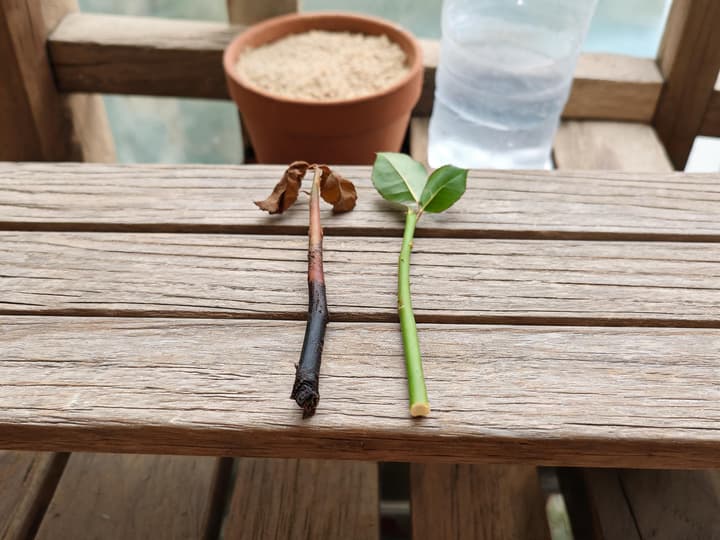
The Rhizoctonia bracket, 24 °C to 30 °C with 60% to 80% humidity, matches what an enclosed plastic bottle creates in a warm environment. The humidity enclosure protecting the cutting from desiccation can simultaneously cook it alongside pathogenic fungi. That is why the pot belongs in a bright, temperate area, never in direct sunlight.
What to do when one cutting turns black: take it out of the container instantly. Embrapa guidelines instruct that any cutting showing discoloration must be removed immediately so it does not infect the others. Discard it far from garden beds and do not reuse that substrate.
How to tell if the others are alive without pulling every stem. After 4 to 5 weeks, gently uncover the base of two or three cuttings. If roots have not appeared yet, tuck them back in: so long as stem and foliage stay green, the cutting remains viable and may simply need more time. A black or mushy brown stem indicates that cutting is spent.
When a cutting rots prior to pushing root growth, the dynamic resembles that of other plants, and the peperomia diagnostic offers a helpful baseline. If the underlying problem traces back to the parent plant rather than the cutting itself, it helps to diagnose the cause in 3 questions before pruning anything.
Rose cuttings in water and rose cuttings in potatoes
Both methods circulate widely and carry very different outcomes.
In water. Certain houseplants root cleanly in water alone, and Georgia extension recommends using a clean vessel, room-temperature water, and refreshing it every 3 to 5 days for those attempting this. The hurdle with roses is their woody stem tissue; everything extension sources require of a rooting medium points directly away from standing water: the medium requires sharp drainage, which is why coarse sand, perlite, and vermiculite make the cut. If you want to experiment, do so using a surplus cutting without sacrificing any already placed in substrate. A detailed comparison between water and substrate rooting appears in the guide on croton propagation, which can root in both.
In a potato. Nobody has documented empirical proof. I found no reference to this method across any university extension service, Brazilian floriculture publication, or peer-reviewed study on rose propagation. Because no verified measurements exist either supporting or debunking it, this guide makes no claim that the potato method works or fails.
What can be confirmed are the two baseline requirements extension sources establish for any medium surrounding the cut stem: it must drain freely and stay free of pathogens. A raw, damp, starch-laden tuber pressed against an open stem wound does not drain, and there is zero assurance it is clean.
Potatoes also sprout eyes. If you choose to test it, do so in an isolated pot.
From cutting to permanent pot
Once roots form, the young plant still transitions through two phases before heading into garden soil.
Hardening off. When root systems establish, vent the humidity cover gradually over several days without letting the foliage wilt, then remove it entirely. Plants cultivated in high humidity wilt quickly if thrust into dry ambient air without preparation.
Potting up. Move each cutting into its own individual pot filled with standard potting mix. This is when fertilizer enters the regimen for the first time, because the plant now has functional roots capable of absorbing it.
Permanent planting. Iowa State extension sets young plants in ground soil in early autumn and advises growing them on for 1 to 2 years before moving them to their permanent garden positions. For a cutting harvested in late summer in Brazil, this schedules transplanting around April or May, with the final garden bed move in year two.
Roses require full sun, so their final location requires at least 6 hours of direct daily sunlight, whether in an outdoor border or an oversized planter. Indoors, they will not thrive.
A cutting's initial flower flush typically waits until the plant builds sufficient vegetative framework, rather than arriving in month one. An own-root cutting starts small from the size of the cutting itself, while a purchased grafted rose departs the nursery with established structure already formed.
Frequently asked questions
How long does it take for a rose cutting to root? 6 to 8 weeks is the typical timeline Iowa State extension provides for most deciduous shrubs propagated from semi-hardwood cuttings. Inspect two or three cuttings between week four and week five. As long as stem and foliage stay green, the cutting remains viable, even without visible roots.
Can you propagate a rose from a cut flower bouquet? The odds are slim. A bouquet stem was cut days prior, originates from varieties bred purely for cut-flower production, and arrives stripped of healthy foliage. Extension sources specify freshly matured wood holding vibrant top foliage that has avoided drying out, none of which describes florist roses. If you want to try, choose the firmest stem and treat it as a standard cutting.
Can you plant a rose without roots? That is precisely how propagation from cuttings functions: you plant an unrooted stem segment and it develops its own root system. What you cannot plant is the blossom itself. Roots generate from stem nodes, meaning your cutting must have at least one buried node.
How do you cut roses to make new plants? Two distinct cuts with separate purposes. The first sits just above a node to protect the mother plant: it leaves no dead stub. The second cut trims the base of the cutting just below a node at an angle. Use sanitized pruners, work in the early morning, and wear protective gloves.
Is rooting hormone necessary? It is not mandatory, but it raises rooting percentages and speeds up development. For semi-hardwood stems, the target range is 1,000 to 3,000 ppm auxin. That matches typical garden powders and reflects standard protocol across commercial Brazilian rose nurseries.
Where to start
Head to your rosebush and locate a stem with a fading flower or young developing hip. Bend it into an arch. If it springs back firmly without snapping or feeling rubbery, cut a 15 to 20 cm section, strip the lower foliage, recut the base right below a node, and insert it 5 cm into damp coarse sand. Cover it, set it in bright indirect light, and leave it undisturbed until week four.
If you are unsure which rose cultivar you grow, or if the plant you want to propagate volunteered naturally in your garden, you can confirm its species by photographing the foliage and flower using Bloom, available for iPhone.
Sources
Iowa State University Extension, How to Propagate Roses, revised in February 2025.
Iowa State University Extension, Propagation of Deciduous Trees and Shrubs from Semi-Hardwood Cuttings, revised in October 2022.
NC State Extension, Beaufort County, Gene Fox, How Do I Propagate Roses From Clippings?, January 11, 2024.
University of Georgia Extension, Bulletin 1553, Bodie V. Pennisi, Sheri Dorn, and Sarah Sawyer, Starting Plants From Cuttings for the Home Gardener.
Freire, F. C. O. and Viana, F. M. P. Podridões em Estacas de Roseira, Minirrosa e Mussaendra no Estado do Ceará. Embrapa Agroindústria Tropical, Comunicado Técnico 129, Fortaleza, October 2007.
Zanão, M. P. C.; Zanão Júnior, L. A.; Grossi, J. A. S.; Vanzella, E.; Villa, F. Cutting collection region and substrate in the vegetative propagation of potted roses. Ornamental Horticulture, v. 22, n. 1, p. 58-62, 2016.
Pizetta, P. U. C. and Pivetta, K. F. L. Produtividade de cultivares de roseira sobre diferentes porta-enxertos ou provenientes de estaquia. Revista Brasileira de Horticultura Ornamental, v. 11, n. 1, 2005.
Galeriani, T. M. Cultivation of cut roses. Revista Agronomia Brasileira, UNESP/FCAV.
Related articles
How to Care for a Goldfish Plant: Light, Watering, and Blooms
How to care for a goldfish plant: bright light without strong sun, water when the soil surface dries, and humid air. Learn how to tell a Nematanthus from a Columnea, why it drops leaves, and how to get it to bloom again.
Lavender Leaves Turning Yellow: Where the Yellowing Starts Shows the Cause
Lower leaves turning yellow with moist soil means overwatered roots, the most common cause. Old leaves drying one by one on woody stems is normal. Take the stem and root test, see if your plant can still be saved, and find out what to do today.
How to Propagate Lavender: Where to Cut and Why Cuttings Rot
A lavender cutting comes from a non-flowering branch tip, about 4 inches long, planted in sandy soil that never stays soggy. Learn where to cut, rooting times, seasonality in Brazil, and what to do if the base turns black.