Schefflera: How to Propagate by Cuttings, Air Layering, and Seeds
A schefflera cutting comes from a stem with a node, planted in moist soil. Discover tip cuttings, single-node cuttings that yield multiple plants, air layering for tall specimens, why a leaf alone will not sprout, and how to preserve variegation.
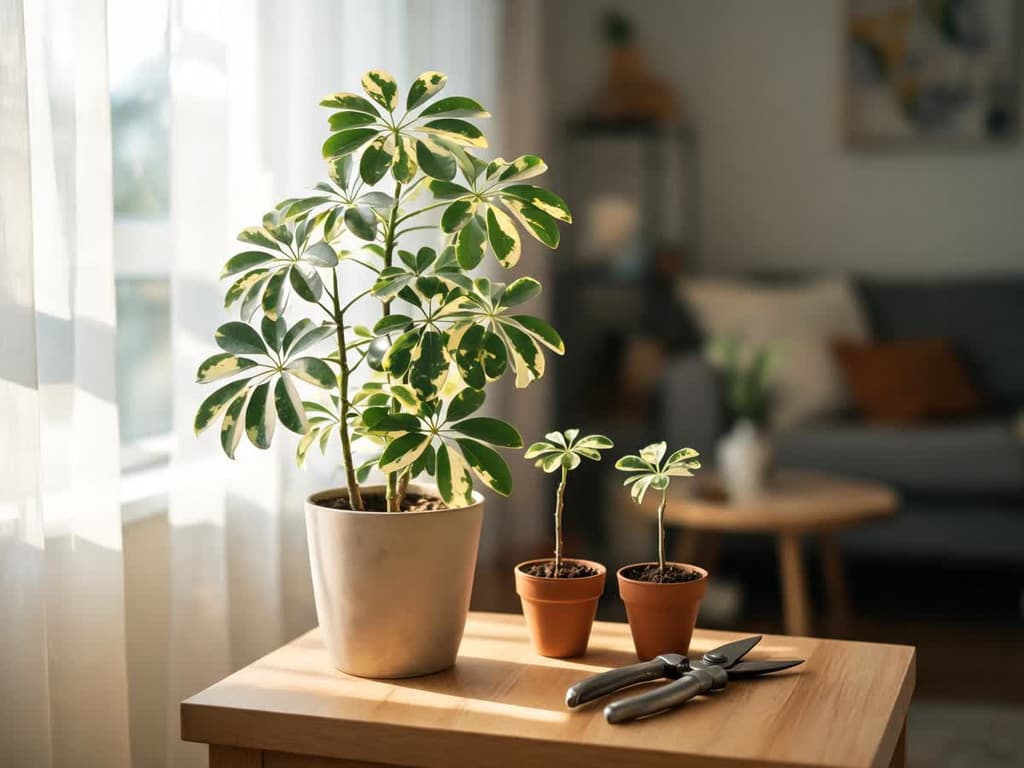
To propagate schefflera, cut a 4 to 6-inch branch tip with at least two nodes. Remove the lower leaves, plant the base in moist soil, and cover it with a clear plastic bag. Roots emerge from the nodes, the points on the stem where leaves emerge.
A stem cutting is the safest route. A schefflera leaf will root in soil, but it will not produce a shoot, and seeds almost never reproduce the patterns of a variegated schefflera. For a tall schefflera that you do not want to risk losing, there is air layering, which roots the new plant while it remains attached to the parent plant.
Quick summary:
Standard potted schefflera: tip cutting, 4 to 6 inches long with two nodes, in moist soil.
Long branch with many leaves: cut into single-node cuttings, each with one leaf and the bud (the point that develops into a new shoot) in the axil.
Variegated schefflera: only cuttings or air layering, and always taken from a branch with variegated leaves.
Tall schefflera or yard plant you do not want to risk: air layering.
Single leaf: develops roots but never becomes a plant.
Season in Brazil: from September to March, right after a flush of new leaves.
Protection: wear gloves, because the sap irritates sensitive skin.
Identify your schefflera before propagating
Two different plants are called schefflera in Brazil, and the two propagate in different ways. Potted schefflera is Heptapleurum arboricola, which has small leaves. Outdoor schefflera is Heptapleurum actinophyllum, a tree with large leaves. Both used to have the name Schefflera and are now in the genus Heptapleurum.
Potted schefflera | Outdoor umbrella tree | |
|---|---|---|
Scientific name | Heptapleurum arboricola (formerly Schefflera arboricola) | Heptapleurum actinophyllum (formerly Schefflera actinophylla) |
Other names | dwarf umbrella tree, umbrella plant | umbrella tree, octopus tree |
Leaflets per leaf | 7 to 9 | 5 to 18 |
Size | 4 to 6 ft in a pot; 10 to 25 ft planted in the ground in tropical climates | tree exceeding 40 ft |
Variegated versions | several, such as 'Gold Capella', 'Trinette', and 'Variegata' | 'Variegata' |
Primary propagation method | stem cuttings | air layering or seed |
A leaflet is each of the individual blades that form the leaf in a circle, like the ribs of an umbrella. In English, both plants are known as "umbrella plant" or "umbrella tree."
A schefflera that sprouted on its own in the yard almost always came from a seed carried by a bird. The Hórus Institute records both scheffleras as invasive exotics in Brazil, spread by birds. The potted variety also germinates on walls, rocks, and roofs.
The methods that work for each schefflera
Potted schefflera propagates by stem cuttings, air layering, and seed. The RHS, the horticultural society of the United Kingdom, lists these three methods for it. A cutting is a piece of branch that forms its own roots after being severed.
The production guide from the University of Florida (UF/IFAS) states that outdoor schefflera is not typically propagated by cuttings. Commercial nurseries rely on seeds and tissue culture. NC State Extension lists air layering, seed, and stem cuttings for it.
Method | Target schefflera | Timeline or success rate |
|---|---|---|
Tip cutting | Potted schefflera, green or variegated | No technical source has measured the rooting time for schefflera |
Single-node cutting | Potted schefflera, long branches | Method used by Florida nurseries (UF/IFAS); timeline unmeasured |
Air layering | Tall schefflera, potted or outdoor | Roots appear in the moss before you cut |
Seed | Non-variegated schefflera; outdoor umbrella trees almost always grow from seed | 93% germination for potted schefflera and 67% for outdoor schefflera when planted immediately after harvest (UF/IFAS) |
In water | Not recommended | Water roots develop thin and struggle when transplanted into soil (Texas A&M) |
Single leaf | None | Forms roots but never produces a shoot (NC State, Iowa State) |
How to propagate schefflera by tip cuttings
A tip cutting is the end of a branch with the cluster of leaves at the top. It is the simplest way to propagate schefflera, and the cutting already displays the leaves of an adult plant. Cutting off a tip does not kill the parent plant, because each node below the cut holds a bud capable of sprouting.
1. Put on gloves before cutting
Schefflera sap irritates sensitive skin. NC State recommends wearing gloves as a precaution for potted schefflera and also records skin irritation from the sap of outdoor schefflera.
2. Cut a 4 to 6-inch tip with two nodes
Using clean pruning shears, cut the tip of the stem just below a node. Penn State Extension recommends 3 to 6-inch tips with at least two nodes for houseplants. Wipe the blade with rubbing alcohol before cutting.
3. Remove leaves from the bottom half
Leave two or three leaves at the top of the cutting and pull off the rest. Penn State advises stripping the leaves from the lower half of the cutting. Buried leaves will rot and spread that rot to the stem.
4. Rooting hormone, if you choose
Rooting hormone is a powder or gel containing auxin, the chemical substance plants use to generate roots. Penn State notes that it speeds up rooting and that applying too much delays it. Dip only the cut tip and tap off the excess.
5. Plant in light, moist potting mix
Bury the cutting until the lower node is covered, in a small pot with drainage holes at the bottom. The NC State gardening handbook recommends a mix of equal parts peat and perlite, or peat and coarse sand. Peat is decomposed moss sold in bags; perlite consists of small white spheres of expanded rock. Water before planting and allow the pot to drain.
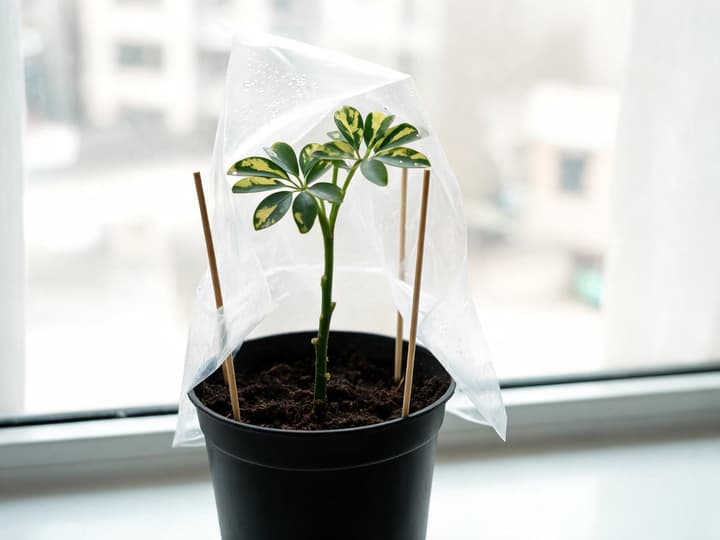
6. Cover with a plastic bag and place in bright light
The cutting does not yet have roots to replace the moisture lost through its leaves. A clear plastic bag placed over the pot holds humidity, supported by stakes so it does not touch the foliage. Texas A&M AgriLife advises allowing air to circulate under the plastic to prevent disease.
Texas A&M recommends bright, filtered light, because direct sun will scorch the cutting, along with daytime air temperatures around 70 °F (21 °C). The soil performs best between 70 and 75 °F (21 and 24 °C). Keep the soil moist without waterlogging it.
No technical source has measured exactly how long a schefflera cutting takes to root. The signal that it has taken is a new leaf opening at the tip. Before that happens, do not pull on the cutting to inspect the roots.
Single-node cutting: multiple schefflera plants from a single branch
A long schefflera branch yields multiple plants when divided into single-node cuttings. Each single-node cutting consists of an entire leaf with the section of stem directly beneath it. The leaf axil, the angle between the petiole and the stem, contains the bud, which is where the new shoot emerges.
The UF/IFAS production guide describes this cutting for potted schefflera, with about 1 inch of stem below the leaf. The cuttings are taken below the two highest fully opened leaves and above the older lower leaves, targeting the middle of the branch.
Cut the branch into sections, each with one leaf and about 1 inch of stem below it.
Discard the soft tip and the woody base section of the branch. The tip can become a separate tip cutting.
Bury the stem with the bud covered and the leaf exposed. The NC State handbook recommends covering the bud with up to 1 inch of potting mix.
Cover with plastic and follow the same care guidelines as for a tip cutting.
Propagating schefflera from a leaf: roots without shoots
A schefflera leaf, severed without a portion of the stem, will grow roots but will never develop into a new plant. A Brazilian gardening blog, Diário de Fé e Flores, tracked a variegated schefflera leaf planted in August 2019. One year later, the leaf had roots and a thickened petiole, but zero shoots.
The NC State handbook explains the reason. A detached leaf carries no bud, and only species that develop adventitious buds directly on the leaf blade can become whole plants this way. In other species, the leaf merely produces a few roots or rots away. Iowa State Extension categorizes both schefflera species under plants propagated by stem cuttings and air layering, not by leaf cuttings.
The fix is to harvest that same leaf with a segment of stem and the axillary bud attached, creating a single-node cutting. The wax plant shares this exact limitation: a lone leaf forms roots and never sprouts. The peperomia represents the opposite case, producing new shoots directly at the base of the leaf petiole.
How to propagate variegated schefflera
A variegated schefflera cutting must come from stem cuttings or air layering performed on a branch with variegated foliage. A variegated plant features leaves splotched or striped with white, cream, or yellow, like 'Gold Capella' and 'Trinette'. This leaf pattern only carries over when propagated vegetatively from a piece of the plant itself.
Seeds almost never reproduce variegation. The RHS notes that very few variegated plants come true from seed. Seedlings mix the genes of the two parent plants, while a cutting is genetically identical to the mother plant.
Inspect the branch carefully before cutting. Variegated specimens occasionally produce a branch with solid green leaves, a process the RHS terms reversion. This branch grows more vigorously than the variegated sections and yields solid green offspring. Take cuttings exclusively from a variegated stem, and prune the solid green shoot flush with the main stem.
Air layering: propagating schefflera without severing the stem first
Air layering forces roots to grow along the middle of a branch, wrapped in moist moss, before you cut the new plant free. It is ideal for tall scheffleras, outdoor umbrella trees, and prize garden specimens you cannot afford to lose. Penn State Extension lists potted schefflera among the plants that multiply readily through air layering.
Schefflera is a dicot, a group of plants with stems featuring outer bark and inner wood, much like trees. For this reason, air layering requires girdling a ring of bark. The NC State handbook details the procedure as follows:
Choose a firm branch section, below the foliage, at the height where you want the base of the new plant to be.
Remove a 1-inch ring of bark all the way around the stem using a clean knife.
Scrape the exposed wood to clear away the green cambium layer beneath the bark. Without this scraping, the ring will heal over and roots will fail to develop.
Apply rooting hormone to the ring, if available. NC State notes that this step is not always essential.
Dampen sphagnum moss, the dried moss sold for orchids, and squeeze out the excess moisture. Wrap the girdled section with the damp sphagnum.
Wrap the moss with plastic wrap or aluminum foil and secure it at the top and bottom with twist ties or electrical tape.
Cut the branch right below the moss once it fills with roots, then pot up the rooted cutting with the moss intact.
The parent plant stays alive after the cut. Give the new plant a few days in bright shade and moist soil, since NC State points out that it initially has an underdeveloped root system. Croton also propagates by air layering with a 1-inch ring of bark.
Schefflera cuttings: water versus soil
Soil is the safest route for a schefflera cutting. Texas A&M AgriLife explains that roots formed in water develop stringy and thin. A plant rooted this way struggles to establish itself once moved to a pot.
Texas A&M includes schefflera on its list of plants suited for tip cuttings, not among those that root readily in water. If you still want to try water rooting, change the water whenever it becomes murky and transfer the cutting into potting mix as soon as the roots emerge.
Schefflera from seed
Schefflera grown from seed is almost always the outdoor umbrella tree. NC State notes that potted schefflera rarely blooms indoors. According to NC State, the fruit of the outdoor umbrella tree is a small dark purple to black berry containing around 8 seeds.
Seeds lose viability in storage. The UF/IFAS production guide recorded 93% germination for potted schefflera seeds planted immediately after harvest. Stored for 3 weeks, that same batch yielded between 35% and 75% germination, depending on temperature. For outdoor schefflera, freshly planted seeds showed 67% germination.
Plant the seeds on the same day you harvest them.
Use fresh potting soil and a clean pot. Damping-off is a fungal rot that fells young seedlings right after emergence. UF/IFAS identifies this disease as the most common issue with schefflera seedlings.
Keep the soil moist and the pot in bright light, protected from direct sun.
Keep seed-grown plants in containers. Instituto Hórus classifies the outdoor umbrella tree as high risk for biological invasion and advises against planting it. Birds that eat the berries carry the seeds far beyond your yard.
Rotting schefflera: how to save the stem tips
You can salvage the tip of a schefflera suffering from a soft stem, provided the branch still has firm tissue below the leaves. The healthy top becomes a standard tip cutting. Cut well above the soft section and plant it in fresh soil.
Cut the stem above the point where it feels soft or looks discolored.
Inspect the cross-section. Firm, light-colored tissue is healthy. If the cut appears soft or stained, cut higher up.
Sterilize the blade with rubbing alcohol between cuts to prevent transferring pathogens to the healthy tissue.
Plant the tip in fresh potting mix and a sanitized pot, never in the soil from the diseased plant.
Quarantine this cutting from your other houseplants for the first few weeks, because a cutting from a rotting plant can harbor latent problems. Before discarding the mother plant, unpot it and check the root system. Soft, dark roots are rotten and can no longer sustain the plant.
Best time to propagate schefflera cuttings in Brazil
The best time in Brazil runs from September to March, from spring to the end of summer. Iowa State Extension notes that most houseplants take cuttings year-round. From early spring to summer, however, the timing is better for both the cutting and the mother plant. The sources are from the United States, and the months were converted for the Southern Hemisphere.
Stem maturity matters more than the calendar date. The NC State manual advises taking semi-ripe cuttings right after a flush of new growth. At this stage, the wood has hardened and the leaves have reached full size. With schefflera, choose a firm, green branch from the midsection of the plant, rather than the limp tip of newly opened leaflets.
During the Brazilian winter, from June to August, the soil in the pot stays colder than the air. Texas A&M recommends warming the pot from below when possible. Keep the cutting away from cold windows and drafts.
The first months of a schefflera cutting
The sign that your cutting has taken is a new leaf unfurling and a firm anchor in the pot, resisting light movement when you touch the stem.
Remove the plastic gradually. Vent the bag for a few hours each day, gradually increasing exposure over a week until you take it off permanently.
Move the cutting near a bright window, with filtered light and no harsh direct sun. In Brazil, the brightest window is the one facing north.
Keep the soil evenly moist without waterlogging until the cutting establishes. Afterwards, water when the top three-quarters of the potting mix dries out, pouring until water drains from the base.
Do not leave plant trimmings on the floor. Schefflera is toxic to dogs and cats, causing oral irritation, drooling, and vomiting among other symptoms (ASPCA).
Frequently asked questions
Does schefflera prefer sun or shade?
Schefflera prefers bright, indirect light without harsh direct sun hitting its leaves. Positioned near a bright window behind a sheer curtain, it develops compact growth. In deep shade, stems stretch and lower leaves drop. A new cutting demands this same bright, filtered light, and never direct sun while enclosed in plastic.
How long does a schefflera cutting take to root?
No scientific source has recorded the exact rooting time for schefflera stem cuttings. The sign of successful rooting is a fresh leaf unfolding at the tip. For seeds, UF/IFAS recorded germination within 3 weeks of planting, with a 93% success rate for potted schefflera seeds planted fresh.
Can you plant a schefflera cutting directly into soil?
Yes, and it is the safest method. Cut a 4 to 6-inch tip with two nodes and strip the leaves from the bottom half. Plant the stem deep enough to cover the lowest node. Cover the pot with a clear plastic bag and set it in bright light, sheltered from direct sun.
Can you propagate a large yard schefflera?
Yes, without cutting the plant down first. Air layering roots a new plant on a branch while it remains attached to the parent tree. Remove a ring of bark, encase it in damp sphagnum moss and plastic, and only sever the branch once roots form. A branch tip can also serve as a cutting, and the parent will push new growth below the cut.
Before reaching for the shears
Confirm which schefflera species you have before selecting a method. Potted schefflera propagates via cuttings; outdoor schefflera propagates by air layering or seed. If the plant came with your home and nobody knows its name, Bloom (available for iOS) identifies species from a photo. The free plan includes two identifications per month.
Schefflera propagates from branches because its stems contain nodes and buds. The peace lily lacks this stem structure and multiplies exclusively through clump division. An aging anthurium develops a distinct stem, and its top can be harvested below the aerial roots to make a cutting.
Sources consulted
When sources differ, this guide adheres to university extension recommendations.
R. T. Poole, A. R. Chase, and L. S. Osborne, Schefflera Production Guide, CFREC-Apopka Foliage Plant Research Note RH-91-31, UF/IFAS, 1991 (Internet Archive copy).
NC State Extension, North Carolina Extension Gardener Plant Toolbox, Heptapleurum arboricola (plants.ces.ncsu.edu) and Heptapleurum actinophyllum (plants.ces.ncsu.edu).
A. V. LeBude and F. A. Blazich, "Propagation," Chapter 13 of the North Carolina Extension Gardener Handbook, 2nd edition, NC State Extension, 2022 (content.ces.ncsu.edu).
Royal Horticultural Society, Heptapleurum arboricola (rhs.org.uk) and Reversion in plants (rhs.org.uk).
Penn State Extension, Propagating Houseplants (extension.psu.edu).
Iowa State University Extension, Propagating Houseplants (yardandgarden.extension.iastate.edu).
Texas A&M AgriLife Extension, Propagating Foliage & Flowering Plants (aggie-horticulture.tamu.edu).
ASPCA Animal Poison Control, Schefflera (aspca.org).
Instituto Hórus, National Invasive Alien Species Database (bd.institutohorus.org.br).
Diário de Fé e Flores, "Update: rooting a variegated schefflera leaf," August 31, 2020 (loucadasplantas.blogspot.com).
Related articles
How to Care for a Maidenhair Fern: Light, Water, and Revival Tips
Learn how to care for a maidenhair fern indoors: bright indirect light, consistently moist soil, high humidity, and how to revive it if it dries out completely.
How to Propagate Spider Plants: Root the Pup Before Cutting
The safest spider plant cutting comes from a pup still attached to the mother plant: rest the plantlet on soil in a small pot, wait for roots to establish, and only then cut the stolon. Learn when the pup is ready, whether rooting in water is worth it, how to divide the clump, and why plants fail to produce babies.
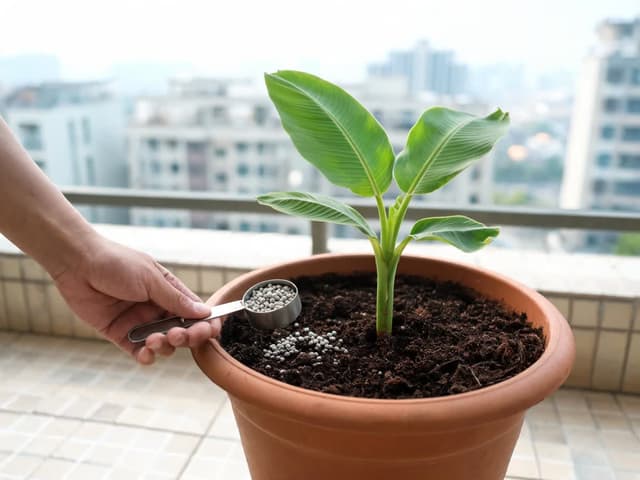
Banana plant fertilizer: fertilizing potted and backyard plants
Banana plant fertilizer needs more potassium than nitrogen, in a 3-1-6 ratio. For a potted plant on a balcony, use the label dose in spring and summer. In the backyard, fertilize every 2 months, adjusting the amount by mat age. Learn the formula, timing in Brazil, and signs of deficiency or excess.