Snake Plant Turning Yellow: Feel the Base to Find the Cause
Is your snake plant turning yellow? Give the base of the leaf a gentle squeeze. If it feels mushy and the soil is damp, you are dealing with root rot from overwatering. If it feels firm, it could be cold damage from weeks ago, sunburn, crown rot, or just the natural yellow edge of the variety.
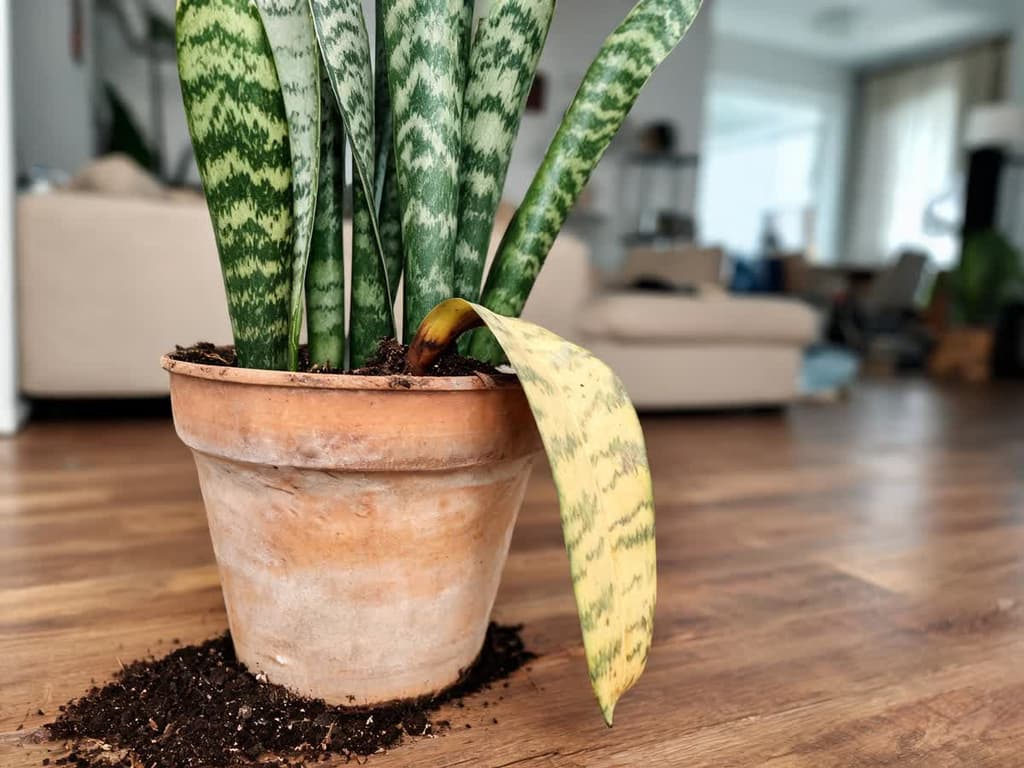
Most of the time, a snake plant turning yellow is dealing with root rot caused by overwatering. You can confirm it in ten seconds: squeeze the yellow leaf right near its base, about an inch above the soil line. If the base feels soft and mushy while the soil is damp, it is rot. If the base feels firm, something else is going on, and the pattern of the yellow will tell you what.
The plant appears under two scientific names, Dracaena trifasciata and Sansevieria trifasciata, and both are the same species. Penn State Extension explains that genetic research moved the former genus Sansevieria into Dracaena. It is the plant with stiff, long, sword-shaped leaves that many people receive as a gift because of its reputation for being indestructible.
Because of that bulletproof reputation, people often water their snake plant on the same schedule as every other plant in the house. Missouri Botanical Garden sums up the main vulnerability in one sentence: overwatering commonly causes root rot.
Quick summary:
Mushy base and wet soil: root rot. Stop watering, take the plant out of its pot today, and check the roots.
A clean yellow band along the edges of every leaf, from bottom to tip, with stiff leaves: natural variegation on the 'Laurentii' variety. This is not a disease.
A whitish, water-soaked area that appears 1 to 4 weeks after a cold night: cold damage. In Brazil, the cold runs from June to August, and the spot can appear through September.
A reddish-brown spot with a yellow halo on an emerging central leaf: fungal leaf spot, which takes hold when water sits inside the rosette.
A leaf that has turned yellow will not turn green again. Cut any mushy leaves off flush with the soil line.
How to tell natural yellow variegation from plant disease
In 'Laurentii' snake plants, the yellow edge is a natural part of the leaf rather than a symptom. The University of Florida (UF/IFAS) sansevieria production guide describes this border as golden-yellow. According to the guide, it varies in width and position from one leaf to another. A leaf with a wider band, or one shifted toward one side, remains completely normal.
Other cultivars also naturally feature yellow markings. 'Futura' has a narrow yellow border, about 3 to 5 mm (0.1 to 0.2 inches) wide. 'Golden Hahnii', a compact snake plant in the form of a rosette (leaves growing in a circle from a single center), has yellow stripes along the edge and in the center of the leaf, according to UF.
Three clear signs help you distinguish natural variety coloration from a real issue:
A healthy border has a crisp, well-defined edge that runs the entire length of the leaf. Trouble-related yellowing looks blurry, blotchy, and creeps upward from the base or inward from the tip.
Varietal striping shows up on brand-new growth emerging from the center. Problem yellowing takes over an older leaf that used to be uniformly green.
A leaf with natural variegation feels stiff and sturdy. Problem yellowing usually comes with foliage that feels limp, mushy, or wrinkled.
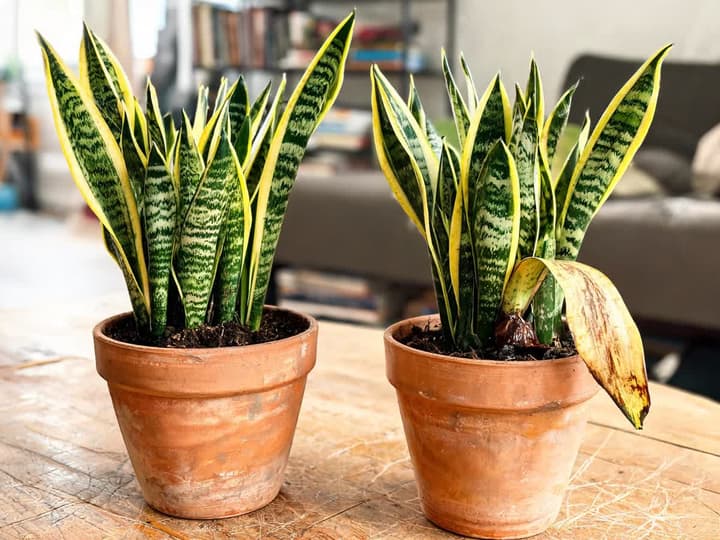
If your pup grew completely green from a 'Laurentii' leaf cutting, there is no disease either. UF notes that a pup grown from a leaf cutting of this cultivar almost always reverts to the green of the species, lacking the yellow margin.
Low light will not turn a snake plant yellow either. UF describes foliage grown in very low light as long, weak, and dark green, lacking the light bands. In a dark corner, the soil takes longer to dry out, and any yellow that appears there usually comes from rotting roots.
The touch test on the base of the yellow leaf
Squeeze the yellow leaf between your thumb and index finger, about an inch above the soil. A healthy snake plant leaf is hard: it does not yield, does not dent, and does not leak water. A rotting base yields under your finger, turns dark or translucent, and sometimes releases a liquid.
Next, touch the soil, and not just the top: the question is whether the bottom of the pot is moist. A wooden skewer pushed down to the bottom and pulled back out shows the moisture down below without removing the plant from the pot. A mushy base with a moist bottom means rot. A wrinkled leaf with dry soil down to the bottom means thirst.
Pairing what you feel at the base with what you find in the soil points straight to the culprit and your next step:
What you see | Likely cause | What to do today |
|---|---|---|
Mushy leaf base and wet soil at the bottom | Root rot from overwatering | Hold all water. Slide the plant out of the pot and inspect the roots |
Soft, dark base with a foul, fishy smell | Bacterial soft rot | Cut away all mushy parts until you reach firm tissue |
Fan-shaped white threads and tiny white or brown beads close to the soil | Soil fungus (Sclerotium rolfsii) | Remove the plant and throw away all the soil from the pot |
Thin, wrinkled leaves with bone-dry soil all the way down | Underwatering | Soak thoroughly until water runs freely out of the drainage hole |
Crisp yellow stripe running along leaf margins from base to tip, firm foliage | Natural variegation ('Laurentii' and similar cultivars) | Nothing: your plant is healthy |
Water-soaked, whitish area, 1 to 4 weeks after a cold night | Cold damage | Move to a warm spot above 50°F (10°C) and keep the soil completely dry |
Reddish-brown spot with a yellow border on tender new central leaf | Fungal leaf spot from water pooled in the rosette | Stop getting the central crown wet when watering |
A single outermost leaf yellowing slowly while the rest of the plant stays stiff | Natural leaf aging (senescence) | Trim it flush at the soil level once it dries up |
When the symptom does not match any of these cases, a close-up photo of the base and the leaf helps. The Bloom app diagnoses diseases from a photo on the Premium plan. If you are not even sure whether the plant is a snake plant, 3 questions can help you find out what is wrong with the plant for any species.
Mushy base and damp soil: root rot from overwatering
Root rot is the most common cause of a yellow snake plant. NC State Extension, the Missouri Botanical Garden, and Penn State point to the same source: overwatering. Roots sitting in wet soil rot and stop taking up water, and the leaf turns yellow or flops over even though the pot is moist.
A flopping leaf with the soil still moist is a sign of root rot. The University of Wisconsin Extension describes a plant with root rot as wilting even with wet soil. Anyone who sees the flopping leaf and waters more delivers water to roots that can no longer use it.
In snake plants, rot appears first at the crown, the base of the plant where the leaves emerge from the roots. The University of Maryland lists the signs of root and crown rot: yellow or brown leaves and a dark or soft crown.
Two specific base-rot variations have distinct warning signs, both documented in the UF/IFAS guide:
A soft base that smells like decaying fish indicates bacterial soft rot. UF/IFAS does not recommend commercial bactericides for this infection because their effectiveness is very low. The only way to stop it is cutting away every trace of diseased tissue and keeping the remaining foliage completely dry.
White threads and seed-like pellets around the soil surface indicate Sclerotium rolfsii, a common soil fungus known as southern blight. It causes water-soaked lesions near the soil line, covered by thick, fan-shaped white mycelium. It also forms tiny round structures about the size of mustard seeds, starting white and hardening to tan or brown. UF/IFAS notes that southern blight peaks during warm summer months.
How to save a snake plant with a rotting base
Slide the root ball out of the pot and gently rinse the old mix away under running water. Dark potting soil clings to healthy roots and makes it difficult to assess their true color and condition.
Check every root by touch. Rotted roots are mushy, stringy, and their outer layer slides right off with a gentle tug, leaving only a thin core behind, according to University of Maryland Extension. Healthy roots feel firm, plump, and do not peel.
Using clean, sharp shears, prune away all blackened, mushy roots and collapsing leaves. Penn State Extension advises cutting damaged foliage clean at the soil level.
Throw away the old soil and thoroughly disinfect the pot. University of Maryland Extension recommends fresh, clean potting mix and a sanitized or brand-new container, warning never to use outdoor garden soil.
Repot the remaining firm sections into dry, well-aerated potting mix inside a container with generous drainage holes.
Do not water on repotting day. Snake plants handle drought exceptionally well: NC State Extension notes that these plants only need water every one to two months in the winter. Wait to give the plant its first drink until the soil has dried out completely to the bottom.
On houseplant diagnostic charts, root rot ranks as a high-risk condition capable of causing severe loss.
Can a rotting snake plant still be saved?
Yes, as long as some firm, healthy tissue remains. If the underground rhizome (the thick, potato-like stem that anchors the leaves) is still firm and has at least a few healthy roots attached, repot that section. If the entire rhizome has turned to mush, the base cannot recover, but any firm, green leaf blades can be cut into segments and rooted as new cuttings.
Wisconsin Extension points out that with extensive root rot, the most practical solution is often discarding the plant. Snake plants are an exception worth rehabilitating, because Penn State highlights how effortlessly they propagate from rhizome divisions and leaf sections.
Is your snake plant overwatered or underwatered?
Feel the leaf and test the bottom of the pot. A yellow, heavy, collapsing leaf sitting in moist soil points straight to overwatering. A yellowing, thin, puckered leaf sitting in bone-dry soil down to the base indicates severe underwatering.
Underwatering is far less common, since snake plants store significant water reserves in their thick, succulent leaves. The most damaging mistake is guessing instead of checking: cutting back water and then soaking the pot without checking soil moisture first. If root rot is already present, adding water simply rots whatever viable roots remain.
Firm leaf base: other reasons your snake plant is yellowing
Cold damage: symptoms appear weeks after a chilly night
Snake plants are native to tropical regions and sustain cold injury well above freezing. UF/IFAS outlines two main types of cold injury. Moderate cold causes localized narrow bands of constriction across the leaf while the tissue stays green. Severe cold causes whitish, water-soaked patches that typically show up one to four weeks after exposure.
Because of this delay, yellowing in August can be from July's cold. In Brazil, winter runs from June to August, and the risk is higher in the South and in mountain regions. At home, the biggest risk is with pots on balconies and leaves touching window glass at night.
NC State notes that the snake plant tolerates temperatures down near 50°F (10°C). In greenhouses, UF instructs not to let temperatures drop into the 40 to 45°F (4 to 7°C) range. Keep the plant above 50°F (10°C), away from window glass, and hold off on watering until it returns to a warm place.
UF also found that excess nitrogen fertilizer increases cold damage. Do not fertilize your snake plant in fall or winter, from March to August in Brazil.
Strong sun after months in the shade
Snake plants sold in pots typically grow in the shade: UF recommends that growers finish the plant in a shaded greenhouse. If the plant is moved directly into the afternoon sun, the foliage burns and develops pale, yellowed, or whitish areas that later dry out. Only the side facing the sun shows the damage.
NC State says it tolerates 2 to 6 hours of direct sun per day. Missouri Botanical Garden advises protection from strong afternoon sun. Move the plant out of the afternoon sun and introduce it to direct light gradually. The burned area will not turn green again, but firm leaves can stay on the plant.
Red-brown spots with yellow halos on new center growth
When a new leaf at the center of the plant has sunken, reddish-brown spots with a yellow border, it is red leaf spot fungus (Fusarium). UF explains that the infection only happens when the center of the plant stays wet. The spots can merge and reach the point where new leaves emerge.
According to UF, keeping the leaf dry eliminates the stage of the disease that attacks foliage. Missouri Botanical Garden offers the same watering advice: never pour water into the center of the plant. In the garden bed, where rain wets the center, water in the morning so leaves dry quickly, as UF recommends to growers.
A single aging outer leaf turning yellow
A new snake plant leaf emerges from the center of the plant, so the outer leaf is the oldest. The University of Maryland calls the yellowing of older leaves on any plant senescence: they yellow with age, and the rest of the plant stays healthy.
For snake plants, the normal pattern is an outer leaf slowly turning yellow, with a firm base and a new leaf emerging in the center. No source has measured how long a snake plant leaf lasts. Multiple leaves turning yellow in the same week points to a problem, and the squeeze test applies again.
Mealybugs and spider mites
NC State and Missouri Botanical Garden cite the same two pests for snake plants: mealybugs and spider mites. Mealybugs form white tufts that look like cotton at the base of the leaves. Spider mites leave tiny yellow spots on the leaf and, when there are many, a fine web. Separate the plant from the others and clean the leaves.
Rarer pests and fungi are in the catalog of causes of yellow leaves on snake plants, which lists 19 possible causes.
Will a yellow snake plant leaf turn green again?
No. Tissue that has turned yellow from rot, cold, or sun does not turn green again, and the plant recovers through new leaves. This rule applies to any plant, and the guide to yellow leaves on any plant shows the only exception: a micronutrient deficiency treated early.
A soft leaf should be removed right away, cut flush with the soil, because the rot continues inside it. A firm leaf with a dry spot can stay on the plant as long as you like.
Frequently Asked Questions
Is winter yellowing caused by cold temperatures or overwatering?
Both happen in winter, and touch separates the causes. A soft base with damp soil is overwatering. A firm base with a whitish, water-soaked area in the middle of the leaf is cold. In Brazil, winter runs from June to August. According to UF, cold damage appears 1 to 4 weeks after the cold night.
Can baking soda cure snake plant rot?
None of the university agricultural extensions recommend baking soda for snake plant rot. For bacterial soft rot, UF/IFAS advises against commercial sprays as well because of very poor control. The proven fix is physical: prune away all decayed tissue, repot in fresh, clean soil, and withhold water until the root ball dries completely.
Why is only one snake plant leaf turning yellow?
Pinch the base of that specific leaf. If it feels firm, sits on the outside of the cluster, and the rest of the plant looks vibrant with fresh growth emerging, it is simply an old leaf reaching the end of its life cycle. If the base feels soft or mushy, early root rot is developing below the soil line. Unpot the plant immediately to inspect the root system.
Should you water a snake plant after it gets cold?
Wait until the plant is back in a warm place. UF identifies cold water as one of the causes of cold injury in Florida greenhouses. And NC State advises watering snake plants only every 1 to 2 months in the winter. Move the pot to a spot above 50°F (10°C) and water when the bottom is dry.
What to do today for your yellowing snake plant
Gently squeeze the base of every yellowing leaf and check the moisture level at the bottom of the pot. If the base is mushy, take the plant out of its container right away and begin root surgery. If the base remains firm, identify the yellowing pattern using the diagnostic table above before altering your care routine.
If the symptom does not match any case in this guide, Bloom (available for iOS) identifies the plant by photo. On the Premium plan, the app also diagnoses the disease.
Sources
UF/IFAS, Central Florida Research and Education Center, Sansevieria Production Guide (R. W. Henley, A. R. Chase, L. S. Osborne; Foliage Plant Note RH-91-30), web.archive.org, 2021-01-16.
NC State Extension, Gardener Plant Toolbox, Dracaena trifasciata.
Missouri Botanical Garden, Plant Finder, Dracaena trifasciata.
Penn State Extension, Snake Plant: A Forgiving, Low-maintenance Houseplant.
University of Maryland Extension, Root Rots of Indoor Plants (2023); Yellowing Leaves on Vegetable Plants.
University of Wisconsin–Madison Extension, Root Rots on Houseplants.
Related articles
How to Care for a Maidenhair Fern: Light, Water, and Revival Tips
Learn how to care for a maidenhair fern indoors: bright indirect light, consistently moist soil, high humidity, and how to revive it if it dries out completely.
How to Propagate Spider Plants: Root the Pup Before Cutting
The safest spider plant cutting comes from a pup still attached to the mother plant: rest the plantlet on soil in a small pot, wait for roots to establish, and only then cut the stolon. Learn when the pup is ready, whether rooting in water is worth it, how to divide the clump, and why plants fail to produce babies.
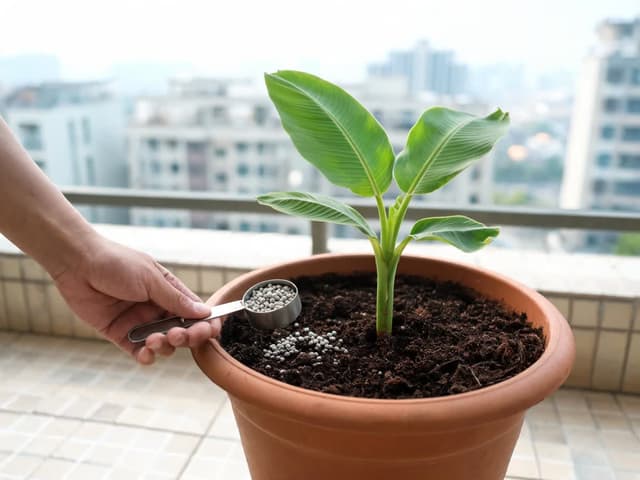
Banana plant fertilizer: fertilizing potted and backyard plants
Banana plant fertilizer needs more potassium than nitrogen, in a 3-1-6 ratio. For a potted plant on a balcony, use the label dose in spring and summer. In the backyard, fertilize every 2 months, adjusting the amount by mat age. Learn the formula, timing in Brazil, and signs of deficiency or excess.