How to fertilize a snake plant: when, how much, and what fertilizer
How to fertilize a snake plant: a single application of liquid fertilizer at half strength in September is enough. Learn when not to fertilize, which NPK ratio to choose, and how to flush excess salts from the soil.
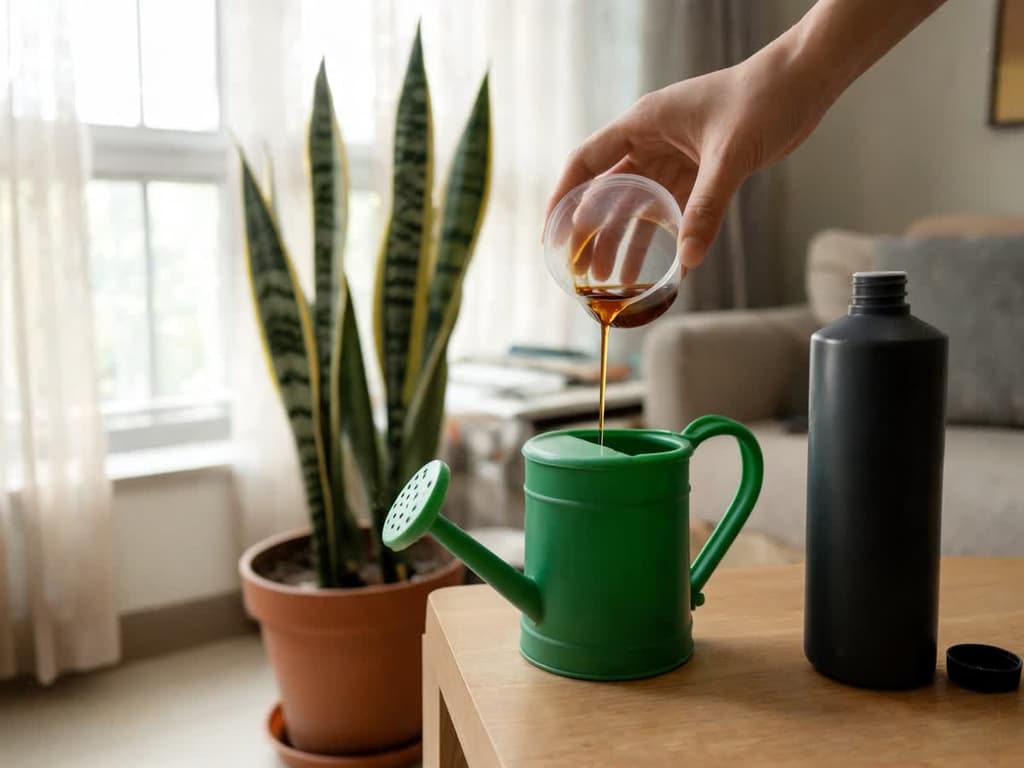
To fertilize a snake plant, make a single application per year, in early spring. Use liquid houseplant fertilizer at half the label strength. In Brazil, spring begins in September. The Iowa State University Extension recommends fertilizer at half strength or quarter strength in the spring. The same extension states that frequent fertilizing is not necessary. Extension is the service of American universities that guides the public.
The snake plant (Dracaena trifasciata, formerly called Sansevieria trifasciata) grows slowly and thrives on little fertilizer. Too much fertilizer, or feeding a sick plant, damages the roots. What kills the snake plant most often, according to Iowa State, is overwatering.
Quick summary:
One application in September using liquid houseplant fertilizer at half strength. Cactus fertilizer can be used at full label strength.
From March to August, fall and winter in Brazil, do not fertilize.
A soft, floppy plant or one with a rotting base does not need fertilizer. It needs less water.
A plant that was repotted or purchased a few months ago should only receive fertilizer again the following spring.
A white crust on the soil indicates salt buildup, and brown leaf tips can be a sign as well. In both cases, stop fertilizing and flush the soil.
Soft, floppy, or yellow snake plant: do not fertilize now
If your snake plant has soft, drooping, or yellowing leaves, do not feed it. Fertilizer nourishes a plant that is actively growing. It does not fix root rot, poor light, or improper watering.
A leaf that softens at the base and bends over, with moist soil, is a sign of root rot from overwatering. Iowa State sums it up: overwatering is the fastest way to kill a snake plant. Fertilizer at this point makes the roots worse. According to the University of Nebraska Extension, excess fertilizer salt damages roots and leaves the plant more susceptible to rot.
The same Nebraska extension lists the plants that should not receive fertilizer: newly repotted ones, those that have not rooted yet, those that are resting and not growing, and wilted plants. A drooping snake plant belongs on that list. First, find the underlying cause: the guide on yellow leaves on snake plants separates rot, cold, sun, and old foliage by their symptoms.
A yellow bottom leaf on a plant that went a year without growing, sitting in the same corner, is also not a sign of a fertilizer deficiency. The cause is usually overwatering. Cut the soft, yellow leaf off flush with the soil line, as directed by the Penn State Extension, and squeeze the base of the other leaves: if it feels firm, rot has not reached those leaves.
To fertilize or not: snake plants in every situation
In most situations, the right answer is not to fertilize. Snake plants only benefit from fertilizer when they are healthy, receiving good light, and in their active growing season.
Plant condition | Fertilize? | Why |
|---|---|---|
Soft base, bending leaf, damp soil | No | It is overwatering. Fertilizer salts worsen root damage (Nebraska). |
Lower leaves yellow and soft | No | The cause is usually overwatering. |
Recently repotted | Not until next spring | Newly repotted plants should not be fertilized (Nebraska). |
Purchased a few months ago | Not until next spring | In commercial nurseries, snake plants receive fertilizer every month (UF/IFAS, University of Florida). |
From March to August, fall and winter in Brazil | No | The plant barely grows, and excess nitrogen increases chilling injury (UF/IFAS). |
Far from the window, no new leaf for months | No. First, provide more light | In low light, fertilizing to force growth creates the opposite effect (Missouri). |
White crust on the soil, or brown tip on a plant fertilized in recent months | No. Flush the soil | It may be salt accumulation (Nebraska). Brown tips also have other causes. |
Firm base, near a bright window, September, no recent repotting or purchase | Yes, once, at half strength | Iowa State recommendation. |
How much fertilizer does a snake plant need
A single application at half strength each year is enough for a snake plant. Extension offices and the Royal Horticultural Society (RHS), the UK gardening charity, disagree on frequency. Recommended dosages also differ from one source to another. Because of that, frequency can only be compared alongside dose.
Source | Frequency | Dose |
|---|---|---|
Iowa State, snake plant guide (2025) | In spring, without repeating (frequent fertilization is not necessary) | Half or one-quarter label strength, general-purpose fertilizer |
Iowa State, succulent guide (2024) | Every 3 to 4 waterings, through spring and summer | Half or one-quarter strength, general fertilizer. Cactus fertilizer at full label strength |
Penn State Extension | Once a month during the growing season | Half strength, general fertilizer |
RHS | Once a month, from April to September in the United Kingdom (October to March in Brazil, with March already in this guide's pause) | Liquid houseplant or cactus fertilizer |
No one has measured how the potted snake plant responds to each of these doses. This guide follows the Iowa State guide dedicated to the snake plant, because it deals only with it, rather than all succulents: one half-strength application in September, and no other until the following September. It is the option that uses the least fertilizer per year among the four, and too much fertilizer is the mistake that causes damage. Anyone who wants even less can use a quarter of the dose.
Penn State presents monthly fertilizer as the way "to a more vigorous plant." The RHS also talks about fertilizing to stimulate growth. Both treat monthly fertilizing as an extra to make the plant grow more. Penn State and the RHS do not link the frequency to light. This guide adds two conditions, strong light and new leaves, to avoid fertilizing an inactive plant. If your snake plant meets both, the most intensive option from the sources is monthly. In that case, use half-strength fertilizer, once a month, from September to February.
To achieve half strength, cut the label's dilution rate in half. If the label calls for 10 ml per liter of water, use 5 ml per liter. Water with this solution when the soil has dried out completely to the bottom, replacing your routine watering.
When to fertilize a snake plant in Brazil
Fertilize the snake plant in September, at the beginning of spring in Brazil. The snake plant's growing season runs from September to February, spring and summer in the Southern Hemisphere. The extension sources are from the Northern Hemisphere: their spring falls from March to May, autumn months in Brazil. Therefore, this guide uses spring in Brazil, which begins in September. If September has passed and the plant has not received fertilizer, you can still apply it through November, within spring.
From March to August, do not fertilize. That is the fall and winter period in Brazil. With shorter days and less light, the plant barely grows. Fertilizer given to a plant that is not growing remains in the soil as salt, according to Nebraska Extension.
Cold weather is another reason not to fertilize from March to August. The UF/IFAS sansevieria production guide, from the University of Florida, notes an effect of fertilizer in cold conditions. High rates of nitrogen greatly increase chilling injury on snake plants. The same guide directs growers to reduce fertilizer when temperatures are expected to drop below 7 °C (45 °F).
Running the heater in winter does not change this rule. According to Nebraska extension, strong light keeps the plant growing in winter. That light comes from a very bright window or artificial light. In that case, Nebraska directs treating the plant as a growing plant. In Brazil, the brightest window faces north or west. For the snake plant, the exception only applies if it puts out a new leaf in winter. In that case, apply half-strength fertilizer once, and wait until the following September for the next feeding. No one has measured potted snake plants in winter, and this is the option that uses the least fertilizer.
Which fertilizer to use on snake plants: the NPK ratio
For snake plants, choose a liquid houseplant fertilizer. Preferably, the first number on the label (nitrogen) should be higher than the middle number (phosphorus). NPK represents the three numbers on the label: nitrogen (N), phosphorus (P), and potassium (K), in that order. According to UF/IFAS, nitrogen is the primary nutrient limiting snake plant growth in production nurseries.
The UF/IFAS guide provides the suggested nutrient range for snake plant leaves. In leaf tissue analysis, nitrogen ranges from 1.7% to 3.0% and potassium from 2.0% to 3.0%. Phosphorus ranges between 0.15% and 0.3%, about ten times less. In container production, UF uses fertilizer in a 3-1-2 or 2-1-2 ratio: three or two parts nitrogen to one part phosphorus. These numbers come from commercial growers, not living room pots: use them to choose your fertilizer ratio, not the dosage.
Bloom fertilizers feature a higher middle number (phosphorus) compared to the others, deviating from this ratio. Save those formulas for flowering plants.
Cactus and succulent fertilizer also works. Iowa State, in its succulent guide, advises following the label for cactus fertilizer. Standard houseplant fertilizer is applied at half strength or quarter strength. Do not reduce it twice: use cactus fertilizer at the label rate, without cutting it in half.
Slow-release fertilizer, which releases nutrients gradually in granules or spikes, also works. Iowa State, in its succulent guide, accepts this type of fertilizer once, at the beginning of the growing season, in place of liquid fertilizer. Never use both together.
Also check the bag of soil. A lot of potting soil already comes with slow-release fertilizer. Nebraska Extension gives the example of a soil that feeds the plant for up to 6 months. In that case, follow the timeline on the bag before fertilizing. Soil with a lot of perlite (light, white grains) or sand holds less fertilizer. UF reduces nitrogen and potassium by about 20% in these mixes. In that case, opt for the lower dose from Iowa State, one-quarter of the label dose.
Coffee grounds and eggshells on snake plants
Do not put coffee grounds into your snake plant pot. Fresh, freshly brewed grounds carry a higher risk of plant toxicity, according to researcher Linda Chalker-Scott from Washington State University. She recommends mixing only fully composted grounds (left to decompose for weeks in a compost bin) into the soil.
Coffee grounds are also fine and compact. As a layer on top of the soil, they can form a barrier to water and air. The warning appears in a summary from University of Arizona extension on the same researcher's work. In a snake plant, which rots in wet, airless soil, a layer of grounds that blocks water and air poses a risk. According to New Mexico State University extension, it is difficult to find published research on coffee grounds in houseplant pots. For this reason, the extension does not recommend putting grounds directly into the pot, and this guide follows that caution.
Eggshells do not fertilize the plant in the same year. The shell takes 1 to 5 years to decompose, even when ground up, according to the University of Illinois Extension. The same extension suggests putting eggshells and coffee grounds into the compost bin, rather than directly into the soil.
Signs of overfertilizing a snake plant and how to flush the soil
A white or yellowish crust on top of the soil is the clearest sign of overfertilization. Nebraska extension also lists stalled growth, brown leaf tips, blackened or dried root tips, and wilted foliage. Another frequent indicator is a white crusty ring forming on the rim of terracotta pots or around the drainage holes.
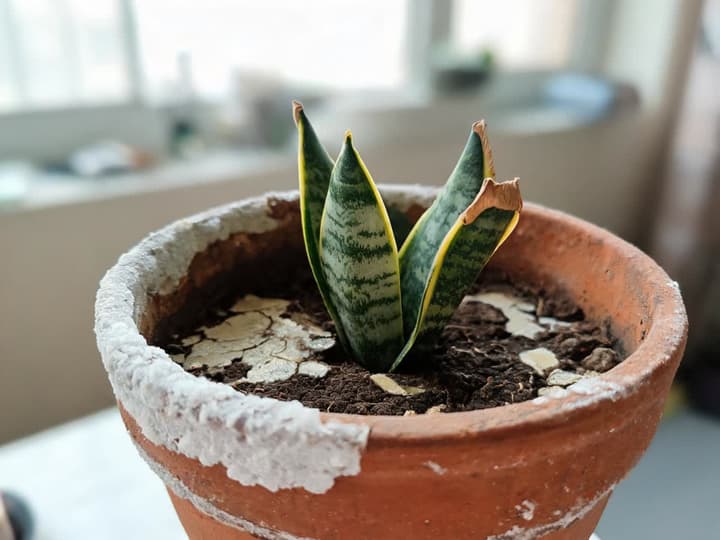
The damage comes from salt. All fertilizer dissolved in water turns into salt. When water evaporates, the salt stays in the soil. With too much salt, the roots lose water even when the soil is moist, and the root tips dry out. The University of Missouri explains that the plant absorbs this salt and accumulates it in the tips and margins of the leaves, which burn.
Brown tips can have other causes, and fertilizer is only suspect if the plant received nutrients within the last few months. The University of Missouri points to softened household water, which replaces calcium and magnesium with sodium or potassium salts. The same university notes that dracaenas are sensitive to fluoride (a mineral common in tap water), and snake plants are now classified as dracaenas. Cold drafts and intense direct sun also scorch foliage, as outlined in the yellow leaves guide.
Watering exclusively from below via the saucer can also cause salts to accumulate: water never flows out the drainage holes to carry salts away. The guide on how to water a snake plant details when top-watering is useful to leach out the soil.
To flush accumulated salts from the soil, follow these step-by-step instructions from Nebraska extension:
Gently scrape away the white surface crust. Take off no more than 6 mm (1/4 inch) of topsoil.
Take the pot to a sink or washbasin where water drains freely.
Pour water slowly and in intervals until it pours out of the drainage hole. Continue until you have applied twice the pot's total volume. A 15 cm (6 inch) pot holds roughly 1.2 liters, so flush with approximately 2.4 liters.
Allow all excess water to drain out thoroughly, without a saucer underneath.
Do not water again until the soil dries completely to the bottom.
If the white crust returns soon after flushing, repot the plant in fresh soil. Nebraska points to fresh potting soil as the alternative way to eliminate built-up salts. The same extension suggests flushing indoor plant soil every 4 to 6 months as a preventative measure. This guide recommends flushing only when visible symptoms appear, since snake plants receive so little fertilizer. After flushing or repotting, withhold fertilizer until the following spring.
Newly purchased or newly repotted snake plant: when to start
Store-bought snake plants have typically received regular fertilization at the grower's greenhouse. The UF guide describes monthly fertilization schedules for potted sansevierias in commercial facilities. Therefore, your new plant likely needs no extra fertilizer during its first few months. Wait until the first September following your purchase before feeding it. If you bought it in September or later, wait until the following year's September.
A newly repotted snake plant should also go unfed. Nebraska extension places newly repotted plants on the list of specimens that must not be fertilized. If you changed the soil after last September, postpone the next feeding until the following September. With fresh potting mix, also observe the feeding timeline of any fertilizer pre-mixed into the bag.
Frequently asked questions
Does fertilizer make a snake plant bloom?
Only under very high light. Iowa State notes that snake plants can produce flowers when provided with abundant light and good nutrition. If your plant sits far from a window, relocate it to brighter light first. Keep the September application at half strength unchanged.
Does a snake plant in low light need fertilizer?
No. Under low light levels, a snake plant barely grows and consumes very little fertilizer. Any surplus remains in the soil as salt. The University of Missouri explains that during short days with low light, fertilizing to stimulate growth produces the exact opposite result. The guide on ideal light for snake plants outlines where to position your plant so it resumes active growth.
Can you use fertilizer spikes for snake plants?
It works, as a single application. Fertilizer spikes are slow-release fertilizers. Iowa State accepts this type of fertilizer once, at the start of the growing season, which in Brazil is September. Use the spikes instead of liquid fertilizer, never combined with it. Follow the label instructions for the pot size: the half-strength dose applies only to regular liquid fertilizer, and Iowa does not provide a dose for spikes.
Can I fertilize my snake plant in winter if my home is heated?
No. Indoor heating keeps rooms warm, but it does not supply more light, and light is what drives snake plant growth during winter. Inactive plants do not absorb nutrients, leaving them behind in the soil as salts. Make an exception only if your snake plant receives supplemental grow lights or sits in an exceptionally bright window and actively produces new foliage during winter. In that single scenario, give one application at half strength, and only one.
What to do today
Squeeze the base of your snake plant's leaves and look at the soil surface. If the base feels soft, do not fertilize: stop watering until the soil dries all the way to the bottom. If there is a white crust, flush the soil today and leave fertilizing for September. If the plant feels firm and has not yet received fertilizer this year, make the year's application by November, at the end of spring in Brazil: liquid houseplant fertilizer at half strength, on the day you water. If it has already received fertilizer, wait until next September.
When you cannot tell whether brown tips are caused by salts, cold, or sunburn, Bloom (available for iOS) analyzes a photo of the symptom through its Premium diagnosis feature. The free plan identifies plants and builds custom watering schedules.
Sources
Iowa State University Extension and Outreach: Caring for Sansevieria, Aaron J. Steil, January 17, 2025 (standard fertilizer at half or quarter strength in spring; frequent fertilizing is not necessary; overwatering kills; flowers appear with high light and good nutrition) and Growing succulents indoors, Aaron Steil, revised December 2024 (every 3 or 4 waterings in spring and summer; cactus fertilizer at label rate; slow-release fertilizer at the start of the season; none in winter).
Penn State Extension: Snake Plant: A Forgiving, Low-maintenance Houseplant (standard fertilizer at half strength, once a month during the growing season, for a more vigorous plant).
Royal Horticultural Society: How to grow sansevierias (liquid fertilizer once a month from April to September to encourage growth).
UF/IFAS, Henley, Chase, and Osborne: Sansevieria Production Guide, RH-91-30 (3-1-2 or 2-1-2 ratio; leaf nutrients; excess nitrogen and cold damage; reduced fertilizer below 7 °C; 20% less nitrogen and potassium in mixes with perlite or sand).
Nebraska Extension in Lancaster County: Success With Houseplants: Fertilization (plants that should not be fertilized, bright window in winter, soil with fertilizer, signs of salt, flushing with twice the volume of the pot).
University of Missouri, David Trinklein: Houseplant problems, 03/01/2019 (fertilizer salt on leaf tips and margins, fertilizer in low light, water softener water, fluoride in dracaenas).
University of Arizona Cooperative Extension, Backyard Gardener: Using Coffee Grounds in the Garden, 01/15/2024, based on the work of Linda Chalker-Scott, Washington State University (compost first, layer of grounds compacts and blocks water and air).
New Mexico State University, Southwest Yard & Garden: Compost spent coffee grounds before using them on your soil, 11/14/2020 (little research on coffee grounds in houseplant pots; cites Washington State University: uncomposted grounds are more toxic, use only composted grounds mixed into the soil).
University of Illinois Extension: Garden mythbusters: dos and don'ts of natural remedies, 03/31/2025 (egg shells take 1 to 5 years to decompose).
All accessed on October 14, 2026.
Related articles

How to Care for Hibiscus: Sun, Watering, Fertilizer, and Pruning for Flowers
How to care for hibiscus: 6 hours of direct sun, evenly moist soil without waterlogging, half-strength fertilizer in spring and summer, and pruning in early spring. Find out why the flower lasts one day and why buds drop before opening.

Do Ferns Like Sun or Shade? It Depends on the Type
Ferns prefer bright shade: plenty of light, but no direct sun on their fronds. Tuberous sword fern is the exception that handles sun. Here is the ideal light for each type, where to place pots, and how fronds show too much or too little light.

African Violet Yellow Leaves: Causes and What to Do
Yellow leaves on an African violet usually stem from overwatering, and the first place to check is the center of the plant. Losing one lower leaf at a time is normal. Identify whether age, watering, cold water, sunlight, cold drafts, or fertilizer is the culprit based on the yellowing pattern, and see what to do today.