Soil for Yucca: The Right Mix and a Pot That Won't Tip Over
Yucca soil mix needs much more perlite or sand than potting soil. See published ratios, what works for store-bought bags, which pot stabilizes a tall plant, and when to repot.
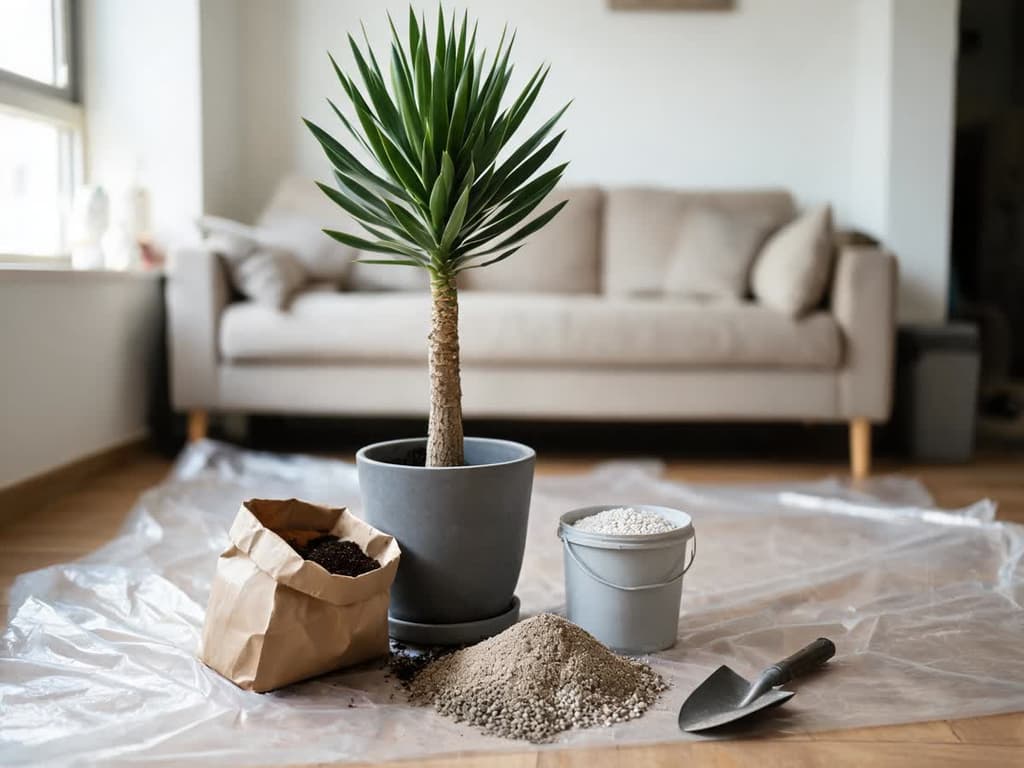
The best potting soil for yucca is standard potting soil mixed with plenty of coarse material, such as perlite (lightweight expanded rock granules) or coarse sand. NC State Extension recommends 1 part potting soil to 3 parts perlite or sand. Yuccas rot in soil that stays wet for days, and this mix prevents that.
Your choice of pot matters just as much as the mix. Indoor yuccas grow tall, with the weight of the leaves at the top, and tip over easily in a lightweight container. A pot with a drainage hole that is heavy enough to anchor the plant prevents falls.
Quick summary:
Use 1 part potting soil to 3 parts coarse material (NC State). The RHS starts with a soil-based mix and adds 20% to 30% grit by volume.
Perlite keeps the soil aerated and lightweight. Coarse sand makes the mix heavy and less aerated. Never use fine sand.
The pot needs a drainage hole. If the plant is tall, choose a heavy pot made of ceramic, stone, or concrete.
A layer of rocks at the bottom of the pot is no substitute for a drainage hole or the right soil mix.
Repot when the roots grow out through the hole, the soil dries out too quickly, or the plant tips over. In Brazil, the best time is from August to October.
What is the best soil mix for yucca
Yucca potting soil needs to let water drain quickly and dry out between waterings. NC State notes that yuccas are drought tolerant, and UF/IFAS points out that root rot occurs when the soil stays too wet. That is why the mix contains more coarse material than soil.
Two sources publish proportions for container-grown yuccas, and the numbers might seem contradictory at first glance:
Source | Base | What to add | Result |
|---|---|---|---|
Standard potting soil | 3 parts perlite or sand to 1 part soil | 3/4 of the total volume is coarse material | |
Soil-based UK compost (John Innes No. 2) | 20% to 30% by volume of grit | The base already contains coarse sand |
The difference lies in the base. John Innes potting compost is made of sterilized loam, a peat substitute, and coarse sand, according to the RHS itself. The ratio is 7, 3, and 2 parts. It already drains well and already has weight before adding grit. Standard potting soil is light and holds more water, so it requires much more coarse material.
In Brazil, the potting soil in these recipes corresponds to a bag of "substrato para plantas" (plant substrate). The NC State gardening manual explains that potting soil sold today contains no actual soil from the ground. Penn State lists its typical ingredients: peat moss (decomposed moss), coconut coir, vermiculite (a flaked mineral that holds water), and perlite. If the bag does not list actual soil among the ingredients, follow the NC State ratio.
The plant sold as a potted yucca is Yucca gigantea, formerly called Yucca elephantipes. In German it is called "Yucca-Palme" (yucca palm), but NC State classifies it in the asparagus family (Asparagaceae), not among palms. The same plant profile lists it as a succulent, which explains the coarse mix: it follows the same logic as fast-drying soil for succulents.
The yucca care profile, covering size, watering, and toxicity, can be found here:
Sand, perlite, or grit: what each one does in the mix
A yucca needs two things: soil that does not get waterlogged and a plant that does not tip over. Perlite helps with the first, and coarse sand helps with the second.
Perlite is volcanic rock heated until it expands, white and very lightweight. It creates air spaces in the soil that last a long time, according to Iowa State University Extension. The downside is its lack of weight: the NC State gardener handbook notes that perlite replaced gravel precisely because it is lighter.
Coarse sand does the opposite. The same manual describes sand as a material that holds little water and provides little aeration, but serves as a counterweight for top-heavy plants. Iowa State says the same: sand remains in use to add weight to tall plants. Use washed, coarse builder's sand. NC State and the University of Illinois Extension prohibit fine, beach, or play sand.
Grit is what the RHS refers to: very small stones added to compost to improve drainage. The NC State recipe does not use grit; it calls for perlite or coarse sand.
Aeration versus weight: the choice for tall yuccas
The NC State manual provides two rules that pull in opposite directions. For plants prone to rot, such as succulents, it instructs you to limit the combined amount of potting soil and sand to no more than 1/3 of the mix. The rest should be perlite, to maximize air. For containers that must not tip over, it instructs you to increase sand and decrease perlite.
No one has tested which of the two rules matters more for yuccas. The safest choice for the roots is to get aeration from perlite and weight from the pot. Follow this approach:
Yucca that sits firmly in its container: 1 part potting soil to 3 parts perlite, in a standard pot with a drainage hole.
Tall yucca that already tips or leans: keep the 1:3 ratio, replace part of the perlite with coarse sand, and use a heavy pot. No source states exactly how much to swap: swap a small amount and monitor it during the first watering.
How to mix yucca soil at home
Measure everything by volume using the same container. A bucket, an empty ice cream container, or a mug works fine, as long as you use the same one from start to finish.
Measure out 1 part potting soil and 3 parts perlite. If the yucca tips over, swap part of the perlite for washed coarse sand.
Put on a mask before handling dry perlite, or dampen the perlite beforehand. The NC State manual cautions that its dust should not be inhaled.
Mix everything in a wide basin or on a plastic tarp on the ground until the color is uniform throughout.
Spray with water and mix again until the soil is moist but not dripping. Penn State Extension advises dampening the mix before planting so it absorbs water evenly.
The first watering will reveal whether the mix is right. Water should soak down through the soil and exit through the drainage hole. If water pools on the surface, you need more coarse material.
Commercial potting soil in Brazil: what works and what to fix
Read the ingredient list on the package before buying. Iowa State recommends checking ingredients to confirm whether the bag contains what the plant needs.
Substrato para plantas (standard potting soil): works as a base, but requires the NC State ratio of 1 part soil to 3 parts perlite or coarse sand. On its own, it holds too much water for a yucca.
Cactus and succulent mix: formulated for plants that cannot tolerate waterlogged soil, like yuccas. If perlite, sand, or grit appear among the first ingredients, it drains faster than standard soil. Run the first-watering test. If water pools, mix in perlite or coarse sand gradually and test again. No source gives a precise amount.
Garden soil or backyard dirt: do not use it. The NC State manual explains that topsoil holds too much water, contains too little pore space, and is very heavy. It can also introduce pests, diseases, and weed seeds.
Old soil from the pot itself: you can reuse it if it has no white salt crust, pests, or rotten smell. Montana State University Extension recommends mixing at least 50% new soil into the old soil. For yuccas, the new soil is the 1-to-3 mix.
The yucca pot: drainage hole, weight, and size
The pot needs at least one hole in the bottom. UF/IFAS instructs not to plant yucca without excellent drainage, and no mix makes up for a pot that does not let water out.
Pot weight depends on the material. Penn State compares them as follows: plastic is the lightest; unglazed clay weighs more than plastic and less than stone; stone and concrete are the least likely to tip when the plant becomes top-heavy. Montana State recommends ceramic for tall plants prone to tipping because of its added weight.
The material also changes how quickly the soil dries out. Unglazed clay pulls water from the soil through its walls, which is why Penn State considers it ideal for succulents. The NC State manual recommends a porous pot, such as clay, for those who tend to overwater. For those who underwater, it suggests a pot that does not lose water through the walls, such as glazed ceramic or plastic. For yucca, which rots with too much water, a clay pot with a hole helps those who tend to overwater.
To get both weight and proper drainage, use a cachepot. A cachepot is a decorative outer pot without drainage holes. Pot your yucca in a plastic or clay pot with holes and set that pot inside a heavy cachepot. Penn State advises leaving space between the bottom of the inner pot and the base of the cachepot. Empty any collected water after every watering.
Choose a new pot that is only slightly larger than the old one, as advised by Penn State. Montana State recommends a container about 1/3 wider and deeper. According to the NC State manual, a 50 cm (20 inch) container filled with soil can weigh 45 kg (100 pounds). The same manual suggests a rolling plant caddy: for large yuccas, place the container on the caddy before filling it.
Rocks at the bottom of the pot: helpful or harmful?
Research is divided, but the practical takeaway is the same on both sides.
The NC State manual tells you never to put a gravel or rock layer under the soil. Water sits in the soil just above the rocks and only drains once that soil becomes waterlogged. Washington State University reaches the same conclusion. An experiment published in 2025 in the journal PLOS ONE measured the opposite: the layer reduced retained water in most tested combinations. The study itself was done without plants growing in the pot.
In both cases, what drains the pot is an unobstructed hole and a mix high in coarse material. Therefore, skip the layer of rocks: NC State and WSU tell you to avoid it, and the study showing otherwise did not test living plants. Every inch of stone at the bottom is an inch of root room lost. If you want to keep soil from washing out through the hole, cover it with a piece of fine mesh as recommended by Penn State.
When to change yucca soil or repot
Repot when the plant shows any of these signs, listed by Penn State and Montana State:
Roots growing out through the drainage hole;
Soil drying out unusually fast, even in cooler weather;
Growth stopping during the active growing season;
Top-heavy plant that leans or tips over;
White mineral crust forming on top of the soil or along the rim of the pot.
To verify, slide the plant out of its pot. According to Penn State, it is time when roots circle the root ball (the mass of roots and soil). It is also time to repot when roots are so dense that they hide the soil in the lower third.
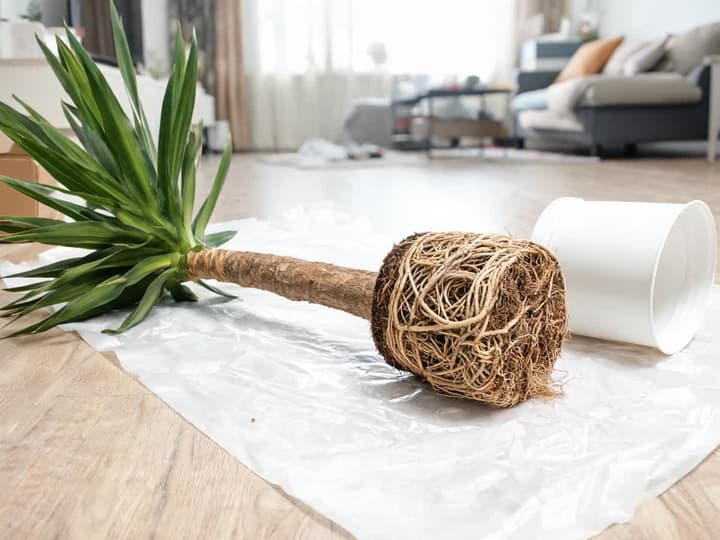
Penn State recommends spring, when the plant resumes growth. Montana State recommends late winter or early spring. In Brazil, these periods run from August to October. If the plant shows signs of distress, Montana State advises repotting at any time of year. Cold weather requires other precautions, which are covered in the guide on yucca care in winter.
If your yucca is already the size you want, it can go right back into the same pot. Penn State outlines the process: prune away outer roots and return the root ball to the container with fresh soil. Then, prune back the top of the plant slightly. Keeping it in the same size pot restricts plant growth, according to the same extension service.
How to repot a yucca step by step
Water the yucca in its current pot and wait 1 hour, as recommended by Penn State. The root ball slides out intact much more easily.
Wash the new pot if it has been used before. Penn State advises scrubbing it thoroughly and disinfecting with 1 part household bleach to 9 parts water.
Cover the drainage hole with a piece of mesh and add a layer of potting mix to the bottom. In step 5, the top of the root ball should sit about 2.5 cm (1 inch) below the rim; adjust the base layer of soil up or down as needed.
Remove the plant by grasping the trunk near soil level. Use your fingers to loosen any roots circling the root ball, and trim away dead or mushy roots with clean shears.
Position the plant in the center and fill in around it with potting mix. Press down gently without compacting the soil.
Water thoroughly until moisture runs out of the drainage hole, then empty the drip tray.
Wait at least 2 weeks before fertilizing, as Montana State advises: the root system needs time to recover first. For subsequent feeding rates, see the guide on how to fertilize yucca.
Problems that start in the soil
Hard, dry soil that repels water
Dry, hardened soil that lets water run down the sides of the pot does not call for immediate repotting. First, moisten the soil thoroughly. Mixes with peat moss or coconut coir repel water when they dry out completely, according to Iowa State and the University of California Santa Clara County Master Gardeners.
The Master Gardeners outline different methods for rewetting soil depending on container size. For small pots: submerge the entire container in a bucket of water and remove it once air bubbles stop rising. For large pots that cannot be lifted: trickle water over the soil in a very thin stream, slowly enough for the mix to absorb it rather than channel it away.
Once the soil absorbs water properly again, check for the repotting indicators listed in the previous section. If none are present, the yucca can remain in its current pot.
White mold on soil and a soft stem base
White fuzz on the soil surface and a softening trunk base are two distinct issues, and only the second generally threatens the plant.
The white layer is fungus growing on damp soil. The University of Maryland Extension notes that this growth generally does not harm the plant. However, a very thick layer hinders water absorption and attracts gnats, according to the same extension. Let the surface dry out between waterings and break up the layer with a fork, or remove the top layer of soil along with it.
A soft stem near soil level can signal root rot. Once roots have rotted, cutting back on water alone is not enough. The RHS instructs you to unpot the plant and remove excess soil and rotted roots. Then repot into a container sized strictly for the remaining root ball, using a small amount of fresh mix. Keep the plant in a warm spot and water sparingly. Symptoms and treatment for yucca root rot are covered here:
Yellowing lower leaves after using standard potting soil
A small amount of yellowing on lower leaves is normal for yuccas: the RHS notes that this occurs naturally as the plant grows. When leaves yellow abruptly and feel limp, the same source points to overwatering. Cut back on watering and allow the mix to dry out almost completely.
Standard bagged potting soil without added coarse material stays wet longer, making overwatering much more likely. If your yucca is sitting in plain potting soil and water pools whenever you irrigate, repot into a 1:3 mix of soil to coarse material during the next repotting window. Act sooner if the stem softens.
Before replacing the soil, make sure your plant is actually a yucca: dracaenas look similar, with woody stems and tufts of foliage up top. Bloom (available for iOS) identifies species from a photo, and the free tier includes 2 identifications per month.
Frequently asked questions
Can I use garden soil for potted yuccas?
No. The NC State Extension Gardener Handbook explains that soil dug from the ground retains too much water and contains insufficient pore space. It can also harbor diseases, pests, and weed seeds. Confined in a container, it stays waterlogged and rots yucca roots. Use potting mix blended with perlite or coarse sand.
Is cactus soil good for yuccas?
It works as a solid base because it is formulated for plants that cannot tolerate wet roots. Check the label: if perlite, sand, or grit are listed near the top, it already drains much faster than standard potting mix. If water pools on the surface during the first watering, mix in additional perlite or coarse sand.
How often should you repot a yucca?
Repot based on signs, not the calendar: roots coming out of the drainage hole, soil drying out too quickly, a plant that stopped growing, or one that tips over. In Brazil, the best time is from August to October, when the plant resumes growth. If there are signs of distress, such as a soft trunk, repot immediately.
What is the right pot size for a yucca?
Only slightly larger than the current container. Montana State University Extension suggests a pot roughly 1/3 wider and deeper than the old one. If your yucca is tall and tips easily, select a heavy material like ceramic, stone, or concrete, or place it inside a heavy decorative cachepot.
The next step
Check your yucca's pot to see if roots are poking through the drainage hole and watch whether water pools on the surface when you water. If either happens, measure out 1 part potting mix to 3 parts perlite or coarse sand and repot during the next potting season, from August to October. If your plant came without a plant tag, Bloom confirms from a photo whether it is indeed a yucca.
Related articles

How to Care for Hibiscus: Sun, Watering, Fertilizer, and Pruning for Flowers
How to care for hibiscus: 6 hours of direct sun, evenly moist soil without waterlogging, half-strength fertilizer in spring and summer, and pruning in early spring. Find out why the flower lasts one day and why buds drop before opening.

Do Ferns Like Sun or Shade? It Depends on the Type
Ferns prefer bright shade: plenty of light, but no direct sun on their fronds. Tuberous sword fern is the exception that handles sun. Here is the ideal light for each type, where to place pots, and how fronds show too much or too little light.

African Violet Yellow Leaves: Causes and What to Do
Yellow leaves on an African violet usually stem from overwatering, and the first place to check is the center of the plant. Losing one lower leaf at a time is normal. Identify whether age, watering, cold water, sunlight, cold drafts, or fertilizer is the culprit based on the yellowing pattern, and see what to do today.