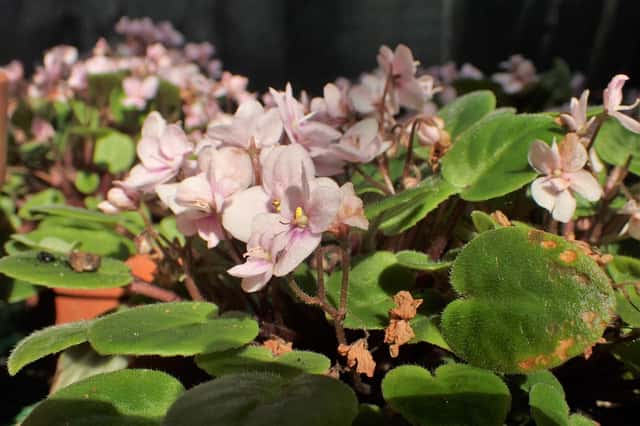
Gesneriaceae
African Violet: Perfect Indoor Houseplant
Saintpaulia ionantha
Provide bright indirect light for 10-12 hours daily. Water when top inch of soil is dry, using room temperature water from below to avoid leaf spotting. Maintain humidity between 40-60% and temperatures of 18-26°C. Fertilize every two weeks during active growth.
Every 7 days
Partial shade
18° - 26°C
40% - 60%
Categories
What is African Violet?
African Violet (Saintpaulia ionantha) is a medium-care plant from the Gesneriaceae family. The African Violet is a beloved compact houseplant native to the cloud forests of Tanzania and Kenya. Discovered in 1892 by Baron Walter von Saint Paul, it features velvety, dark green leaves and delicate flowers that bloom in shades of purple, blue, pink, white, and red. With proper care, these cha...
African Violet grows up to 15cm, spread of 45cm, watering every 7 days, 18°C – 26°C, 40–60% humidity. It is suitable for indoor environments and safe for pets.
Unlike many popular species, African Violet is safe to keep around pets. Without adequate drainage, root rot can develop within 14 days.
How to Care for African Violet?
TLDR: African Violet needs Partial shade, watering every 7 days, and temperatures between 18-26°C with 40-60% humidity.
How Often Should You Water African Violet?
Water from the bottom by placing the pot in a saucer of room temperature water for 15-30 minutes. Never let water sit on leaves as it causes permanent spotting. Avoid crown rot by keeping the center dry.
How Much Light Does African Violet Need?
Place in bright, indirect light near a north or east-facing window. Avoid direct sunlight which scorches leaves. Can thrive under fluorescent grow lights for 10-12 hours daily.
What Is the Best Soil for African Violet?
Use a well-draining, peat-based mix with 50% coarse perlite. Maintain pH between 6.0-6.5. African violets bloom best when slightly pot-bound.
What Pot Should You Use for African Violet?
Use shallow, wide pots with drainage holes. Self-watering pots work well. Avoid terracotta as it dries out too quickly.
Care Schedule
Fertilize
Every 14 days
Rotate
Every 14 days
Repot
Every 365 days
What Is African Violet and Where Does It Come From?
The African Violet is a beloved compact houseplant native to the cloud forests of Tanzania and Kenya. Discovered in 1892 by Baron Walter von Saint Paul, it features velvety, dark green leaves and delicate flowers that bloom in shades of purple, blue, pink, white, and red. With proper care, these charming plants can live up to 50 years and bloom nearly year-round.
How to Propagate African Violet?
Leaf cuttings
One leaf can produce 3-10 new plants
- 1 Select a healthy, mature leaf with its stem
- 2 Cut at a 45-degree angle
- 3 Insert stem into moist African violet mix
- 4 Cover with plastic to maintain humidity
- 5 Keep warm (21°C) in bright indirect light
- 6 Plantlets emerge in 8-12 weeks
- 7 Separate when plantlets have 3-4 leaves
Materials needed:
Division
Best done during repotting in spring
- 1 Remove plant from pot
- 2 Identify multiple crowns
- 3 Gently separate root systems
- 4 Pot each crown individually
- 5 Water lightly and provide humidity
Materials needed:
How Big Does African Violet Grow?
TLDR: African Violet can reach up to 15cm tall with Slow growth rate.
Max height
15cm
Spread
45cm
Growth rate
Slow
Foliage
Evergreen
Plant Uses
Ornamental
Great for decoration
Is your plant showing symptoms?
Click on the symptom to discover possible causes:
What Diseases Commonly Affect African Violet?
TLDR: African Violet is susceptible to 37 known diseases. Monitor regularly for early detection.
Crown Rot
Crown rot is a serious fungal disease that attacks the crown (base) of the plant where the stem meets the soil. It is caused by various fungal pathogens including Phytophthora, Fusarium, and Rhizoctonia. The disease thrives in waterlogged conditions and can quickly spread to kill the entire plant if not addressed promptly.
Root Rot
Root rot is a serious fungal disease that affects the root system of plants, causing them to decay and die. It is primarily caused by overwatering, poor drainage, or soil-borne fungi such as Pythium, Phytophthora, Rhizoctonia, and Fusarium. The disease thrives in waterlogged conditions where roots are deprived of oxygen, making them susceptible to fungal infection.
Powdery Mildew
Powdery mildew is a common fungal disease caused by various fungi species including Erysiphe, Podosphaera, Oïdium, and Leveillula. It affects over 10,000 plant species worldwide. The disease thrives in warm, dry climates with high humidity and appears as a distinctive white powdery coating on plant surfaces.
Gray Mold (Botrytis Blight)
Gray mold, caused by the fungus Botrytis cinerea, is one of the most common fungal diseases in plants. It affects over 200 plant species, including ornamentals, vegetables, fruits, and houseplants. The disease thrives in cool, humid conditions with poor air circulation, causing grayish spots and soft rot on infected tissues.
Meaning & Symbolism
Symbolizes modesty, virtue, devotion, and faithfulness. Associated with maternal wisdom and feminine energy. Purple represents spirituality, blue for peace, pink for innocence, and white for purity.
Compare with similar plants
| Attribute | Difficulty | Light | Watering | Pet Safe |
|---|---|---|---|---|
| Dark Fieldcap | Medium | Low light | 2d | ⚠️ |
| Azalea | Medium | Partial shade | 3d | ⚠️ |
| Bougainvillea | Medium | Direct sun | 7d | ⚠️ |
| Wild Lettuce | Medium | Direct sun | 7d | ⚠️ |



