26 Easy Palms | 2026 Guide
Find 26 easy palms. Complete guide for your garden.
26 Palms with easy level
26 plants found
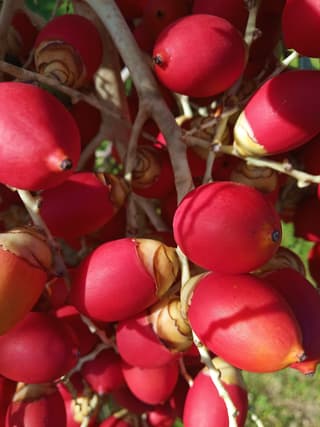
Christmas Palm
Adonidia merrillii
Adonidia merrillii, commonly known as the Christmas Palm, is an elegant and compact species native to the Philippines. It is distinguished by its smooth, single trunk and, most notably, its large clusters of berries that turn bright red in winter, resembling Christmas ornaments. It is one of the world's most popular ornamental palms for tropical landscapes and bright indoor spaces.
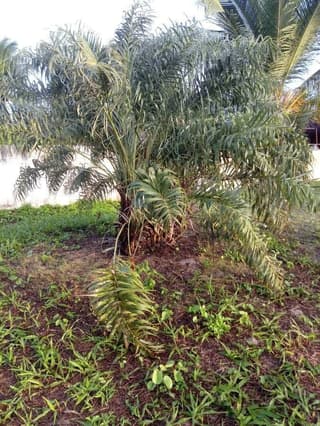
Seashore Palm
Allagoptera arenaria
Allagoptera arenaria, commonly known as the Seashore Palm or Shore Palm, is a small palm species native to the restingas (coastal scrublands) of the Brazilian coast. It typically features an underground or very short stem, with grayish-green pinnate leaves that emerge directly from the sandy soil. It is an extremely resilient plant, adapted to strong winds, high salinity, and intense solar radiation, playing a vital ecological role in dune stabilization.
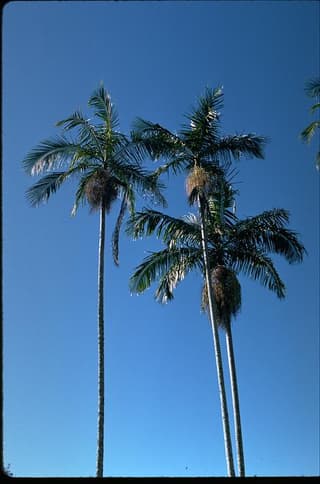
Bangalow Palm
Archontophoenix cunninghamiana
The Bangalow Palm (Archontophoenix cunninghamiana) is a majestic palm native to the subtropical rainforests of eastern Australia. It features a slender, elegant trunk that can reach up to 20 meters in height, topped by a crown of graceful arching fronds up to 3 meters long. Widely used in tropical and subtropical landscaping, it is prized for its fast growth, ornamental value, and adaptability.
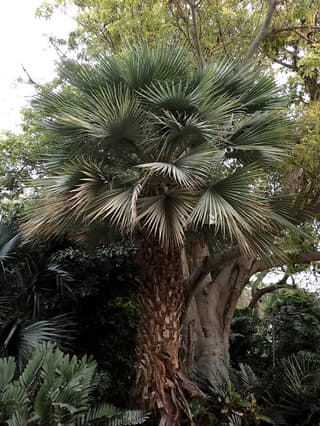
Mexican blue palm
Brahea armata
Brahea armata is a fan palm native to Baja California, Mexico, where it grows in canyons and dry washes of the Sonoran Desert. It has a stout trunk and reaches 11 to 15 m. The stiff fan leaves, 1 to 2 m across, are silver-blue, and the leaf stalks carry curved teeth. In late winter it sends out arching sprays of cream flowers that reach up to 5 m, well beyond the crown, followed by brown fruits. It is one of the most cold- and drought-tolerant palms, and a slow grower.
Pindo Palm
Butia capitata
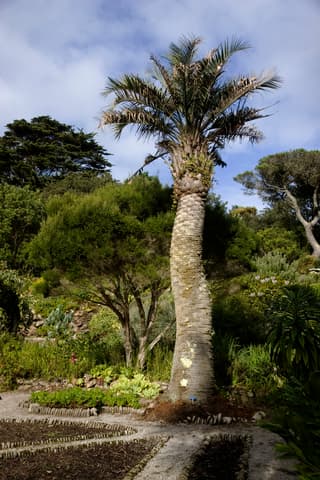
Butia capitata, commonly known as the Pindo Palm or Jelly Palm, is a slow-growing feather palm native to southern Brazil, Uruguay, and Argentina. It is prized for its graceful blue-gray arching fronds and clusters of edible orange-yellow fruits used to make jellies and wines.
Jelly Palm
Butia odorata
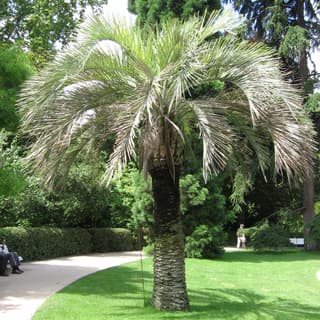
Butia odorata, commonly known as the Jelly Palm or Pindo Palm, is a hardy feather palm native to the grasslands of southern Brazil, Uruguay, and Argentina. It is one of the most cold-tolerant palms in the world, withstanding temperatures as low as -12°C (10°F). Its arching blue-green fronds and clusters of edible orange-yellow fruits make it a prized ornamental and edible landscape tree.
Parlor Palm
Chamaedorea
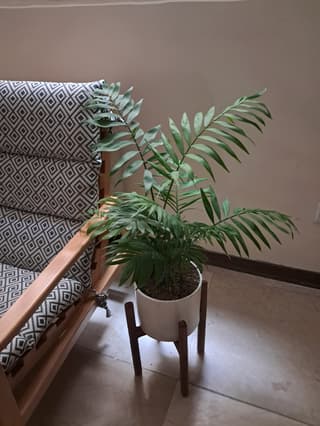
Chamaedorea is a genus of about 110 species of understory palms native to the tropical rainforests of Central America and Mexico. The most famous member, Chamaedorea elegans (Parlor Palm), is one of the world's most popular houseplants, celebrated for its graceful arching fronds and remarkable tolerance of low-light indoor conditions.
Parlor Palm
Chamaedorea elegans
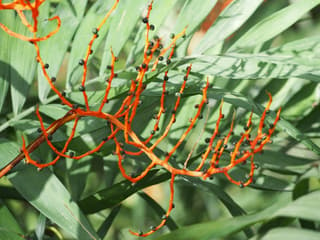
Chamaedorea elegans is a small palm native to the tropical rainforests of Mexico and Guatemala. It is one of the most popular houseplants due to its elegant bright green foliage, ability to thrive in low light conditions, and easy care requirements. It was featured in NASA's Clean Air Study for its ability to purify air by removing toxins like formaldehyde and benzene. Completely safe for pets and children.
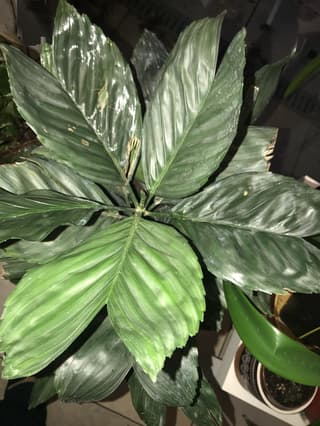
Metallic palm
Chamaedorea metallica
Chamaedorea metallica is a small palm in the Arecaceae family, endemic to a tiny area of southeastern Mexico (Veracruz and Oaxaca), where it is endangered. It has a single slim stem with no crownshaft and broad fishtail-shaped leaves, dark blue-green with a metallic sheen. It grows slowly to about 1.5 m in a pot. Plants are male or female; females carry orange flower stalks and small black fruit.
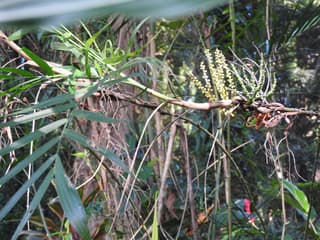
Bamboo Palm
Chamaedorea seifrizii
Chamaedorea seifrizii is a tropical palm native to Mexico and Central America that forms dense clusters of slender bamboo-like stems. Highly valued as an indoor plant for its elegance, low light tolerance and air-purifying qualities. It can reach up to 3 meters tall with dark green pinnate fronds.
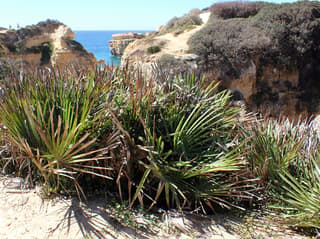
European Fan Palm
Chamaerops humilis
Chamaerops humilis, commonly known as the European Fan Palm or Mediterranean Fan Palm, is the only palm species native to mainland Europe. Indigenous to the western Mediterranean basin — spanning Spain, Portugal, and North Africa — this slow-growing, clumping shrub palm is celebrated for its exceptional hardiness: it tolerates frost down to -12°C, prolonged drought, and poor soils. Its striking silver-green fan-shaped fronds and multi-stemmed habit make it a prized specimen in Mediterranean gardens and a handsome indoor plant for bright spaces.
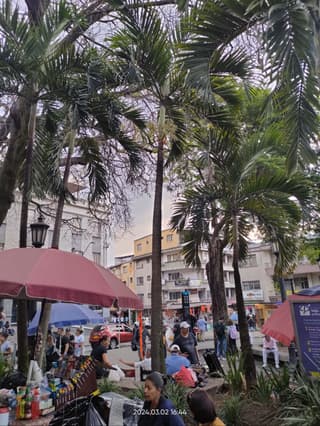
Areca palm
Chrysalidocarpus lutescens
The Areca palm (Chrysalidocarpus lutescens, formerly Dypsis lutescens) is a clustering palm from the Arecaceae family native to Madagascar. It produces clusters of slender, cane-like stems with yellowish-green sheaths and arching pinnate fronds, which have earned it nicknames such as the 'golden cane palm' or 'butterfly palm.' In the wild, it grows up to 8 m tall, but as a houseplant, it remains significantly smaller and is among the most popular indoor palms due to its low maintenance and ability to naturally purify and humidify indoor air.
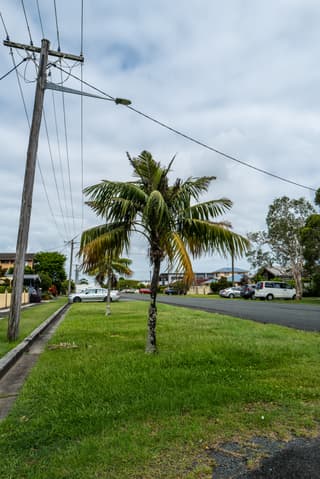
Kentia Palm
Howea forsteriana
The Kentia Palm (Howea forsteriana) is an elegant, slow-growing palm native to Lord Howe Island, Australia. Renowned for its graceful, arching fronds and tolerance of indoor conditions, it became the quintessential Victorian parlour palm in the 1870s. Queen Victoria herself kept these palms in all her homes. With its single trunk and dark green, pinnate fronds reaching up to 3 meters long, it adds a sophisticated tropical touch to any space while being remarkably low-maintenance.
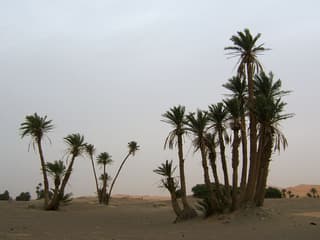
Date Palm
Phoenix dactylifera
Phoenix dactylifera, commonly known as the Date Palm, is a majestic palm tree native to the Middle East and North Africa. It can reach up to 30 meters in height and has been cultivated for over 5,000 years for its nutritious fruits — dates — and exceptional ornamental value.

Mountain Date Palm
Phoenix loureiroi
The Mountain Date Palm (Phoenix loureiroi) is a small, tough palm native to the hills and forests of southern Asia, from India and Pakistan through Burma, Thailand, Vietnam, China, Taiwan and the Philippines. It grows as a solitary or clustering palm reaching 1-4 m tall, with a trunk clad in diamond-shaped old leaf bases and stiff, plumose pinnate fronds up to 2 m long. Small yellow flowers are followed by bluish-black, single-seeded fruits. In the wild it thrives from sea level to 1,500 m altitude, tolerating both seasonal drought and periodic flooding, and is often found colonizing disturbed ground such as roadsides and rice-paddy borders. As a landscape or container plant it is prized for being slow-growing, drought-tolerant once established, and largely free of the serious pest and disease problems that trouble other ornamental palms.
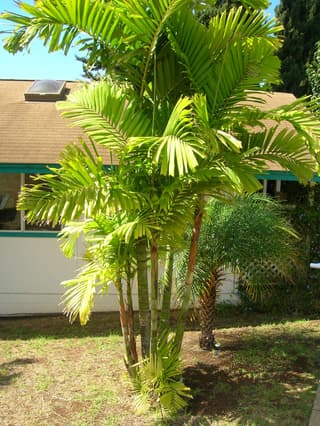
Macarthur Palm
Ptychosperma macarthurii
The Macarthur Palm (Ptychosperma macarthurii) is a clustering, multi-stemmed palm native to northern Australia and New Guinea. It produces slender, ringed canes topped with dark green, arching, pinnate fronds, forming a dense and graceful clump. Prized for its adaptability, this palm tolerates a wide range of soils, grows well both outdoors in tropical landscapes and indoors in bright rooms, and is notably resistant to pests, disease, and even lethal yellowing, a condition that affects many other palm species.
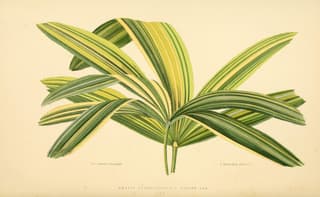
Lady Palm
Rhapis excelsa
Rhapis excelsa, commonly known as the Lady Palm or Broadleaf Lady Palm, is an elegant fan palm native to southern China. With its slow growth and lush fan-shaped foliage, it is one of the best indoor palms for beginners. Its multiple slender stems covered in brown fibers give it a bamboo-like appearance, making it an excellent decorative choice for indoor spaces. NASA studies have recognized it as one of the top air-purifying plants.
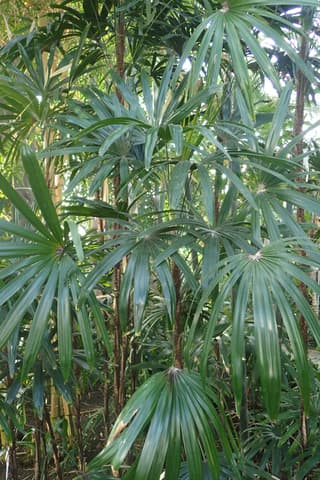
Slender Lady Palm
Rhapis humilis
Rhapis humilis, commonly known as the Slender Lady Palm or Reed Rhapis, is a clumping understory palm native to the subtropical forests of South China (Yunnan). It forms dense clusters of slender, bamboo-like stems topped with elegant fan-shaped fronds with narrow, finger-like segments. Slower growing than its cousin Rhapis excelsa, it is widely cultivated as both an indoor ornamental and a garden accent plant in warm climates.
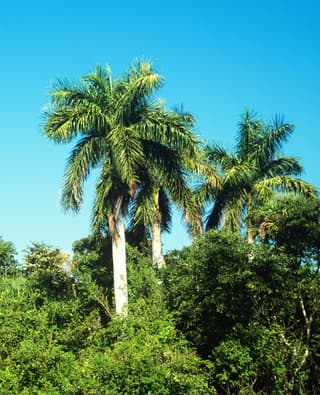
Cuban Royal Palm
Roystonea regia
The majestic Cuban Royal Palm, Roystonea regia, is a large-sized palm tree native to the tropical regions of the Americas. It is characterized by its single, smooth, light gray trunk that widens slightly at the base and is crowned by a dense canopy of large, arching pinnate leaves. It is widely used in landscaping to create a dramatic visual impact in avenues, parks, and gardens.
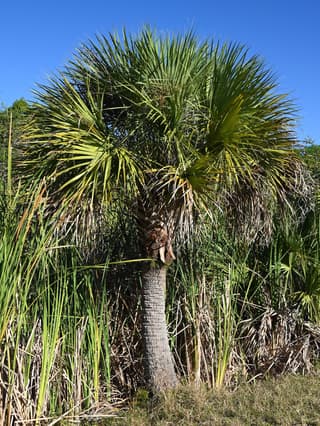
Cabbage palm
Sabal palmetto
Sabal palmetto, the cabbage palm, is a solitary fan palm native to the coastal plain of the southeastern United States (Florida to North Carolina), the Bahamas, northern Cuba and the Yucatan Peninsula. It carries a round crown of large costapalmate, fan-shaped leaves on a single trunk 25-40 cm thick that can reach 24 m in the wild, though garden specimens usually stay at 4-10 m. Old leaf bases ("boots") often remain on the trunk in a crisscross pattern. In late spring and early summer long branched flower stalks carry thousands of tiny, fragrant creamy-white flowers that draw bees, followed by small black fruits eaten by birds and raccoons. It is the state tree of both Florida and South Carolina, and is famous for shrugging off salt spray, hurricanes, drought, floods and fire.
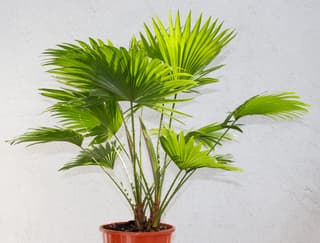
Footstool Palm
Saribus rotundifolius
The Footstool Palm (Saribus rotundifolius, formerly Livistona rotundifolia) is native to Southeast Asia (Malaysia, Indonesia, Philippines). Its solitary, smooth, brown trunk, marked with leaf-scar rings, can reach up to 80 feet in the wild, though it remains much smaller in containers. Its nearly circular fan-shaped leaves measure about 5 feet wide on young specimens. It bears small yellow flowers in spring and summer, followed by round fruits 0.6 to 0.8 inches in diameter that turn from red to black when ripe. It is one of the fastest-growing palms, popular both as a bright indoor plant and in tropical gardens.
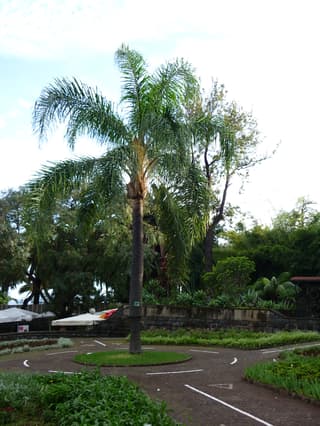
Queen Palm
Syagrus romanzoffiana
The Queen Palm (Syagrus romanzoffiana) is a stately feather palm native to Brazil and South America, belonging to the family Arecaceae. Prized for its graceful arching fronds and slender trunk, it is one of the most popular landscape palms in subtropical and tropical regions worldwide. It can reach heights of 10-15 meters and produces clusters of bright orange fruits that attract wildlife.
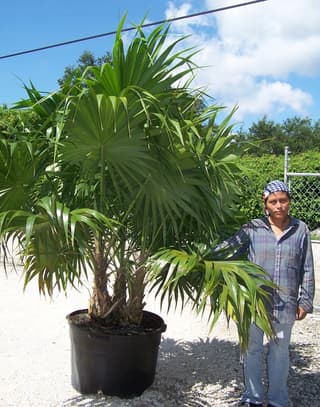
Florida thatch palm
Thrinax radiata
The Florida thatch palm (Thrinax radiata) is a species in the Arecaceae family, native to the Florida Keys, the Yucatán Peninsula, the Caribbean, and Central America. It is a solitary, slender-trunked palm, without a crownshaft, that can reach between 6 and 9 meters in height, although it grows very slowly. Its leaves are palmate (fan-shaped), bright green on the upper side and silvery on the underside. It produces white inflorescences that can bloom year-round, followed by small white fruits. It inhabits coastal scrublands and calcareous soils, which makes it very tolerant to salinity and drought. In Florida, it is listed as an endangered species in the wild.
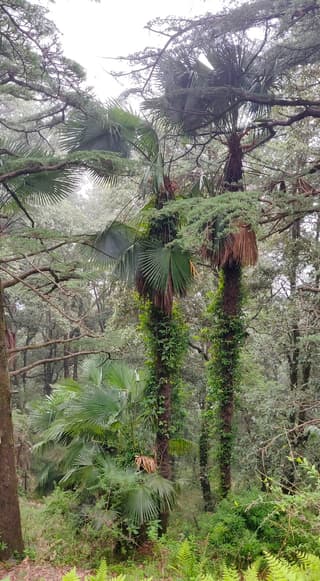
Kumaon palm
Trachycarpus takil
Trachycarpus takil is a fan palm in the family Arecaceae, endemic to the Himalaya in the Kumaon region (Uttarakhand, northern India) and neighbouring western Nepal, where it grows at 1,800-2,700 m in cool, moist oak and rhododendron forest that gets snow every winter. It has a single trunk covered in tightly clasping chestnut-brown fibre and, with time, reaches 10-15 m. The fan leaves, almost three-quarters of a circle, are 1-1.2 m across and split to the middle into 45-50 stiff segments that do not droop at the tips. It is dioecious (separate male and female plants). It ranks among the most cold-hardy tall-trunked palms. In the trade it is often confused with Trachycarpus fortunei, and plants sold as "takil" are sometimes another species.
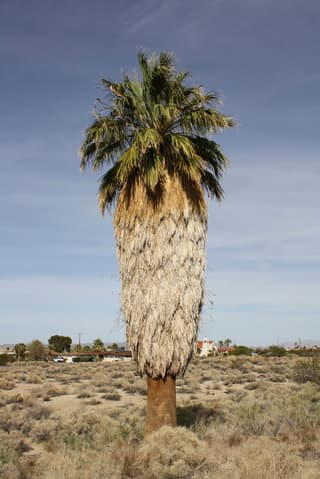
California Fan Palm
Washingtonia filifera
Washingtonia filifera, the California fan palm (also called desert fan palm), is a massive, single-trunked palm native to desert oases of the southwestern United States. It is the only palm species native to the western United States and forms dense groves around natural springs in the Colorado and Mojave deserts. Mature palms develop a thick, fibrous gray-brown trunk topped with a crown of large, fan-shaped (palmate) leaves that can reach 1.5-2 m across, each armed with curling filaments along the leaf margins that give the species its epithet "filifera" (thread-bearing). Older, uncultivated specimens often retain a skirt of dead fronds hanging down the trunk, earning it the nickname "petticoat palm."
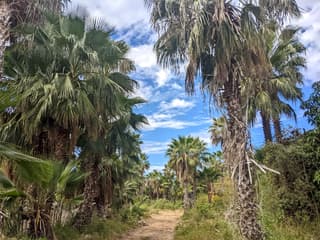
Mexican Fan Palm
Washingtonia robusta
Washingtonia robusta, commonly known as the Mexican Fan Palm or Skyduster, is a fast-growing palm native to Baja California and Sonora, Mexico. Prized for its slender towering trunk and large fan-shaped fronds, it can reach up to 30 meters tall and is widely planted along boulevards, in parks, and in warm-climate gardens worldwide.
Easy Care Palms
Our selection of 26 easy palms combines the characteristics of this category with reduced care needs. Perfect for beginners who love this category.
Why Choose Easy Palms?
Combining the beauty of palms with easy difficulty level lets you enjoy this category without excessive maintenance worries. Each plant was selected to offer the best characteristics of the category at the care level you are looking for.