Alocasia Flower: What It Looks Like, Should You Cut It, and How to Make It Bloom
Alocasia can flower, but indoors it is rare. Learn how to recognize the bloom, when to cut it, why it warms up and will not set fruit in a pot, and what helps the plant bloom.
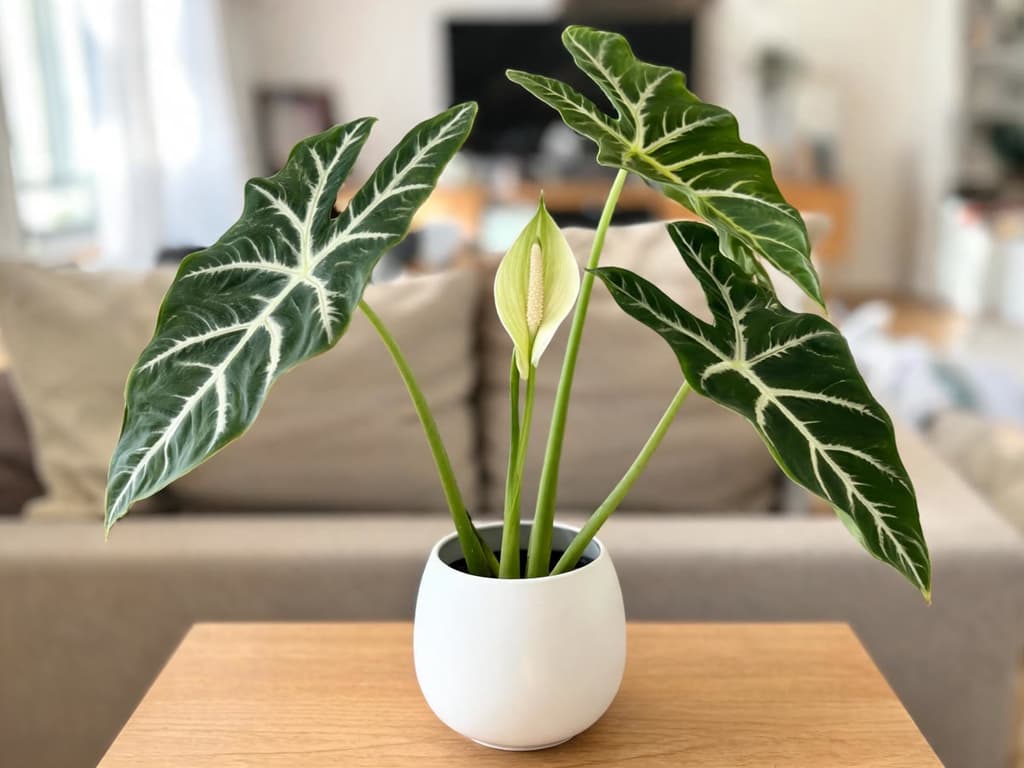
Alocasia (elephant ear) does flower: a modified hood-shaped leaf, the spathe, greenish-cream in color, wraps around a cream spike, just like in a calla lily. Indoors, an alocasia flower is rare, and the plant is grown for its foliage. If yours blooms and is sturdy, you can leave the flower until it dries out or cut the flower stalk right where it emerges between the leaf petioles. Both choices are safe.
In a pot, the flower almost never sets fruit. The flies that carry pollen from one flower to another live in the plant's native forests, not inside a house. In addition, each flower receives and releases pollen on different days.
Quick summary:
NC State Extension, the consultation service of North Carolina State University (USA), notes that alocasia grown as a houseplant rarely blooms.
No study has measured how much energy a flower drains from alocasia leaves. Small, weak plant, or one dropping leaves without putting out new growth: cut the flower. Sturdy plant: you can leave it.
In Alocasia macrorrhizos, the tip of the spike heats up to 25.6 °C above the air temperature at dawn, which is when the scent is strongest.
My alocasia bloomed: should I cut the flower or leave it?
If the plant is small, weak, or losing leaves without pushing new growth, cut the flower. If the plant is sturdy, with new leaves emerging, you can leave the flower until it wilts and cut it later. No source records any harm to the plant from cutting or leaving the flower.
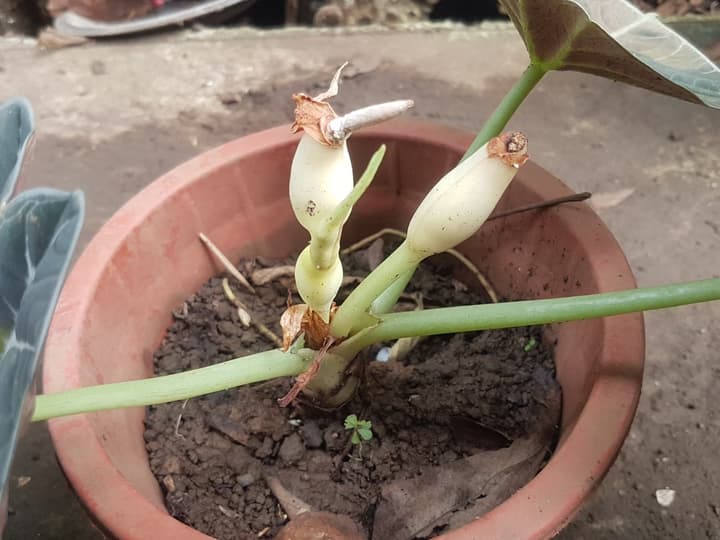
To cut, wear gloves. NC State marks alocasia as a plant that causes contact dermatitis, a skin irritation in anyone who touches the sap. Cut the small flower stalk close to the base, right where it emerges between the leaf petioles. Use a clean knife or scissors and do not cut any leaf petioles. Wash your hands afterward.
If you decided to leave it, wait for the upper part of the flower to dry out. A 2012 study in the journal Plant Biology followed Alocasia macrorrhizos in Borneo. The upper part of the spathe and spike wilts shortly after shedding pollen, dries out, and falls off. The lower part of the spathe remains attached to the stalk. When the upper part turns brown and dry, cut the entire stalk right where it emerges between the leaf petioles.
How much energy the flower takes from the alocasia
Nobody has measured this. We found no study and no university extension service that has counted how many leaves an alocasia fails to produce because of a flower. The search also included taro (Colocasia esculenta), a close relative cultivated for food. The claim that "one flower costs two or three large leaves" circulates without any measurement behind it.
When in doubt, choose the safest option for the plant. A weak plant has no leaves to spare, and cutting the flower carries no known cost. A sturdy plant, with a new leaf emerging from the center, can support the bloom with no apparent risk.
How to recognize an alocasia flower
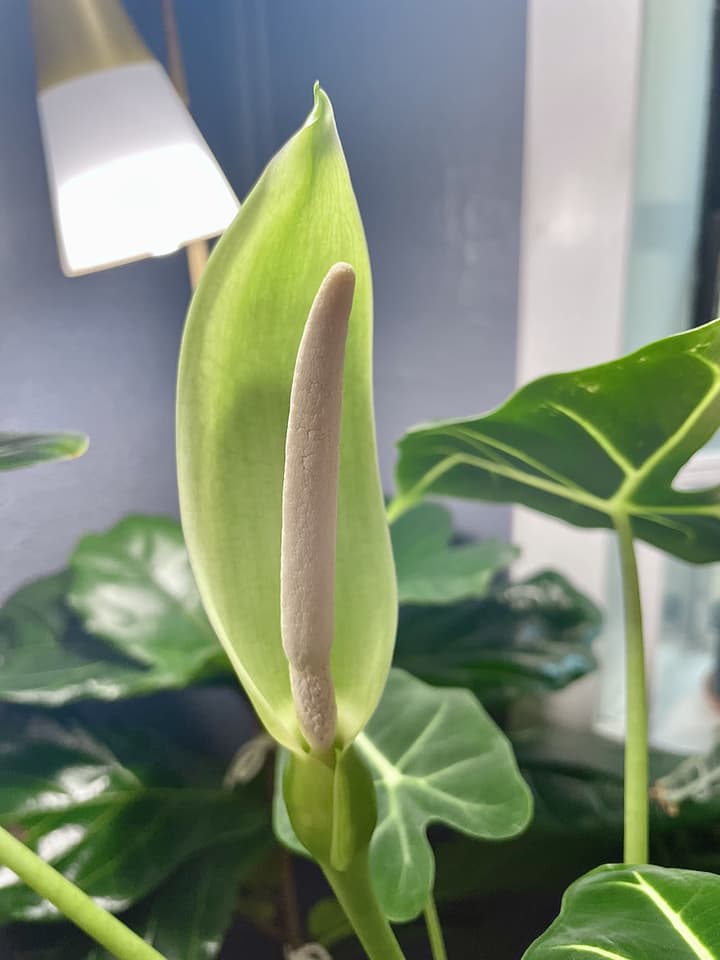
The flower emerges on its own stalk from among the petioles, with its tip closed like a light green pod. Within a few days, this pod opens a slit along one side and reveals the cream-colored spike inside. A new leaf is different: it emerges rolled up like a cigar and unfurls into a full leaf blade, with no spike whatsoever. If you are still not sure which one it is, wait: the flower opens a slit on one side, and the leaf unfurls.
The flower is not a sign that the plant is dying. It is simply how an alocasia reproduces by seed. In Alocasia macrorrhizos, the 2012 study recorded flowers emerging in pairs, one after the other. After the first flower, a second one may appear beside it.
What the alocasia flower looks like on the inside
What is called an alocasia flower is actually a cluster of tiny flowers. In Alocasia macrorrhizos, each spike has more than 100 female flowers. The central spike is called a spadix and bears the flowers. The modified leaf around it is called a spathe. It is the same design as the anthurium flower and the peace lily, both from the same family, the aroids (plants with a spathe and spike).
The spike has four zones from bottom to top, according to the 2012 study on Alocasia macrorrhizos:
female flowers, which turn into fruit if pollinated;
a sterile zone, free of fertile flowers;
male flowers, which shed pollen;
a sterile tip, called the appendix.
The spathe forms a closed chamber around the female flowers and constricts at the level of the sterile zone. Each spike goes through a female phase first, when it receives pollen, and then a male phase, when it sheds its own pollen. In Alocasia macrorrhizos, the female phase lasts about 1 day.
The size varies by species. In Alocasia cucullata, the spathe measures 9 to 15 cm and the spike 7.5 to 14 cm, according to the Missouri Botanical Garden.
The flower warms up and gives off a scent
The spike of many alocasias produces heat. A 2005 study in the journal Canadian Journal of Botany measured Alocasia macrorrhizos in Vanuatu. The sterile tip of the spike reached 43.9 °C on average, with a maximum of 47.4 °C. It was up to 25.6 °C above air temperature. The peak came between 5:45 and 6:00 a.m., when the flower's scent was strongest.
NC State Extension explains the reason: many alocasia species heat the spike, and the heat spreads the scent that attracts pollinating insects. If your flower has a scent, it tends to be strongest right at dawn.
Small flies carry the pollen. In Alocasia odora, a 2003 study in the American Journal of Botany identified two fly species in the genus Colocasiomyia, from the fruit fly family. They are attracted by the scent of the appendix. When the researchers removed the appendix, the flower set significantly fewer fruits.
The German gardening portal Gartenjournal describes the scent as musty and rotten, without citing a source. No source cited here confirms this, and the University of Wisconsin Extension calls the flowers fragrant. This guide follows the extension.
Why an alocasia flower will not produce fruit indoors
It lacks both the insect and pollen from another plant. In the 2012 study on Alocasia macrorrhizos, flowers covered with fine netting to keep out all insects produced almost no fruit. The species is largely incapable of self-pollination using its own pollen. Furthermore, on the same plant, the female phase of one flower never overlapped with the male phase of another.
When pollination happens, the fruits are berries, fleshy little fruits that ripen in 45 to 90 days. In Alocasia macrorrhizos, they turn red, each holding 1 to 5 seeds. The fruits are also toxic: NC State lists flowers, fruits, and seeds among the poisonous parts of the plant.
The alocasia bloomed and the leaves are turning yellow: what to do
Check the base of the petioles, not the flower. Gently squeeze the petioles where they emerge from the soil. A firm base with a new leaf coming out from the center means a healthy plant shedding an old leaf. A soft, dark base with a bad smell points to root rot. Stop watering, remove the plant from its pot, and inspect the roots.
The bloom and the yellow leaf usually have separate causes. NC State lists three causes for yellow leaves in the genus: overwatering, underwatering, and low light. A soft yellow lower leaf with wet soil indicates excess water.
A droopy, wilted leaf with dry soil points to underwatering, and the leaf perks up a few hours after watering. The page on yellow leaves on elephant ears separates the causes by the way the yellow appears on the leaf. On a weak plant with a flower, cut the bloom and treat the cause of the yellow leaf at the same time.
How to make an alocasia bloom
There is no proven recipe to make an alocasia bloom indoors. No university extension connects light or heat to blooming in potted alocasias. Regarding the season, sources only state that the genus blooms in spring and summer. What the sources report is summarized in this table:
What is known | Source | Applies to |
|---|---|---|
As a houseplant, rarely blooms | NC State Extension | the genus and 'Polly', a white-veined potted alocasia |
Blooms in spring and summer | UF/IFAS (Florida), NC State | genus |
Flowering is uncommon in the cold-winter US Midwest | University of Wisconsin Extension | elephant ears (Alocasia, Colocasia, Xanthosoma) |
Gibberellic acid, a plant hormone, induces flowering in taro | Alamu and McDavid, 1978 | taro, experimentally |
In Brazil, spring and summer run from September to March. This is when a healthy alocasia is most likely to bloom.
What is within your control is keeping the plant growing well, with new leaves emerging one after another. Place the pot 1 to 2 meters from a bright window facing east or north. In the northern hemisphere, switch the north window to one facing south. Direct midday sun should not hit the leaf. Do not let the air drop below 15.5 °C, the limit NC State gives for 'Polly'. Water when the top 2 to 3 cm of soil is dry to the touch.
Gibberellic acid is not a solution for houseplants. Spraying gibberellic acid triggered flowering in taro during breeding experiments. The response varied from one cultivar to another (Ferraren and Nuñez, 1991). No published trials exist for potted alocasia.
Alocasia, taro, or taioba: the flower of each elephant ear
In Brazil, elephant ear is the common name for alocasia (Alocasia), taro (Colocasia esculenta), taioba (Xanthosoma sagittifolium), and caladium (Caladium). Alocasia is the potted plant, with an upright leaf and the stalk attached to the leaf margin. Taro is the garden bed plant, with the stalk attached to the center of the underside of the leaf.
The taro flower is also rare. NC State writes that taro "rarely flowers" and that the spathe ranges from green to yellow. Its factsheet notes a useful difference for anyone cutting the flower: contact dermatitis is "no" for taro and "yes" for alocasia.
The name elephant ear also appears, in other languages, for plants from other families. One example is Haemanthus albiflos, a bulb plant with a white brush-shaped flower. If you are not sure which plant you have at home, Bloom (available for iOS) identifies the species from a photo of the leaf.
Is an alocasia flower toxic?
Yes, the flower, the fruit, and the rest of the plant. The ASPCA, an American animal poison control center, lists Alocasia as toxic to dogs, cats, and horses. The irritating substance is insoluble calcium oxalate crystals. The ASPCA lists oral irritation, pain and swelling of the mouth, drooling, vomiting, and difficulty swallowing.
For anyone cutting the flower, the risk comes from sap contacting the skin, which is why gloves are necessary. In homes with dogs, cats, or young children, pick up the cut bloom and any pieces that drop to the floor.
Frequently asked questions
Does a flower mean the alocasia is healthy?
Not necessarily. No source links flowering to the overall health of an alocasia: it is simply how the plant reproduces by seed. The base of the petioles reveals true plant health. A firm base with a new leaf coming out indicates a healthy plant. A simultaneous yellow leaf has its own cause, which the bloom does not explain.
How long does an alocasia flower last?
A few days once open. In the Alocasia macrorrhizos studied in 2012, the pollen-receptive phase lasted about 1 day, and the pollen-shedding phase followed immediately. After that, the upper spathe wilts, dries out, and falls away. No one has measured how long a flower lasts on an indoor potted alocasia.
Does an alocasia flower have a scent?
It can, and it is strongest early in the morning. In Alocasia macrorrhizos, the scent peaked between 5:45 AM and 6:00 AM, when the spadix was warmest. The scent attracts small pollinating flies. The Wisconsin Extension describes elephant ear flowers as fragrant.
Can you plant seeds from an alocasia flower?
Indoors, seeds almost never form because the flower is not pollinated. Alocasia relies on pollen from another plant, carried by small flies. Even when fruit does develop, growing plants from seed is slow. A practical way to propagate alocasia is by separating the offsets that sprout around the base.
What to do with your blooming alocasia today
Squeeze the base of the petioles. Firm base with new leaf growth emerging: leave the flower until the tip dries out, then cut the stalk where it emerges between the leaf stems, wearing gloves. Soft base or a plant losing leaves without new growth: cut the flower now and address the underlying cause of the yellow foliage.
Sources
Takano, K. T., Repin, R., Mohamed, M. B. and Toda, M. J. Pollination mutualism between Alocasia macrorrhizos (Araceae) and two taxonomically undescribed Colocasiomyia species (Diptera: Drosophilidae) in Sabah, Borneo. Plant Biology 14 (2012).
Ivančič, A., Roupsard, O., Garcia, J. Q., Lebot, V. et al. Thermogenic flowering of the giant taro (Alocasia macrorrhizos, Araceae). Canadian Journal of Botany 83 (2005).
Miyake, T. and Yafuso, M. Floral scents affect reproductive success in fly-pollinated Alocasia odora (Araceae). American Journal of Botany 90(3) (2003).
NC State Extension, Plant Toolbox: Alocasia, Alocasia × mortfontanensis ('Polly'), and Colocasia esculenta.
University of Florida IFAS Extension, FPS-33, Alocasia spp.
Wisconsin Horticulture, Division of Extension, University of Wisconsin-Madison, Elephant Ears (Colocasia, Alocasia, and Xanthosoma).
Missouri Botanical Garden, Plant Finder: Alocasia cucullata.
ASPCA Animal Poison Control, Alocasia.
Alamu, S. and McDavid, C. R. Promotion of flowering in edible aroids by gibberellic acid. Tropical Agriculture 55(1) (1978).
Ferraren, D. O. and Nuñez, M. C. M. Flowering in taro (Colocasia esculenta) as affected by genotype and method of gibberellic acid application. Philippine Journal of Crop Science (1991).
Related articles

How to Care for Hibiscus: Sun, Watering, Fertilizer, and Pruning for Flowers
How to care for hibiscus: 6 hours of direct sun, evenly moist soil without waterlogging, half-strength fertilizer in spring and summer, and pruning in early spring. Find out why the flower lasts one day and why buds drop before opening.

Do Ferns Like Sun or Shade? It Depends on the Type
Ferns prefer bright shade: plenty of light, but no direct sun on their fronds. Tuberous sword fern is the exception that handles sun. Here is the ideal light for each type, where to place pots, and how fronds show too much or too little light.

African Violet Yellow Leaves: Causes and What to Do
Yellow leaves on an African violet usually stem from overwatering, and the first place to check is the center of the plant. Losing one lower leaf at a time is normal. Identify whether age, watering, cold water, sunlight, cold drafts, or fertilizer is the culprit based on the yellowing pattern, and see what to do today.