Why Your Peace Lily Isn't Blooming: The 4 Real Causes and How to Fix It
Almost every peace lily is sold in full bloom, only to never produce another white spathe once you bring it home. Learn how to identify the four real causes behind this, how much light your plant actually needs in measurable numbers, and what commercial growers do that you simply cannot replicate at home.

If your peace lily hasn't bloomed since the day you brought it home, you probably shouldn't blame yourself. The plant was chemically forced to bloom inside a commercial greenhouse so it would look stunning on the store shelf, covered in white spathes. Once that effect wears off, the plant returns to its natural rhythm, which means blooming only once or twice a year, and only after reaching maturity.
A peace lily that won't bloom usually suffers from one of four issues: insufficient light, being too young, the lingering effects of commercial forcing, or the wrong fertilizer or pot size. Each cause leaves a distinct clue on the plant. Identifying that clue tells you exactly what to do next.
This guide is for those who have a beautiful, healthy plant with firm, green leaves that simply refuses to flower. If your plant is wilting, turning yellow, or has brown tips, you are dealing with a different issue, which we cover in our guia de como cuidar do lírio da paz.
Quick summary:
The store plant is not a point of comparison. Growers spray Spathiphyllum with gibberellic acid between 100 and 250 ppm, 8 to 15 weeks before sale. The flower opens 70 to 110 days after application (UF/IFAS Extension, ENH1047; Oglesby Plants International). No home care reproduces this.
Light is the only cause with a number. In production, the peace lily stays between 800 and 2,500 foot-candles (UF/IFAS Extension, ENH958). Indoors, placed right against an east window, you provide about 300 (Illinois Extension). This is why "brighter" is almost never bright enough.
Cold only advances the date. If the plant spends a period at around 12 °C (54 °F), it blooms 3 to 4 weeks earlier. Outside of this period, what it wants is 22 °C (72 °F), the temperature at which the peace lily grows best (UF/IFAS Extension, ENH1047). In a young plant or a plant in the dark, no amount of cold produces flowers.
Understanding the peace lily "flower"
The white, sail-like part of a peace lily is not actually a flower. It is a spathe, which is a modified leaf that wraps around the spadix, the bumpy, cream-colored spike in the center. The actual flowers are tiny bumps located on the spadix itself.
The Spathiphyllum spathe measures 10 to 30 cm and grows above the foliage. It stays white for about ten days and then turns green. It remains greenish for a month or more before drying (NC State Extension).
Knowing that the white part is just a modified leaf changes how you diagnose your plant in two ways. First, a green spathe does not mean your plant is sick; it is just the natural end of the bloom cycle. Second, when counting blooms, you are looking at events that last for weeks, not days. A plant that produced a single spathe in October and nothing else for the rest of the year is doing just fine.

When the peace lily blooms
Virtually all literature on Spathiphyllum blooming comes from Florida and Belgium, and therefore comes with the Northern Hemisphere calendar. In it, most cultivars (cultivated varieties of the same species) bloom between January and August. The plant does not initiate flower buds between June and August, the peak of summer there (UF/IFAS Extension, ENH958; UF/IFAS Extension, ENH1047).
What applies in both hemispheres is the season, not the month: in the southern hemisphere, this same calendar shifts by six months. For this reason, the table below is in seasons, not months. It is an interpretation of data from Florida, not data measured where you live. It serves as a guide for expectations:
Time of year | What the plant does | What you should do |
|---|---|---|
Late autumn and winter | Bud initiation phase, provided the plant has enough light and maturity | Ensure adequate light now. This is when the blooming potential for the year is decided |
Spring and early summer | Main blooming window | Keep watering regularly and apply diluted fertilizer. Avoid moving the plant |
Peak of summer | Period of lowest bud initiation | Do not expect new blooms. Focus on keeping the foliage healthy |
Autumn | Old spathes turn green and dry up | Cut the spent stems down to the base |
Different cultivars behave differently, and the UF/IFAS description lists three blooming patterns. Age-dependent cultivars bloom continuously once mature. Age-and-season-dependent varieties bloom only in spring and early summer. Multi-seasonal varieties can bloom multiple times throughout the year.
Meanwhile, NC State notes that the species "has no specific flowering season." If your plant blooms outside of the typical calendar, there is absolutely nothing wrong with it.
The 4 real reasons your peace lily won't bloom
A peace lily stops blooming for four main reasons, and each one leaves a specific clue on the plant. Low light shows up as dark, beautiful green leaves with no buds in sight. Lack of maturity is common in small plants or those that were recently divided.
The lingering effects of gibberellic acid appear in newly purchased plants that finish blooming and then grow very narrow, strap-like leaves. Fertilizer or potting mistakes usually show up as pale, stunted new leaves.
The most common mistake growers make is trying to fix all four issues at the exact same time. This is counterproductive because three of these fixes take months to show results, making it impossible to know what actually worked. Always start by addressing the specific clue your plant is showing you.
1. Insufficient light
The clue: Large, beautiful, dark green leaves with very slow growth and absolutely no blooms for over a year. This is the most common culprit.
The peace lily survives in the shade. Because of this, it earned the nickname of closet plant and became a standard in windowless office receptions. Surviving, however, is a step below blooming. The Royal Horticultural Society is direct in saying that the plant tolerates deep shade, but there it "rarely flowers and grows very slowly" (RHS).
The difference between the lighting in a greenhouse and your living room is easily measurable. Indoor light is measured in foot-candles. Illinois Extension defines indoor levels as follows: around 75 foot-candles is low light, 150 is medium light, and 300 is high light. High light corresponds to placing the plant right next to an east- or west-facing window.
Outdoors, the sun delivers 10,000 to 12,000 foot-candles (Illinois Extension). In production, nurseries grow Spathiphyllum between 800 and 2,500 foot-candles (UF/IFAS Extension, ENH958; Oglesby).
Where the plant is | Approximate foot-candles | Will it bloom? |
|---|---|---|
Hallway, windowless bathroom, deep corner of a room | 25 to 75 | No |
6 to 10 feet from a window, middle of a room | 100 to 150 | Rarely |
Right next to an east- or west-facing window | 300 | The highest realistic limit in an apartment |
Commercial greenhouse | 800 to 2,500 | Yes, with hormone assistance |
The best spot in an apartment usually offers around 300 foot-candles, compared to the 800 to 2,500 foot-candles of a commercial peace lily greenhouse. No normal home can match greenhouse lighting. Your goal is simply to move the plant out of the "impossible to bloom" zone and into the brightest spot your home can provide.
The brightest window in the house is the one that points toward the equator. In the northern hemisphere, it is the south-facing window; in the southern hemisphere, the north-facing one.
Place the plant less than three feet from an east-facing window, with morning sun filtered by a thin curtain. Or place it near the equator-facing window, protected from the midday sun. Direct sun hitting the leaf in the afternoon burns it in a few hours and does not help at all.
To measure light without buying expensive equipment, you can use your smartphone. Bloom features a built-in light meter that reads in lux (available for iPhone). There are also standalone light meter apps that do the same calculation.
The conversion is roughly 1 foot-candle to 10.8 lux. You want to aim for around 3,000 lux, with an ideal target of over 5,000 lux for a few hours a day. Measure with your phone lying flat exactly where the leaves are, not right against the glass.
If you don't know which cultivar you have at home, you should identify it before changing your routine. 'Sensation' reaches over three feet and requires more shade than 'Chopin' or 'Bellini', which stay close to 20 inches (RHS). A photo solves this in a minute, and the guia de como identificar planta de interior explains what the camera needs to frame.
2. The plant is too young
The clue: A small plant bought in a pot under 6 inches, or a division you separated from a larger plant less than a year ago.
Peace lilies must mature before they can bloom. Commercial production almost always starts with tissue-cultured micro-cuttings. From that point, it takes a plant 15 to 23 months to reach maturity, depending on the cultivar.
The cultivation time until the pot is ready for sale confirms the same pattern. It ranges from 4 to 9 months for a 6-inch pot. It also takes 12 to 20 months to reach a 14-inch pot (Oglesby Plants International).
Dividing the plant delays blooming. When you split a large pot into three smaller plants, each division reverts to being too young to bloom. The plant will spend the entire next season producing leaves instead of flowers. If you want to see spathes anytime soon, avoid dividing your plant this year.
There is nothing you can do here except keep the plant healthy and well-lit. Fertilizer will not speed up maturity, and no product sold as a "bloom booster" can force a young plant to age faster.
3. Lingering effects of commercial forcing
The clue: You bought a blooming plant, the white spathes withered within a few weeks and never returned, and you notice a second physical symptom: the new leaves are visibly narrower than the older ones, looking almost strap-like.
Since the 1980s, Spathiphyllum growers have induced blooming with a single foliar spray of gibberellic acid, GA3. The doses used in the industry range from 100 to 250 ppm, applied 8 to 15 weeks before sale. The flower opens 70 to 110 days later, regardless of the time of year or temperature. This is what allows a flower shop to have blooming pots in any month (UF/IFAS Extension, ENH1047; Oglesby Plants International).
The treatment causes side effects, documented by the very researchers who studied it. Some of the flowers come out distorted, and some varieties stretch the petiole in an unacceptable way. The new foliage produced after the application comes out narrow, in a ribbon-like shape (UF/IFAS Extension, ENH1047). If your plant has thin new leaves in the middle and wide leaves on the edge, you are looking at the record of the hormone in the plant.

What you can and cannot replicate at home:
What you cannot do: Spraying GA3. This is a professional-grade chemical that requires precise dosing based on leaf surface area and specialized greenhouse equipment. The side effects will likely deform the foliage you want to keep looking beautiful. Retail "blooming hormones" sold for home use do not follow the same scientific protocol.
What you can do: Provide the best light your home can offer, wait for the plant to mature naturally, respect the natural seasons, and avoid overwatering. This is the recipe that produces one to two natural blooms a year.
What you should accept: The plant's natural rhythm. One spathe per year on a healthy plant is a perfectly normal result for a peace lily growing without synthetic hormones.
This is true for almost any flowering plant you buy. Supermarket orchids and flor de maio arrive home looking perfect, and the subsequent frustration is identical. In the case of orquídea, o gatilho de refloração é temperatura, not hormones. This makes orchids much easier to bloom again than peace lilies.
4. Fertilizer and potting issues
The clue: A mature plant kept in good light that produces new leaves that are small and noticeably paler than the older foliage.
Fertilizer is mentioned last for a reason. Nutrients cannot replace light: feeding a plant sitting in a dark hallway will not produce flowers, it will only build up harmful salts in the soil. Once light issues are resolved, a weak, diluted fertilizer during the active growing season is more than enough.
Over-fertilizing is much more dangerous than under-fertilizing. Peace lilies are highly sensitive to salt buildup, which they show by developing crispy, brown leaf tips.
Regarding the pot, there is a myth and a fact. The myth is that crowding the plant in a small pot forces blooming; there is no published evidence of this. The fact is the opposite. A pot much larger than the root ball keeps the soil wet for too long and leads to root rot (RHS).
When you replantar o lírio da paz, only increase the pot size by an inch or two at a time. A plant with unhealthy roots cannot bloom. When a plant struggles, the very first thing it sacrifices is its flowers.
The role of temperature in blooming
Cool temperatures can accelerate blooming in a plant that is already mature and ready to flower. However, cold will not create flowers where they cannot otherwise grow: in young plants or low-light conditions, lowering the temperature changes nothing. This is why temperature is a secondary factor, never a replacement for proper light and maturity.
The peace lily grows best at 72 °F (22 °C), and this is the temperature you want for most of the year. The exception is a cold period. Plants that spend a few weeks at around 54 °F (12 °C) bloom 3 to 4 weeks earlier than those that do not (UF/IFAS Extension, ENH1047).
Indoors, the comfortable range goes from 20 °C to 29 °C during the day. It drops a few degrees at night (UF/IFAS Extension, ENH958).
Whether this cooling will happen in your home depends on the winter in your city, and you can check before trying. Look up the average minimum temperature of the coldest month where you live, which is a number published by your country's meteorological service.
Where the minimum temperature of the coldest month is close to 12 °C, an unheated room gets close to this value on winter nights. This happens without you having to do anything. Where the minimum temperature stays well above that, or where the room is heated in the winter, this cooling will not happen in your home, and the work is all in the light.
Do not place your plant directly in front of an air conditioner. Cold drafts blowing directly onto the leaves will only stress the plant, without providing the stable, cool period described in scientific studies.
There is incorrect information circulating about photoperiod. One of the popular gardening guides claims that the peace lily is a short-day plant and that it only forms buds when the nights are long. UF/IFAS tested photoperiods of 8, 12, and 16 hours and did not confirm any type of photoperiod responsiveness in the species (UF/IFAS Extension, ENH1047).
A Belgian study monitored ten greenhouse cultivation cycles. It observed flower initiation associated with days of less than 12 hours. It also associated a temperature of 20 °C to 24 °C and low total light (Oyaert et al., Acta Horticulturae 624, 2003).
The scientific evidence is mixed, and even under the most favorable interpretation, none of this is practical to replicate in an apartment. You cannot easily control day length indoors; you can only control light intensity, plant maturity, and pot size.
What will NOT make your peace lily bloom
The shortcuts below are some of the most common myths surrounding peace lily care. None of them will help your plant bloom.
Coffee grounds directly in the pot. The New York Botanical Garden advises against direct application on indoor plants. The grounds compact the soil and reduce aeration. They become a breeding ground for fungus and accumulate salts (NYBG Plant Information Service, updated in March 2022). Their nitrogen is also not available without going through composting.
Sugar water. Plants produce their own sugars through photosynthesis; they need light, not table sugar. Adding sugar to the soil feeds harmful fungi and bacteria around the roots, which is the last thing you want.
Baking soda. This is not a plant nutrient and adds unnecessary sodium to potted soil, which is already prone to salt accumulation.
Bloom booster fertilizer in the dark. Extra phosphorus cannot make up for a lack of light. The correct order is always light first, fertilizer second.
Misting the leaves to induce blooms. While high humidity helps prevent brown leaf tips, it has no effect on flower bud initiation.
Cutting off all the leaves to "force" growth. Leaves are the plant's energy factory. Fewer leaves mean fewer resources and a much lower chance of blooming.
The only item on this list that has any beneficial effect is humidity, and its benefits are strictly for the leaves, not the flowers. If your peace lily has brown tips or amarelando leaves, fix those issues first: a stressed plant will not spend energy on blooming.
What to expect over the next 12 months
Once you move your plant to a brighter spot, this is the typical timeline. Almost nothing will happen in the first month.
Time after moving the plant | What usually happens |
|---|---|
Weeks 1 to 4 | Nothing visible. The plant is acclimating to the new light levels. An occasional old leaf may turn yellow |
Months 2 to 4 | New leaf growth. The new leaves should be the same size or larger than the old ones, showing that the light is correct |
Months 4 to 8 | If the plant is mature, this is when buds begin to form, usually hidden deep within the foliage |
Months 8 to 12 | Spathes appear during the next natural blooming window. If they don't, the issue is likely age, and you should see results the following year |
If a year passes in correct light with a mature plant and still no blooms, double-check three things: the actual age of the plant, whether it was recently divided, and if the soil is staying waterlogged. Do not simply increase the fertilizer.
Frequently asked questions
How often do peace lilies bloom?
A mature, well-lit peace lily typically blooms once or twice a year, with spathes lasting for several weeks. Do not expect the constant blooming of a newly purchased plant: commercial blooms are chemically induced and will not happen on their own at home.
Is it rare for a peace lily to bloom indoors?
Not at all, but it requires the right conditions. The plant needs to be mature, receive much more light than it gets in a dark hallway, and experience the correct season. Most plants that "never bloom again" are simply kept in spaces that are too dark to trigger buds.
What does it mean when a peace lily blooms?
Botanically, it means the plant has reached maturity and has received the right balance of light, temperature, and seasonal cues. It is a great sign that your care routine is on track. The association with peace comes from the white spathe resembling a white flag, not from any botanical property.
Why does the peace lily flower turn green?
This is a completely normal part of the flower's life cycle. The spathe stays white for about ten days, then naturally turns green, often remaining on the plant for over a month before finally drying up. It is not a disease or a sign of nutrient deficiency. Once it dries, cut the stem off at the base.
How long do peace lily blooms last?
They stay white for four to six weeks, and the greening spathe can remain on the plant even longer. Cutting the spent stems back to the base will not make the plant bloom again faster, but it keeps the plant looking tidy and prevents it from wasting energy on dying tissue.
In summary
A peace lily that will not bloom is rarely a sick plant. In most cases, it is simply a healthy plant that needs more light, a young plant, or one that is still recovering from commercial hormones. Those hormones were simply used to make the plant look perfect for sale.
All three scenarios require the same initial step: measure the light levels exactly where the leaves sit. If the reading is under 3,000 lux, move your plant to a brighter spot today. The results will show up during the next growing season, not this month.
If you have other houseplants in the same room, these same light guidelines apply to them as well, with minor adjustments depending on the species.
Related articles
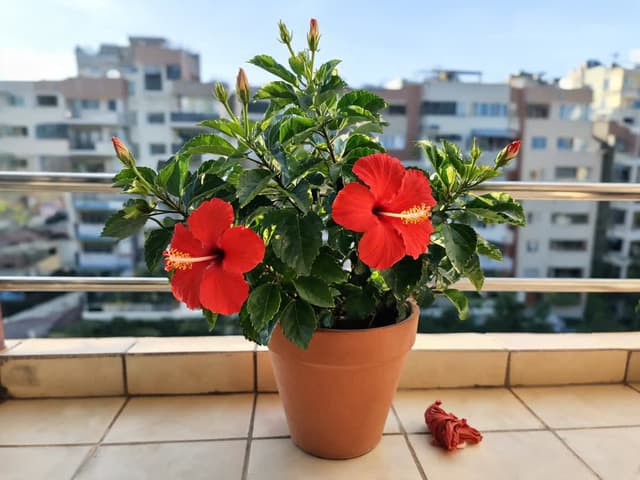
How to Care for Hibiscus: Sun, Watering, Fertilizer, and Pruning for Flowers
How to care for hibiscus: 6 hours of direct sun, evenly moist soil without waterlogging, half-strength fertilizer in spring and summer, and pruning in early spring. Find out why the flower lasts one day and why buds drop before opening.
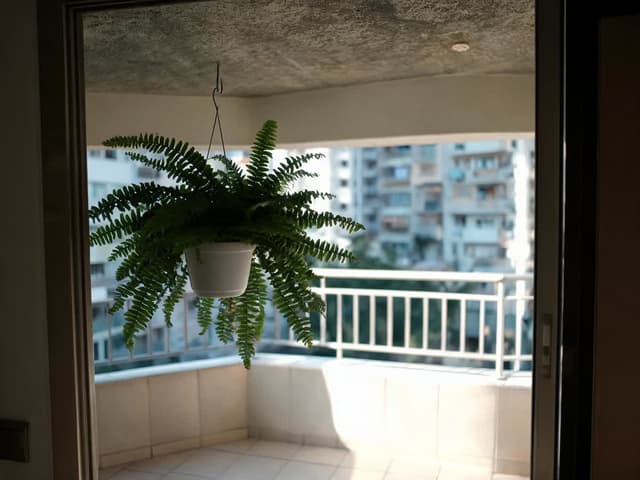
Do Ferns Like Sun or Shade? It Depends on the Type
Ferns prefer bright shade: plenty of light, but no direct sun on their fronds. Tuberous sword fern is the exception that handles sun. Here is the ideal light for each type, where to place pots, and how fronds show too much or too little light.
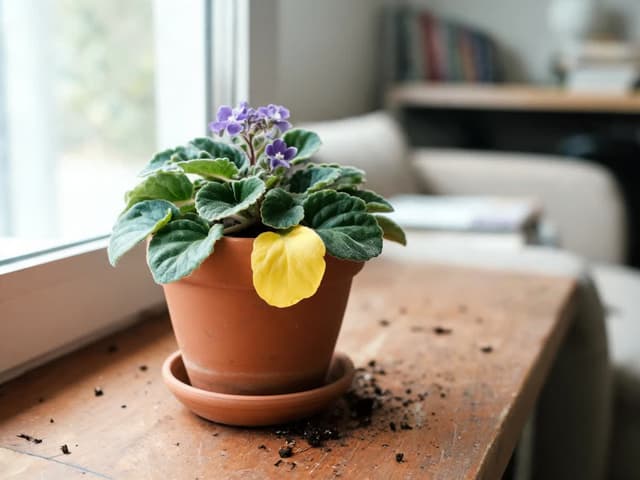
African Violet Yellow Leaves: Causes and What to Do
Yellow leaves on an African violet usually stem from overwatering, and the first place to check is the center of the plant. Losing one lower leaf at a time is normal. Identify whether age, watering, cold water, sunlight, cold drafts, or fertilizer is the culprit based on the yellowing pattern, and see what to do today.