Can azaleas tolerate cold? Frost, pots, and winter care
Potted azaleas (Rhododendron simsii) tolerate cold, but cannot handle hard frost; cold-climate garden azaleas tolerate -5 °C to below -20 °C. See how cold yours can get, how to protect it from frost, how to water in winter, and how to tell if it died.
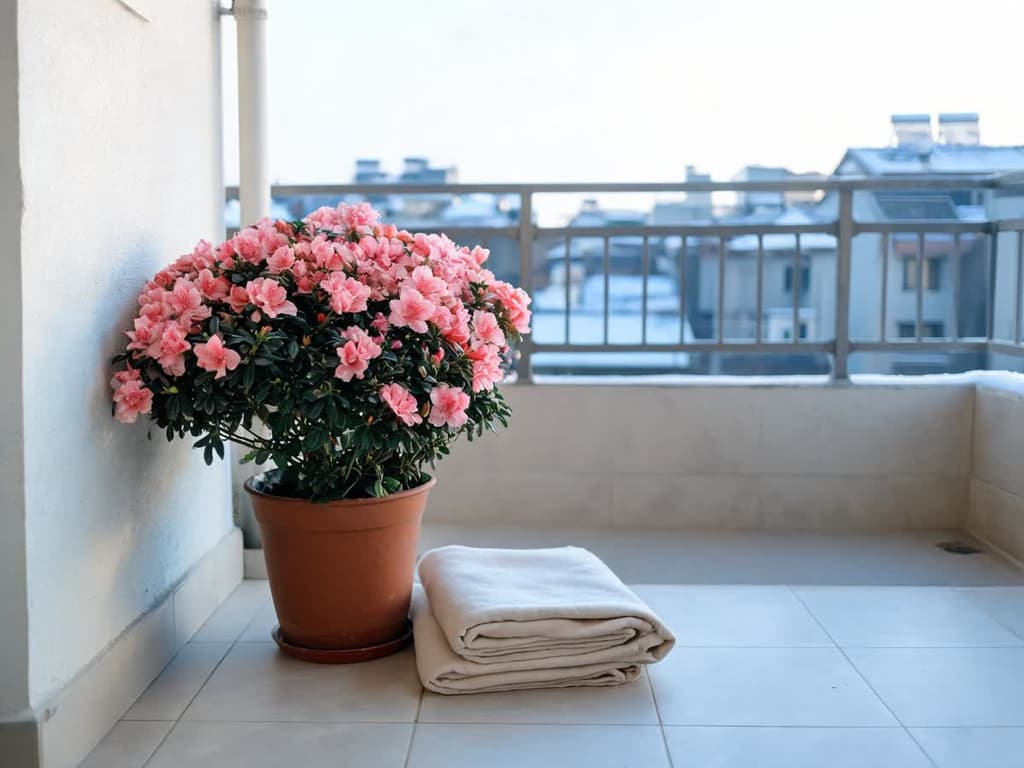
Azaleas can handle the cold, but the limit depends on which azalea you have. Potted azaleas sold in bloom (Rhododendron simsii) cannot withstand hard frost. The Royal Horticultural Society (RHS), the British horticultural society, classifies them as frost-tender. In contrast, garden azaleas bred for cold climates, when planted in the ground, tolerate from −5 °C to below −20 °C, depending on the variety. These are Japanese azaleas and deciduous azaleas, which lose all their leaves in autumn.
In Brazil, the azalea blooms in the cold, from autumn to winter. Frost-free cold is good for it. The first winter care step is to protect the plant on frost nights. In Brazil, they occur from June to August in the South and in the mountains of the Southeast. The second is to not let the root ball (the block of soil with the roots) dry out in the dry wind. For the rest of the year, the guide on how to care for azaleas covers light, soil, fertilizer, and pruning.
Azalea | How to recognize | Cold it tolerates in the ground (RHS) |
|---|---|---|
Potted gift azalea (R. simsii) | Bought in bloom, with single or double flowers | Frost-tender |
Evergreen Japanese (Kurume group) | Low and compact shrub, with leaves that stay through winter | From -5 °C to -15 °C, depending on the variety |
Mild-climate garden azalea (R. indicum and Southern Indica hybrids) | Shrub up to 1 m, with leaves that stay through winter | Up to -15 °C in the RHS rating; down to -7 °C from UF/IFAS |
Deciduous (Knap Hill and Exbury groups) | Loses all leaves in autumn | From -10 °C to below -20 °C, depending on the variety |
Which azalea is yours: potted or garden
The azalea bought in Brazil is usually the potted type, Rhododendron simsii. The Federal University of Paraná (UFPR) describes it as widely grown in the country, with flowers that appear in autumn or winter. It is the plant bought in bloom at flower shops and supermarkets. The RHS explains that it is forced into flower in a warm greenhouse before being sold.
The azalea is a type of rhododendron (genus Rhododendron), and cold-climate garden azaleas are other groups within this genus. Evergreen Japanese azaleas, like 'Hinode-giri', form a compact shrub up to 60 cm and keep their leaves in winter, according to the RHS. Deciduous azaleas, from the Knap Hill and Exbury groups, lose all their leaves in autumn and sprout again in spring.
If your azalea lost all its leaves in autumn, it may be a deciduous type, and leaf drop is normal. UFPR also notes that R. simsii can lose part of its leaves in winter. If you do not know which azalea you have, the Bloom app (available for iOS) identifies the plant from a photo of the leaf and flower.
What temperatures an azalea can tolerate
The potted azalea tolerates frost-free cold and suffers under hard or prolonged frost. The University of Missouri extension service, which guides gardeners, explains that the potted azalea was chosen for its bloom. Cold hardiness was not part of the selection. According to the same source, it tolerates a light frost. Consecutive days below freezing kill the developing flower buds.
The RHS gives a cold hardiness rating to each garden azalea. The rating ranges from H1 (needs a greenhouse) to H7 (tolerates below -20 °C) and measures the United Kingdom climate. In the RHS plant records, garden azaleas are rated as follows:
Evergreen Japanese: H4 to H5, meaning from -5 °C to -15 °C. 'Kure-no-yuki' is H4 and the RHS calls it not fully hardy; 'Hinode-giri' is H5.
Deciduous: H5 to H7. 'Honeysuckle' is H5 (-10 °C to -15 °C) and 'Basilisk', from the Exbury group, is H7 (below -20 °C).
Mild-climate garden azalea (*R. indicum*): H5 from the RHS.
For R. indicum and its Southern Indica hybrids, sources do not agree. The RHS gives H5, but the UF/IFAS, the University of Florida Extension, says the hybrids tolerate down to −7 °C without serious damage. Stick with UF/IFAS, which gives the more cautious limit: below −7 °C, protect the plant.
In a pot, roots tolerate less cold
The root is the part of the azalea that tolerates the least cold. Iowa State University Extension explains that container roots stay at the air temperature, while ground soil protects planted roots. Penn State Extension, from Pennsylvania State University, advises treating container plants as if they were two zones more sensitive to cold. A zone is a cold-hardiness band on the map from the United States Department of Agriculture (USDA). Each zone equals about 5.5 °C. By Penn State's rule, an azalea that tolerates −15 °C in a garden bed tolerates only about −4 °C in a container.
Azaleas in Brazilian winter: the cold that triggers blooming
In Brazil, winter is the flowering season for potted azaleas. UFPR notes, in a study of Curitiba's public squares, that the azalea (R. simsii) blooms profusely during the winter months. In the same survey, it was the most common plant found in 32 squares across the city: 438 plants, 19.2% of the total.
A potted azalea needs a cold period to set buds. American extension services give similar numbers, but not the same:
The University of Missouri mentions about two months near 4 °C.
Virginia Tech recommends a room between 4 °C and 10 °C, with filtered light.
The University of Georgia (UGA) mentions cold between 0 °C and 7 °C, without freezing.
None of these sources measured this in Brazil. The range of 4 °C to 7 °C fits all three, so use this range as a target. In autumn, keep the azalea in the coolest, brightest spot in the house, such as the porch. Bring the pot indoors only on nights with a risk of frost.
Dry heat causes the azalea to drop its buds. The Missouri Botanical Garden says that an azalea already in bloom, indoors, does well between 10 °C and 20 °C. In a room above 24 °C, the soil dries out quickly and buds and leaves fall, according to the same source. In winter, keep the azalea away from heaters, fireplaces, and closed windows that heat up with the sun.
Frosty nights: how to protect azaleas
Protect the azalea whenever the forecast calls for frost. In Brazil, frost occurs from June to August, mostly in the South and in the mountain ranges of the Southeast. UF/IFAS explains on its winter plant protection page that covering protects more against frost than against extreme cold.
Potted azaleas on frosty nights
Bring your potted azalea indoors on frosty nights. Virginia Tech states that greenhouse azaleas are not hardy and must be brought inside before freezing weather. Choose a bright, unheated room, such as an enclosed utility room.
If the pot is too large to bring inside, place it against a wall of the house, sheltered from the wind. Group it with other pots and cover the soil with pine bark or straw. UF/IFAS advises grouping and covering to reduce heat loss through the pot walls. On frosty nights, also cover the plant with a sheet or blanket, keeping plastic from touching the leaves. Water during the day if the soil is dry, because moist soil retains more heat overnight, according to the same source.
Garden bed azaleas on frosty nights
Cover the garden bed azalea with a sheet, old blanket, or frost protection cloth. UF/IFAS explains that the fabric must reach the ground to trap soil heat, without resting against the leaves. Do not let plastic touch the plant: the same source says leaves that contact plastic usually burn. Remove plastic on sunny days so the air underneath does not overheat.
Keep the soil around the azalea covered all winter with 5 to 8 cm of pine bark or pine straw. The RHS calls for at least 5 cm of bark or straw in late autumn to protect the plant from frost. The University of New Hampshire (UNH) Extension gives the same measurement and warns not to pile the bark or straw against the trunk. Penn State Extension recommends 7.5 to 10 cm. Stick with 5 to 8 cm, the range that fits within the RHS and UNH guidelines.
Where cold wind blows hard, set up a barrier on the windward side. The University of Maryland Extension recommends burlap fabric or plastic about 45 cm from the plant. Also avoid spots where the first morning sun hits the azalea directly after a frost. UF/IFAS explains that a frozen branch that thaws quickly can split its bark.
Watering azaleas in winter
Water your azalea in winter when the soil surface loses moisture to the touch, just like during the rest of the year. Push your finger into the soil up to the first knuckle: if it comes out dry, water until it drains from the pot's drainage hole. In the cold, soil takes longer to dry, and watering becomes more spaced out. Water according to how the soil feels, without counting days.
Azalea leaves lose water in winter, especially with sun and wind. Penn State Extension explains that this loss, combined with dry soil, dries out and kills leaf tissue. This is called winter burn (the leaf dehydrates in the cold), and it appears as a brown leaf margin. Because of this, do not let the root ball dry out on windy, dry days.
Moist soil also protects roots from the cold. Rutgers University points to water in the potting soil as the main factor reducing the effect of cold air on roots. But do not waterlog it: UF/IFAS points out that soil soaked for too long damages roots.
Brown, curled, or falling leaves after cold weather: did the azalea die?
Curled leaves in the cold do not mean the azalea died. UNH explains that leaf curling is a defense against water loss in the cold. Leaves usually open again when it warms up. The RHS records the same for rhododendrons, the genus to which the azalea belongs. Leaves droop in severe cold and recover in mild weather.
Dry, brown tips do not recover, according to Penn State, but the rest of the branch may be alive. UNH warns that winter damage often only shows up in spring. Therefore, do not prune heavily right after frost: wait for spring bud break and remove only the dry leaves.
The scratch test
The scratch test tells you if a branch is alive. Lightly scrape the bark of a thin branch using your fingernail or a pocket knife. If a green layer appears underneath, the branch is alive and should recover, according to UNH. If you see only dry brown tissue, that part of the branch has died.
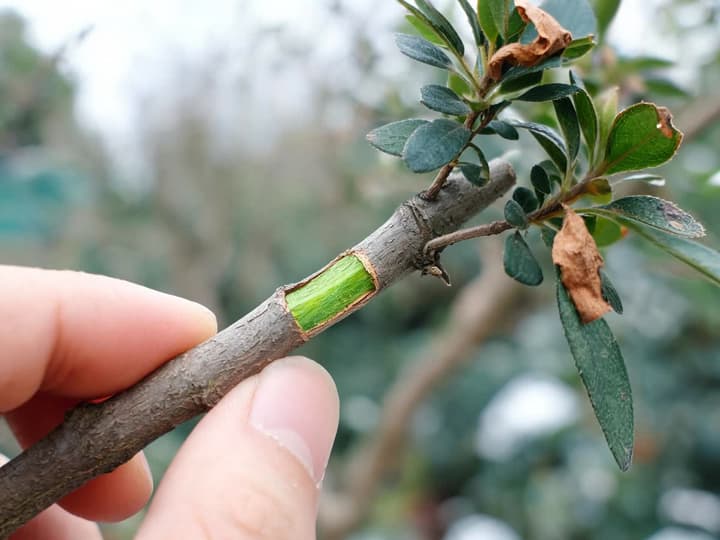
Scrape at different points, moving from the tip toward the branch base. The point where green appears again shows how far back the branch died. Wait for the azalea to sprout in spring before cutting. UF/IFAS advises saving major pruning for after new growth starts, to avoid cutting live wood. After bud break, cut the dead branch just above the point where the green layer appears.
Wilted leaves with moist soil
Wilted leaves with moist soil in a pot point to roots, not cold weather. Root rot caused by Phytophthora, a soil microorganism that attacks waterlogged roots, makes azaleas wilt and drop leaves. Remove the plant from the pot and gently tug on a fine root. On rotten roots, the outer root sheath slips off, leaving only a thin thread at the center, according to UF/IFAS. Neem oil (a natural insecticide) does not solve this, because neem acts against insects on foliage while the problem sits in the roots.
Yellow leaves have their own causes, such as iron deficiency, which the guide on yellow leaves on azaleas sorts out one by one. Brown or yellowish leaf spots can be fungal, and the page on azalea leaf spots outlines the most common causes.
Fertilizing and pruning: what to avoid before cold weather
In Brazil, stop fertilizing azaleas at the end of December and do not fertilize again in autumn or winter. UNH warns that late fertilizer delays dormancy. UF/IFAS adds that it causes new leaves to sprout, which suffer more from the cold.
Do not prune azaleas in autumn and winter while they have flower buds or blooms. The University of Georgia (UGA) explains that azaleas set flower buds before the cold weather. Pruning with buds on the plant removes the year's flowers. Prune as soon as the last flowers fade and finish by the end of December, in Brazil.
Frequently asked questions
Can I plant a gift potted azalea in the garden?
Yes, where there is no heavy frost. The RHS says potted azaleas are not suitable for planting in the garden in areas subject to frost. The University of Arkansas notes that they usually overwinter well once the roots are established, in a protected spot. Follow the caution of the RHS: plant only where there is no heavy frost and choose a sheltered corner, the condition from Arkansas. Plant after flowering so the roots establish before the cold.
Do azaleas lose their leaves in winter?
It depends on the azalea. Deciduous types from the Knap Hill and Exbury groups lose all their leaves in autumn and sprout in spring. Potted azaleas (R. simsii) can lose part of their leaves in winter, according to UFPR. If the plant dropped all its leaves and you are unsure which type you have, do the scratch test before concluding that it died.
Can azaleas take sun during winter?
They can take morning sun, just like throughout the rest of the year. Caution is needed on the morning after a hard frost. UF/IFAS explains that direct sun on that morning thaws branches too quickly and can split the bark. For potted plants, keep azaleas away from early direct sun on that morning.
Are azaleas toxic to cats and dogs?
Yes. The ASPCA, an animal poison control center in the United States, lists azalea as toxic to dogs, cats, and horses. The toxic substance is grayanotoxin. Signs are vomiting, diarrhea, weakness, and heart failure. If the animal ate a leaf or flower, take it to the vet right away.
If you are not sure which azalea you have, a photo of the leaves and flowers will clear up the question.
Related articles
How to Care for Hibiscus: Sun, Watering, Fertilizer, and Pruning for Flowers
How to care for hibiscus: 6 hours of direct sun, evenly moist soil without waterlogging, half-strength fertilizer in spring and summer, and pruning in early spring. Find out why the flower lasts one day and why buds drop before opening.
Do Ferns Like Sun or Shade? It Depends on the Type
Ferns prefer bright shade: plenty of light, but no direct sun on their fronds. Tuberous sword fern is the exception that handles sun. Here is the ideal light for each type, where to place pots, and how fronds show too much or too little light.
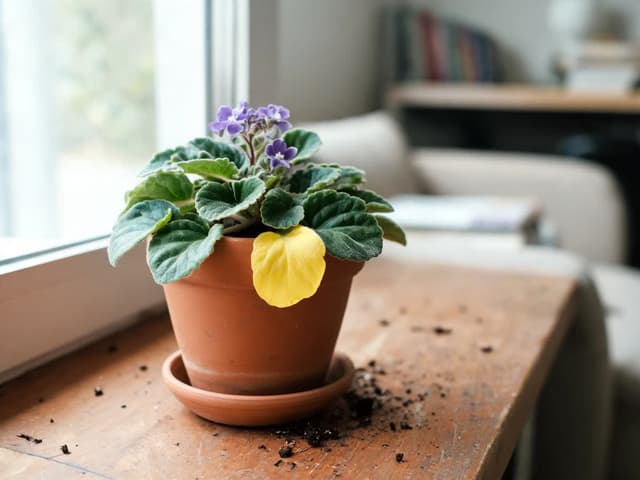
African Violet Yellow Leaves: Causes and What to Do
Yellow leaves on an African violet usually stem from overwatering, and the first place to check is the center of the plant. Losing one lower leaf at a time is normal. Identify whether age, watering, cold water, sunlight, cold drafts, or fertilizer is the culprit based on the yellowing pattern, and see what to do today.