How to Water an Azalea: When, How Much, and Which Water to Use
To water an azalea, keep the root ball consistently moist without waterlogging it, and water when the soil surface feels dry to the touch. Learn why water runs right through dry soil, how to bottom-soak the pot in a bucket, and which water to use.
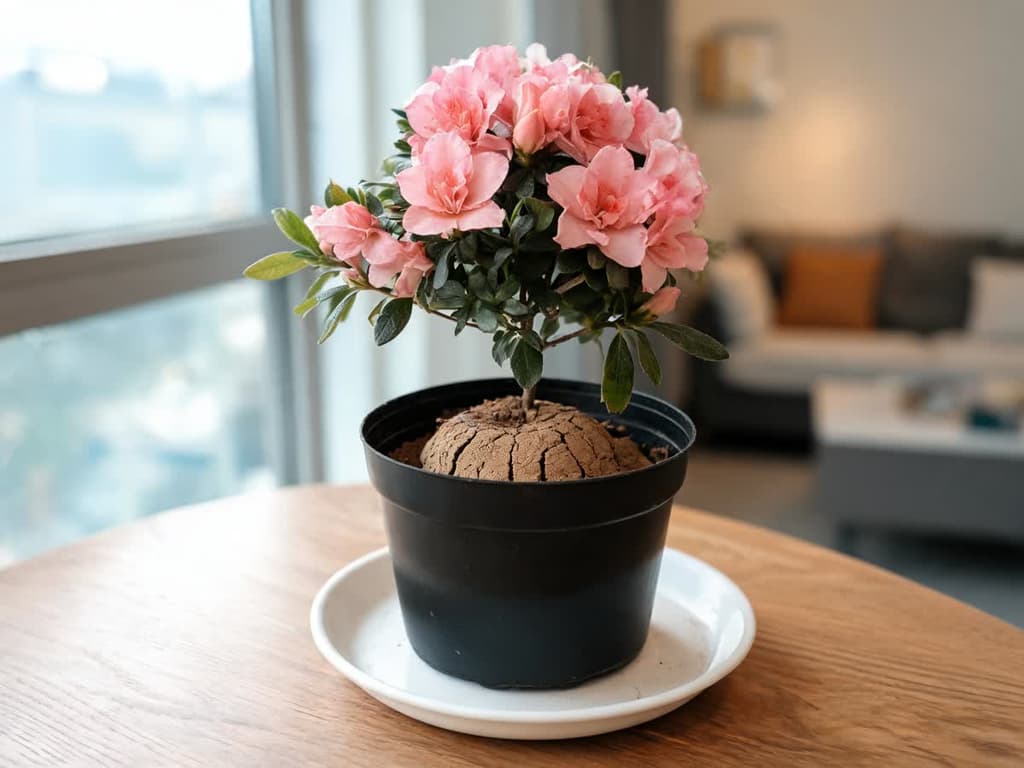
To water an azalea, keep the root ball (the mass of soil and roots) consistently moist without getting it soggy. Water when the surface of the soil feels dry to the touch, until water drains through the drainage hole, and empty the saucer. If the soil dried out completely, water will run straight through without wetting it: submerge the pot in a bucket until air bubbles stop rising.
The potted azalea (Rhododendron simsii) is the one given as a blooming gift. It grows in a peat soil (a fibrous material of decomposed moss) that dries out quickly. The American Rhododendron Society, an association of azalea and rhododendron growers, points to improper watering as a common cause of death for this plant. The two mistakes that kill it are soil that dries out completely and soil that stays waterlogged.
Watering an azalea | What to do |
|---|---|
When to water | When the soil surface feels dry to the touch; no fixed schedule |
How much | Until water drains through the drainage hole |
Soil dried out completely | Submerge the pot in a bucket until air bubbles stop rising |
Water | Rainwater; avoid hard tap water |
Saucer | Empty after every watering |
During blooming | More water: check the soil more frequently |
In cold weather | Less water, without letting the soil dry out completely |
How often to water an azalea
Water your azalea when the surface of the soil feels dry to the touch, not on a set day of the week. The American Rhododendron Society advises letting only the top 1.3 cm (half an inch) dry out between waterings. Below that surface layer, the soil must stay moist.
The interval between waterings depends on three things. The first is the pot, which holds little water when it is small. Horticulturist Larry Hodgson, from the Canadian website Jardinier paresseux, notes that azaleas are usually sold in small pots packed with roots. The second is temperature: the RHS, the Royal Horticultural Society in the United Kingdom, says the plant requires less water in cold weather. The third is flowering: according to the same source, the need for water rises again when the buds swell and the flowers open.
Because of this, no set schedule works year-round. The reliable way to know when to water is to check the soil with your finger. Check every day while the azalea is blooming.
A French plant shop recommends letting the soil dry out between waterings. The RHS and the American Rhododendron Society say the opposite: potted azalea soil should never dry out completely. Follow the RHS and the American Rhododendron Society, which are horticultural institutions; the shop cites no source.
How to tell if your azalea is thirsty
Stick your fingertip into the soil, down about 1.3 cm. If it comes out dry, the azalea needs water. If it comes out moist and cool, wait another day.
The pot's weight is the second test. Lift the pot right after a thorough watering and note how heavy it feels. Before the next watering, lift it again: if it feels significantly lighter, the soil has dried out inside, even if the surface still looks dark.
Wilting leaves can be misleading because they occur at both extremes. Wilting leaves with dry soil mean thirst: water or submerge the pot in a bucket. Wilting leaves with wet soil signal damaged roots: do not water again and see the section on overwatering versus underwatering in azaleas.
Azalea dropping leaves: can it still be saved?
You can save it if the roots are still light-colored and firm. The RHS attributes leaf drop in potted azaleas to three conditions: dried-out soil, soil waterlogged for too long, and prolonged dry heat. Identify which one applies to you before changing your watering routine.
When the soil has dried out, the oldest leaves fall first, and the soil feels light and sometimes pulls away from the pot walls. In this case, submerge the pot in a bucket, as shown in the bucket section. When the soil stays wet hours after watering, it is waterlogged: stop watering until the surface dries and inspect the roots.
Dry heat is the third situation. The RHS notes that the plant weakens when kept in dry heat for extended periods. Move the pot to a bright, cool spot away from heaters.
If you brought your azalea indoors during cold weather and the top of the soil is dry, push your finger into the soil. If it is dry below the surface too, water it. The risk of root rot comes from soil that stays wet, not from watering dry soil.
A small amount of leaf drop is also normal. The RHS notes that azaleas drop some of their older leaves every year in spring and summer. In Brazil, this period runs from September to March. If all the roots are dark and mushy, the plant is unlikely to recover: UF/IFAS notes that root rot leads to branch dieback and, ultimately, the death of the entire plant.
Why water drains straight through while the azalea's soil stays dry
When peat dries out completely, it begins to repel water. The Texas A&M AgriLife Extension, the university's agricultural extension service, explains what happens. Dry soil shrinks and pulls away from the wall of the pot. Water from watering runs down this gap and drains through the hole without reaching the roots.
Seeing water pour out of the drainage hole in this case is deceiving. The pot appears watered, but the root ball remains dry inside. That is why an azalea watered every week can still die of thirst.
A visible dark gap between the soil and the pot wall is the telltale sign. Another sign is water disappearing through the drainage hole within seconds of pouring it onto the soil. In both cases, submerge the pot in a bucket, because top-watering will not moisten the root ball.
How to submerge an azalea pot in a bucket
The RHS provides the method for a dried-out potted azalea: place the pot in a bucket of water until air bubbles stop rising from the soil. The bubbles are air trapped within the dry peat. When they stop, water has replaced the air and the root ball is thoroughly moistened.
Fill a bucket or basin with room-temperature or lukewarm water.
Place the pot inside, with the water level reaching the rim of the pot.
Wait until bubbles stop rising from the soil. The American Rhododendron Society recommends around 15 minutes in lukewarm water.
Remove the pot and let the excess water drain through the hole over a sink or tub.
Return the pot to its saucer only once it stops dripping.
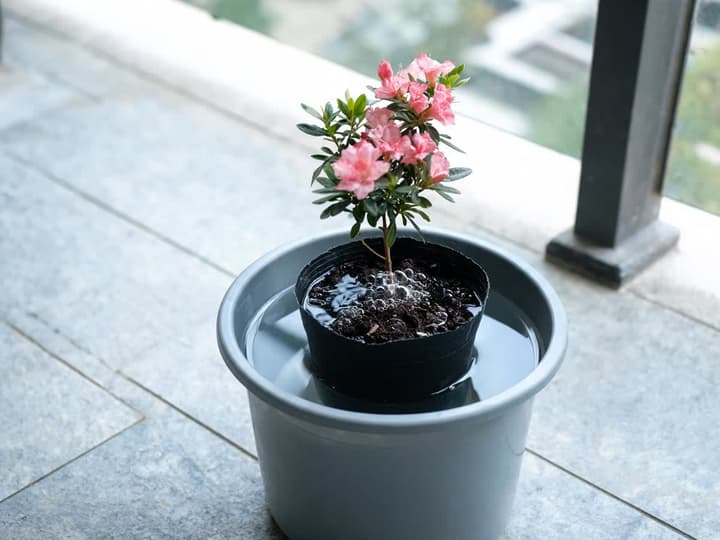
Do not leave the pot in the bucket and forget it. The RHS warns that soaking for too long drowns the roots. Jardinier paresseux mentions 10 to 30 minutes, but provides no source. Use the bubbles as your signal and the American Rhododendron Society's 15 minutes as a benchmark.
There is also a slower method. Texas A&M AgriLife suggests placing the pot in a shallow dish of water so the soil can absorb it through the bottom drainage hole. This can take 1 to 2 hours. Remove the pot from the dish as soon as the topsoil feels moist.
How to water an azalea day to day
Once the root ball absorbs water properly again, water from the top. Pour water slowly over the soil around the stem until it flows out through the drainage hole. If water drains through the hole in just a few seconds without the soil darkening, the root ball has dried out again and needs the bucket method.
Empty the saucer as soon as water stops draining through the hole. Azalea root rot is caused by soil-borne fungus-like organisms, such as Phytophthora. UF/IFAS, the University of Florida Extension, records that this disease occurs with periods of excess soil moisture and poor drainage.
Remove any decorative foil or plastic wrapping around a gift pot. The American Rhododendron Society recommends doing this as soon as the plant arrives home, because decorative wrap prevents proper drainage. Water that drains out gets trapped inside the wrap at the bottom of the pot. The same applies to cachepots (decorative outer pots with no drainage holes): pour out any standing water that collects at the bottom after each watering.
Which water to use for your azalea
The best water for an azalea is rainwater. The RHS recommends it for watering potted azaleas and advises avoiding tap water in hard-water areas. Hard water is water rich in dissolved lime (the mineral that forms white scale inside kettles).
The RHS explains why hard water causes harm. Hard water contains sodium bicarbonate, which is alkaline (the opposite of acidic) and toxic to the plant. It also delivers excess calcium and lowers the acidity of the soil around the roots. Azaleas require acidic soil. The pH scale measures soil acidity: the higher the number, the less acidic it is. UF/IFAS reports that when pH rises above 6.5, iron becomes less available to the roots.
Iron deficiency shows up first on new leaves. They turn yellow while the veins stay green, as UF/IFAS describes. This is one of two types of yellow leaves on an azalea: the other comes from soil that stays soggy for too long after watering.
To tell if your water is hard, check your kettle or showerhead. White buildup that keeps returning indicates hard water. If rainwater is unavailable, the American Rhododendron Society suggests bottled water, since municipal tap water is often too alkaline.
The RHS has two pages that offer differing advice on tap water. The potted azalea page says to avoid tap water in hard-water areas. The rhododendron guide, the broader group that azaleas belong to, allows tap water for a month or two in summer during dry spells. Stick with the safest route: use rainwater. During a dry spell, use tap water only if your water leaves no white scale in your kettle, and keep it to a month or two.
Watering azaleas during bloom and through the rest of the year
The RHS classifies potted azalea blooming as winter-flowering, which in Brazil runs from June to August. In this phase, the azalea demands more water: according to the RHS, the need rises as the buds swell and the flowers open. Check the soil every day while there are buds and flowers.
Dry air hinders blooming. The RHS notes that flower buds struggle to open in hot, dry air and recommends misting them. Stop misting once the buds show color. Misting humidifies the air and wets the foliage, but it does not hydrate the root ball: it does not replace watering. Keep the pot away from heaters, ovens, and air conditioning vents.
Hot, dry air also favors the twospotted spider mite, a tiny pest that sucks on the leaf and leaves it stippled or bronzed, according to the UF/IFAS. If the leaves show this stippling, see the azalea pests and how to treat each one.
Late summer is the second phase that calls for attention. The RHS explains that rhododendron buds begin to form in late summer, which in Brazil is February and March. A brief drought during this phase prevents buds from forming or causes them to drop unopened. The RHS instructs to water thoroughly and regularly during dry periods starting in July, which in Brazil is January. Therefore, do not let the soil dry out from January to March.
In cold weather outside the blooming window, azaleas require less water, though the soil must never dry out completely. Space your waterings further apart and check the soil with your finger before adding water. If the plant is blooming during cold weather, apply the blooming rule: check the soil daily.
Overwatering vs. underwatering in azaleas: how to tell them apart
Underwatering causes the oldest leaves to drop first. The RHS reports that after a dry spell, the oldest leaves are the first to fall. Upper foliage may turn brown at the tips or along the edges. The soil feels dry, light, and sometimes pulls away from the container walls.
Overwatering turns leaves yellow and can cause leaf drop as well. The RHS links yellow foliage to soil that remains waterlogged long after watering. The same source notes leaf drop following prolonged periods of waterlogging. Damaged roots cannot supply the water that leaves transpire.
Sign | Underwatering | Overwatering |
|---|---|---|
Soil | Dry, lightweight, pulled away from pot walls | Wet hours or days after watering |
Leaves | Wilted; oldest leaves drop first | Yellow or wilted; drop after prolonged soil saturation |
Roots | Light-colored and firm | Dark and mushy from rot |
What to do | Submerge the pot in a bucket | Stop watering until the surface dries; inspect the roots |
When in doubt, checking the roots settles the issue. Gently lift the plant from its pot and inspect the root ball: light-colored, firm roots are healthy. Dark, soft roots indicate rot, and UF/IFAS advises correcting the excessive moisture. NC State Extension is the extension service of North Carolina State University. It lists leaf loss, branch dieback, and plant wilting among the symptoms of this disease.
If the symptoms match neither underwatering nor overwatering, the Bloom app (available for iOS) can help. It identifies plants from photos and, with the Premium plan, diagnoses diseases directly from a photo of the foliage.
How to water azaleas planted in the garden
Garden azaleas have shallow roots, close to the surface. Clemson Extension, from Clemson University, advises watering during dry periods. When the top few centimeters of soil are dry, water deeply, to a depth of 15 to 20 cm.
The same source considers it essential to apply a 5 to 7.5 cm layer of organic mulch, such as composted pine bark or leaves, over the soil. Mulch preserves moisture around shallow roots. NC State notes that azaleas do not tolerate heavy, wet soil: in the garden, watering deeply does not mean keeping the soil waterlogged.
Watering only works with the right soil. UF/IFAS recommends acidic soil, with a pH between 5.0 and 5.5, that drains well. Light, fertilizer, and pruning are covered in the guide on how to care for azaleas.
Frequently asked questions
Can I bottom-water my azalea by leaving water in the saucer?
You can water from below, provided you remove the pot from the water afterward. Texas A&M AgriLife outlines bottom-watering in a shallow tray for 1 to 2 hours. Take the pot out of the tray as soon as the topsoil becomes damp. What you must avoid is letting standing water sit indefinitely in the saucer: UF/IFAS connects root rot directly to excessive moisture.
Does misting the leaves replace watering an azalea?
No. Misting moistens the leaves and surrounding air, but moisture does not reach the root ball. The RHS suggests misting flower buds in hot, dry air to help them open, stopping once they show color. Watering requirements remain unchanged: apply water to the soil when the surface feels dry to the touch.
Are azaleas toxic to cats and dogs?
Yes. The ASPCA, an animal poison control center in the United States, lists azalea as toxic to dogs, cats, and horses. The toxic substance is grayanotoxin. If your pet ate azalea leaves or flowers, call the veterinarian immediately.
Summary: how to water an azalea
Water your azalea when the soil surface feels dry to the touch, until water drains through the hole, and empty the saucer. If the soil dried out completely and water channels through without wetting it, submerge the pot in a bucket until bubbling ceases. Use rainwater, increase watering during the winter bloom period, and keep the soil moist from January to March while flower buds develop.
Related articles

How to Care for Hibiscus: Sun, Watering, Fertilizer, and Pruning for Flowers
How to care for hibiscus: 6 hours of direct sun, evenly moist soil without waterlogging, half-strength fertilizer in spring and summer, and pruning in early spring. Find out why the flower lasts one day and why buds drop before opening.

Do Ferns Like Sun or Shade? It Depends on the Type
Ferns prefer bright shade: plenty of light, but no direct sun on their fronds. Tuberous sword fern is the exception that handles sun. Here is the ideal light for each type, where to place pots, and how fronds show too much or too little light.

African Violet Yellow Leaves: Causes and What to Do
Yellow leaves on an African violet usually stem from overwatering, and the first place to check is the center of the plant. Losing one lower leaf at a time is normal. Identify whether age, watering, cold water, sunlight, cold drafts, or fertilizer is the culprit based on the yellowing pattern, and see what to do today.