Basil in Winter: How Much Cold It Can Take and What to Do
Common basil is not a winter plant: leaves can turn black at 50 °F (10 °C), long before frost. See when to bring the pot indoors and how to water in winter. Also learn to distinguish cold damage from disease and how to propagate new plants from cuttings or seeds.
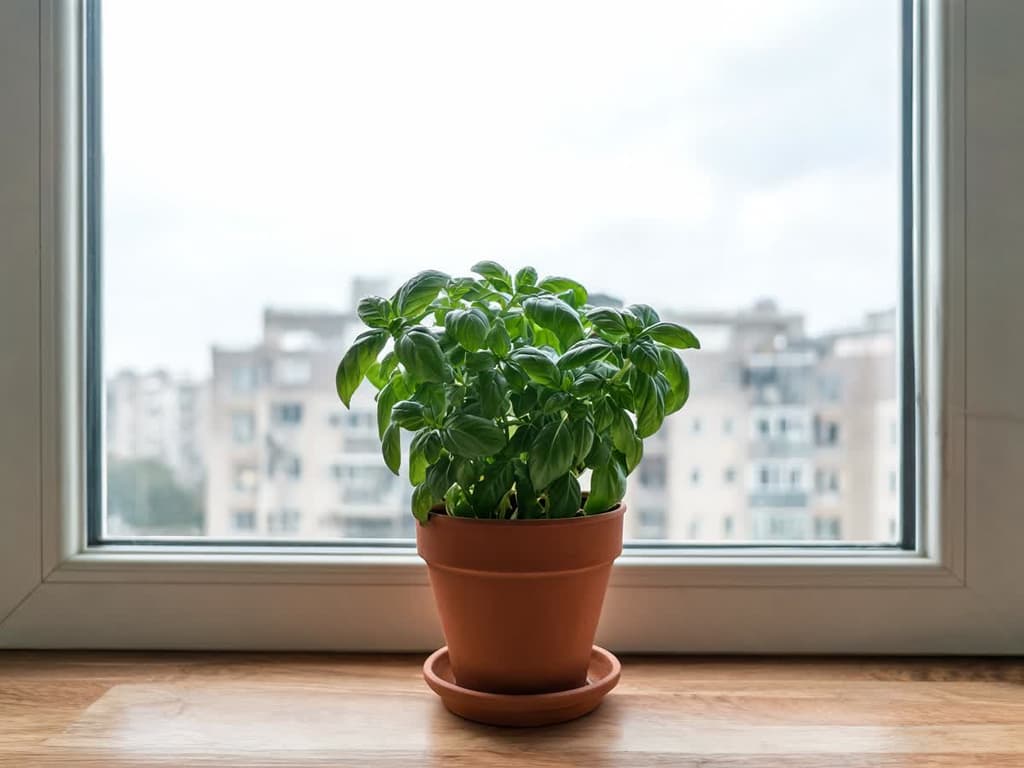
Basil in winter suffers even before the first frost hits. The University of Illinois Extension is the university service that guides farmers and gardeners. It reports that common basil (Ocimum basilicum) can suffer damage and blackened leaves at 50 °F (10 °C). On the day the forecast predicts a night at 50 °F (10 °C), bring the pot indoors to your brightest window, and water only when the surface of the soil dries out.
The other option is to accept the plant's cycle. Common basil grows as an annual, completing its life cycle in a single growing season: it flowers, sets seed, and dies. A cutting (a stem piece that grows roots) rooted in water, or a pot seeded on a windowsill, provides a fresh plant to harvest throughout the winter. Keeping an older plant on the windowsill also works as long as it has not started flowering.
In Brazil, winter runs from June to August, but the month matters less than the thermometer. Those who live where the low never reaches 50 °F (10 °C) can leave the basil outside. Those who live in the South or in a mountain region of the Southeast need to act before the first night with a low of 50 °F (10 °C).
How much cold basil can take
Basil handles cold weather very poorly: at 50 °F (10 °C) it can already suffer damage, even without frost. Rosemary, another potted herb, tolerates around 18 °F (−8 °C) when planted in the ground, according to the Royal Horticultural Society (RHS).
Temperature | What happens to basil | Source |
|---|---|---|
77 °F (25 °C) | Leaves have 70% more aromatic oil than at 59 °F (15 °C) | Chang et al., 2007 (measured) |
59–68 °F (15–20 °C) | Range recommended by gardening guides for indoor pots in winter; no consulted source measured this range | Mein schöner Garten magazine |
Below 51.6 °F (10.9 °C) | Stops growing (base temperature for the species) | Chang et al., 2005, cited by Yokota and Souza, 2022 |
50 °F (10 °C) | Leaves can turn black and the plant can suffer damage | University of Illinois Extension |
40 °F (4 °C) | Leaves of many varieties turn black and drop | University of Florida (UF/IFAS), 40 °F |
Frost | Sensitive to frost; protect the plant on cold nights | University of Florida (UF/IFAS) |
The base temperature is the threshold below which a plant stops growing. For basil, it is 51.6 °F (10.9 °C). UF/IFAS sets leaf blackening at 40 °F (4 °C), while the Illinois Extension places it at 50 °F (10 °C). We follow 50 °F (10 °C), the safer threshold for the plant.
The basil guide gathers light, watering, and the species' most common problems:
Black leaves after a cold night: cold or disease
When leaves turn dark right after a night below 50 °F (10 °C), cold is the most likely cause. Cold turns foliage black, according to the Illinois Extension. Downy mildew, the disease most easily confused with it, starts with yellowing, according to UF/IFAS.
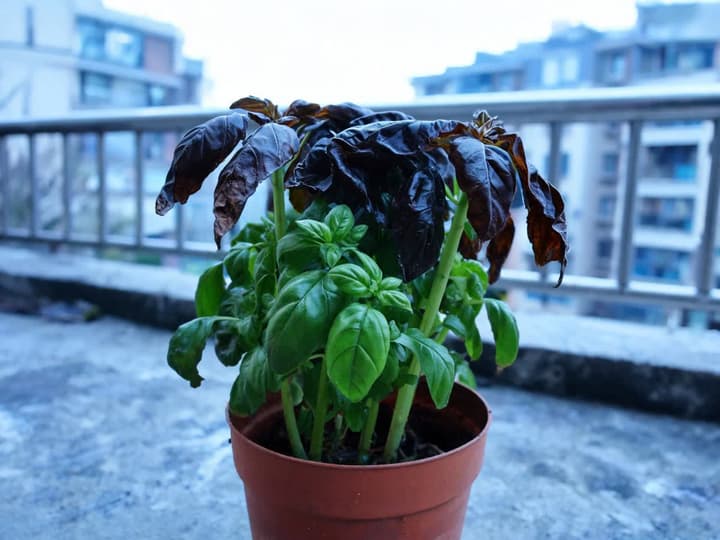
Two other causes can also turn leaves black or yellow and might be confused with cold damage:
Downy mildew (a disease caused by a fungus-like organism): leaves turn yellow first, and the yellowing resembles nutrient deficiency. UF/IFAS explains that spores on the underside of the leaf confirm downy mildew. They are easiest to see early in the morning.
Isolated spots scattered across otherwise green leaves, with the rest of the plant looking normal, point to different issues. The causes of spots on basil leaves include bacteria and fungi, and each requires a specific treatment.
To test for downy mildew without waiting for the morning, UF/IFAS suggests this test. Place a leaf upside down on a wet paper towel inside a sealed plastic bag. Keep the bag in the dark for one day and check for spores on the underside of the leaf.
If cold caused the damage, trim off the black leaves right above a pair of healthy leaves. Keep the plant indoors on your brightest windowsill at 59–68 °F (15–20 °C). No consulted source measures recovery rates after cold injury; the safest path is removing what turned black and keeping the rest warm. Check the stem: if it feels firm and green, buds (the spots where leaves emerge from the stem) can sprout new growth. If it feels soft and dark near the soil line, the issue could be basil rot.
When a leaf photo leaves you unsure whether it is cold damage or disease, Bloom (available for iOS) checks the image against known diseases for the species. Photo-based diagnosis is included in the Premium plan.
Basil in winter in Brazil: what changes in each region
The cold that damages basil reaches many parts of Brazil without frost. According to the National Institute of Meteorology (INMET), frost occurs in the South, the Southeast, and Mato Grosso do Sul (INMET, winter forecast). Where frost occurs, bring outdoor basil indoors before the first one hits, because the plant is frost-sensitive (UF/IFAS).
A single frost-free night at 50 °F (10 °C) can already blacken leaves, even if the plant looks healthy during the day. Check the forecast low for your city every day and ignore the calendar.
Even without cold damage, winter reduces the harvest. An experiment by the State University of Londrina (UEL), in Paraná, compared 17 basil varieties across two growing seasons (Yokota and Souza, 2022). In fall/winter, leaf dry weight per plant, weighed after drying in an oven, ranged from 2.97 g to 6.90 g depending on the variety. In spring/summer, it ranged from 7.34 g to 14.67 g. Across the average of the 17 varieties, it was 4.47 g versus 9.77 g. In spring/summer, the harvest came 10 days earlier.
Where winter lows consistently stay above 50 °F (10 °C), basil can spend the winter outside. What changes in these areas is growth speed: with lower light and cooler temperatures, the plant grows slowly and yields fewer leaves to pick.
Basil growing in garden beds has two options before the first 50 °F (10 °C) night. Harvest the whole plant, or pot it up and bring it indoors.
Is basil annual or perennial
Common basil grows as an annual. The Illinois Extension classifies it as a tender annual, and the University of Maryland lists it as an annual herb. The RHS, the British horticultural society, explains that many basils are perennial. They are grown as annuals because they require extensive heat and sunlight.
Perennial, here, means that the plant lives more than one year. It does not mean that it tolerates cold. An example of a perennial basil is 'African Blue'. North Carolina State University Extension (NC State) describes it as a hybrid: a cross between Ocimum kilimandscharicum and the purple basil 'Dark Opal' (NC State, African Blue). It is sterile, meaning it does not produce seeds.
According to NC State, 'African Blue' is only perennial in United States Department of Agriculture (USDA) hardiness zone 10 and above. A plant hardiness zone is a minimum winter temperature range defined by the USDA. In zone 10, the annual minimum is around 30 °F (−1 °C) or higher. In colder climates, NC State advises growing it as an annual and notes that it grows well indoors.
Basil sold in supermarket pots is a special case. The RHS explains that these pots contain many crowded, thin seedlings grown for a quick single harvest. They fall prey to fungal issues easily and bloom early. According to the RHS, these seedlings can survive if you divide the root ball (the soil bound by roots) and repot each cluster into its own container right after purchase.
Rosemary planted in the ground tolerates around 18 °F (−8 °C), according to the RHS. That is why rosemary winter care focuses on shielding roots from frost and waterlogged ground, rather than moving the plant inside.
How to bring basil indoors
Bring basil inside before predicted nighttime temperatures drop to 50 °F (10 °C). Waiting for the first frost is too late, because leaves turn black on chilly nights without any freezing. Follow these steps:
Check for pests before moving inside. Inspect the undersides of leaves and the points where leaves join the stem. Aphids and whiteflies are among basil's common pests and will hitch a ride into your home. If you spot bugs, treat the plant before bringing it indoors: our guide on basil pests includes photos and control measures.
Use a container with drainage holes. The RHS recommends a pot at least 8 inches (20 cm) wide and deep. Iowa State warns that oversized pots hold moisture too long, while terra cotta pots dry out faster. To lift basil from a garden bed, dig around it with a spade and lift the plant with its entire root ball intact.
Trim back the longest stems. Cut right above a pair of leaves, leaving 4 to 6 inches (10 to 15 cm) of stem, and use the harvested leaves in the kitchen.
Choose the brightest window in the house. In Brazil, that is the north-facing window, which receives direct sunlight in winter. East- or west-facing windows work if they are very bright.
Provide plenty of direct light. Iowa State University Extension (Iowa State) recommends about 8 hours of direct light daily for indoor herbs. Some tolerate 6 hours. Without adequate natural sun, run a grow light for 12 to 16 hours a day, placed 6 to 12 inches (15–30 cm) from the foliage.
Keep the pot clear of cold glass, drafts, and heat vents. Keep foliage from touching window panes. Glass chills alongside the outdoor air, and no consulted source has measured cold damage from direct contact with it.
Watering and fertilizing basil in winter
In winter, water basil when the soil surface feels dry to the touch. Water until moisture runs out through the drainage hole at the bottom. Iowa State recommends letting the soil dry between waterings, as most herbs do not tolerate soggy conditions.
Other extensions give slightly different guidance for basil. The Illinois Extension states that it prefers to be kept well-watered, while UF/IFAS, NC State, and the University of Maryland call for moist, well-drained soil. Both recommendations align on this: soil can remain moist, but never waterlogged. We follow Iowa State for indoor pots, since winter plant growth slows (Yokota and Souza, 2022) and potting mix takes longer to dry.
Water in the morning. The RHS explains that basil does not tolerate wet roots overnight. After watering, empty the saucer beneath the pot.
If basil wilts despite wet soil, root rot may be setting in (the RHS warns that the plant does not tolerate wet roots overnight):
Do not fertilize basil during winter. Iowa State recommends fertilizing herbs from early spring to late summer, halting plant food through the winter months.
Low light and cold: why winter basil has less flavor
Plants grown at lower temperatures have less aroma, and cold is a measured cause. An experiment published in the Journal of the Science of Food and Agriculture compared two temperatures. Plants grown at 25 °C had 70% more aromatic oil in their leaves than those grown at 15 °C (Chang and colleagues, 2007).
Iowa State notes that many indoor herbs have weaker flavor, though basil retains true basil flavor indoors or out. We adhere to the measured study. Indoors, temperatures of 59–68 °F (15–20 °C) keep the potted plant alive, but leaves develop more aroma the closer you get to 77 °F (25 °C).
Low light reduces photosynthesis and overall biomass accumulation, according to Yokota and Souza (2022). To encourage branching, harvest frequently. Iowa State advises cutting just above a leaf pair and leaving 4 to 6 inches (10 to 15 cm) of stem.
Pinch off flower stalks (the flowering stems that form at branch tips) as soon as they appear. The RHS notes that flowering alters leaf flavor and that removing buds keeps foliage tasting fresh longer.
Renewing basil in winter: water cuttings or seed
After multiple harvests, Iowa State recommends discarding annual herbs and starting fresh plants from seed. Cuttings offer another great way to rejuvenate basil during winter.
To take cuttings, snip a non-flowering stem tip just below a leaf node. Strip the bottom leaves and set the cutting in a glass of water. The RHS explains that basil cuttings root quickly in water and can move to a potting mix container within a few weeks.
To sow seeds, fill a small container with seed-starting mix and set it in full sun. Keep the medium moist until seeds germinate, which takes about 5 to 7 days (Illinois Extension). The same extension notes that seeds germinate best with soil temperatures of at least 70 °F (21 °C). On a chilly windowsill, germination slows down. Harvesting starts 4 to 5 weeks after sowing, and starting a fresh pot every 2 weeks ensures tender leaves all winter.
When basil can go back outside
Move basil back outdoors once nighttime temperatures reliably stay above 55 °F (13 °C). That is the benchmark from UF/IFAS, which advises planting basil out after the last frost once nights exceed 55 °F (13 °C). For direct outdoor sowing, the RHS waits for nights consistently above 50 °F (10 °C). We follow the UF/IFAS number, which offers a safer buffer against unexpected cold snaps.
The RHS instructs gardeners to harden plants off first, but does not provide a specific method. A safe approach: set the pot outside for a few hours each day, starting in shade, and gradually increase its outdoor exposure over the course of a week.
Frequently asked questions
Does basil come back every year?
Generally, common basil does not return. It grows as an annual: once it blooms and sets seed, the plant dies at the end of its life cycle. To keep fresh basil on hand year-round, root stem cuttings in water or start a new pot from seed every 2 weeks. Perennial basils, such as 'African Blue', live for multiple years, but only in frost-free climates.
Can you leave basil outside in winter?
Yes, provided your area's minimum winter temperature consistently stays above 50 °F (10 °C). Below that threshold, foliage can turn black, according to the Illinois Extension. The RHS suggests covering plants with a cloche (a glass or plastic plant cover) to extend autumn harvests. No consulted source has measured how well cloches protect against non-freezing cold; moving the pot indoors remains the safer choice.
Is there a cold-hardy basil?
No consulted source lists a basil that survives freezing frost. The Illinois Extension cites the cultivar 'Dolly' as more cold-tolerant, but that does not mean it tolerates frost. Perennial varieties like 'African Blue' survive multiple years only where the annual minimum stays around 30 °F (−1 °C) or warmer (USDA zone 10, cited by NC State).
What is the difference between common basil and perennial basil?
Common basil (Ocimum basilicum) blooms, sets seed, and dies in the same year. Perennial basil, such as 'African Blue', is a hybrid that lives for several years. It can develop woody stems and, being sterile, produces no viable seed. It propagates via cuttings. Both types remain sensitive to cold and cannot survive frost.
Sources
University of Illinois Extension: Basil
University of Florida, UF/IFAS Gardening Solutions: Basil
Iowa State University Extension: Growing Herbs Indoors
Royal Horticultural Society: How to grow basil
NC State Extension: African blue basil
University of Maryland Extension: Growing basil in the home garden
United States Department of Agriculture: USDA Plant Hardiness Zone Map
Yokota, L. H. T.; Souza, J. R. P. (2022). Performance of basil cultivars influenced by seasonal variation. Científica, v. 50. DOI
Chang, X. and colleagues (2007). Flavour and aroma of fresh basil are affected by temperature. Journal of the Science of Food and Agriculture. DOI
Mein schöner Garten magazine: Overwintering basil
National Institute of Meteorology: Winter climate outlook
Related articles

How to Care for Hibiscus: Sun, Watering, Fertilizer, and Pruning for Flowers
How to care for hibiscus: 6 hours of direct sun, evenly moist soil without waterlogging, half-strength fertilizer in spring and summer, and pruning in early spring. Find out why the flower lasts one day and why buds drop before opening.

Do Ferns Like Sun or Shade? It Depends on the Type
Ferns prefer bright shade: plenty of light, but no direct sun on their fronds. Tuberous sword fern is the exception that handles sun. Here is the ideal light for each type, where to place pots, and how fronds show too much or too little light.

African Violet Yellow Leaves: Causes and What to Do
Yellow leaves on an African violet usually stem from overwatering, and the first place to check is the center of the plant. Losing one lower leaf at a time is normal. Identify whether age, watering, cold water, sunlight, cold drafts, or fertilizer is the culprit based on the yellowing pattern, and see what to do today.