How to Propagate Basil from Cuttings: Where to Cut and How to Root
To propagate basil from cuttings, snip a 4 to 6-inch non-flowering stem and remove the lower leaves. Place it in a glass of water or a pot with moist soil. Learn where to cut without harming the plant, how long roots take, and when to pot it up.
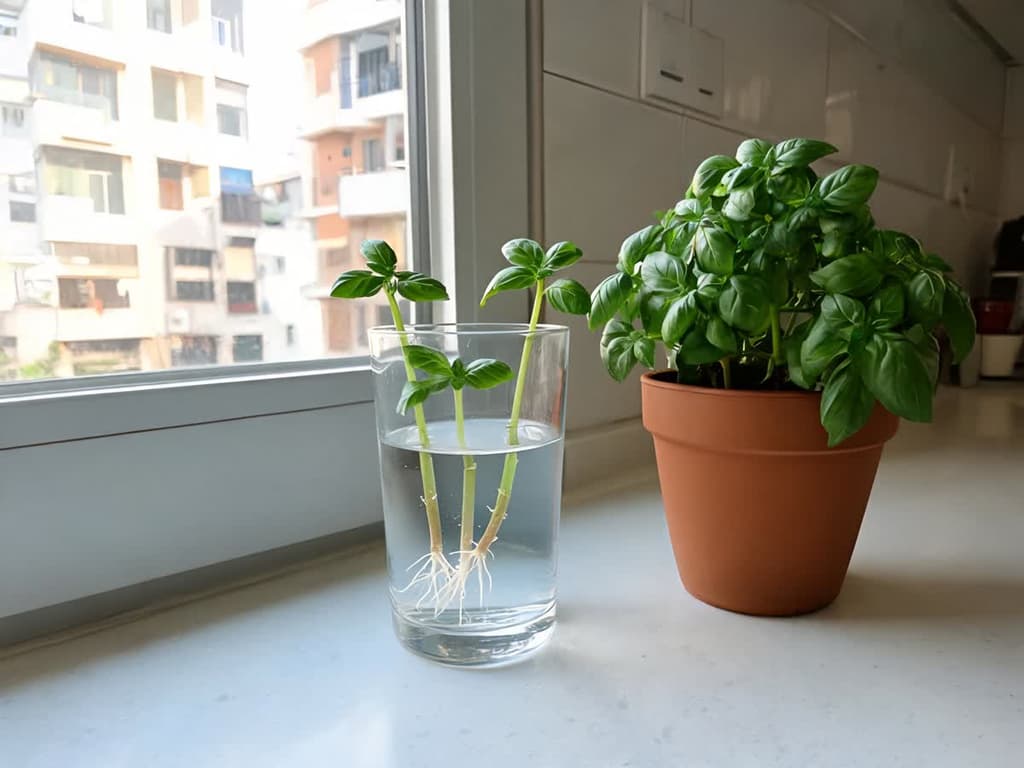
To take a basil cutting, snip the tip of a non-flowering stem (branch), measuring 4 to 6 inches (10 to 15 cm). This piece that becomes a new plant is called a cutting. Cut the base of the cutting just below a node, the point on the stem where a pair of leaves emerges. Strip the lower leaves and keep only the ones at the top. Place the cutting in a glass of water or in a pot with moist soil, in a bright spot without direct sun. Expect roots to appear in about 3 weeks.
Extension at West Virginia University uses the top 4 inches (10 cm) of the stem, rooted in a glass of water. Extension is a university's agricultural outreach service. The RHS, the horticultural society of the United Kingdom, advises using a non-flowering stem and cutting just below a leaf.
Quick summary:
Stem: tip of a non-flowering stem, preferably a side shoot.
Size: 4 to 6 inches (10 to 15 cm), with leaves only on the top 1 to 2 inches (2.5 to 5 cm).
Cut on the mother plant: just above a pair of leaves, so it can regrow from there.
Cut on the cutting: just below the lowest node, without leaving a long stub.
Water: change every 3 days and never let it go past a week.
Roots: about 3 weeks; take at least 5 cuttings, because not all of them will root.
Season: in Brazil, spring and summer.
Where to cut the stem to propagate basil
Cut twice: on the mother plant (the plant you take the shoot from), just above a pair of leaves, and on the cutting, just below a node. The two cuts seem opposite, but each serves one plant. The bottom one keeps growing, and the top one becomes the new plant.
At each node are two small buds, one at the base of each leaf, and that is where new branches and roots emerge. The extension of Purdue University explains that the cutting should be cut at the node because that is where roots form most easily.
On the mother plant, the remaining stem must end at a node with a pair of leaves. By cutting right above this pair, the two buds grow into two new branches. This is the same cut used for harvesting, explained step by step in the guide on how to prune basil.
The cutting needs to end at a node at its base. Because roots develop most easily at the node, a long stem stub below it will not help rooting. Do it like this:
On the mother plant, choose a non-flowering stem longer than 6 inches (15 cm).
Cut this stem right above a pair of leaves, measuring 4 to 6 inches (10 to 15 cm) from the tip.
On the cutting, locate the lowest node and make another cut right below it to remove the stub.
Strip all the leaves except those on the top 1 to 2 inches (2.5 to 5 cm). No leaves should sit underwater or under the soil.
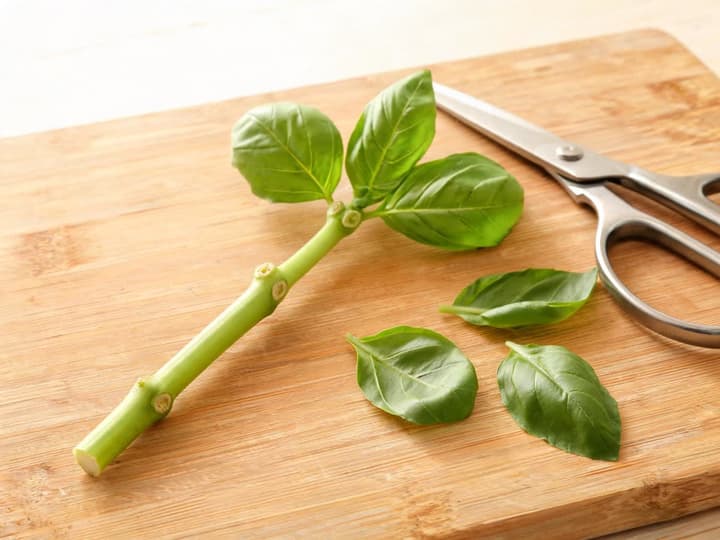
Choose side shoots over the main stem. In a study published in Acta Horticulturae in 2006, side shoots of sweet basil (Ocimum basilicum) rooted more easily than main stems. Sweet basil is the broad green-leaf variety, the most common in pots. The same study found that tip cuttings root better than other stem sections. The University of Brasília (UnB) used middle-stem cuttings and also got roots. The tip is the best bet, but not the only one.
How to prepare the basil cutting
Use a 4 to 6-inch (10 to 15 cm) cutting and keep leaves only at the top. The Cornell University extension, in a text on herb cuttings that includes basil, specifies 4 to 6 inches (10 to 15 cm). Under the same guidance, leaves stay only on the top 1 to 2 inches (2.5 to 5 cm) of the stem.
Keep at least one pair of leaves. In a trial from the journal Ciências Agroveterinárias with two related basil species, leafless cuttings of clove basil rooted much less, and 30% of them died. In both species, the best result came from cuttings with one pair of leaves.
Keep the tip of the cutting, including the newest shoot. The Virginia Cooperative Extension includes this shoot in its soft-stem cutting method. The Acta Horticulturae study found better rooting in tip cuttings. The RHS recommends pinching out the tip, meaning pinching off the newest growth with your fingers. No one has compared both methods directly in basil, and this guide follows the extension service and the published study.
If the top leaves are large, cut each one in half. UnB prepared its trial cuttings this way, cutting 2 or 3 of the upper leaves in half.
Take several cuttings at once. Cornell recommends taking extras because some will fail to root. In the UnB trial, only 9% to 71% of cuttings developed roots after 20 days, depending on the variety. Because of that, take at least 5 cuttings.
How to root basil cuttings in water
Place the cutting in a glass of clean water, with the bare stem submerged and the leaves kept dry above the water. Keep the glass in a bright, warm spot out of direct sunlight, and change the water every 3 days. White roots will appear at the base around the submerged nodes.
Change the water every 3 days, before it becomes stagnant. Virginia Cooperative Extension explains that water left unchanged for a week loses oxygen and begins to hinder root formation. The literature review in the UnB study recommends daily changes, while the UnB trial itself changed the water every 3 days. This text follows the 3-day interval, the only frequency used in a test with measured roots.
Virginia Extension recommends bright indirect light and temperatures of 70 to 75 °F (21 to 24 °C) for cuttings in general. A bright kitchen window works well, as long as the glass stays out of reach of direct sun.
How long basil cuttings take to root in water
Expect about 3 weeks. No extension service gives a timeline for basil roots in water. In a 2021 bachelor's thesis from the University of Brasília, cuttings of 14 varieties spent 20 days in drinking water. There was no rooting hormone. Cornell mentions up to 2 weeks for basil to root in a pot.
Not every cutting roots at the same pace. In the small-scale UnB trial, the percentage of cuttings with roots at 20 days ranged from 9% to 71%, depending on the variety. If a cutting shows no roots after 3 weeks but the stem remains green and firm, give it another week. A mushy or darkened base is a different issue, covered in the section on rotting cuttings.
When to move the basil cutting from water to soil
Pot up the cutting as soon as it has several new roots. None of the consulted sources specify a root length for transplanting. The RHS suggests potting up the cutting into soil after a few weeks in water.
Do not leave the rooted cutting waiting in the glass. Virginia Extension explains that roots formed in water differ from roots formed in soil. According to the same extension service, water roots may experience more shock when moving into a pot, and more cuttings may fail. No source has measured this specifically in basil.
Propagating basil directly in soil
Cuttings can also root directly in a pot with moist potting mix, skipping water entirely. Purdue advises removing the lower leaves and sticking the base into seed-starting mix, or into moist vermiculite or perlite. Vermiculite and perlite are lightweight minerals sold at garden centers that retain moisture while allowing aeration. Keep the pot in a warm, bright spot out of direct sunlight (Purdue recommends a shaded spot).
To trap humidity around the foliage, cover the pot with a clear plastic bag. Support the bag with 2 or 3 wooden sticks stuck into the soil. Purdue warns that the plastic must not touch the leaves, as wet foliage against plastic will rot. Bury the stem deep enough to cover the lowest node, where the roots form.
Use soil that drains well and does not become waterlogged. Herbalist (herb specialist) Sílvia Jeha, in an interview with Globo Rural, explains that rootless cuttings rot in waterlogged soil. That is why her nursery roots cuttings in sand.
In an ESALQ/USP study published in 2015, basil cuttings rooted without hormones in commercial seedling soil. In washed sand, they only rooted well with rooting hormone (indolebutyric acid, sold at farm supply stores). The published study carries more weight than the interview: without hormones at home, use seedling soil, not sand.
Water vs. soil: which to choose
Medium | Pros | Cons |
|---|---|---|
Glass of water | You can watch the roots develop. | Water roots can struggle more during transplant; stagnant water inhibits rooting. |
Pot with seed-starting mix | Roots develop straight in soil without media shock. | Waterlogged soil rots the cutting; you cannot see root progress. |
Washed sand | Does not stay waterlogged. | In the ESALQ study, it only rooted well with hormones. |
For your first cutting, use a glass of water. The RHS and WVU, which specifically discuss basil, recommend water, and you get to watch the roots form. Virginia Extension, which addresses cuttings in general, accepts water for easy-to-root species but prefers soil. If you already have seed-starting mix at home, plant it directly in soil and avoid switching media later.
How to plant a rooted basil cutting in a pot
Plant the seedling in a pot with a drainage hole at the bottom and vegetable potting soil, and water until it runs out of the hole. Cover only the rooted part with soil, without burying any leaves. Keep the pot in a bright spot without direct sun for about 3 days, as herbalist Sabrina Jeha recommends to Casa e Jardim.
Acclimate the seedling to the sun gradually. The University of Illinois extension explains that new leaves suddenly exposed to direct sun will scorch. For seedlings started indoors, the extension advises starting with 2 to 3 hours outdoors during the warm part of the day. Increase this time each day over about 2 weeks.
Water when the top layer of soil feels dry to the touch. A newly planted cutting has a minimal root system, and constantly wet soil rots those delicate new roots. Signs of root rot include wilting foliage despite wet soil and dark, mushy roots:
Once the cutting establishes roots and resumes active growth, follow the lighting, watering, and pruning rules in the guide on how to care for basil. Prune it for the first time when it develops 6 to 8 leaves, as Utah State University recommends: the plant will branch out into two stems and grow bushier.
Can you take cuttings from flowering basil?
Yes, but take shoots that have not produced flowers yet. The RHS advises choosing non-flowering shoots for cuttings, and the UnB research recommends taking cuttings before flowering starts. None of the consulted sources measured whether flowering stems root worse: it is practical gardening advice without hard figures.
WVU explains that once basil starts flowering, it stops producing new leaves and directs its energy toward setting seed. Cuttings taken from non-flowering branches come from parts of the plant still actively producing foliage.
If your plant is covered in flowers and dropping foliage, follow this order:
Look for non-flowering side branches, even short ones, and harvest your cuttings from them first.
If every shoot has flowers, select one branch and cut off the top flower spike along with the pair of leaves right below it.
From that cut, measure 4 to 6 inches (10 to 15 cm) down the stem and cut again: this segment, complete with leaves and nodes, is your cutting.
Afterward, remove all the remaining flowers from the mother plant, following the guide on flowering basil.
Step 2 is simply the safest approach, not an experimentally proven fact: no study has directly compared flowering versus non-flowering basil cuttings. With other herbs in the mint family, the rule varies by species. Cornell calls for non-flowering shoots when propagating rosemary and recommends taking lavender cuttings right after flowering finishes.
Propagating supermarket potted basil: divide the root ball
Pots of grocery store basil are packed with dozens of seedlings planted closely together in a single root ball (the dense mass of roots and soil). The RHS explains that these crowded plants are prone to fungal diseases or premature flowering, but they can survive if you divide and repot them promptly.
Each rooted clump you separate is already an established plant, with no need for water rooting. Tease the root ball apart gently with your fingers into separate clumps, each with its own roots and leaves. Repot each cluster into its own container at the same depth as before. The RHS recommends spacing the plants at least 4 inches (10 cm) apart.
If the purchased pot is already too weak to survive division, take cuttings from any stems that are still firm and green. A cutting starts a fresh plant, completely independent of the existing root ball.
Varieties like purple basil can be propagated through the exact same cutting method as sweet basil. In the UnB trial, rooting ease varied significantly from one cultivar to another.
Propagating basil from seeds
Seeds also produce seedlings, but they take longer than cuttings. The Texas A&M AgriLife Extension states that starting from cuttings lets you harvest 2 weeks earlier. The harvest also turns out 50% to 70% larger than that of a seed-grown plant.
To sow, cover the seed with a thin layer of soil, 1/8 to 1/4 inch (3 to 6 mm). The University of Kentucky indicates 1/8 inch (3 mm) and Clemson indicates 1/4 inch (6 mm). Keep the soil moist and warm.
Germination time varies among sources. The University of Illinois says the seed germinates in 5 to 7 days with soil at least 21 °C (70 °F). Clemson gives 5 to 10 days, and Utah State gives 10 to 14 days with soil between 24 and 29 °C (75 and 85 °F).
Move each seedling into its own small pot when it has 2 pairs of true leaves, as Clemson indicates. True leaves are the ones that appear after the first two small round leaves. In a study in Londrina (PR), published in the journal Científica, the seedlings went into the garden bed with 4 pairs of leaves.
When to take a basil cutting in Brazil
In Brazil, take cuttings in spring and summer. Basil does not tolerate frost. According to the literature review in the UnB study, the ideal temperature range for growth and germination is between 20 and 30 °C. For the cutting, the Virginia extension calls for 21 to 24 °C.
Some sources accept other times of year. A 2021 article from the journal Research, Society and Development, citing another author, states that planting can be done year-round. The ESALQ study rooted cuttings in late winter inside a greenhouse. At home, without that shelter, spring and summer are the safer choice.
The Londrina study shows the difference between seasons for seed-grown seedlings. Seedlings were ready for the garden bed in 45 days when planted in spring and summer. In fall and winter plantings, it took 55 days. Leaf production in spring and summer was about double that of fall and winter.
Take cuttings before cold weather sets in to keep the plant alive through winter. Basil is an annual that flowers and weakens toward the end of the warm season. Stem cuttings taken before chilly temperatures arrive let you keep the plant growing indoors, as described in the guide on winter basil care.
Why basil cuttings rot or wilt
Cuttings display three distinct symptoms, each requiring a different fix.
Symptom | Likely cause | What to do |
|---|---|---|
Stem base feels mushy, dark, or smells foul | Stagnant water or waterlogged soil | Pull the cutting out and trim off the rotted section just below the first firm node. Wash the container and add fresh water. If it was in soil, repot into a drier seed-starting mix. |
Leaves wilted from day one | Excess foliage or direct sun exposure | Remove more lower leaves, keeping only the top set, and move the cutting to bright indirect light. |
Stem is green and firm, but no roots after 3 weeks | Slow-rooting variety | Wait another week or take a fresh cutting from a side shoot. |
A blackened stem section will not recover. If rot creeps all the way up to the leaves, the cutting is dead: start fresh with a healthy stem.
Picked up an unlabeled pot and need to verify it is basil? Bloom (available for iOS) identifies plants from photos, and the free version includes 2 identifications per month.
Frequently asked questions about basil cuttings
How long does a basil cutting take to root?
In water, expect roots in about 3 weeks. In a University of Brasília trial, cuttings of 14 varieties were evaluated after 20 days in water. Rooting success ranged from 9% to 71%, depending on the variety. Cornell notes that rooting in potting mix can take up to 2 weeks. Prepare several cuttings, as they will not all root at the same speed.
Do you need rooting hormone to propagate basil?
No, not when using water or seed-starting potting mix. In the UnB trial, cuttings rooted in plain drinking water without any hormones. In an ESALQ/USP study, cuttings rooted without hormone in commercial seed-starting mix, requiring rooting agents only when propagated in washed sand. None of the cited sources tested cinnamon or honey as rooting aids.
Do you propagate purple basil the same way?
Yes. Purple basil is a cultivar of sweet basil, and cuttings follow the exact same steps. None of the consulted studies evaluated purple basil separately. In the UnB trial, rooting success after 20 days ranged from 9% to 71% across 14 different varieties. Expect rooting timelines to differ across types.
Can new basil cuttings go straight into full sun?
No. Keep newly potted cuttings in bright indirect light for about 3 days. After that, acclimate the young plant to direct sun gradually. University of Illinois Extension recommends starting with 2 to 3 hours outdoors during the day. Increase the duration daily over about 2 weeks. Tender young foliage exposed to sudden direct sun will scorch.
Summary: how to propagate basil
To take a basil cutting, snip the tip of a non-flowering branch just above a pair of leaves on the mother plant. On the cutting, cut the base just below a node and leave leaves only at the top. Root it in water, changed every 3 days, or in moist soil that does not get waterlogged. Plant it when several new roots appear. In Brazil, take cuttings in spring and summer. Today, choose 5 non-flowering side branches and set up the glass on a bright kitchen windowsill, out of direct sun.
Related articles
How to Care for Hibiscus: Sun, Watering, Fertilizer, and Pruning for Flowers
How to care for hibiscus: 6 hours of direct sun, evenly moist soil without waterlogging, half-strength fertilizer in spring and summer, and pruning in early spring. Find out why the flower lasts one day and why buds drop before opening.

Do Ferns Like Sun or Shade? It Depends on the Type
Ferns prefer bright shade: plenty of light, but no direct sun on their fronds. Tuberous sword fern is the exception that handles sun. Here is the ideal light for each type, where to place pots, and how fronds show too much or too little light.

African Violet Yellow Leaves: Causes and What to Do
Yellow leaves on an African violet usually stem from overwatering, and the first place to check is the center of the plant. Losing one lower leaf at a time is normal. Identify whether age, watering, cold water, sunlight, cold drafts, or fertilizer is the culprit based on the yellowing pattern, and see what to do today.