Does Basil Need Sun or Shade? Hours, Windows, and Balconies
Basil thrives in direct sun, needing 6 hours or more per day. See when small pots need afternoon shade in summer, which window to choose, and how to spot light issues.
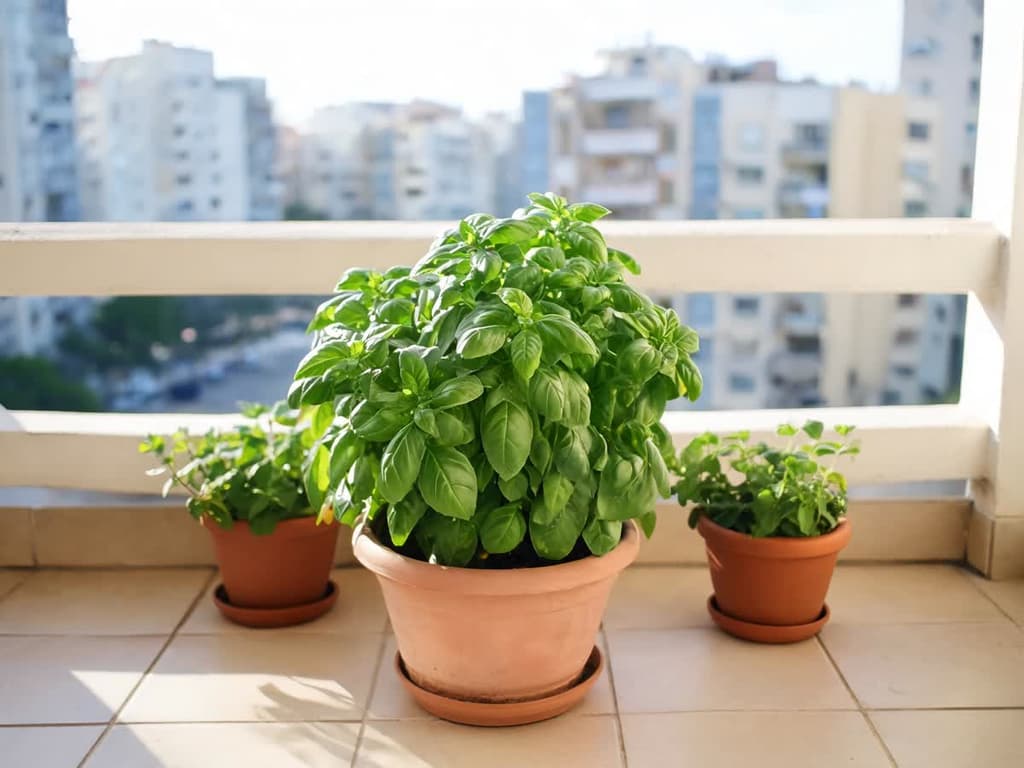
Basil likes sun, not shade: it needs 6 hours or more of direct sun per day, according to the NC State Extension. NC State Extension is the public outreach service of North Carolina State University in the United States. Indoors, provide 8 hours of direct sun, which is what the Iowa State Extension recommends for herbs grown on a windowsill. In the shade, basil (Ocimum basilicum) survives, but it grows with a thin stem and produces smaller leaves.
The exception in Brazil is a small pot (less than 8 inches / 20 cm wide) in summer. Afternoon sun on a hot balcony dries out the soil of a small pot before late afternoon, and the plant wilts. UF/IFAS (University of Florida) recommends sun with some afternoon shade to protect basil from the heat. This text follows that advice only for small pots. The documented problem is hot roots and dry soil, not air temperature.
Quick summary:
Direct sun for 6 hours or more per day outdoors; 8 hours on a windowsill indoors.
In Brazil's summer (December to March), a small pot in the afternoon sun requires shade starting at 1:00 PM, or a larger pot.
In Brazil, the window with the most hours of sun is usually the one facing north. In Brazil, the sun moves across the northern sky.
The basil care guide has the plant's essential care tips in one place:
How many hours of sun does basil need?
Basil requires at least 6 hours of direct sun per day to grow dense. The Cobasi store blog mentions 4 hours, but this text follows the 6 hours from university extension offices, which have more evidence. NC State calls this full sun: 6 hours or more of sun hitting the plant directly. Partial shade, within the same classification, is direct sun for only part of the day, from 2 to 6 hours. Indirect light is something else: it is ambient room light without sun hitting the leaf, and it does not count as a sun hour.
The sources do not use the same names. Clemson Extension says that basil prefers full sun, but grows reasonably well with 6 hours of sun. It calls this condition partial shade. In practice, both sources state the same number: 6 hours of direct sun is the minimum that works well.
Where the basil is placed | Direct sun per day | Source |
|---|---|---|
Yard, garden bed, or open balcony | 6 hours or more | NC State Extension |
Windowsill, indoors | Around 8 hours (some herbs tolerate 6) | Iowa State Extension |
No sunny window | Plant grow light for 12 to 16 hours | Iowa State Extension |
Hot balcony, small pot, summer | 6 hours or more, with morning sun and shade starting at 1:00 PM | UF/IFAS |
Partial shade reduces yield. Researchers from the Federal University of Mato Grosso do Sul (UFMS) and Embrapa Pantanal grew basil in Ladário, Mato Grosso do Sul, intercropped with lettuce and arugula. Half of the garden beds were placed under a screen that blocks half of the light (50% shade cloth). With organic fertilizer, the bed in full sun yielded 130.2 metric tons per hectare (t/ha) of fresh weight, the weight of the freshly harvested plant. Under the screen, it yielded 97.96 t/ha, about a quarter less.
The Embrapa test has a limitation that the authors themselves highlight. It was conducted from April to May, during Brazil's autumn, without intense heat. The authors write that the result applies "at least during this period of the year." We found no measurements of basil in full sun during the Brazilian summer. Therefore, the safest option is to provide afternoon shade only to small pots, as UF/IFAS recommends.
Basil on a balcony with afternoon sun
On a balcony with afternoon sun, basil can stay in the sun if the pot is large (20 cm, about 8 inches, or more). The small pot is the problem: the soil dries out by mid-afternoon and the plant wilts. In summer (December to March, in Brazil), shade the small pot starting at 1:00 PM.
Air temperature alone is not the problem. In a study published in PLOS ONE in 2023, sweet basil yielded more fresh weight at a high daily average temperature. The optimal point was 32.6 °C under low light and 35.5 °C under higher light. These plants grew hydroponically (soilless cultivation, with roots in nutrient-rich water), so they never lacked water. On a balcony, the roots rely on the small amount of soil in a small pot, which dries out quickly in the sun.
The root heats up as well. NC State Extension states that soil in a black or dark pot in the sun can reach 11–17 °C (20–30 °F) above the air temperature. Soil at 45 °C (113 °F) for 30 minutes can severely damage the root. The small black plastic pot sold with the seedling is a dark pot.
To keep basil on an afternoon-sun balcony:
Replace the store-bought pot with a pot at least 20 cm wide and deep. That is the minimum measurement the RHS recommends for basil. A larger volume of soil takes longer to dry out.
Choose a light-colored pot. Terracotta pots dry out faster, according to Iowa State; in them, check the soil more frequently. With a dark pot, place another pot in front to shade its sides, leaving only the leaves in the sun.
In summer, if the balcony gets sun in both morning and afternoon, move small pots out of the sun starting at 1:00 PM. A taller plant placed in front of the pot also casts shade.
If the balcony only receives sun in the afternoon, leave the basil in the sun, but swap the small pot for a large, light-colored pot (steps 1 and 2). Taking the pot out of the afternoon sun would deprive the plant of its 6 hours of direct sun. The large, light-colored pot is what shields the roots.
Check the soil in the morning and, on hot sunny days, again in the early afternoon. If the top inch (2 cm) feels dry, water until it drains from the bottom hole. The RHS recommends watering in the morning whenever possible.
On the same balcony, herbs demand different light levels. Rosemary thrives in full sun even in Florida's heat, according to UF/IFAS, without the afternoon shade it recommends for basil.
Indoor basil: which window to use
Indoors, basil belongs by the window that receives direct sun for the most hours of the day. In Brazil, that is usually a north-facing window, because in Brazil the sun travels across the northern sky. East- or west-facing windows also work if they are very bright, according to Iowa State.
The exact placement matters just as much as the window orientation. Iowa State notes that even the brightest windowsill receives only a fraction of the outdoor light found in any open spot. A pot positioned 3 to 6 feet (1 to 2 meters) away from the glass in the middle of a room receives even less, as light intensity drops with distance. For basil, the right spot is right on the windowsill, with foliage a few inches from clean glass without touching it.
Kitchen countertops far from the window and sunless laundry rooms will not provide 8 hours. In those spots, basil stretches toward the light and grows smaller new leaves. If your home has no sunny window, the solution is the grow light discussed in the next section.
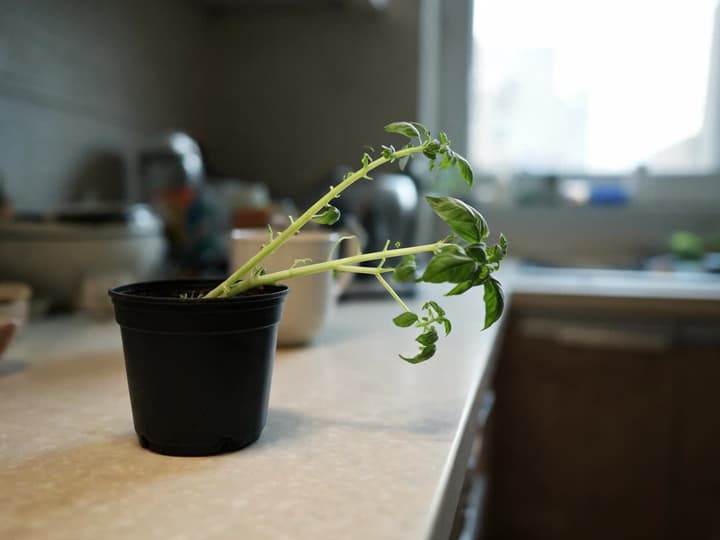
In winter (June to August, in Brazil), the days are shorter and the sun sits lower through the window. The cold also damages basil before frost hits, and basil in winter calls for a different window and watering routine.
Artificial lighting for kitchen basil
A grow light can replace a sunny window. Iowa State outlines these indoor herb guidelines:
Type: a full-spectrum grow light (emitting all light wavelengths, like the sun) mounted in a high-output fixture. LEDs work well.
Distance: 6 to 12 inches (15 to 30 cm) above the foliage.
Duration: 12 to 16 hours daily, using a plug-in timer.
Basil is among the plants that demand high light. Iowa State places leafy herbs, such as lettuce and basil, in the range of 12 to 16 mol/m² per day. This measurement is called DLI (Daily Light Integral). It is the total useful light that the plant receives in 24 hours, measured in moles of light per square meter. The same page places herbs in general in a higher range. However, in the HortScience study cited below, basil gains almost stop above 16.5. For that reason, this text follows 12 to 16.
More light yields more basil leaves. In a study published in HortScience in 2018, basil with 12.9 mol/m² per day produced 54.2% more fresh mass than with 9.3. Fresh mass is the weight of the harvested plant. At 16.5, it produced 78.6% more. Leaves also grew larger and thicker with more light.
To check if the window is enough, you can measure light in lux, the unit of brightness that meters and apps report. The Bloom app (available for iOS) has a meter that reads lux through the phone camera. The calculation below is our estimate. It uses the Iowa State formula and the sunlight conversion from a 1983 study (Thimijan and Heins):
To reach 12 mol/m² per day across 8 hours of sun, light levels need to average about 22,500 lux throughout those 8 hours.
If your windowsill measures below 22,500 lux for most of those 8 hours, supplement with a grow light.
Signs of too little light and too much sun on basil
Basil shows in its leaves and stems whenever light conditions are off. Insufficient light and excessive sun produce distinct symptoms, and wilting might simply mean dehydration:
What you see | Probable cause | What to do |
|---|---|---|
Long, spindly stems, widely spaced leaf pairs, plant leaning toward the window | Insufficient light | Move the pot to a sunny windowsill or set up a grow light |
New leaves smaller and thinner than older leaves | Insufficient light | Same action: add more hours of direct sun |
Pale or dried patches on top leaves, appearing hours after moving into direct sun | Sunburn | Return to partial shade and transition gradually |
Wilting during the hottest hours, accompanied by dry soil | Thirst | Water until drainage runs out; pot up into a larger container |
Wilting in the early afternoon despite moist soil, recovering by late afternoon | Hot roots in an afternoon-sun pot | Shade starting at 1:00 PM in summer; choose a larger, light-colored pot |
Wilting that does not recover by evening or next day, with moist soil and green leaves | Root or stem disease | Inspect roots and stems, and read the paragraph below on Fusarium wilt |
The technical name for a long, thin stem stretching for light is etiolation. The South Dakota State Extension warns that seedlings without sunlight stretch and can turn yellow. The page on low-light stress in basil lists signs for indoor plants in general. In basil, the two clearest signs are the long stem and smaller new leaves.
Sunburn develops quickly on the most exposed leaves when a plant moves from shade straight into harsh sun:
Wilting that does not resolve despite moist soil points to another diagnosis. Clemson describes Fusarium wilt as sudden wilting while leaves remain green, because the pathogen blocks water uptake. If the soil remains moist yet the plant stays wilted, check the causes of wilting basil leaves and Fusarium wilt in basil.
How to move basil into the sun without burning it
Basil bought from the store or kept indoors for days needs 7 to 14 days to adjust to full sun. This process is called hardening off or acclimation. South Dakota State recommends this routine for seedlings moving outdoors:
Day 1: place the pot outdoors for 3 to 4 hours in a shaded spot protected from wind. Then bring the pot back to its previous location.
Subsequent days: leave the pot outside for a few additional hours each day, gradually increasing exposure to direct sun.
Between days 7 and 14: once foliage handles direct sun without pale spots appearing, the pot can remain in its permanent outdoor location full-time.
Throughout the transition: check soil moisture in the morning and, on hot sunny days, again in the early afternoon. If the top inch (2 cm) feels dry, water until moisture drains from the bottom.
The RHS (Royal Horticultural Society, the gardening society of the United Kingdom) also advises acclimating basil seedlings before taking them outdoors. According to the RHS, the grocery store pot contains many thin, crowded seedlings intended only for short-term harvest. The RHS says these seedlings can survive if divided and repotted right away: separate the clumps and replant them in a pot of at least 20 cm (8 in).
Frequently asked questions
Can basil grow in shade?
It can survive, but it grows less and develops smaller leaves. With less than 6 hours of direct sun, stems stretch and harvest yields drop. In the Embrapa Pantanal trial, basil grown under 50% shade netting yielded about one-quarter less than basil in full sun. Shade only makes sense in the afternoon, during Brazil's summer, for small pots.
Can basil stay indoors?
It can, if kept on a windowsill with direct sun for about 8 hours. In Brazil, this is usually a north-facing window. Far from the window, such as on a kitchen counter, there is not enough light. In that case, use a grow light 6 to 12 inches (15–30 cm) from the leaves for 12 to 16 hours a day.
Does basil prefer morning or afternoon sun?
For small pots during Brazil's summer, morning sun works best. It provides required light hours without drying out soil during the hottest period after 1:00 PM. A large, light-colored pot with moist soil easily handles the entire afternoon in direct sun. UF/IFAS recommends sun with some afternoon shade in warm climates.
Why does purple basil turn green?
Purple basil loses color under low light levels as well as under excessive heat. In a 2023 study published in PLOS ONE, hydroponic purple basil turned green at a daily average of 95°F (35°C), regardless of light quantity. At 77°F (25°C), it developed deeper purple hues under high light. To maintain its color, provide direct sun and protect the pot from intense afternoon heat.
Basil: sun or shade, and finding the right spot for your pot
Basil likes sun: 6 hours of direct sun outdoors and 8 hours on the windowsill. Without a sunny window, use a grow light for 12 to 16 hours. In summer (December to March in Brazil), a small pot on the balcony needs shade starting at 1:00 PM. Start today: check hour by hour where the sun hits the pot and add up the hours of direct sun.
Related articles
How to Care for Hibiscus: Sun, Watering, Fertilizer, and Pruning for Flowers
How to care for hibiscus: 6 hours of direct sun, evenly moist soil without waterlogging, half-strength fertilizer in spring and summer, and pruning in early spring. Find out why the flower lasts one day and why buds drop before opening.

Do Ferns Like Sun or Shade? It Depends on the Type
Ferns prefer bright shade: plenty of light, but no direct sun on their fronds. Tuberous sword fern is the exception that handles sun. Here is the ideal light for each type, where to place pots, and how fronds show too much or too little light.

African Violet Yellow Leaves: Causes and What to Do
Yellow leaves on an African violet usually stem from overwatering, and the first place to check is the center of the plant. Losing one lower leaf at a time is normal. Identify whether age, watering, cold water, sunlight, cold drafts, or fertilizer is the culprit based on the yellowing pattern, and see what to do today.