Best Potting Mix for Fiddle Leaf Fig: A Recipe That Drains
The best soil for a fiddle-leaf fig is a fast-draining mix that still retains a bit of moisture: 1 part potting soil, 1 part fine pine bark, and 1 part perlite. Learn when to repot, what to buy in Brazil, and how to stabilize a top-heavy plant.
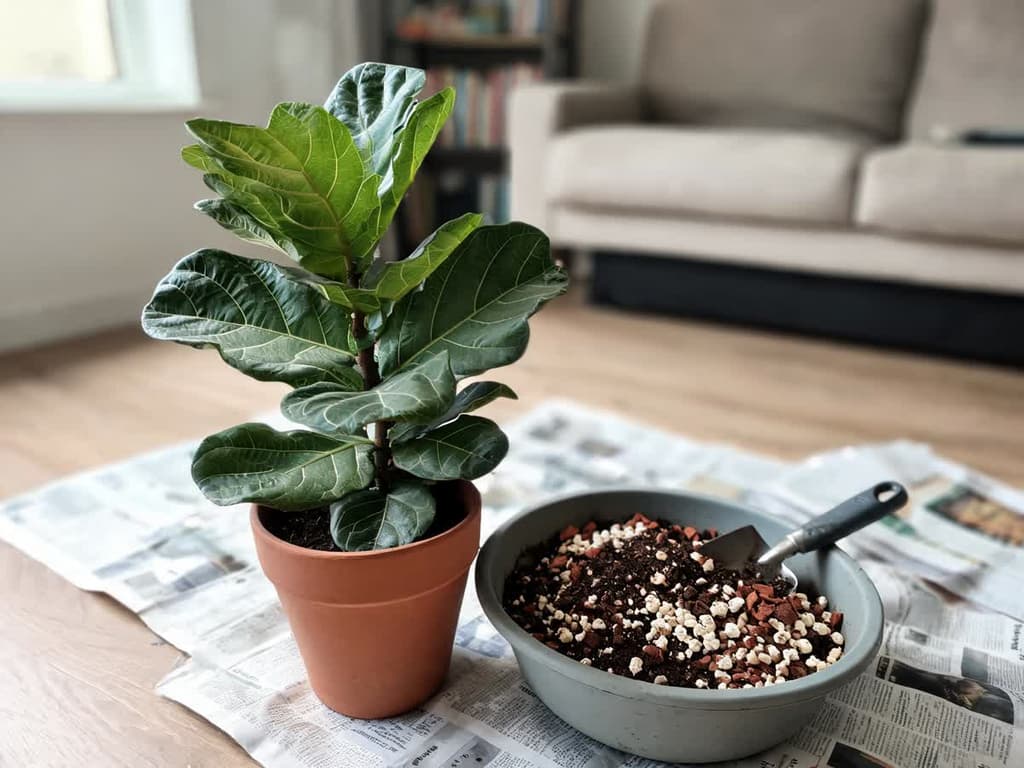
The best potting mix for a fiddle-leaf fig (Ficus lyrata) is a lightweight blend that lets water drain through the drainage hole within seconds. At the same time, it holds a bit of moisture for the roots. The simplest recipe, published by Clemson Cooperative Extension for foliage plants, calls for equal parts of three ingredients: potting mix, fine pine bark, and perlite.
Potting mix is the soil used in containers: the blend that anchors roots and replaces garden soil. For a fiddle-leaf fig it determines almost everything, because roots rot in waterlogged soil and the plant wilts when it dries out completely.
Quick summary:
Recipe: 1 part potting soil, 1 part fine pine bark, and 1 part perlite (lightweight white volcanic rock pebbles).
Tall, top-heavy plants that tip over: replace half of the perlite with coarse washed sand. Sand adds weight to the pot.
Coco coir can replace potting soil, but rinse it first: it may contain residual salt.
Waterlogged soil with mushy, brown roots calls for repotting today. A newly purchased plant without these signs should wait about 4 weeks.
Use a pot with a drainage hole, only 1 to 2 inches (2.5 to 5 cm) wider than the current one. Skip the layer of stones at the bottom.
What is the best soil for a fiddle-leaf fig?
The best soil for a fiddle-leaf fig drains quickly, maintains air pockets between particles, and holds light moisture between waterings. NC State Extension describes the species' preferred soil as moist, well-drained, and acidic. Extension services are university programs that publish research-based growing guidance for the public. The same plant profile notes that it is sensitive to overwatering.
Drainage matters because of the roots. Fungi that cause root rot grow and multiply best in wet soil, according to Wisconsin Horticulture. Heavy soil takes days to dry out and keeps roots soaking wet after every watering.
A fiddle-leaf fig does not grow well in pure bark. Orchids and monsteras cling to tree trunks in nature, with aerial roots exposed to the air. NC State does not describe aerial roots on the trunk of the fiddle-leaf fig. The University of Florida (UF/IFAS) profile notes that it produces few, fewer than the weeping fig (Ficus benjamina).
That is why its mix contains a fine-textured component to hold water, alongside bark and perlite to create air pockets.
Inherited a large indoor tree and not sure if it is a fiddle-leaf fig? Its leaves are fiddle-shaped, stiff, dull, and reach up to 18 inches (45 cm) in length, according to NC State. If the leaves are smooth, glossy, and oval, it might be another ficus with different needs. Bloom (available for iOS) identifies the species from a single photo of a leaf.
Waterlogged soil: repot now or wait?
Root rot requires repotting today. A newly arrived plant with firm roots should wait. Disturbing the roots adds stress, so repotting is only worthwhile when the potting mix is the actual problem.
To check the roots without repotting, tip the pot on its side and gently slide the plant out by the base of the stem. Healthy roots are firm and light-colored.
Scenario 1: the soil is wet, the plant is still wilting, and the roots are mushy and brown, sometimes smelling bad. Repot today. Wisconsin Horticulture describes root rot like this: a plant wilting despite wet soil, with soft, brown roots that may smell foul. Here, waiting is worse than disturbing the plant.
Scenario 2: you bought the plant a few weeks ago and it is dropping leaves, without bad odors or soft roots. Wait. UF/IFAS recommends avoiding moving, pruning, repotting, or fertilizing a fiddle-leaf fig for about 4 weeks after bringing it indoors. During this period, water only when the top 2 inches (5 cm) of soil are dry, and empty the saucer.
Scenario 3: the soil remains moist at a depth of 2 inches (5 cm) more than a week after watering, but the roots are firm and light-colored. First check the saucer and the drainage hole, because standing water under the pot keeps the soil wet. If the pot drains well and the soil stays heavy, replace the potting mix during the plant's growing season. In Brazil, it usually runs from September to March.
Symptoms outside these three scenarios have other causes. The indoor plant diagnostic guide helps narrow them down before you disturb the pot.
Conflicting recipes: what each source suggests
Fiddle-leaf fig soil recipes circulating on blogs and online plant shops disagree on the proportion of bark. One plant shop suggests 30% to 40% bark in the mix. A fiddle-leaf fig blog uses 4 parts pre-made potting mix to 1 part bark and 1 part charcoal. Another gardening blog skips bark entirely: 2/3 peat moss and 1/3 perlite.
Cactus mix divides opinions just as sharply. One blog recommends straight cactus mix as the simplest option. The plant shop says cactus mix alone dries out too quickly, causing brown leaf tips and edges.
University extension guidelines align closer with the higher-bark recipe. Clemson recommends equal parts peat moss, pine bark, and perlite for foliage plants. Peat moss is decomposed sphagnum moss, which forms the dark base of many bagged potting soils. Pine bark makes up roughly 33% of that mix. UF/IFAS lists the exact same ingredients (peat moss, pine bark, vermiculite, or perlite) for commercial ficus nurseries.
This guide follows the Clemson recipe. It comes from a university extension and uses ingredients that UF/IFAS confirms for the genus. The bark creates pore space for air, while the finer component retains the moisture that NC State recommends.
Fiddle-leaf fig soil mix recipe
The recipe below adapts Clemson's to what you can buy in Brazil. Instead of pure peat moss, it uses bagged potting soil, which already contains peat moss or coco coir as its base. Measure the parts using the same container, such as a bucket or an ice cream tub.
Ingredient | Amount | Purpose |
|---|---|---|
Potting soil, free of garden dirt | 1 part | Holds water and nutrients between waterings |
Fine, composted pine bark | 1 part | Creates air pockets and adds structure |
Perlite | 1 part | Creates air pockets and does not decompose |
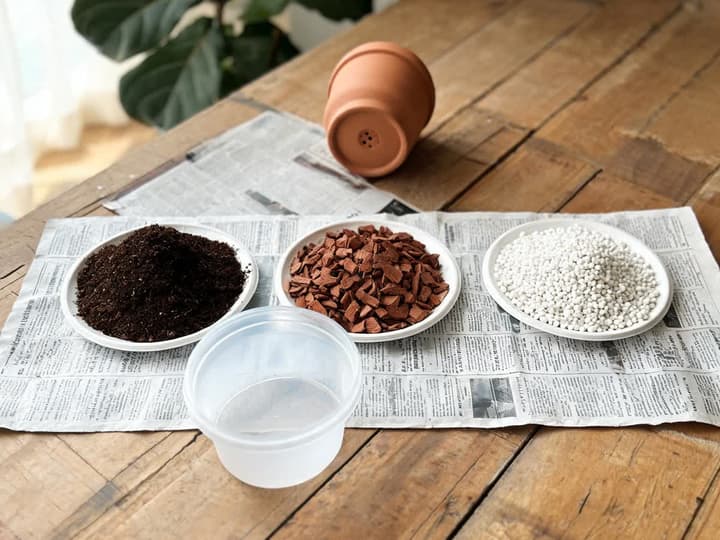
Mix the dry ingredients thoroughly in a bucket or large tub. Then moisten the blend until it feels damp to the touch, without dripping. According to Iowa State Extension, bone-dry potting mix is difficult to wet, and the first watering will run right through without soaking the mix.
Adjust the recipe based on your plant and watering habits:
Tall plants, heavy canopies, or pots that have tipped over before: replace half of the perlite with coarse washed sand. The mix will consist of 1 part potting soil, 1 part pine bark, 1/2 part perlite, and 1/2 part sand.
Dry home, running air conditioning, or you frequently forget to water: use 1.5 parts potting soil to 1 part bark and 1 part perlite. This variation is suggested by this guide; no university extension has specifically tested a recipe for dry homes.
If you cannot find bark, Clemson and UF/IFAS provide an alternative recipe for foliage plants: 2 parts peat moss, 1 part perlite, and 1 part coarse sand. This works well whenever fine pine bark is unavailable.
The ingredients under the names found in Brazil
The recipes from the American extension services use pine bark, the same material sold in Brazil. Orchid bark in American texts is usually fir bark, a different material, as detailed in the guide on potting mix for monstera.
Ingredient | How it appears in stores | What to look for |
|---|---|---|
Pine bark | Fine or medium pine bark, or "composted pine bark" | Small pieces. UF/IFAS recommends aged bark that has already been composted |
Perlite | Expanded perlite, in bags | Lightweight, white granules that float on water |
Coco coir | Coir peat powder or compressed coir brick | Rinse before using to remove residual salts |
Coarse sand | Washed coarse sand | Coarse grit. UF/IFAS advises against fine sand, which packs down and makes the mix too dense |
Vermiculite | Expanded vermiculite | Retains water and nutrients; does not substitute for perlite |
Potting soil | "Potting soil", "container mix", or "foliage plant mix" | Read the ingredients list on the back of the bag |
Coco coir can replace standard potting soil; Clemson lists it as an alternative to peat moss. However, coir requires an extra step that store recipes rarely mention. Clemson and UF/IFAS advise rinsing coir thoroughly before use because processing often involves saltwater. Residual salts left in the coir accumulate in the pot, eventually showing up as a white crust on the soil surface.
Horticultural charcoal appears in one blog recipe and in a commercial retail mix. That blog attributes antibacterial properties to it without citing a source. None of the university extensions consulted include charcoal in their foliage mixes, so you can safely skip it.
Topsoil and bagged black garden soil must stay out of the mix. Penn State Extension warns that garden soil in containers introduces diseases and pests, and Clemson advises against using it for potted plants. If the first ingredient on the bag is "soil" or "dirt", it does not work as a container base.
Commercial potting mix: what to check on the label
Commercial potting mix can serve as the fine portion of your recipe, and sometimes on its own if the bag already contains visible perlite or bark. Always check the ingredients on the back: the plant name on the front of the bag is no guarantee of what is inside.
Use it alone if: the first ingredient is peat moss, coco coir, or pine bark, and you can clearly see bark chunks and white perlite granules throughout the bag.
Use it only in the recipe, with bark and perlite added, if: the mix is fine-textured and uniform, resembling ground coffee.
Do not use it if: the first ingredient is topsoil, garden soil, or black dirt.
Cactus mix is not the right base on its own. It is formulated to dry out quickly, whereas NC State calls for moist, well-drained soil for fiddle-leaf figs. However, one part of cactus mix can replace the perlite in your recipe if that is what you already have at home.
Potting soil that remains constantly damp at the surface also attracts fungus gnats, whose larvae feed in that top layer.
Top-heavy plants tip over: add ballast to the pot
Fiddle-leaf figs can grow up to 10 feet (3 m) tall indoors, according to NC State. The broad canopy becomes top-heavy, and a plastic nursery pot filled with lightweight soil will easily tip over if bumped.
Coarse sand solves this problem directly in the potting mix. UF/IFAS recommends that ficus nurseries add 10% to 20% coarse sand to the substrate to prevent plants from blowing over in the wind. Indoors, that same weight keeps the pot stable whenever someone bumps into it. The university's homemade potting mix publication recommends sand specifically for top-heavy plants because it is much heavier than other ingredients.
The recipe variation with a half part of sand works out to about 17% sand in the total mix, right within the UF/IFAS recommendation. In addition, choose a terracotta or ceramic pot, which provides far more weight than plastic.
Placing gravel or rocks at the bottom of the pot takes up space that roots would otherwise use. Mixing coarse sand throughout the potting soil adds ballast without sacrificing root volume.
Drainage layer at the bottom of the pot: does it help or hurt?
A layer of stones or gravel at the bottom of the pot is unnecessary as long as the pot has drainage holes and the potting mix drains well. Sources disagree on how it affects water movement, but practical advice arrives at the exact same conclusion on both sides.
Extension specialist Linda Chalker-Scott of Washington State University (WSU) wrote that a drainage layer interferes with water movement. According to her, water is retained in the upper potting mix and only moves down into the coarse stone once the fine mix is saturated. Clemson and Wisconsin Horticulture also advise against putting stones or gravel at the bottom.
A 2025 study from the scientific journal PLOS ONE measured the opposite. In soilless organic substrates, almost every drainage layer reduced the water retained in the pot. The best performer was a 60 mm layer of coarse sand. The author tested only waterlogged, draining pots, with no plant growing in them.
This guide advises against adding a drainage layer because both sides agree on one fundamental point: in a container with drainage holes and a well-draining mix, a drainage layer is unnecessary. Every inch of rock at the bottom means an inch less root space for your plant. If you still choose to include one, the 2025 study identifies coarse sand as the best performer, never as a replacement for drainage holes.
Pot selection: drainage holes and 1 to 2 inches larger
The pot must have drainage holes at the bottom, without exception. Without holes, you cannot tell how much standing water has collected underneath, and roots deteriorate in waterlogged soil, according to Wisconsin Horticulture.
Select a new pot that is only 1 to 2 inches (2.5 to 5 cm) wider in diameter than the current one. This is the exact range Clemson recommends for indoor plants in its repotting guide. In an oversized pot, excess soil sits untouched by roots and takes days to dry out.
If you prefer a decorative cachepot (a pot without drainage holes), use the double-potting method described by Wisconsin Horticulture. Keep the plant in a plastic nursery pot with drainage holes and place it inside the decorative cachepot. After every watering, dump out any runoff that collects in the bottom of the outer pot.
When old soil turns hydrophobic and water runs down the sides
Potting mix that dries out completely shrinks and pulls away from the inside walls of the pot. When watered, moisture runs straight down that gap and out the drainage hole, leaving the center of the root ball bone dry. Iowa State Extension describes this hydrophobic effect and its solution: bottom-watering by soaking the pot in a basin of water for 20 to 30 minutes.
Do this before deciding to repot. An inherited plant with dust-dry soil may simply be dehydrated, and bottom-watering will reveal whether the root ball can still absorb water.
A dense root ball surrounded by a much coarser soil mix can run into the exact same moisture-channeling problem. WSU explains that water does not readily move from a fine-textured material into a coarse one until the finer material is fully saturated. Applying this rule to the perimeter of a container is an inference of this guide, not a formal measurement. Following that logic, the dense nursery root ball could stay dry in the center while water drains around it.
That is why this recipe uses fine bark rather than coarse orchid bark. For the same reason, whenever you repot, gently tease the outer roots of the root ball loose before settling the plant into its new container.
How to repot a fiddle-leaf fig
Repot the plant when it is actively growing and putting out new leaves. In Brazil, this phase usually runs from September to March. Root rot is the exception: treat it the day you discover it.
Gather your prepared mix, a container with drainage holes, clean shears, and gloves. The milky white sap from the stem irritates skin, and NC State recommends wearing gloves when handling the plant.
Water the plant 1 hour beforehand, as advised by Penn State. A moist root ball slides out intact.
Turn the pot on its side and slide the plant out by the base of the trunk, never by pulling the leaves.
Gently loosen the outer layer of the root ball with your fingers, untangling any circling roots that hugged the pot walls.
Add fresh potting mix to the bottom of the new pot until the top of the root ball rests about 1 inch (2.5 cm) below the rim, as recommended by Penn State.
Fill in around the sides with your mix, pressing down lightly with your fingertips without compacting it firmly.
Water thoroughly until moisture runs out the drainage hole, then empty the saucer. After that, wait to water again until the top 2 inches (5 cm) are dry.
If you are treating root rot, the procedure changes in two ways. Trim away all soft, rotten roots back to firm, healthy tissue, and discard the entire old soil mix. Wisconsin Horticulture advises against reusing soil from a plant with root rot. The extension also recommends disinfecting pruning tools, work surfaces, and terracotta pots with rubbing alcohol or a 10% bleach solution (1 part bleach to 9 parts water).
Root rot in fiddle-leaf figs has multiple underlying causes, all detailed in our guide to fiddle-leaf fig root rot. Repotting other houseplants follows this exact same routine: keep the root ball intact and inspect roots before moving to a new container. Our guide on how to repot a peace lily demonstrates each step in detail.
Ideal soil pH for fiddle-leaf figs
The pH range accepted by fiddle-leaf figs runs from slightly acidic to neutral. UF/IFAS recommends a pH of 5.5 to 7.0 for ficus growing media. Clemson formulates its mixes to roughly 6.0, and NC State describes the species as tolerant of acidic soil.
Pure peat moss is very acidic, with a pH of 4.0 to 5.0, according to the University of Arkansas. UF/IFAS notes that soil manufacturers typically add agricultural limestone to bagged potting mixes to balance their pH. Because commercial bags are already pH-adjusted, do not add lime or vinegar to modify your mix.
Frequently asked questions
Can standard potting soil be used alone for a fiddle-leaf fig?
It works if the bag already contains visible perlite or bark pieces. Fine, uniform potting soil that resembles ground coffee stays far too heavy on its own. In that case, mix equal parts: 1 part potting soil, 1 part fine pine bark, and 1 part perlite. Garden dirt and topsoil should never be used under any circumstances.
Do fiddle-leaf figs like large pots?
No. In a pot that is much larger than its root ball, the excess soil holds water that roots cannot access, keeping the container wet for days. This creates ideal conditions for root rot. Choose a pot just 1 to 2 inches (2.5 to 5 cm) wider than the current one, always with drainage holes, as Clemson recommends for houseplants.
Can I use cactus mix for a fiddle-leaf fig?
On its own, it is not the ideal choice. Cactus mix is designed to drain and dry out rapidly, whereas NC State notes that fiddle-leaf figs prefer moist, well-draining soil. It can, however, substitute for perlite as one part of your mix alongside standard potting soil and fine pine bark.
Can I pot a fiddle-leaf fig entirely in orchid bark?
No. The bark sold for orchids in Brazil is usually pine bark in large chunks. According to UF/IFAS, pine bark leaves too much air space and holds little water. The fiddle-leaf fig has few aerial roots and needs light moisture in the pot. Use fine bark as one of the three parts of the recipe.
What you can do today
Start by inspecting the pot you currently have. Make sure it has drainage holes and that the saucer has no standing water. Push your finger 2 inches (5 cm) into the soil a week after watering: if the saucer is dry and the hole is clear, soil that remains soggy points to a mix that is too heavy. Wet soil accompanied by mushy, brown roots means you should repot today; soil that has turned bone dry and powdery calls for a 20- to 30-minute bottom-soak before making any decisions.
If it is time to repot, combine equal parts: potting soil, fine pine bark, and perlite. For tall, top-heavy plants, substitute half a part of perlite with coarse sand. Move into a pot that is 1 to 2 inches (2.5 to 5 cm) wider, and water thoroughly until moisture flows from the drainage hole.
Bloom identifies the species from a photo whenever you are unsure if your indoor tree is truly a fiddle-leaf fig.
Sources
Clemson Cooperative Extension, HGIC 1456: Indoor Plants: Soil Mixes, updated October 2024; HGIC 1458: Indoor Plants: Transplanting & Repotting. Accessed October 19, 2026.
UF/IFAS Extension, EP136: Ficus Production Guide; ST254: Ficus lyrata, Fiddleleaf Fig; Solutions for Your Life: Homemade Potting Mix. Accessed on October 19, 2026.
NC State Extension Gardener Plant Toolbox, plant profile for Ficus lyrata. Accessed October 19, 2026.
Wisconsin Horticulture, Division of Extension: Root Rots on Houseplants and Healthy Roots, Healthy Houseplants. Accessed on October 19, 2026.
Iowa State University Extension and Outreach: Care of Plants Growing in Containers. Accessed on October 19, 2026.
Penn State Extension: Repotting Houseplants. Accessed October 19, 2026.
Linda Chalker-Scott, Washington State University: The Myth of Drainage Material in Container Plantings. Accessed October 19, 2026.
Rowe A. Effect of drainage layers on water retention of potting media in containers. PLOS ONE 20(2), 2025. doi:10.1371/journal.pone.0318716.
University of Arkansas Cooperative Extension: Potting Soil or Media. Accessed on October 19, 2026.
Related articles

How to Care for Hibiscus: Sun, Watering, Fertilizer, and Pruning for Flowers
How to care for hibiscus: 6 hours of direct sun, evenly moist soil without waterlogging, half-strength fertilizer in spring and summer, and pruning in early spring. Find out why the flower lasts one day and why buds drop before opening.

Do Ferns Like Sun or Shade? It Depends on the Type
Ferns prefer bright shade: plenty of light, but no direct sun on their fronds. Tuberous sword fern is the exception that handles sun. Here is the ideal light for each type, where to place pots, and how fronds show too much or too little light.

African Violet Yellow Leaves: Causes and What to Do
Yellow leaves on an African violet usually stem from overwatering, and the first place to check is the center of the plant. Losing one lower leaf at a time is normal. Identify whether age, watering, cold water, sunlight, cold drafts, or fertilizer is the culprit based on the yellowing pattern, and see what to do today.