Holes in Bougainvillea Leaves: Pests and How to Treat Them
Chewed bougainvillea leaves are almost always caused by an insect or pest eating or cutting the foliage, not a watering issue. Use the damage pattern to identify loopers, leafcutter bees, slugs, or ants, and learn how to treat each one without harsh chemicals.
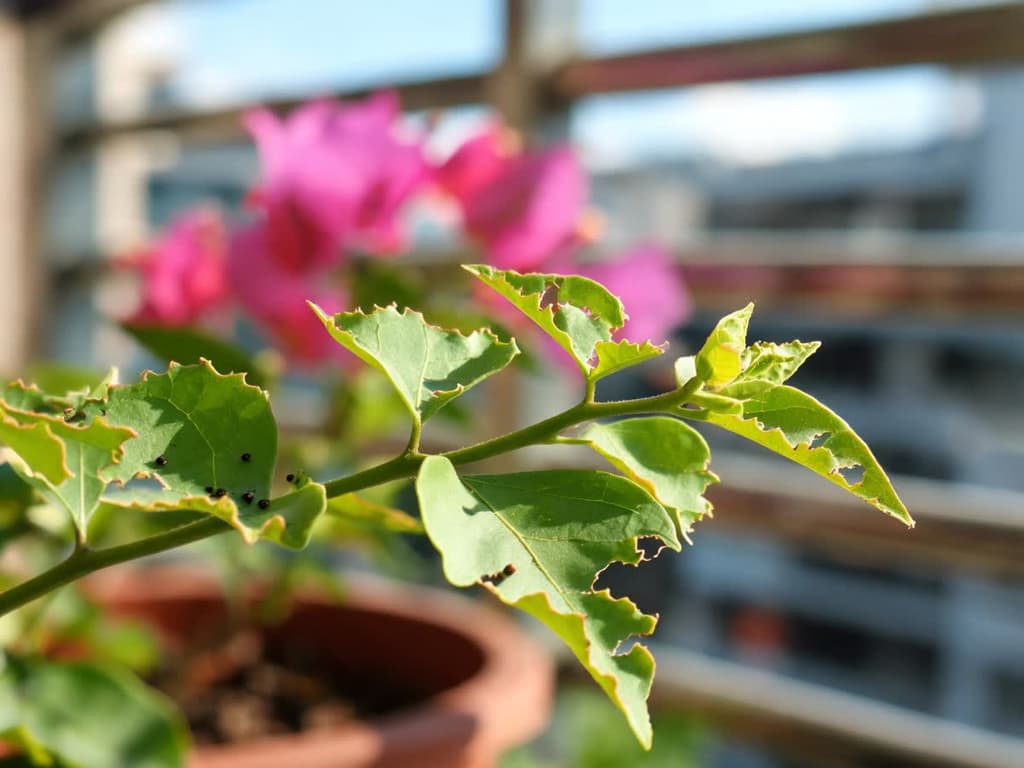
A bougainvillea with chewed leaves, holes, or ragged edges has been attacked by a pest that eats or cuts foliage. Watering mistakes do not make holes in leaves. UC IPM, the pest management program of the University of California, and the University of Hawaii describe the bougainvillea looper. It moves by arching its body into a loop, feeds at night, and leaves small dark droppings on the foliage.
Do not tear off damaged branches: a leafless branch can still be alive. Lightly scrape the bark with your fingernail; if it is green underneath, the branch is alive. Before treating, identify who chewed the leaf by looking at the damage pattern. A smooth, rounded cut on the leaf margin comes from a bee, and that bee should not be sprayed.
Quick summary:
Chewed edges and small dark droppings on the leaves indicate caterpillars. Bacillus thuringiensis (Bt), a bacterium sold as a biological insecticide, controls small caterpillars. The insecticide spinosad controls both small and large ones (UC IPM).
A smooth, circular cut measuring 0.6 to 1.3 cm (1/4 to 1/2 inch) is made by leafcutter bees. They pollinate plants, and insecticides almost never stop the cutting (UF/IFAS, the University of Florida Extension).
Curled or crinkled leaves without holes indicate another problem: sap-sucking pests like aphids or mites.
Which pest ate your bougainvillea leaves: the damage pattern test
The shape of the hole reveals the pest. Check the edge of the damage, the leaves below, and the ground around the pot, and compare them with the table.
What you see on the leaf | Other signs | The culprit |
|---|---|---|
Scalloped chewed edges, chewed new growth | Small dark droppings on the leaves | Bougainvillea looper |
Young leaves tied together into a tube | Caterpillar hidden inside the tube | Leafroller caterpillar |
Smooth-edged circle or oval cut from the leaf margin | No pests visible on the plant | Leafcutter bee |
Irregular hole with smooth edges | Shiny, silvery slime trail | Slug or snail |
Crescent-shaped piece removed from the leaf | Line of ants carrying green leaf fragments | Leafcutter ant |
Large amounts of chewed foliage, ragged look | Grasshopper on the plant or nearby | Grasshopper |
Curled or distorted leaf without holes | Small stationary insects underneath the leaf | Aphid, mite, or other sap-sucking pest |
Sources for each row: bougainvillea looper, slug, and snail from UC IPM. The leafroller caterpillar is from UF/IFAS, and the leafcutter bee from UF/IFAS and Texas A&M. The leafcutter ant comes from a Brazilian review on urban ants (Picanço et al., 2023), and the grasshopper from the University of Hawaii (CTAHR).
If damage appears and you see no pests during the day, inspect the plant at night with a flashlight. The bougainvillea looper feeds at night (UC IPM), and slugs and snails also emerge to feed in the dark (UC IPM).
Bougainvillea looper, the bougainvillea caterpillar
The bougainvillea looper (Disclisioprocta stellata) is smooth, yellowish, green, or brown, and reaches up to 2.5 cm (1 inch) long. The name "looper" comes from the way it moves. It arches the back of its body up toward its head to make a loop, then moves its front legs forward. The adult is a gray or brown moth with a wingspan of about 2.5 cm (1 inch), according to UC IPM.
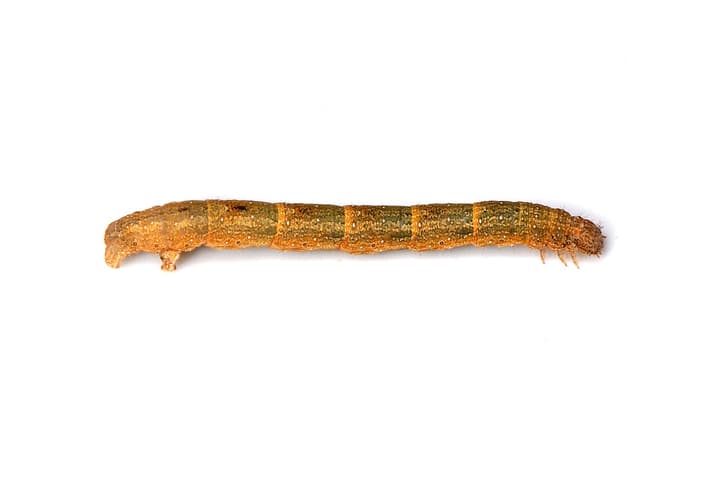
Young caterpillars feed on tender shoots and the margins of leaves, leaving scalloped edges. Older caterpillars eat mature foliage. A heavy infestation can almost completely defoliate a bougainvillea, according to UC IPM and the University of Hawaii. The adult moth does not eat leaves.
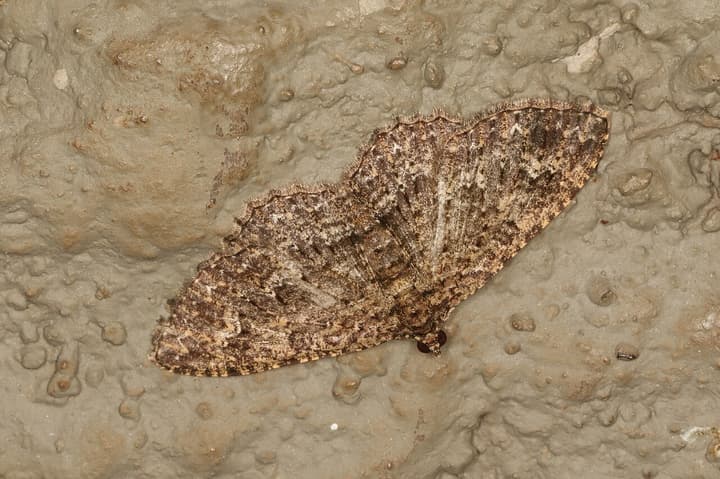
In warm weather, UC IPM recommends checking bougainvilleas frequently for chewed leaves and dark droppings. The source does not give a specific interval: check whenever you water. During the day, when caterpillars hide, dark droppings are the easiest sign to spot.
UF/IFAS mentions another common caterpillar on Florida bougainvilleas, the leafroller. It feeds on new leaves and ties them together into a tube, where it hides from predators. Recommended control involves hand-picking and applying Bt or spinosad according to the label, just as with the looper.
The sources that describe these two caterpillars are from the United States. The looper moth has been photographed in Brazil, but no consulted Brazilian source records the caterpillar attacking bougainvillea here. If you find another caterpillar eating the leaves, Bt still works against small caterpillars that eat the treated leaves (UC IPM).
Circular leaf cuts: the leafcutter bee
Smooth, rounded notches on the margin of bougainvillea leaves are the work of leafcutter bees. According to UF/IFAS, the female cuts circles or ovals measuring 0.6 to 1.3 cm (1/4 to 1/2 inch) across. She carries these leaf pieces away to line her nest. Texas A&M and University of California Cooperative Extension Ventura County list bougainvillea among the plants she cuts, along with roses.
Do not spray your bougainvillea to stop leafcutter bees. They do not eat the foliage they cut, so insecticides almost never prevent the damage (UF/IFAS). The damage affects appearance, but rarely harms the plant. Leafcutter bees are important native pollinators in North America, where these sources originate. No consulted Brazilian source reports this bee on bougainvillea. Ventura County Extension recommends avoiding sprays whenever possible.
If the notches bother you on a small potted plant, cover the entire plant with cheesecloth (a fine cotton fabric), as recommended by UF/IFAS. On large bougainvilleas growing against walls or fences, leave the cuts alone: no treatment is needed.
Slugs, snails, leafcutter ants, and grasshoppers on bougainvillea
Slugs and snails
Slugs and snails chew irregular holes with smooth edges and leave a shiny, silvery slime trail. This trail separates their damage from that of other pests (UC IPM). They prefer tender foliage and are mainly pests of seedlings and herbaceous plants (UC IPM). Because of this, young bougainvillea plants face greater risk than mature specimens. To lure slugs and snails, UC IPM recommends watering the area in the late afternoon. After dark, search for them with a flashlight and gloves, pick them by hand, and discard them in a sealed bag in the trash. In daily care, water near sunrise: the foliage and soil stay wet for less time.
Leafcutter ant
The leafcutter ant cuts crescent-shaped pieces from leaves. In the city, it is a garden and ornamental plant pest, according to a 2023 Brazilian review. It travels along well-defined trails between the nest and the plant (Revista Cultivar). Follow the trail to the nest. Revista Cultivar mentions a poison-free option: a physical barrier on the plant's stem, such as a plastic cone or adhesive tape. The same magazine states that ant bait is one of the most effective methods, because the ants themselves carry it inside the anthill. If you use bait, follow the label and keep it out of reach of cats. Neither of the two sources mentions bougainvillea specifically.
Grasshoppers
Grasshoppers sometimes eat large amounts of foliage and leave the plant looking ragged, according to the University of Hawaii. Against grasshoppers, the University of Hawaii recommends an insecticide registered for this pest: follow the label.
How to treat chewed bougainvillea leaves without harsh chemicals
Start with non-chemical methods and only move to the next step if caterpillars continue feeding.
Hand-pick caterpillars at night. Use a flashlight and gloves, checking near chewed margins and dark droppings. Master Gardeners (trained volunteers with the University of California Cooperative Extension) and UF/IFAS recommend hand-picking.
For small caterpillars, use Bt. Bacillus thuringiensis (Bt) is a bacterium sold as a biological insecticide. It affects caterpillars when they eat treated leaves. Apply it in warm, dry weather and thoroughly coat the leaves where caterpillars feed. About 1 day after eating treated foliage, caterpillars stop feeding (UC IPM).
For large caterpillars, use spinosad. Bt can fail against mature loopers, whereas spinosad works on both small and large caterpillars (UC IPM). None of the consulted sources defines what size counts as large. When in doubt, use spinosad. The University of Hawaii classifies spinosad as an organic insecticide.
Spray spinosad in the late afternoon. The University of Hawaii recommends spraying when caterpillars and moths are active at the end of the day. For Bt, UC IPM only requires warm, dry weather.
Follow label rates. None of the consulted sources gives a specific dose of Bt or spinosad formulated specifically for bougainvillea.
Is Bt harmful to cats?
Bt has very low toxicity to humans and other mammals, according to NPIC. NPIC is the National Pesticide Information Center at Oregon State University. Mammals lack the enzymes and gut receptors that caterpillar digestive systems use to activate the toxin. Some Bt formulations have caused eye and skin irritation. On leaves, half of the Bt degrades in 1 to 4 days, according to NPIC. No consulted source discusses cats specifically, nor spinosad with cats. The safest option is hand-picking caterpillars. If you apply Bt or spinosad, keep cats away from the plant until the treated foliage dries.
Dish soap is not an insecticide
Dish soap does not replace insecticidal soap, a product made for plants that contains true soap. Dish soap is not true soap and has a variable composition, which is why UF/IFAS advises against using it on plants. Iowa State University adds that dish soap has limited effectiveness against pests and causes much more plant damage than insecticidal soap. For caterpillars, sources recommend hand-picking, using Bt, or using spinosad, rather than soap.
Do chewed leaves grow back?
A chewed piece of a leaf does not grow back, and none of the consulted sources measures how much a bougainvillea resprouts after an attack. To check whether a leafless branch is alive, gently scrape the bark with your fingernail: green underneath means live wood. The scratch test is explained in detail in the guide to bougainvillea winter and frost care. Only prune off sections that are brown or black inside.
Curled leaves without holes: sap-sucking pests
Bougainvillea leaves that are curled, crinkled, or distorted without holes indicate sap-sucking pests like aphids or mites. The Royal Horticultural Society (RHS) lists whiteflies, mealybugs, aphids, and red spider mites among the pests that can attack bougainvillea. The University of Hawaii describes aphids distorting new foliage and mites leaving leaves curled, crinkled, and bronzed.
Sticky foliage with white, cotton-like tufts is a sign of mealybugs. For aphids, the University of Hawaii points to insecticidal soap as the safest, most effective control. Use insecticidal soap made for plants and officially registered in your country: it contains only 1% to 2% actual soap. Do not apply it to drought-stressed plants, in very humid weather, or above 32 °C (90 °F), according to UF/IFAS.
Ants protect aphids and scale insects, and controlling ants helps control these pests (University of Hawaii). The website has a pest page for each of the two bougainvillea species most commonly used in gardens: Bougainvillea glabra pests and Bougainvillea spectabilis pests. Both pages describe aphids and mealybugs, with step-by-step treatment.
How to confirm your plant is a bougainvillea
Bougainvillea is a climbing vine with thorns. The colorful parts of bougainvillea are bracts (modified leaves surrounding the flowers), in groups of 3, according to UF/IFAS. In Brazil, it is also called primavera or três-marias.
Many people inherit the plant with a home and do not know its name. If you are unsure, Bloom (available for iOS) identifies plants from a photo, offering 2 free identifications per month. Photo pest diagnosis is included in the Premium plan.
The guide on how to care for bougainvillea explains the plant's names along with light, pruning, and fertilizer needs. Leaves turning yellow and dropping without any holes usually point to a watering or cold issue. The guide on how to water bougainvillea explains how to distinguish overwatering from underwatering.
Frequently asked questions
Does the bougainvillea caterpillar turn into a butterfly?
The bougainvillea looper turns into a moth, not a butterfly. According to UC IPM, the moth is gray or brown, flies rapidly, and has a wingspan of about 2.5 cm (1 inch). It is active at night. The adult moth does not feed on leaves: all foliage damage comes from the caterpillar.
Are round holes in bougainvillea leaves a disease?
Smooth, circular cuts along the edge of a bougainvillea leaf are caused by leafcutter bees, not a disease. The bee carries the cut circle back to her nest and does not eat the leaf. The damage is purely cosmetic and rarely harms the plant, according to UF/IFAS. Do not apply insecticides, as they almost never prevent the cutting.
Do beetles eat bougainvillea leaves?
None of the consulted sources lists beetles as a bougainvillea pest. Master Gardeners from the University of California, the University of Hawaii, and the RHS list caterpillars, grasshoppers, slugs, snails, and sap-sucking insects. If your damage does not match any entry in the table, inspect the plant at night with a flashlight.
Does neem oil work against bougainvillea loopers?
None of the consulted sources measured whether neem oil (extracted from the neem tree) is effective against this caterpillar. The University of Hawaii lists neem-based products among its management options, alongside Bt and spinosad. The best-documented treatments are Bt for small caterpillars and spinosad for large ones (UC IPM).
Related articles
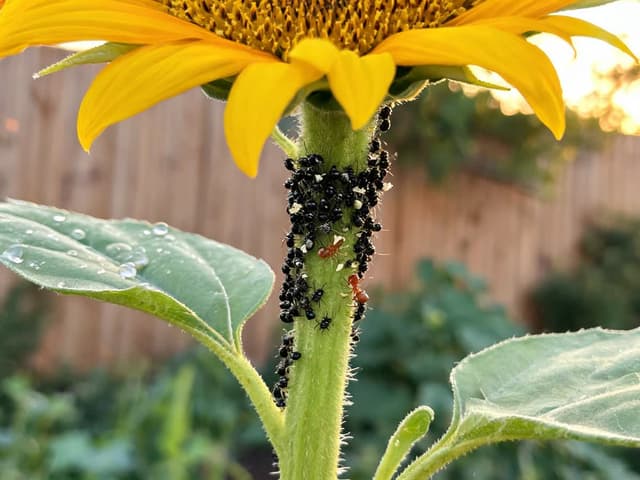
Bugs on Sunflowers: What They Are and What to Do
The bordered patch caterpillar is the main pest among the bugs on sunflowers in Brazil. Learn how to recognize this caterpillar, aphids, leaf beetles, stink bugs, and birds by the damage, when to treat, and when to let the plant finish its cycle.
Yellow Leaves on Sunflowers: Causes and What to Do
Yellow leaves on sunflowers: use the plant's stage and where the yellow sits to tell end of life cycle, watering, low fertilizer, fungus or mites apart, plus the test that confirms each cause.
How to Prune Bougainvillea: When, How Much, and Where to Cut
How to prune bougainvillea: cut after flowering, right above a node, and save hard pruning for when the plant starts growing again. See how much to remove, the three types of pruning, and how to train potted bougainvillea.