Can Camellias Tolerate Cold? Camellia Winter Care
Japanese camellia planted in the ground tolerates frost; in a pot, the roots freeze before the canopy. See how much cold each camellia can handle, where to place the pot, how to water, and what to do with brown buds after a frost.
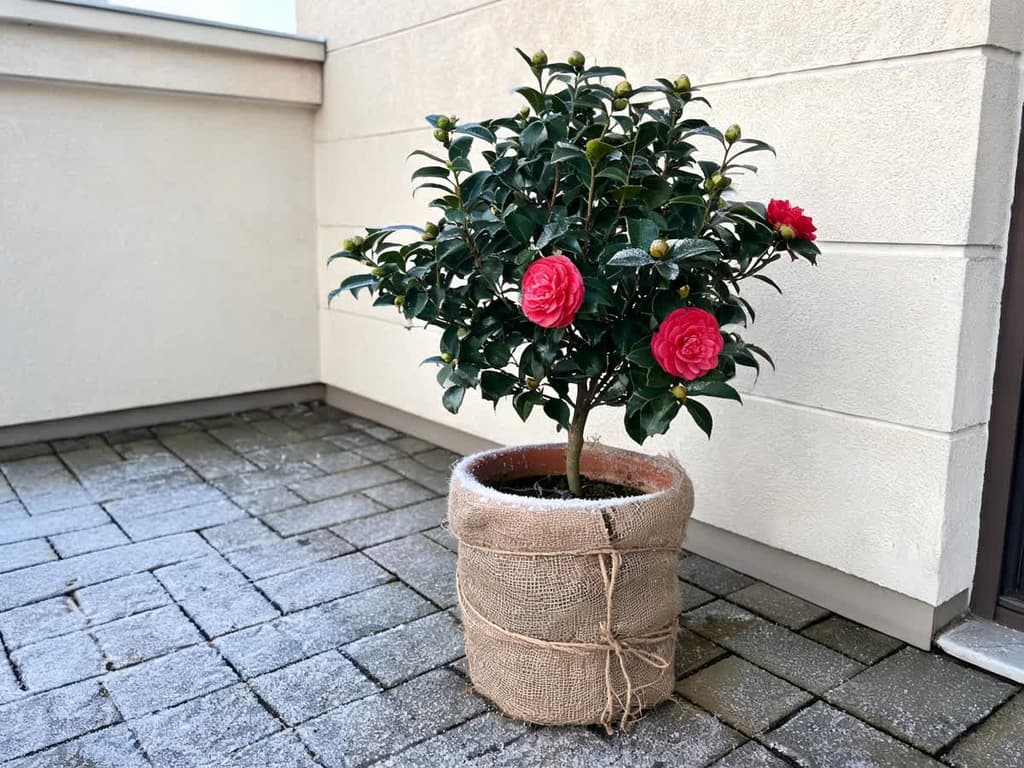
The camellia tolerates cold and frost when planted in the garden. The Japanese camellia (Camellia japonica) withstands −10 to −15 °C in the garden. The figure comes from the Royal Horticultural Society (RHS), the British gardening charity, which groups plants into cold hardiness ratings. In a pot, the roots freeze before the canopy (the top part, with leaves and flowers), and the same plant faces greater risk. The sasanqua camellia, another garden species, is more sensitive to cold than japonica.
In Brazil, camellias in winter face frost from April to September, strongest in June and July, according to Embrapa. Frost is more frequent in the South and in high-altitude regions. This is precisely the period when japonica has buds and flowers. Because of this, winter care here protects the blooms more than the plant itself.
Camellias in winter: how much cold each situation tolerates
Situation | Cold it tolerates | Source | What to do in winter |
|---|---|---|---|
Japanese camellia planted in the ground | −10 to −15 °C (rating H5) | RHS | Mulch (pine bark or dry leaves over the soil) at the base, shelter from the wind, and frost cloth on nights with heavy frost |
Camellia sasanqua planted in the ground | −5 to −10 °C (rating H4) | RHS | Mulch at the base and frost cloth on nights with heavy frost |
Any camellia in a pot outdoors | Less than the same plant in the ground; the roots suffer first | RHS, Iowa State | Protect the pot, push it against a wall without direct sun |
Winter's series hybrids (Camellia oleifera × others) | Little to no damage down to −23 °C (−10 °F) in a sheltered spot | NC State | Same care as japonica in the ground |
Do camellias tolerate frost?
Yes, camellias tolerate frost, and their hardiness depends on the species and where they are planted. The RHS generally classifies camellias as H5, the category for plants that tolerate −10 to −15 °C (14 to 5 °F). Camellia sasanqua falls into rating H4, from −5 to −10 °C (23 to 14 °F).
The RHS hardiness rating table itself (the cold-hardiness list for each rating) makes three caveats for rating H5. Plants that keep their leaves in winter, like camellias, can suffer foliage damage in this cold. Potted plants face greater risk. An open site exposed to wind also increases the risk.
Cold-tolerance figures for camellias vary across websites because they apply to different situations. One applies to a plant in the ground, sheltered from wind; another applies to a pot on an open balcony. This guide follows the RHS, which publishes the range for each rating: −10 to −15 °C (14 to 5 °F) for japonica in the garden. In a pot, protect the plant on every frost night.
Japonica, sasanqua, and hybrids: which camellia tolerates the most cold
Japonica tolerates more cold than sasanqua, according to the RHS camellia growing guide. The two differ by their bloom time. Sasanqua blooms in the fall and winter. Japonica blooms from late winter to early spring, and NC State records cultivars that open as early as fall.
The Winter's series, bred in the United States, has cold hardiness measured and published by a university. NC State Extension is the North Carolina State University (USA) service that guides gardeners and growers. According to it, very cold winters nearly destroyed the japonicas and sasanquas at the US National Arboretum (a public collection of trees and shrubs). Camellia oleifera survived those winters without damage.
Researcher William Ackerman crossed C. oleifera with sasanqua and other species. The hybrids, released in 1991, suffered little to no damage down to −23 °C (−10 °F) in a sheltered spot. They bloom in the fall and bear names such as 'Winter's Snowman', 'Winter's Joy', and 'Snow Flurry'.
When a label or website does not cite the source of its number, count on −10 °C (14 °F) for japonica in the garden. In a pot, protect the plant on every frost night.
Shrub with dark, glossy leaves: is it a camellia?
A shrub with thick, dark, glossy leaves that stay on in winter can be a camellia or another garden shrub with similar foliage. Camellias have leaves 5 to 8 cm (2 to 3 inches) long with lightly serrated margins, according to NC State. The flowers emerge where the leaf meets the branch and are large, often double (with many petals).
Knowing the species changes winter care. Sasanqua tolerates less cold than japonica (rating H4 versus H5), and other similar shrubs have their own rules. Bloom (available for iOS) identifies the plant from a photo of the leaf or flower.
Potted camellias in winter: protect the pot, not just the canopy
In potted camellias, the roots suffer the most from the cold. Iowa State University explains that the roots of most trees and shrubs tolerate much less cold than the stems. In the garden, the surrounding soil protects the roots. In a pot, only the container wall separates the roots from the freezing air.
Protect the pot first, then the canopy. None of the consulted sources measure the exact temperature at which the root ball begins to suffer; to stay safe, protect the container on every frost night. The RHS recommends these measures for potted camellias:
Place the pot against a wall that receives no direct winter sun (in Brazil, a south-facing wall). Another option is a corner sheltered from the wind.
Cover the canopy with plant protection fleece, a lightweight fabric sold at garden centers. The heavy-duty version provides about 2 °C (3.6 °F) of protection, according to the RHS.
During prolonged frost spells, move the pot indoors to a bright, cool space, such as an unheated glass-enclosed porch.
Wrapping the pot itself also protects the roots. Commercial nurseries protect containers in winter with straw or foam boards, according to Rutgers University. At home, use the same principle: wrap the pot with burlap, straw, or bubble wrap and leave the soil surface uncovered so you can water.
Iowa State suggests another option if you have a yard: bury the pot in a garden bed so the surrounding soil protects the roots.
Dry winter winds also damage camellias, and NC State recommends shielding japonica from them. On high, open balconies, place the pot against a wall and behind larger plants that cut the wind.
Where to keep a camellia indoors in winter
If the camellia needs to come inside, choose a bright, unheated spot. The RHS recommends a cold greenhouse (an unheated greenhouse) or a cool, glassed-in porch. Three German gardening websites give different ranges, from 2 to 15 °C, without citing a source. The safest option is the coldest, brightest room in the house, away from any heater. The camellia is a garden plant: the camellia profile marks it as not suitable for indoors.
Keep camellias indoors only during consecutive frost nights. Return the pot to its usual spot once the forecast no longer predicts frost. An enclosed porch or a bright, unheated utility room works well.
Winter sun and wind: why leaves scorch in the cold
Camellia leaves can scorch in winter even without heat. According to Washington State University, roots absorb water slowly in cold soil. The winter sun causes the leaf to lose water faster than the roots can replace it, turning the leaf margins brown.
The damage is greater on the side of the plant that receives sun or wind. WSU cites a plant up against a wall that receives direct sun. In Brazil, this is a north-facing or west-facing wall.
The RHS recommends planting camellias away from cold winds and early morning sun. A good winter location offers partial shade, where a wall or other plants block the morning rays.
How to water camellias in winter
Water your camellia in winter whenever the soil feels dry 10 cm (4 inches) deep. For Rutgers, keeping container soil moist through winter is the most effective way to reduce cold injury to roots. The RHS advises checking the soil at that depth with a trowel; if dry, water until it drains from the bottom hole. WSU recommends watering during dry periods in fall and early winter.
Camellias keep their leaves through winter, and those leaves continue transpiring. WSU highlights plants situated under eaves (the roof edge extending past the wall), where rainfall cannot reach.
A layer of mulch helps retain soil moisture and buffers roots against cold. Clemson University recommends a 5 to 8 cm (2 to 3 inch) layer of mulch over the garden soil. Pine bark and dry leaves work well. In a container, use a layer that fits below the rim so the soil dries more slowly.
Use rainwater if your tap water is hard (high in lime), as recommended by the RHS. Overwatering or underwatering can also trigger bud drop, according to NC State.
Brown buds and falling leaves after a frost
Brown buds right after a frost indicate cold injury to flower buds. WSU explains that unusually low temperatures can kill buds and twigs. Blooms also turn brown along their edges. In contrast, leaves that wilt and curl during freezing weather do so as a protective mechanism and typically return to normal in spring.
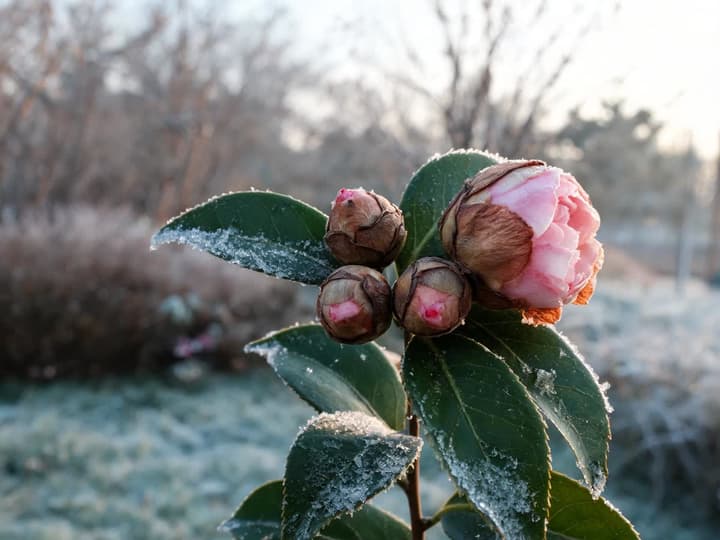
Take these steps if your camellia suffered frost damage:
Gently hand-pick any brown buds that come loose to the touch. Buds killed by frost will not open.
Do not prune in winter. WSU advises waiting until spring to prune. Cut dead twigs back to green wood, the living part of the branch.
Do not fertilize to "help" the plant. WSU recommends avoiding fertilizer and pruning late in the growing season, the time of year when the plant actively grows.
Water whenever the soil dries 10 cm (4 inches) deep and protect the container during subsequent frosty nights.
Not every dropped bud stems from the cold. Clemson University notes that many camellias set more flower buds than they can open, naturally shedding some. The RHS points to another common culprit: dry soil in summer causes buds to drop the following winter.
Fertilizing at the wrong time also drops buds. The RHS recommends not fertilizing camellias after the end of July in the Northern Hemisphere, which in Brazil corresponds to the end of January. NC State says that drought in August and September in the Northern Hemisphere reduces blooms the following year. In Brazil, this corresponds to February and March.
In-ground camellias: frost protection
In frost-prone regions, these care steps protect camellias planted in the ground:
Spread a 5 to 8 cm (2 to 3 inch) layer of mulch over the soil around the base of the trunk.
Plant or maintain the camellia in a spot sheltered from wind and shielded from early morning sun.
On nights with severe frost, drape frost cloth over the canopy.
According to Embrapa, frosts in Brazil are most common from April to September and strongest in June and July. The risk increases with altitude and distance from the Equator. NC State notes that japonica flowering, depending on the cultivar, runs from October to mid-March in the northern hemisphere. In Brazil, this corresponds to April through mid-September.
Frequently asked questions
Can camellias stay outdoors in winter?
Yes, it can. The Japanese camellia planted in the garden tolerates −10 to −15 °C (14 to 5 °F), according to the RHS. In Brazil, frost is most common from April to September, according to Embrapa. In a pot, protect the roots: place the pot against a wall away from direct sunlight, out of the wind, and wrap the container with burlap or straw. On frost nights, also cover the canopy with horticultural fleece.
Can I bring a camellia indoors during winter?
Yes, but only during frost nights and into a bright, cool space. The RHS recommends an unheated greenhouse or a cool glass-enclosed porch. Camellias are outdoor plants. Move the pot back outside once the frost clears, and water whenever the soil dries 10 cm (4 inches) deep.
Why does my camellia drop its flower buds in winter?
The most frequent culprits are dry soil the previous summer, ill-timed fertilization, and frost hitting swollen buds. The RHS links bud drop to summer drought and late-season feeding. Clemson notes that some buds shed naturally because camellias set more buds than they can open.
Do camellias bloom in the winter in Brazil?
Yes. Sasanqua blooms in the fall and winter, according to the RHS. Japonica, depending on the cultivar, blooms from April to mid-September in Brazil. This is the period that NC State records for the Northern Hemisphere (October to mid-March), reversed. The heaviest frost, in June and July, falls right in the middle of this bloom period.
Related articles

How to Care for Hibiscus: Sun, Watering, Fertilizer, and Pruning for Flowers
How to care for hibiscus: 6 hours of direct sun, evenly moist soil without waterlogging, half-strength fertilizer in spring and summer, and pruning in early spring. Find out why the flower lasts one day and why buds drop before opening.

Do Ferns Like Sun or Shade? It Depends on the Type
Ferns prefer bright shade: plenty of light, but no direct sun on their fronds. Tuberous sword fern is the exception that handles sun. Here is the ideal light for each type, where to place pots, and how fronds show too much or too little light.

African Violet Yellow Leaves: Causes and What to Do
Yellow leaves on an African violet usually stem from overwatering, and the first place to check is the center of the plant. Losing one lower leaf at a time is normal. Identify whether age, watering, cold water, sunlight, cold drafts, or fertilizer is the culprit based on the yellowing pattern, and see what to do today.