How to Water Camellias: When, How Much, and What Water to Use
How to water camellias in pots and in the garden: water when the soil dries down to 4 inches and tell apart overwatering from underwatering, especially in summer, when the buds form.
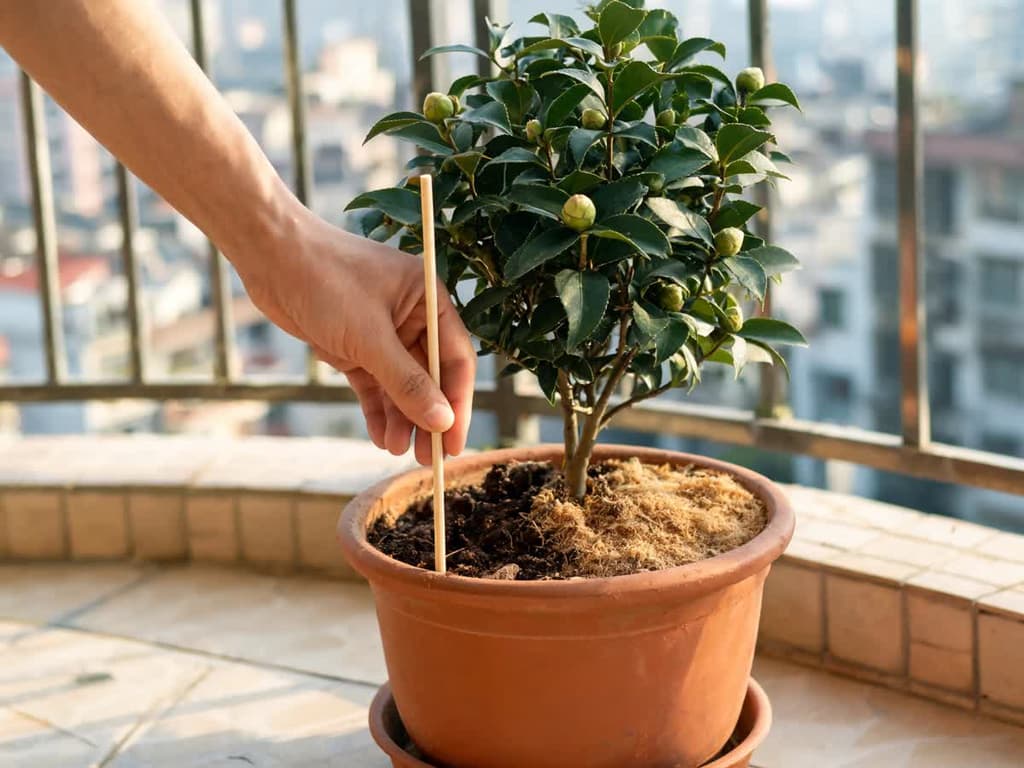
To know how to water a camellia, check the soil, not the calendar. Push a wooden stick 10 cm (4 inches) into the soil. If the soil is dry at that depth, water slowly until water drains through the drainage hole of the pot. That is the test recommended by the Royal Horticultural Society (RHS), the British gardening society. The camellia (Camellia japonica) prefers soil that is consistently moist and never waterlogged.
One care factor that decides flowering is summer watering. Camellias form their fall and winter flower buds in the summer. Dry soil during this stage causes the buds to drop months later. In Brazil, summer runs from December to March.
Quick summary:
Water your camellia when the soil is dry at a depth of 10 cm (4 inches), not on a set day of the week.
In the garden during dry periods, UF/IFAS recommends 25 mm of water every 10 to 14 days (25 liters per square meter).
Dropping flower buds can indicate either overwatering or underwatering. The soil at 10 cm (4 inches) and the root color will reveal which one it is.
Camellia watering by situation
Situation | When to water | How much | Source |
|---|---|---|---|
Container in hot weather | Soil dry at 10 cm (4 inches); check every 2 days | Until water runs out of the drainage hole; empty the saucer | RHS (10 cm test) |
Container in cold weather | Soil dry at 10 cm (4 inches); drying slows down | Until water runs out of the drainage hole | RHS |
Garden, first year and a half after planting | Whenever the soil dries out at 10 cm (4 inches) | Slow watering at the base of the trunk | RHS, Clemson |
Garden, established plant, dry spell | Every 10 to 14 days | 25 liters per square meter | UF/IFAS |
Garden, during flowering | Every rainless week | 25 liters per square meter | UF/IFAS |
How often to water camellias
There is no set day of the week to water a camellia: frequency depends on container size, sunlight, wind, and heat. The RHS uses a test rather than a fixed interval. Check the soil at a depth of about 10 cm (4 inches), and if it feels dry at that level, water thoroughly.
The American Camellia Society (ACS), the American camellia society, summarizes the goal: soil that is consistently moist, but never waterlogged. According to the ACS, irregular watering halts growth and leaves foliage and twigs small. UF/IFAS, the University of Florida extension service, warns of the other side. According to the institution, the camellia is sensitive to overwatering, and the roots rot in soil that is too wet.
The UF/IFAS guide provides numbers for camellias planted in the ground. The camellia tolerates drought reasonably well, but during prolonged drought it needs 25 mm (1 inch) of water every 10 to 14 days. During flowering, the guide calls for 25 mm per week. One millimeter of water corresponds to one liter per square meter. Therefore, 25 mm is 25 liters per square meter of soil around the trunk, about two and a half 10-liter watering cans.
Potted camellias: how to tell when to water
A camellia in a container dries out faster than one planted in the ground because it has less soil to store water. None of the sources cited in this guide provides a set watering frequency for containers, so the standard remains the soil test. Perform the test this way:
Using a wooden stick: push a wooden skewer 10 cm (4 inches) into the soil near the edge of the pot, and wait 1 minute. If it comes out clean and light-colored, water. If it comes out dark with bits of soil clinging to it, the soil is still moist.
Using your finger: your finger can only reach the top few centimeters. Dry soil at your fingertip is your cue to run the stick test.
By weight: lift the container right after watering, and then again a few days later. If the pot feels significantly lighter than it did right after watering, the soil has dried out. With practice, you will learn to gauge this weight.
Water slowly until water drains out of the bottom hole, and empty the saucer. Rain rarely waters container camellias sufficiently. The International Camellia Society (ICS) points out that rain bounces off the canopy and falls outside the pot. Check the soil after every rain shower, even a heavy downpour.
Pot size also affects watering. The ACS says camellias should not go into a pot that is too large. Soil without roots becomes compacted and waterlogged, which promotes root rot. When moving a camellia to a larger container, choose one only slightly larger than the previous one.
Camellias planted in the ground
In-ground camellias require deep, spaced-out watering. The ACS recommends moistening the soil down to a depth of 35 to 45 cm (14 to 18 inches) at each watering. Apply water slowly to the base of the trunk using a gentle stream from a garden hose or a watering can until water stops running off the surface.
A newly planted camellia needs more attention. The RHS instructs to water as needed until the plant establishes, which takes about 18 months. Clemson University states that competition for water with neighboring plants is the critical challenge during this initial period.
Mulch (a layer of pine bark, dry leaves, or straw over the soil) retains moisture. Clemson recommends 5 to 8 cm (2 to 3 inches). The ACS adds two caveats. Do not use peat moss (dark moss sold in bags), which dries out and then repels water. And do not exceed the recommended depth: a layer that is too thick keeps the soil wet and encourages root rot.
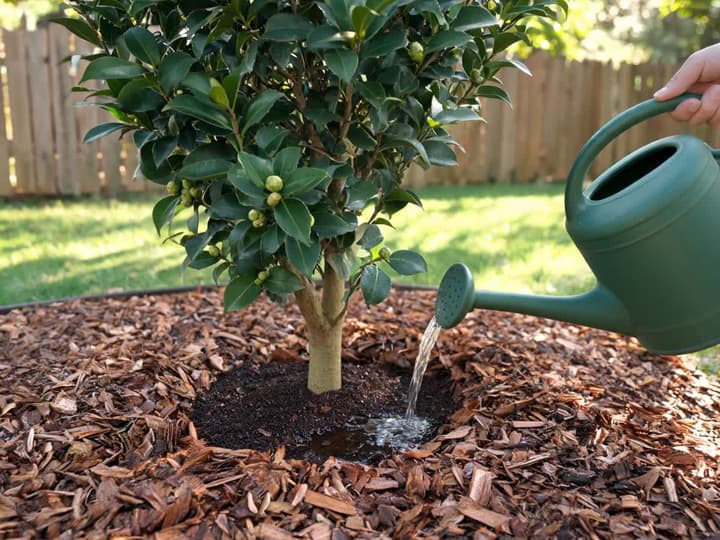
An older shrub that came with your home and shows dry leaves during warm weather may be thirsty or suffering from root damage. Before watering, push a stick 10 cm (4 inches) into the soil. If it is dry, water deeply, apply mulch, and check the soil again in 3 days.
Summer watering determines winter blooming
The camellia forms flower buds in summer, and dry soil during this period causes the buds to drop before opening. The RHS instructs to keep camellias well watered through summer, because this is when they produce next year's flower buds. The ICS states that most buds form from midsummer onwards on new growth. A lack of water from then on can cause buds to drop and leave the plant without flowers.
The effect appears with a delay. The RHS states that dry soil in late summer or early spring can cause the bud to drop before opening. Clemson also links bud drop to a lack of water in summer. In Brazil, late summer runs from February to March, and early spring from September to October. A camellia that went thirsty in late summer may only drop its buds in autumn, once they are already large.
A French fertilizer brand, Algoflash, recommends the opposite. It advises reducing watering when the buds appear and watering very little afterward, without letting the soil dry out completely. This guide follows Clemson and NC State universities, which link summer drought to bud drop and poor blooming. The RHS and the ICS, gardening and camellia societies, call for consistent watering during this phase.
In summer, check the soil of potted camellias every 2 days. Water as soon as the top 10 cm (4 inches) dry out, without waiting for the plant to wilt.
Overwatering vs. underwatering camellias: how to tell them apart
Both overwatering and underwatering cause camellia buds to drop and leaves to turn yellow, so the symptom alone does not reveal the mistake. The NC State Extension is the extension service of North Carolina State University. According to the service, bud drop can be natural or result from too much or too little water. What separates overwatering from underwatering is the soil at 10 cm (4 inches) and the roots.
Sign | Overwatering | Underwatering |
|---|---|---|
Soil at 10 cm (4 inches) | Soggy days after watering; standing water in the saucer | Dry and crumbly |
Leaves | Uniformly yellow, small, or limp; dying branch tips | Wilted and drying, especially in sunlight |
Leaf underside | Spots that turn into corky scabs | No marks |
Buds | Drop or open very slowly | Drop, sometimes weeks or months after drought stress |
Roots | Brown and mushy | White and firm, surrounded by dry soil |
The ACS lists the first signs of root rot: yellow leaves, smaller or limp leaves, and branch tips dying back. Buds dropping or opening slowly are also on the list. The ICS lists other causes of yellow leaves: excessively alkaline soil, lack of fertilizer, and strong sun. Each yellowing pattern is described in camellia with yellow leaves. Crusty spots on the underside of the leaf are edema. According to the RHS, the roots draw up more water than the leaves can release as vapor, and the cells burst.
A camellia with root rot can wilt in warm weather, even after receiving water. The ACS explains that diseased roots degrade during cold, wet weather, but the plant only collapses once the weather turns hot and dry. Wilting combined with wet soil points to root damage. Wilting in dry soil may simply mean thirst: if watering does not revive the plant, inspect the roots.
Brown leaf edges and tips
A camellia leaf with brown tips and edges usually means too much fertilizer, not too much water. The ICS calls this pattern a classic sign of over-fertilization and advises watering thoroughly to flush out the excess. The Connecticut Agricultural Experiment Station states that camellias are very sensitive to salt buildup in container soil. This salt consists of fertilizer residues the plant did not absorb. The sign of this salt is a white crust on the rim of the pot or on the soil surface.
To flush out the salt, remove the pot from the saucer and place it in the sink or laundry tub. Let water run slowly through the soil for about 20 minutes, as recommended by the Connecticut station. If the salt returns quickly, change the soil and the pot. The brown spot in the center of the leaf has another cause. The ICS links this damage to frost, wind, or very strong sun.
"I watered more, then less, and nothing changed"
Swapping between heavy soaking and extended dry spells worsens a camellia's health. The ACS explains that soggy soil and hard, parched soil both damage roots, and irregular watering disrupts overall growth. Do not stop watering abruptly to experiment. Follow the 10 cm (4-inch) test before each watering for 3 weeks, and only then assess the outcome.
Potted camellia dropping yellow leaves: can it still be saved?
You can save your camellia as long as the roots remain white and firm. Carefully slide the plant out of its pot and examine the fine roots around the edge of the root ball (the cluster of soil and root mass). White, firm roots are alive. Brown, mushy roots that shed their outer layer when gently pulled have rotted.
Camellia root rot comes from Phytophthora, a fungus-like soil organism. The ACS says that potted camellias are very susceptible and that the disease is much more severe in poorly drained soil. The organism releases spores that swim through the water in the soil, from one root to another.
If the roots are still white, follow these steps:
Stop watering until the top 10 cm (4 inches) of soil have dried out.
Empty the saucer and ensure the drainage hole on the pot is unobstructed.
Do not apply fertilizer: the ICS compares feeding a sick plant to serving a heavy feast to an invalid.
Resume watering based on the 10 cm (4-inch) test and wait for new shoots to emerge, which may take several weeks.
If a large portion of the root system has turned brown, the ACS recommends discarding both the soil and the pot from the diseased plant. Move the camellia into a fresh pot of identical size using fresh, loose, well-draining soil. Do not throw the plant away simply because it shed its leaves. According to the ICS, if leaf loss was triggered by excessive fertilizer, the camellia can push new growth once the excess salts wash out of the soil.
Rainwater or tap water: camellias and hard water
Rainwater is best for camellias, and tap water works when the rain runs out. The ICS explains that rain is slightly acidic, which suits the camellia, an acid-soil plant. The RHS advises against watering for long periods with hard water, which is tap water high in lime.
Lime is the mineral responsible for leaving a white chalky crust inside tea kettles. The RHS offers this warning when addressing alkaline soils: in high-pH conditions, camellias suffer from iron and manganese deficiencies. NC State describes the symptom: yellow leaves with prominent green veins. This condition is chlorosis (leaf yellowing from nutrient deficiency), which is treated by applying chelated iron to the soil. Chelated iron is a form of iron readily absorbed by plants, sold in garden centers.
Even so, never let your camellia dehydrate simply because you have run out of rainwater. The ICS reassures growers dealing with alkaline tap water that any water is better than no water, since drying out causes far more severe damage. Use tap water and switch back to rainwater whenever possible. The azalea, another acid-loving plant, follows the exact same guideline: use rainwater whenever feasible, and tap water when the rain runs out.
In Brazil, the amount of lime in tap water varies from city to city, and it is impossible to generalize. Decree 5,440/2005 requires water utility companies to inform consumers about water quality. The annual report from Águas do Rio for Mesquita, for example, lists turbidity, chlorine, color, and coliforms, but not lime. To find out the hardness of your water (the amount of lime), request the complete analysis from customer service at your utility company.
A household clue helps: white crust on the kettle and showerhead indicates hard water. In that case, store rainwater in a covered bucket and use tap water only when the rainwater runs out.
How to water camellias, step by step
Check the soil at 10 cm (4 inches) using a wooden stick. Water only if the soil is dry at that depth.
Water at the base of the trunk, pouring slowly without wetting blooms or buds. For pots, water until it drains out the base; in garden soil, water until the ground is moist 35 to 45 cm (14 to 18 inches) deep.
Empty the saucer once drainage water stops dripping through.
Water in the late afternoon or early evening during hot spells, when evaporation rates are lowest. The ICS mentions irrigation systems being run at night in hot, arid climates.
Never fertilize a plant in dry soil. The ACS cautions against fertilizing camellias growing in parched soil. UF/IFAS recommends watering thoroughly both before and after applying fertilizer.
Watering camellias in winter
In winter, the blooming season for camellias, the soil still needs moisture. In pots, use the 10 cm (4-inch) test: in the cold, the soil dries more slowly and waterings are spaced further apart. In the garden, during flowering, UF/IFAS calls for 25 mm (1 inch) per week without rain. On frosty nights, protect the roots of container camellias: the step-by-step instructions are in winter camellia care.
Dark green shrub in the garden: is it really a camellia?
People who inherit a garden do not always know that the shrub with dark, glossy leaves and pink flowers is a camellia. Bloom (available for iOS) identifies the plant by photo, and the free plan includes 2 identifications per month and a watering schedule. Use the schedule as a reminder to perform the soil test. Once the species is confirmed, the camellia requires partial shade and acidic soil, as shown in the complete camellia care guide.
Frequently asked questions
Do camellias need a lot of water?
Camellias need soil that is consistently moist but never soggy, according to the ACS. In the garden, UF/IFAS recommends 25 liters per square meter every 10 to 14 days during dry periods and weekly during flowering. In containers, water when the soil dries out to a depth of 10 cm (4 inches).
Should I stop watering a camellia that is dropping buds?
Do not stop watering a camellia dropping its buds before testing the soil. NC State explains that buds drop from both excess and insufficient water. If the soil is dry at 10 cm (4 inches), water thoroughly. If it is soggy, let it dry out and inspect the roots. The buds that have already dropped will not grow back for this flowering cycle.
Can I mist camellia leaves with water?
Misting the leaves does not water a camellia, because water must reach the root system. Truffaut, a French retailer, suggests misting; Willemse, another retailer, advises against wetting the leaves and flowers. This guide follows Washington State University: the pathogen causing petal blight flourishes in cold, damp conditions. Apply water strictly to the soil.
How do you water a camellia indoors?
The camellia is a patio and garden plant, and the camellia care guide does not recommend growing it indoors. If it must stay inside for a few days, place the container in a bright, cool spot away from heaters and air conditioning units. Water using the same 10 cm (4-inch) test and empty the saucer.
Conclusion
A well-watered camellia has consistently moist soil: water as soon as the top 10 cm (4 inches) dry out, soak deeply, and empty the saucer. One care step that determines blooming is summer watering, when the buds form. Today, push a stick into your camellia's soil and use it to decide when to water next.
Related articles

How to Care for Hibiscus: Sun, Watering, Fertilizer, and Pruning for Flowers
How to care for hibiscus: 6 hours of direct sun, evenly moist soil without waterlogging, half-strength fertilizer in spring and summer, and pruning in early spring. Find out why the flower lasts one day and why buds drop before opening.

Do Ferns Like Sun or Shade? It Depends on the Type
Ferns prefer bright shade: plenty of light, but no direct sun on their fronds. Tuberous sword fern is the exception that handles sun. Here is the ideal light for each type, where to place pots, and how fronds show too much or too little light.

African Violet Yellow Leaves: Causes and What to Do
Yellow leaves on an African violet usually stem from overwatering, and the first place to check is the center of the plant. Losing one lower leaf at a time is normal. Identify whether age, watering, cold water, sunlight, cold drafts, or fertilizer is the culprit based on the yellowing pattern, and see what to do today.