How to Make Camellias Bloom and Stop Bud Drop
Camellia buds form in late spring and drop when the soil dries out in late summer. Learn the timing in Brazil, cited causes, and how to tell cold damage, drought, and fungus apart on brown buds.
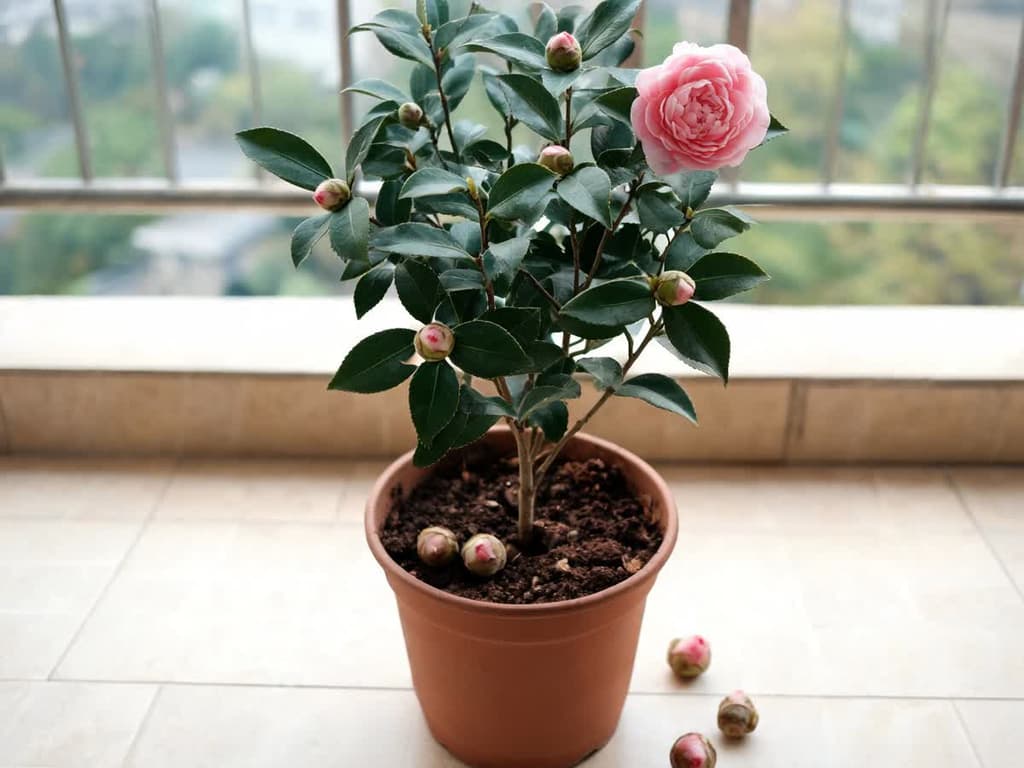
To make a camellia bloom, care for it from late spring through fall, not during winter. The buds that open in fall and winter start developing in late spring and grow throughout the entire summer. The most frequently cited reason camellia buds drop before opening is dry soil during this growth window, especially in late summer.
Three practices target the most cited causes. Keep the soil consistently moist, without waterlogging, from November through May (in Brazil). Prune only right after blooming and stop fertilizing at the end of January.
Quick summary:
The camellia (Camellia japonica) bud begins forming from May to July in the Northern Hemisphere, with 90% of it forming in June. In Brazil, the same stage falls between November and January.
Dry soil in late summer is the cause of bud drop cited by four university fact sheets and the RHS. In Brazil, late summer runs from February to March.
Pruning after early summer cuts away the buds set for the next bloom cycle. Heavy pruning that removes one-third to one-half of the plant usually leaves the camellia with few flowers for 1 to 2 years.
Can a camellia that drops its buds be saved?
In most cases, yes: the plant survives, but dropped buds will not come back during the current bloom cycle. Camellias only set new buds in late spring of the following year. Because of this, fixes apply to the next bloom cycle, and your first step is deciding what not to do right now.
Do not prune the plant to "give it strength." NC State Extension warns that pruning late in the year sacrifices the following year's flowers. Extension is the public outreach service of American universities, and this one belongs to North Carolina State University. Also, do not repot the plant or waterlog the soil to compensate.
Look at the leaves and the soil first. Bud drop with firm, green leaves usually points to an issue with water, temperature, or too many buds, and the plant remains fine. Bud drop alongside yellow leaves on your camellia and soil that has stayed wet for days requires a different investigation. In that situation, if the plant is in a pot, remove it and check the roots. Dark, soft roots signal Phytophthora root rot, which is caused by a soil microorganism that attacks waterlogged roots.
Some drop is normal. The Clemson Cooperative Extension, from Clemson University (USA), writes in its camellia factsheet that many camellias set more buds than they can open. Losing a bud or two from a full branch does not signal disease.
When camellias form buds and when they bloom
The camellia forms buds about 7 to 9 months before opening, according to a study in a Chinese city. A 2025 study in the journal International Journal of Molecular Sciences tracked Camellia japonica in Hangzhou, China. The buds formed only from May to July, 90.08% of them in June, and opened from January to March.
A 2015 study in Frontiers in Plant Science describes the same sequence. The bud begins in late spring and grows visibly through fall. All sources in this guide come from the Northern Hemisphere. In Brazil, the seasons arrive roughly 6 months apart. The RHS (Royal Horticultural Society of the United Kingdom) indicates this same difference for the Southern Hemisphere. In the table, the Brazil column adds these 6 months to the dates from the sources.
Camellia stage | Northern Hemisphere (source) | In Brazil (conversion) |
|---|---|---|
Buds begin to form | May to July, 90% in June (IJMS 2025) | November to January |
Buds grow and become visible | Through fall (Frontiers 2015) | Through fall, March to May |
Drought that causes the most bud drop | Late summer; August and September (RHS; NC State) | February and March |
Sasanqua camellia bloom period | October to December (UF/IFAS) | April to June |
Japanese camellia bloom period | December to March (UF/IFAS) | June to September |
Pruning | Right after flowering or in early summer (NC State) | Right after flowering, December at the latest |
Fertilizer | In spring, never after late July (RHS) | September through late January |
The species changes the calendar. Sasanqua camellia (Camellia sasanqua) blooms earlier, in the fall. Japanese camellia (Camellia japonica) blooms from winter to early spring, according to UF/IFAS, the University of Florida extension. Each plant stays in bloom for 3 to 4 weeks in Japanese camellias and 4 to 6 weeks in sasanquas, according to NC State fact sheets. NC State also records Japanese varieties that start blooming as early as October in the north, which corresponds to April in Brazil.
Sasanqua camellias have smaller leaves, simpler blooms, and tolerate more direct sun than Japanese camellias:
If you inherited the plant and do not know the species, the Bloom app (available for iOS) identifies plants from a photo. The species determines when yours should bloom and how much light it tolerates.
Why camellia buds drop before opening
Camellia buds drop before opening for seven sourced reasons. Five sources identify a lack of water in late summer as the most frequently cited cause. Clemson lists nine causes in its camellia diseases and insect pests factsheet, and the RHS compiles the most common ones in its camellia frequently asked questions.
Cause | Sign on the plant | Reported by |
|---|---|---|
Dry soil in summer | Buds turn brown and drop closed during blooming season | RHS, NC State, Clemson, UF/IFAS (2 fact sheets) |
Overwatering or poor soil drainage | Buds drop and leaves turn yellow; soil stays wet for days | NC State, UF/IFAS, Clemson, CT CAES |
Severe cold or frost | Brown buds fall without opening; petal edges appear scorched | RHS, Clemson, UF/IFAS |
Unseasonable heat | Early varieties fail to bloom; buds open only halfway | UF/IFAS, Clemson, CT CAES |
Excess or late fertilizer | Buds turn brown and drop before opening | RHS, CT CAES |
Too many buds | A portion of buds in each cluster dries up and drops | UF/IFAS, Clemson |
Bud mites | Buds drop before opening, with no other apparent cause | UF/IFAS, Clemson |
Dry soil in late summer
Dry soil is the most cited cause. The RHS states that dry soil in late summer or early spring causes buds to abort. NC State says drought in August and September (February and March, in Brazil) inhibits the next bloom. A UF/IFAS extension agent wrote in 2015 that drought is the primary stress preventing buds from opening.
The effect shows up with a delay. The plant suffers from drought in February and only drops its buds months later, once they are already large. Because of this, watering more after dry periods will not rescue buds already damaged back in February. The watering that protects the buds happens from November through May.
The American Camellia Society, a US growers' association, summarizes the goal: soil always moist, never soggy. In the 1999 fact sheet from UF/IFAS, Professor Edward Gilman adds that periods of very low air humidity also cause buds to drop.
Excess water and waterlogged roots
Waterlogging the soil also triggers bud drop, but it appears less often in sources than drought. NC State and UF/IFAS cite both extremes, putting greater weight on water deficiency. Clemson includes poor drainage among the causes.
In containers, waterlogging gets worse over time. The RHS explains that potting soil loses its structure over time and starts holding too much water. Repotting at the right time avoids waterlogging. The RHS also warns against oversized pots, which can lead to root rot.
Severe cold, frost, and morning sun after frost
Buds tolerate less cold as they swell. UF/IFAS explains that buds become more sensitive to freezing when they begin swelling, and even more so when they start opening. Cold-damaged buds fail to open. The RHS states that winter cold can turn buds brown and cause them to drop. For sensitive varieties, it recommends protective fleece, such as horticultural fabric.
After a frosty night, plants hit by early direct sun suffer much more, according to the RHS. Where frost occurs, keep camellias in a sheltered spot away from early morning direct sun. No extension service provides an exact temperature at which Japanese camellia buds die.
Unseasonable heat
Unseasonable heat disrupts blooming, and this effect hits early-blooming varieties most reliably. UF/IFAS notes that a warm fall can prevent early varieties from blooming properly. In late-blooming varieties, the plant may begin putting out new shoots before flowering finishes. When this happens, flowers fail to open fully or fall off while still closed. In English, this defect is called bullnosing.
Cold temperatures also play a role in opening. In the 2015 study, chilling between 2 and 7 °C helped buds break dormancy and open. Dormancy is the pause in bud growth. The same study points out that warm spells in late fall and winter can keep buds from receiving the chill hours they require. Extended cold, on the other hand, reduced flower size and longevity. The trial used potted plants inside a cold room and does not establish a universal rule for gardens.
Too much fertilizer or fertilizing at the wrong time
The RHS says excessive or late fertilization also causes bud drop, and advises against fertilizing camellias after the end of July. In Brazil, the Northern Hemisphere's end of July corresponds to the end of January. UF/IFAS takes the same line: fertilizer in late summer or fall produces tender shoots that the first cold burns.
Not every source agrees. The American Camellia Society allows fertilizing until September (March, in Brazil), switching to a fertilizer higher in potassium. This guide follows UF/IFAS and the RHS: both link late fertilization to plant damage. UF/IFAS is a university extension, the RHS is a horticultural society, and the American Camellia Society is a growers' association.
Too many buds on the same branch
Many camellias produce more buds than they can open, according to Clemson and UF/IFAS. A UF/IFAS extension agent explains that when overloaded with buds, the plant lacks the reserves to open them all. Some of them dry out and drop, and this drop does not indicate disease.
Moving containers when buds are set
Gartenjournal, a German gardening website, advises against frequent location changes once a camellia has buds. No university extension service has measured this effect. Clemson lists wide temperature swings as a cause of bud drop. Moving a plant from a cold spot to a warm spot triggers that swing. Choose a permanent spot before November, when buds start forming, and leave the container there until flowering ends.
Bud mites
The camellia bud mite (a microscopic pest related to spiders) appears on Clemson's list and in Gilman's UF/IFAS fact sheet. It infests buds and makes them drop before opening. Neither source describes a home diagnostic method or treatment. Consider mites only after ruling out water, cold, and fertilizer issues.
Brown buds or flowers: cold, drought, or fungus
Brown buds that drop while closed usually stem from summer drought or severe cold. Clemson describes browning at the tip of young buds as a symptom of bud drop. Meanwhile, open flowers that turn brown stem from three main causes: frost, gray mold, and a fungal disease specific to camellia petals.
Frost is the most common cause of brown flowers, according to the RHS. The shape of the discoloration helps distinguish frost from fungal infections:
Frost: browning stays on petal edges after a cold night.
Petal blight (*Ciborinia camelliae*): begins as brown specks anywhere on the petal, with darkened veins. A white or gray ring of fungal growth appears at the base of the petals, and the flower drops within 24 to 48 hours.
Gray mold: also starts as brown specks anywhere on the petal, but without the white ring at the base.
NC State describes petal blight as browning that advances from the edges toward the center. When in doubt, look for the white or gray ring at the base of the petals and the darkened veins, which frost never produces (RHS and Clemson).
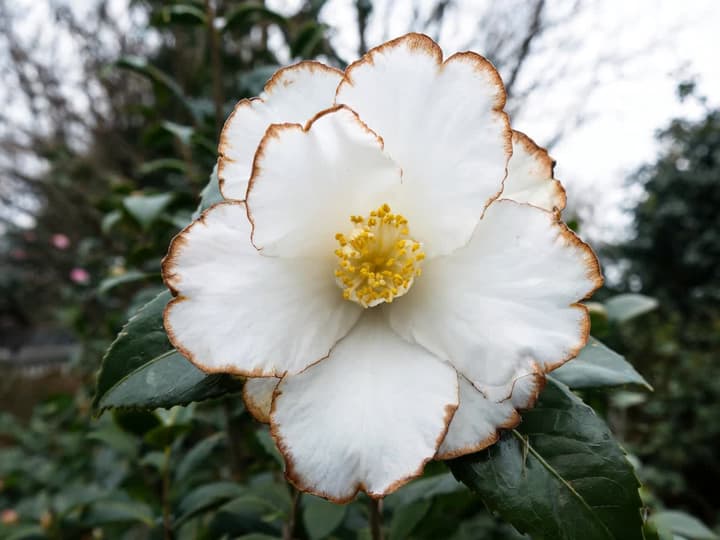
The description of petal blight comes from the RHS and Clemson. The fungus only attacks flowers and does not harm the plant's long-term health, according to the American Phytopathological Society. Camellia sasanqua almost always escapes, because it blooms before the time when the fungus releases spores. Gray mold also attacks camellias:
Against petal blight, sanitation works better than any chemical product, according to the American Phytopathological Society. Gather all fallen blooms from the ground and discard them in the trash. The fungus survives up to 5 years in the soil, according to the RHS. After blooming finishes, clear out the layer of leaf or bark mulch and lay down 2.5 to 5 cm of fresh mulch.
Camellias that fail to form buds: light, pruning, and age
Camellias that form no buds at all usually suffer from insufficient light, pruning at the wrong time, or recent hard pruning. NC State states that excessive sun, severe cold, or deep shade reduces flowering. UF/IFAS reports that heavy shade produces sparse foliage and few flowers.
Light requirements for camellia blooming
Japanese camellias bloom best in partial shade, with filtered sunlight from trees or direct sun for only part of the day. Sasanqua camellias tolerate more sun, according to the RHS and UF/IFAS, but also prefer shelter from intense afternoon sun. Clemson notes that mature plants handle full sun once their canopy shades their own roots. In an apartment, choose a balcony where the container receives filtered light or direct sun for just part of the day. No sources have evaluated camellias grown indoors.
Pruning at the wrong time
Camellias bloom on old wood, so pruning at the wrong time removes flower buds. NC State advises pruning right after flowering or in early summer. UF/IFAS states that pruning in late summer or fall removes buds. In Brazil, prune as soon as the flowers finish and complete all pruning by December at the latest.
The American Camellia Society defines severe pruning as taking off one-third to one-half of the plant. After such pruning, camellias typically spend the following season with few or no buds, returning to normal bloom in the second season. The RHS provides a longer recovery window: after hard pruning, it takes two years or more before the plant blooms well again. This guide uses the RHS timeframe, as it is the safest estimate: plan on 2 years.
Young or newly planted specimens
No extension service provides an exact age for a Japanese camellia's first bloom. NC State characterizes the species as slow-growing and slow to establish roots. The RHS recommends watering newly planted garden camellias whenever the soil starts drying out during their first 18 months, until they establish.
Care calendar to make camellias bloom in Brazil
Camellias bloom reliably with four seasonal tasks, each carried out at its proper time of year. The months below apply to Brazil, converted from Northern Hemisphere references.
Right after flowering (sasanqua: typically June and July; Japanese: September and October; varies by cultivar): complete any pruning needed for shaping and remove dead wood. Finish all pruning by December at the latest.
From early spring through late January: fertilize without exceeding the package rate. In the garden, UF/IFAS recommends roughly 225 g of 12-4-12 fertilizer per 9 m² of planting bed. UF/IFAS advises one or two applications per year, using equal proportions of nitrogen and potassium with low phosphorus, such as a 12-4-12 blend. On the label, the first number represents nitrogen and the third represents potassium. The second and third numbers on the label are declared as phosphate and potash, rather than pure elemental forms. The guide on how to read the three fertilizer numbers explains the calculation. Do not apply fertilizer after late January.
From November to May, when buds develop and expand: keep the soil consistently moist without waterlogging. In pots, water as soon as the soil surface feels dry to the touch, until water drains through the bottom hole, and empty the drip tray. In the garden without rain, UF/IFAS advises about 25 mm of water every 10 to 14 days. During flowering, in the garden without rain, the same source recommends roughly 25 mm weekly.
In fall and winter, with enlarged buds: keep the container in the same spot. On freezing nights, protect the plant with frost fleece. Gather any fallen flowers from the ground.
Camellias thrive in acidic soil, much like azaleas. NC State recommends a pH between 5.5 and 6.5 (the lower the number, the more acidic the soil). Clemson and the RHS suggest specialty fertilizer formulated for azaleas and camellias (acidifying fertilizer). UF/IFAS recommends this type only for well-established garden specimens, not for young plants or container-grown camellias. For those, follow UF/IFAS, as a university extension service, and use the 12-4-12 fertilizer described in step 2.
Bud thinning: when it is worth doing
Bud thinning means removing some flower buds from a cluster so the remaining ones open larger. UF/IFAS notes that growers preparing camellias for flower shows thin out extra buds on each cluster. These competitive growers also apply gibberellic acid, a plant hormone, to produce larger, earlier blooms. No university extension service recommends bud thinning specifically to stop bud drop.
The Southern California Camellia Society (SCCS), which brings together growers who compete in shows, offers three practical guidelines in its text on disbudding:
Thinning too early prompts the plant to set a replacement batch of buds where the old ones were removed.
Flower buds usually break away easily when twisted, whereas leaf buds resist.
On sasanqua camellias and varieties grown for a mass flowering display, disbudding provides virtually no benefit.
No source specifies a set number of buds to leave per branch. If your camellia sheds part of its bud clusters every year, the safest route is minimal thinning: in fall, pinch off only the smallest buds in each cluster by hand and leave the largest ones.
Frequently asked questions
Should I deadhead wilted camellia flowers?
Yes, deadheading spent blooms is helpful, and picking up flowers that drop onto the ground is essential. Fallen, infected flowers leave petal blight survival structures in the soil that persist for up to 5 years, according to the RHS. Discard spent flowers in the trash. Pruning branches is a separate task: perform it only right after flowering finishes.
Do camellias bloom twice a year?
No. NC State factsheets describe one blooming season per year. Each plant stays in bloom for 3 to 4 weeks for Japanese camellias and for 4 to 6 weeks for sasanquas. The season seems long because varieties bloom at different times. In Brazil, sasanqua camellias open in fall and Japanese camellias from winter to early spring.
Can camellias tolerate full sun?
Japanese camellias bloom best in partial shade, and excess sun decreases bloom production, according to NC State. Sasanqua camellias tolerate more sun, but perform best protected from harsh afternoon sunlight, according to UF/IFAS. Clemson notes that mature plants handle full sun once their own foliage shades the root area.
Can I water camellias with tap water?
Yes, provided your municipal tap water is not excessively hard (rich in calcium, which leaves a white crust inside kettles). Camellias require acidic soil, and according to the RHS, they can suffer iron deficiency in alkaline soil (the opposite of acidic). Because of this, the RHS advises against prolonged watering with hard tap water and prefers rainwater. Yellow foliage with green veins indicates this iron deficiency.
Conclusion
To make camellias bloom, the work takes place from November to May, in Brazil. Keep the soil consistently moist without waterlogging while the bud forms and grows. Prune only right after flowering and stop fertilizing at the end of January. If the buds have already dropped, the plant usually stays alive: note the month they dropped and correct your watering before next summer.
Camellias thrive outdoors in the garden or on the patio:
Sources
RHS. Camellia: frequently asked questions; Camellia growing guide; Camellia flower blight.
NC State Extension. Camellia japonica; Camellia sasanqua.
Clemson Cooperative Extension. Camellia (HGIC 1062); Camellia diseases and insect pests (HGIC 2053).
UF/IFAS. Camellias at a glance (EP002); Gilman, E. F. Camellia japonica (FPS-97), 1999; Williams, L. Camellia flowers that fail to open, 2015.
Connecticut Agricultural Experiment Station. Camellia, Plant Pest Handbook.
McCorkle, K. et al. Petal blight of camellia. The Plant Health Instructor, APS, 2019.
Differences in the gene regulatory network for floral induction in two Camellia species. International Journal of Molecular Sciences, 2025, 26(22):10854.
Berruti, A. et al. Cold treatment breaks dormancy but jeopardizes flower quality in Camellia japonica L. Frontiers in Plant Science, 2015, 6:983.
Southern California Camellia Society. Disbudding.
Related articles

How to Care for Hibiscus: Sun, Watering, Fertilizer, and Pruning for Flowers
How to care for hibiscus: 6 hours of direct sun, evenly moist soil without waterlogging, half-strength fertilizer in spring and summer, and pruning in early spring. Find out why the flower lasts one day and why buds drop before opening.

Do Ferns Like Sun or Shade? It Depends on the Type
Ferns prefer bright shade: plenty of light, but no direct sun on their fronds. Tuberous sword fern is the exception that handles sun. Here is the ideal light for each type, where to place pots, and how fronds show too much or too little light.

African Violet Yellow Leaves: Causes and What to Do
Yellow leaves on an African violet usually stem from overwatering, and the first place to check is the center of the plant. Losing one lower leaf at a time is normal. Identify whether age, watering, cold water, sunlight, cold drafts, or fertilizer is the culprit based on the yellowing pattern, and see what to do today.