Carnivorous Plants in Winter: Which Handle Cold and How to Induce Dormancy
Sarracenia and Venus flytrap go dormant in winter and handle light frost; drosera and pinguicula depend on the species; nepenthes does not go dormant and suffers in the cold. See what to do with each one during winter in Brazil.
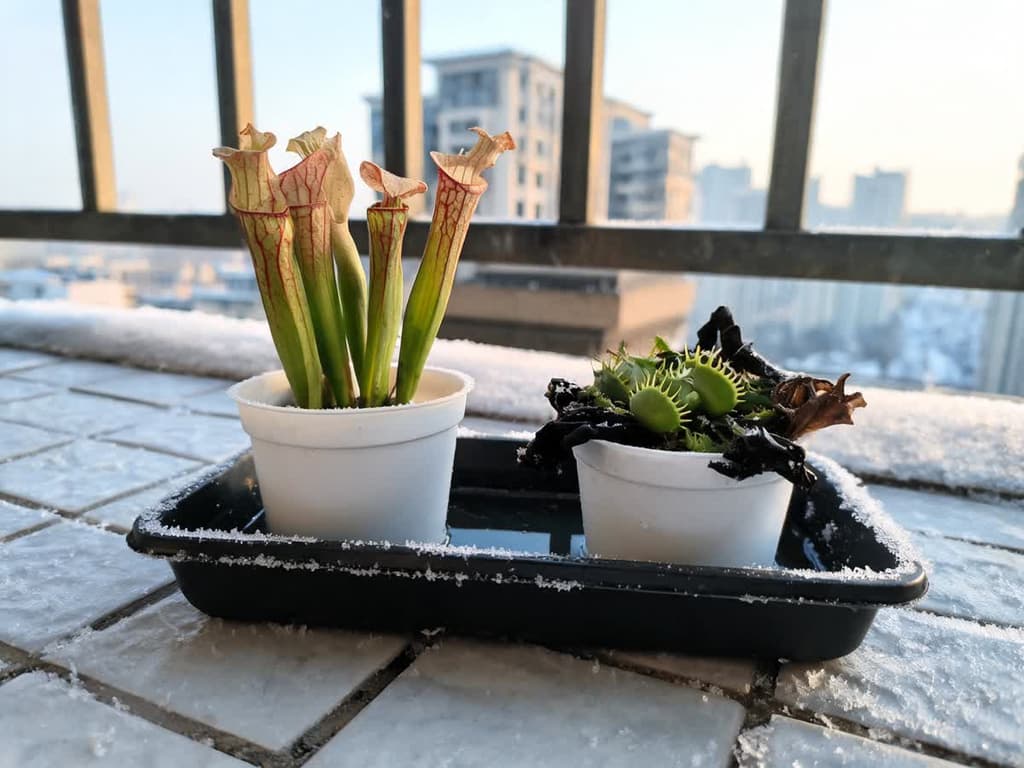
A carnivorous plant in winter handles cold when it is a sarracenia or a Venus flytrap. Both come from temperate climates and spend the winter in dormancy, a resting period where they stop growing. During dormancy, both tolerate light frost. Some sundews (leaves with sticky glue droplets) and butterworts (smooth, sticky leaves) also need a cold winter, while others do not go dormant. Nepenthes is tropical: it does not enter dormancy and suffers in the cold.
Black leaves and dried pitchers (the tube-shaped leaves of sarracenia) in winter are usually part of the plant's cycle, not disease. In Brazil, winter runs from June to August. The Venus flytrap comes from the coast of North Carolina, where the coldest month averages 7 °C. The New York Botanical Garden explains that it only keeps growing in winter with supplemental artificial light and heat.
Carnivorous plants in winter, group by group
Group | Does it go dormant in winter? | Cold it tolerates | What to do during winter in Brazil |
|---|---|---|---|
Sarracenia | Yes | One species remained intact at −7 °C during dormancy; in a pot, it tolerates a few weeks frozen, provided the soil does not dry out (ICPS, International Carnivorous Plant Society) | Leave outdoors in full sun, in a cool spot; keep soil damp |
Venus flytrap | Yes, when days shorten and cool down | Up to 1 week frozen during dormancy, provided the soil does not dry out (ICPS) | On a windowsill or outdoors, it goes dormant on its own; under LED light, it keeps growing |
Subtropical sundew (e.g., Drosera capensis) | No | Thrives between 10 and 35 °C (ICPS) | Same routine year-round |
Cold-temperate sundew (e.g., Drosera rotundifolia) | Yes, about 6 months | Requires a distinct winter (ICPS) | Difficult without cold; see the refrigerator section |
Mexican butterwort | Changes leaves: in winter, succulent and non-sticky leaves | A cooler, drier winter, like indoors (ICPS) | Keep cooler and with less water |
Temperate butterwort | Yes, forms a closed winter bud | Requires a cold winter to survive (ICPS) | Difficult without cold; see the refrigerator section |
Nepenthes (pitcher plant) | No | 21 to 35 °C for lowland species (NC State, North Carolina State University Extension) | Indoors, in the warmest and brightest spot |
Which carnivorous plants tolerate cold
Dormant sarracenia withstands severe cold. The International Carnivorous Plant Society (ICPS) shows a Sarracenia jonesii covered in frost at −7 °C without any damage, because it was fully dormant. In pots, according to the ICPS, sarracenia survives several weeks frozen, as long as it is dormant and the soil does not dry out. The exception is Sarracenia psittacina, which the ICPS describes as sensitive to freezing. The hardiest is Sarracenia purpurea subsp. purpurea: according to the ICPS, it is the only sarracenia that spends the entire year outdoors in the harshest winters.
The Venus flytrap (Dionaea muscipula) also handles frost when dormant. The ICPS reports that a dormant Venus flytrap survives up to a week frozen solid, provided the soil does not dry out. The greatest danger, according to the ICPS, is the plant losing water while frozen. The other threat is out-of-season frost, at the beginning or end of winter.
Droseras (carnivorous plants with leaves covered in glue droplets) fall into three categories, according to the ICPS:
Subtropical, like Drosera capensis: thrive between 10 and 35 °C and do not need dormancy (ICPS).
Warm-temperate, such as Drosera capillaris: they tolerate frost, but do not tolerate long freezes (ICPS). The ICPS cites Brazilian plants in this group.
Cold-temperate, such as Drosera rotundifolia and Drosera anglica: they need a distinct winter to live for many years (ICPS).
Butterworts (carnivorous plants with smooth, sticky leaves in a rosette) also fall into two types. Temperate butterworts, such as Pinguicula vulgaris, tolerate freezing temperatures because they form a winter bud. Mexican butterworts spend the winter indoors, and the ICPS considers them excellent houseplants.
Nepenthes does not tolerate cold. NC State, the North Carolina State University extension, describes nepenthes as a tropical plant that thrives in heat and high humidity.
Carnivorous plant dormancy: asleep or dead?
Carnivorous plant dormancy is the winter resting period for temperate species. The plant stops producing new traps, grows very little, and sheds some of its foliage. Shorter days and cooler temperatures trigger the process. For Venus flytraps and sarracenia kept outdoors or on a windowsill, dormancy occurs every year. Black leaves during this period are completely normal.
Botanist Barry Rice, author of the Carnivorous Plant FAQ, separates a dormant Venus flytrap from a dead one by speed. A dying plant loses all its leaves quickly and turns into a mushy mass. A plant entering dormancy merely grows more slowly, and its leaves darken over several weeks.
The simplest sign, according to Rice, is the color above the soil line. If the Venus flytrap still shows any green, it is dormant. Even if everything has turned black, it might still be alive. Rice recommends waiting another month before drawing any conclusions.
In winter, do not dig up the plant to check. Rice explains that disturbing the roots of a dormant plant opens the door to fungus and rot. The Sydney Botanic Gardens, in the Southern Hemisphere like Brazil, also calls black Venus flytrap leaves in winter completely normal.
Venus flytrap in winter: does it need cold?
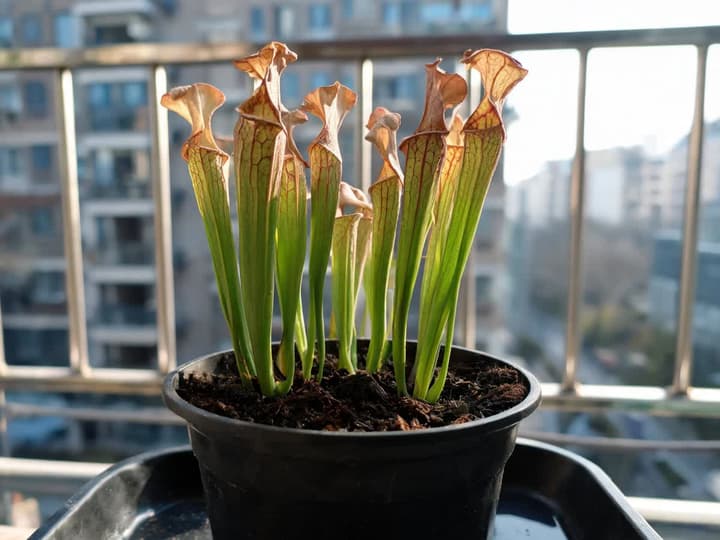
A Venus flytrap kept on a windowsill or outdoors enters dormancy on its own as days grow shorter and colder. One grown under LED light year-round can keep growing. According to the ICPS, an indoor Venus flytrap does not need dormancy to live for many years. According to the ICPS, dormancy is only mandatory for plants that will face freezing temperatures outdoors.
Sources disagree on this point. Barry Rice recommends that every beginner provide dormancy for a Venus flytrap. The New York Botanical Garden (NYBG) notes the divergence among experts and treats dormancy as optional indoors. This guide follows the ICPS, the scientific society in the field, as does our guide on how to care for a Venus flytrap.
A windowsill Venus flytrap enters dormancy during the Brazilian winter, and its care routine changes. The NYBG outlines dormancy as follows:
Allow light levels to drop naturally and temperatures to fall to around 7 to 10 °C.
Stop offering food.
Remove the pot from its water tray and water only to keep the soil slightly damp, never allowing it to dry out.
Trim leaves only after they turn entirely black.
In the Northern Hemisphere, according to the NYBG, the leaves begin to die back around November. The plant resumes growth around March. In Brazil, the leaves begin to darken around May, and the plant resumes growth around September.
Rice publishes the temperatures for Wilmington, on the coast of North Carolina, where the Venus flytrap grows in the wild. In its coldest month, the average high is 13 °C and the average low is 1 °C. Rice defines a cool winter as one with highs up to about 24 °C and nights that almost never drop below 0 °C. In this climate, he leaves the Venus flytrap outdoors all winter long, in full sun, with moist soil.
Rice admits uncertainty, but suggests avoiding forced dormancy on a Venus flytrap purchased in winter. Rice explains that store-bought plants often originate from tissue-culture labs and do not follow outdoor seasonal rhythms. His advice is to maintain normal care and observe: if the plant wants to rest, it will halt new leaf production. Rice only recommends dormancy for a Venus flytrap that has been actively growing in your care for at least 4 months.
Sarracenia in winter: the most cold-dependent carnivorous plant
Sarracenia generally needs winter dormancy, even indoors. NC State calls for sun during the growing season and winter dormancy for indoor plants. The same extension service notes that sarracenia grows best outdoors in a bog garden. This bed uses poor, continuously waterlogged soil to mimic a bog.
In Brazil, leave sarracenia outdoors in the sun during winter. If you store the pot in an enclosed space, choose a cool or cold location. The ICPS warns that in conditions that are too warm, the plant resumes growth prematurely and suffers when moved back outside. According to the society, an unheated enclosed porch and a cold greenhouse work well for the pot during the cold period.
Trim only the brown sections of the leaves. The ICPS explains that sarracenia reclaims nutrients from aging leaves to fuel new growth, so removing green foliage can deplete the plant of reserves. The exception applies to plants stored in enclosed spaces, where decaying leaves harbor pests and fungal issues; there, the ICPS suggests trimming pitchers back in autumn.
For indoor-only cultivation, the ICPS recommends two species under artificial lights year-round: Sarracenia psittacina and Sarracenia rosea. Tall pitcher plants, according to the ICPS, are challenging to grow successfully under grow lights.
Sundews and butterworts: the type determines winter care
Subtropical sundews, such as Drosera capensis, do not change their behavior in winter. The ICPS notes that subtropical types thrive between 10 and 35 °C and do not require dormancy. They also do not need shortening photoperiods to live for many years.
Cold-temperate sundews overwinter as a hibernaculum. A hibernaculum is a tight bud of shortened leaves, hugging the soil surface, which shields the crown from freezing temperatures. The ICPS states that Drosera rotundifolia and Drosera anglica need a defined winter to survive over multiple years. Both remain dormant for roughly 6 months. The society advises selecting sundews native to climates similar to your own.
Warm-temperate sundews fall in between. The ICPS states that Drosera capillaris tolerates frost, produces no hibernaculum, and cannot endure prolonged freezes. In a heated greenhouse or terrarium, it cycles through phases of active growth and semi-dormancy.
Mexican butterwort changes leaves in winter. The ICPS explains that summer leaves are sticky and carnivorous, while winter leaves are succulent and lack glue. In winter, the ICPS directs growers to keep the plant cooler and with less water. Mexican butterwort needs to sense the days gradually shortening and lengthening. Place the plant in a sunny window or use a timer that shifts the light cycle throughout the year. Under fixed-schedule lighting, it only produces non-sticky winter leaves.
Temperate butterwort needs a cold winter to survive, according to the ICPS. In early autumn, it forms a winter bud that withstands freezing.
If you are unsure which carnivorous plant you have at home, Bloom (available for iOS) identifies plants from a single photo. Knowing the species lets you determine whether it needs a cold winter or can stick to the same routine all year.
Nepenthes in the cold: the carnivorous plant that never sleeps
Nepenthes does not undergo winter dormancy. NC State recommends 21 to 35 °C for lowland nepenthes. For highland species, the extension recommends 24 to 29 °C during the day with night drops around 16 °C.
During winter, keep nepenthes indoors in your warmest, brightest location. NC State notes that it prefers bright light and high ambient humidity. If the room housing a lowland nepenthes drops below 21 °C, move the pot to a warmer room in the house.
Refrigerator dormancy for carnivorous plants: when it works
The refrigerator is for carnivorous plants that die without a cold winter: temperate butterworts and cold-temperate sundews. Barry Rice described the method in the Carnivorous Plant Newsletter, the ICPS journal, in 2002. He grew these plants in the Sonoran Desert in the southwestern United States, with 46 °C summers. His list includes Pinguicula vulgaris and Drosera rotundifolia. Rice also grew Sarracenia purpurea this way, but the ICPS says it does well in moderate winters.
Rice's method involves four steps:
Wait until the plant develops its winter bud and its summer foliage dies back.
Clear away weeds and decaying leaves, then place the entire pot inside a sealed plastic bag in the refrigerator, never the freezer.
Once a month, open the bag and discard any dead leaves.
Once the winter bud begins opening, wait a few more weeks before removing the pot from the refrigerator.
For Venus flytraps, sources differ. In the Carnivorous Plant FAQ, Rice considers the refrigerator method "probably the best method" for tropical growers, keeping the soil damp. He also notes that the method proves less successful with Venus flytraps than with other carnivorous plants. The ICPS considers putting an indoor Venus flytrap in the refrigerator a waste of effort. This guide follows the ICPS: an indoor Venus flytrap does not go into the refrigerator.
A cool, dark spot cannot replace the refrigerator. Rice warns that keeping a Venus flytrap in a basement, dark garage, or closet proves fatal: lacking refrigerator-level cold, it keeps trying to photosynthesize while deprived of light.
Outdoor carnivorous plants: bog gardens and frost
Sarracenia and Venus flytraps grown in the ground do not need digging up during winter. The ICPS notes that Venus flytraps handle cold conditions best when planted directly in a bog garden. For sarracenia grown outdoors without shelter, the ICPS recommends leaving plants exposed to natural rainfall. Remove only dead leaves and browned tips.
Where frost falls, an outdoor Venus flytrap needs cover and moist soil. In Brazil, frost is concentrated in the South and in the mountains. A study using INMET data across 8 cities in Rio Grande do Sul counted about 13 frosts per year in each city. According to the authors (Tazzo and colleagues, 2024), 81% of them fell in winter. The ICPS recommends covering an in-ground Venus flytrap with a few inches of pine needles or with frost cloth. This cloth is a lightweight fabric designed to protect plants from frost. The soil cannot dry out, because the greatest danger is the plant losing water while frozen.
Where frost is rare, Rice protects Venus flytraps by laying a sheet of newspaper over them on freezing nights. Rice insists that Venus flytraps should never freeze solid, whereas the ICPS states that a dormant Venus flytrap can withstand being frozen for a week. The safer path follows Rice: drape a cover over the plant on freezing nights. The ICPS notes that snow cover protects sarracenia from extreme freezes. For the ICPS, unseasonal frosts, occurring in early or late winter, cause the real damage.
In regions with severe cold, the ICPS recommends clustering potted sarracenias together at ground level throughout the winter.
Light and watering during dormancy
A dormant carnivorous plant still needs sunlight. Rice notes that sunlight remains beneficial throughout dormancy because the plant continues photosynthesizing, just at a slower rate. Only plants overwintering in a refrigerator can manage without light.
Do not alternate a Venus flytrap between a windowsill and LED grow lights. The ICPS explains that shifting setups disrupts the plant's seasonal rhythm. According to the society, keeping a Venus flytrap under artificial lighting year-round works better than changing locations during winter.
Watering decreases. For a dormant Venus flytrap on a windowsill, remove the pot from its water tray and keep the soil only slightly damp, never dry, following advice from the NYBG and Rice. Outdoors, Rice leaves pots sitting in a shallow water tray through winter. Our guide on how often to water carnivorous plants explains using trays during dormancy: fill, wait 1 to 2 days, and pour out the excess.
When dormancy ends
Dormancy ends in spring, when days grow longer and warmer. In Brazil, this happens around September. The Royal Botanic Garden Sydney states that the Venus flytrap resumes growth in spring and that watering returns to normal at that point.
Set the pot back in a water tray once fresh leaves emerge from the center. If the plant needs repotting, do so in spring just as the Venus flytrap resumes growth. The NYBG explains that a Venus flytrap can remain in its original container for 2 years or longer, making annual repotting unnecessary.
A mature Venus flytrap often sends up a flower stalk shortly after waking from dormancy. The NYBG advises trimming the stalk off at the base as soon as it appears, since flowering expends energy that would otherwise fuel new leaf traps.
Frequently asked questions
Can carnivorous plants stay on a balcony in winter?
That depends on the group. Sarracenia and Venus flytraps can spend winter on a balcony in full sun with moist soil, handling light frosts while dormant according to the ICPS. Subtropical sundews and Mexican butterworts fare well indoors. Nepenthes should stay in the warmest room in the house.
How long does Venus flytrap dormancy last?
An outdoor Venus flytrap spends at least 3 months a year in dormancy, according to the ICPS. The NYBG describes it beginning when days grow shorter and returning in the spring. In Brazil, the leaves darken starting in May. The plant sleeps in the winter, from June to August, and resumes growth around September.
Can I feed carnivorous plants in winter?
Not for dormant Venus flytraps. The NYBG advises against feeding a dormant Venus flytrap, which barely grows and forms no new traps. Resume feeding in spring when new, fully opened traps appear. Carnivorous plants that do not enter dormancy, such as subtropical sundews, keep up their normal routine year-round.
Do carnivorous plants repel mosquitoes?
No. Barry Rice explains that carnivorous plants attract sugar-seeking insects, such as flies and moths, and almost never catch mosquitoes. The tray of standing water can also become a breeding site. Rice instructs discarding the water and rinsing the tray whenever larvae appear, then refilling it (Carnivorous Plant FAQ).
Why did my sarracenia turn brown in winter?
Brown pitcher tips in winter typically reflect normal sarracenia dormancy. The plant reclaims nutrients from older foliage before generating fresh growth, according to the ICPS. Trim off only the dried brown parts and keep the soil moist. In spring, fresh pitchers will emerge from the rhizome's center.
Related articles

How to Care for Hibiscus: Sun, Watering, Fertilizer, and Pruning for Flowers
How to care for hibiscus: 6 hours of direct sun, evenly moist soil without waterlogging, half-strength fertilizer in spring and summer, and pruning in early spring. Find out why the flower lasts one day and why buds drop before opening.

Do Ferns Like Sun or Shade? It Depends on the Type
Ferns prefer bright shade: plenty of light, but no direct sun on their fronds. Tuberous sword fern is the exception that handles sun. Here is the ideal light for each type, where to place pots, and how fronds show too much or too little light.

African Violet Yellow Leaves: Causes and What to Do
Yellow leaves on an African violet usually stem from overwatering, and the first place to check is the center of the plant. Losing one lower leaf at a time is normal. Identify whether age, watering, cold water, sunlight, cold drafts, or fertilizer is the culprit based on the yellowing pattern, and see what to do today.