Carnivorous Plant Soil: The Right Mix for Every Type
The best soil for Venus flytraps, pitcher plants, and sundews is unfertilized sphagnum peat moss with silica sand. Discover the right mix for Nepenthes, the Mexican butterwort exception, and the peat-free options tested by the RHS.
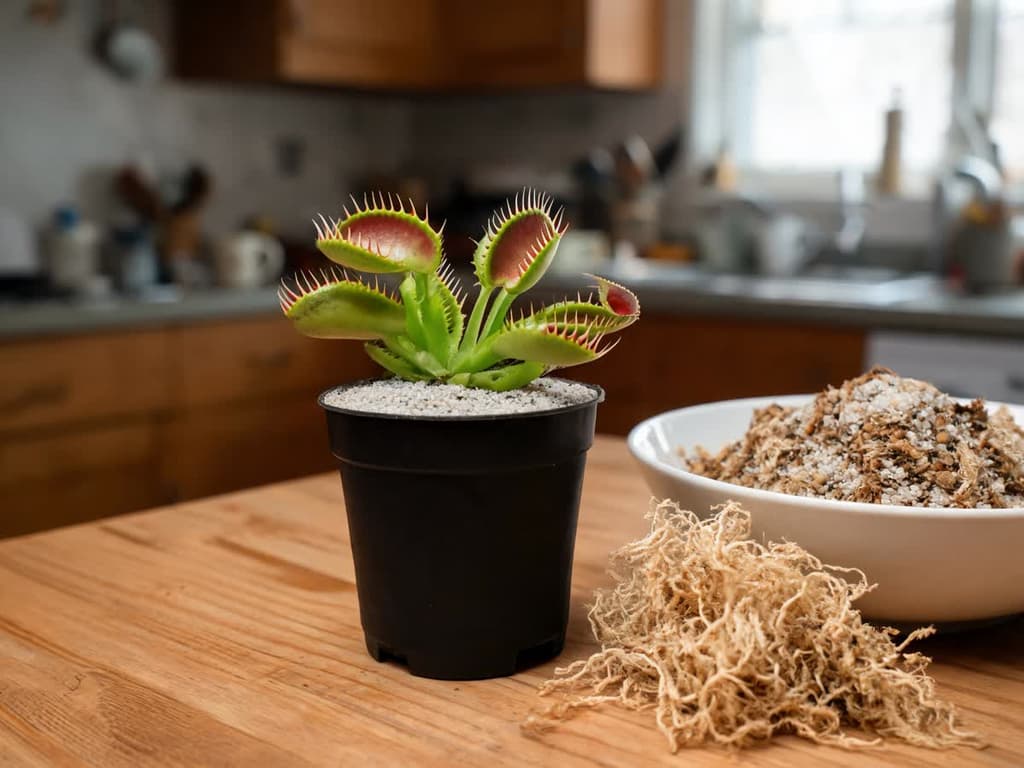
The best substrate for a carnivorous plant (its potting soil) is sphagnum peat moss (decomposed moss sold in bags) without fertilizer or lime. Mix the peat in equal parts with washed silica sand (quartz sand). Pure sphagnum moss also works. This mix suits Venus flytraps, pitcher plants (Sarracenia), and sundews (Drosera).
Two plants break this rule. Nepenthes (tropical pitcher plants) need an airier mix, using sphagnum moss or orchid bark. Mexican butterworts (Pinguicula) prefer alkaline soil containing lime. Regular potting soil, garden soil, and fertilizer kill bog-dwelling carnivores like flytraps, pitcher plants, and sundews, which naturally thrive in waterlogged, nutrient-poor soil.
Substrates by Carnivorous Plant Type
Plant | Mix | Perlite | Source |
|---|---|---|---|
Venus flytrap | Sphagnum peat moss and silica sand 1:1, or pure sphagnum moss | No | ICPS |
Sarracenia pitcher plant | Sphagnum peat moss and silica sand 1:1 | Only outdoors, replacing sand | ICPS |
Subtropical sundew (such as Drosera capensis) | 30% to 100% sphagnum peat moss, with the rest silica sand; or pure sphagnum moss | Not mentioned | ICPS |
Nepenthes | Sphagnum moss, or an orchid mix with peat and perlite; moist with good drainage | Yes | NC State |
Mexican butterwort (Pinguicula) | Peat, coarse sand, and perlite 1:1:1, with dolomitic lime | Yes | ICPS |
Carnivorous plants in regular soil: change the soil today
If the carnivorous plant went into regular potting soil, all-purpose potting mix, or fertilized soil, change the soil now, at any time of year. Botanist Barry Rice, author of the Carnivorous Plant FAQ, states that a Venus flytrap left in this soil almost certainly dies. Before dying, it produces a few deformed leaves, almost always without traps, and rots.
Rice's fix is to repot in an equal-parts mixture of peat and sand. Remove the plant from the pot and loosen the old soil clinging to the roots with your fingers. Rice does not mention washing the roots. Growers on forums rinse the roots with distilled water or rainwater to remove remaining soil. No institutional source has tested whether this helps. At minimum, loosen the old soil with your fingers without rubbing the roots, and if you rinse them, use only distilled water or rainwater.
Take advantage of having the plant unpotted to check its base, the rhizome: the thick section that produces leaves and roots. According to criteria used by growers, a firm, white base is healthy, while a black, mushy base with a foul smell indicates rot. Rhizome rot is a fungal disease that spreads rapidly in waterlogged soil.
A Nepenthes potted in standard soil also needs fresh media right away. NC State warns that carnivorous plants cannot tolerate garden soil as a growing medium. Repot your Nepenthes in sphagnum moss or in the orchid bark, peat, and perlite mix detailed below.
Pitchers drying out on a newly bought Nepenthes are not always caused by the soil. NC State explains that overly dry air causes pitchers to form incorrectly or dry out prematurely. One or two blackened traps on a Venus flytrap can also simply be natural leaf die-off, as noted in the carnivorous plant care guide.
Why regular soil kills carnivorous plants
Standard potting soil kills carnivorous plants because it contains fertilizers, mineral salts, and lime. Bog carnivores naturally grow in acidic, nutrient-deficient soil. Their root systems cannot handle the salts that accumulate in potting mixes engineered for ordinary houseplants.
Lime removes the acidity that bog carnivores need. Pure sphagnum peat moss has a pH between 3.0 and 4.5, according to Iowa State University. pH measures acidity: the lower the number, the more acidic the soil.
Bagged potting soil made with peat moss receives dolomitic limestone to raise the pH to around 5.4 to 6.4. Dolomitic limestone is a limestone rock powder that reduces acidity. This is the recommended range for almost all greenhouse plants, according to an NC State study published in HortTechnology in 2020.
Fertilizer is the second problem. The International Carnivorous Plant Society (ICPS) instructs not to add fertilizer of any kind to sundew soil. According to the ICPS, when fertilizer does not kill the plant right away, it alters the soil chemistry and weakens the plant.
Salty soil shows a clear sign in the Venus flytrap. The ICPS describes new leaves emerging without being able to form the trap. When this happens, the soil needs to be replaced.
Carnivorous potting ingredients and how they work
Sphagnum peat moss. This consists of dead sphagnum moss decomposed over centuries at the bottom of bogs. It holds moisture, stays acidic, and contains almost no nutrients. Iowa State differentiates between two types. Horticultural peat moss is coarser. Black peat, sold for conditioning garden soil, is much more decomposed and fine. According to the university, black peat retains too much water and suffocates plant roots.
Sphagnum moss. This is the same moss before turning into peat, sold dried or alive. On its own, it already works as a substrate for Venus flytraps and sundews, according to the ICPS. The same society says the best sphagnum comes from New Zealand and Chile. In Brazil, dried Chilean sphagnum is sold in orchid supply shops.
Silica sand. This is pure quartz sand, which releases no calcium or minerals into water. It maintains aeration between dense peat particles. The ICPS recommends grain sizes around 1.2 mm and strictly prohibits builders sand and play sand.
Vermiculite. This is a mineral in shiny flakes that holds water. NC State accepts coarse vermiculite in place of sand, in a 1:1 mix with peat for Venus flytraps.
Pine bark and coconut coir. Both appear in peat-free mixtures. Pine bark sold for orchids is coarser and maintains plenty of air space between chunks, according to Iowa State. The section on peat-free alternatives below covers trials conducted with each.
Perlite for carnivorous plants: should you use it?
Perlite is volcanic rock heated until it puffs, which keeps the soil light and aerated. For Venus flytraps, the ICPS says to avoid perlite and pumice, because these materials can leach salts. For Sarracenia, the same society accepts perlite in place of sand. The condition is that the plant stays outdoors, where rain washes the soil.
Other sources use perlite more liberally. NC State includes perlite in its Nepenthes mix. The Carnivorous Plant Society, a UK growers group, mixes about 50% perlite with sphagnum for Venus flytraps and sundews. All four commercial carnivorous mixes sold in Germany whose ingredients we examined also contain perlite.
For the Venus flytrap, this guide follows the ICPS, which explains the reason: perlite can leach salts. No one has measured perlite in Venus flytraps, and silica sand in its place is the safer option. For outdoor Sarracenia, Nepenthes, and Mexican butterworts, perlite goes in.
Soil mixes for each carnivorous plant
Venus flytrap
The Venus flytrap (Dionaea muscipula) grows successfully in three mixes, according to the ICPS: pure sphagnum moss, pure sphagnum peat moss, or equal parts peat moss and silica sand. NC State also approves peat mixed 1:1 with coarse vermiculite. On top of the soil, the ICPS recommends a 1 cm layer of pure silica sand to reduce rotting on older leaves.
Pot height changes the ideal mix. The ICPS explains that the wetter the substrate stays, the taller the pot must be. In shallow pots, the ICPS calls for higher proportions of sand, without giving a specific measurement, and advises avoiding pure sphagnum or pure peat. The society recommends a pot measuring approximately 8 cm wide by 10 cm deep.
Sarracenia pitcher plants
The standard mix for Sarracenia is equal parts sphagnum peat moss and silica sand, according to the ICPS. For plants kept outdoors, perlite can replace sand. Some species require something else: the ICPS cites Sarracenia psittacina, which prefers pure peat and a shallow pot.
The same organization reports that some specimens of Sarracenia purpurea and Sarracenia minor grow better in live sphagnum moss. For Sarracenia, sphagnum moss also emerged as the top performer in peat-free potting trials by the RHS, detailed below.
Sundew (Drosera)
Subtropical sundews, such as Drosera capensis, are not picky about soil, according to the ICPS. They grow in pure sphagnum moss, live or dried. They also grow in a mix of peat and silica sand, with 30% to 100% peat. NC State describes the nutrient-poor peat and sand mix as moist year-round.
The ICPS recommends topping the mix with live sphagnum moss for larger sundews. Some sundews from South Africa and Australia stop growing in the summer, entering a summer dormancy. This group requires different care, which this guide does not cover.
Nepenthes (Tropical pitcher plants)
Nepenthes requires moist, but not waterlogged, soil. NC State recommends sphagnum moss or an orchid mix (pieces of pine bark sold for orchids) with peat and perlite. The soil must remain moist, well-draining, and acidic. The Nepenthes pot does not sit in a water tray. The Carnivorous Plant FAQ, by botanist Barry Rice, cites Nepenthes and many Pinguicula as exceptions to the water tray method.
The ICPS warns that many orchid bark products contain added fertilizer, in amounts that the label does not always state. Buy the bark only if the packaging states that it contains no fertilizer; when in doubt, use sphagnum moss.
Mexican butterwort (Pinguicula)
The Mexican butterwort is the exception: it prefers alkaline soil, according to the ICPS. The society states that these plants are not bog plants and should not be grown like bog plants. Pure, acidic peat is not the right base for them.
The ICPS recommends equal parts peat, coarse sand, and perlite for indoor butterworts. To this mix, the society adds dolomitic limestone, sold in garden centers: about 1 tablespoon per cup of mix. Pumice can replace perlite. On top, the ICPS places up to 5 mm of coarse silica sand against fungus gnats, whose larvae eat butterwort leaves.
How to choose peat moss, sphagnum, and sand in Brazil
Read labels carefully before purchasing. The ICPS insists on sphagnum peat moss or sphagnum moss free from added fertilizers. Commercial bagged potting mixes containing peat almost always include added fertilizers and lime, making them unusable for carnivores.
Check the pH on the label and select peat with a pH of 4.5 or lower. Pure sphagnum peat moss tests between pH 3.0 and 4.5, according to Iowa State. Any pH above 5 indicates peat adjusted with lime, matching the commercial potting soils evaluated in the HortTechnology study.
Avoid black peat entirely. It is dark and extremely fine, which Iowa State explains traps too much water and cuts off air to roots. The correct peat moss is light brown, crumbly, and fibrous with visible short strands.
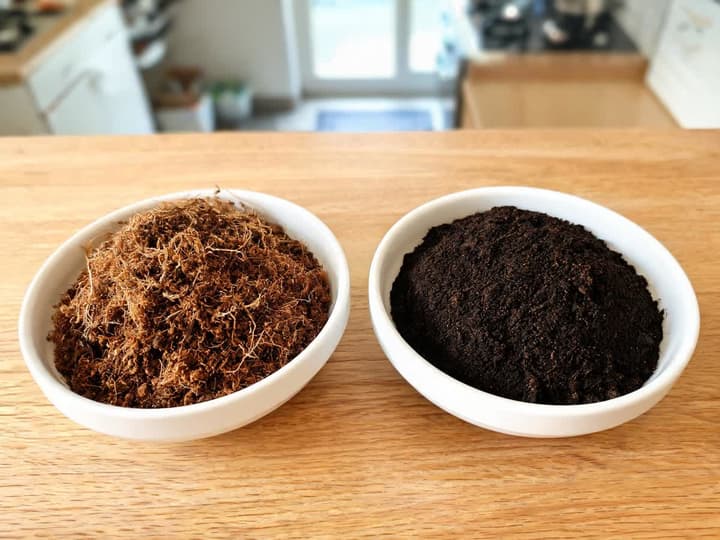
For sphagnum moss, dried Chilean sphagnum sold for orchids works, as long as it is pure sphagnum without fertilizer. Buy coarse-grain silica or quartz sand, around 1.2 mm, and check the label to confirm the material is silica. Construction sand and beach sand are out: beach sand contains shell fragments, which are limestone.
Peat-free carnivorous substrates: what trials show
You can successfully grow Sarracenia without peat, and with superior results. The Royal Horticultural Society (RHS) has conducted peat-free trials on carnivorous plants since 2022. The motive is environmental: natural peat extraction depletes bogs that require thousands of years to form and act as vital carbon sinks.
In one of the trials, the RHS planted two types of Sarracenia in six substrates, one of them pure peat. According to Hort News, expert judges rated the plants in sphagnum mixes as much better than those in peat. Pine bark aided a Sarracenia leucophylla hybrid.
Another trial, with Sarracenia rosea and Sarracenia 'Bella', started with six substrates and expanded to 12 in 2023. Members of the Carnivorous Plant Society voted blind, casting 28 votes per plant, and pure milled sphagnum moss won for both. For S. rosea, it received 18 of the 28 votes. Second place went to a mix of 75% sphagnum, 20% pine bark, and 5% biochar, according to the RHS. Biochar is charcoal made for plant use.
The RHS expanded trials to Venus flytraps in 2023. The lead researcher noted that sphagnum moss once again yielded the healthiest plants. The RHS report does not include specific quantitative data for the Venus flytrap trial.
The same researcher issued two warnings. Standard garden biochar can kill carnivorous plants. Furthermore, any potting medium that smells like rotten eggs has turned anaerobic from lack of oxygen and must be replaced immediately.
Coconut coir divides opinions. In the comments section of a German carnivorous plant shop's website, a reply to a reader states that coconut does not work. The same reply states that no alternative to peat exists. The Carnivorous Plant Society approves coconut coir chunks (coarsely chopped coconut husk, not the dust) for Nepenthes and Sarracenia. The same society does not recommend coconut for Venus flytraps and sundews, which weaken over time in this material.
To eliminate peat, this guide follows the RHS: sphagnum moss had the best measured result. The Carnivorous Plant Society states that sphagnum works for almost all carnivorous plants. Regarding coconut coir, the guide follows the British society: only for Nepenthes and Sarracenia, because no published trial has measured coir. Use coir only if the label states that it was neither washed in salt water nor amended with calcium. Before planting, rinse the coir with rainwater.
How to mix and repot step by step
Pre-moisten the peat or sphagnum moss using distilled water or rainwater. Iowa State warns that dry peat and coconut coir actively repel water, requiring soaking a few days prior to planting.
Combine the peat and silica sand according to the ratios in the chart at the beginning of this guide, using a clean bucket or basin. Moisten only with distilled water or rainwater.
Select a plastic pot with drainage holes. For Venus flytraps, the ICPS recommends a container roughly 8 cm wide by 10 cm deep. Wetter mixes require taller containers.
Plant the carnivorous plant in the center of the pot, ensuring all roots are thoroughly covered by the potting mix.
Top the surface with 1 cm of pure silica sand in the case of Venus flytraps.
Place the pot into a saucer with 1 to 2 cm of distilled water or rainwater for Venus flytraps and Sarracenia. For flytraps, the ICPS specifies keeping the water line more than 5 cm below the soil surface.
In hot weather, the water tray evaporates much faster. During winter dormancy, remove Venus flytraps from standing water trays and keep the medium barely moist. The carnivorous plant watering guide explains how much water to keep in the tray during every season.
When to change carnivorous plant soil
Repot your plant whenever the medium shows signs of breakdown or degradation. New Venus flytrap leaves emerging without traps indicate salt buildup, according to the ICPS. A visible salt crust on the soil surface also signals the need for fresh substrate, per the ICPS guide for Mexican butterworts. A rotten-egg smell points to anaerobic decomposition, as the RHS highlights.
Sources differ on repotting schedules. The ICPS states that a well-tended Venus flytrap benefits from fresh media "about every year." The New York Botanical Garden suggests it can remain in the same container for two years or more. This guide follows the condition of the substrate: without visible warning signs, there is no need to rush.
The timing of repotting depends on the plant. Without problems in the soil, repot a Venus flytrap in the spring, which runs from September to November in Brazil. If it sits in standard soil, repot it immediately, regardless of the season. Repot a Mexican butterwort in the winter, from June to August in Brazil, according to the ICPS. During this phase, it produces small, thick leaves without the glue that traps insects.
Which carnivorous plant do you have?
Choosing the right potting mix depends on your exact carnivorous plant, yet nursery labels often say nothing more than "carnivorous plant." The Bloom app (available for iOS) identifies your plant from a single photo. Once identified, you can pick the ideal potting medium: standard peat-and-sand, an airy Nepenthes blend, or an alkaline butterwort mix.
Frequently Asked Questions
Can I use regular potting soil for carnivorous plants?
No. Standard potting soil contains minerals and fertilizers that flytraps, Sarracenia, and sundews cannot tolerate. NC State advises never fertilizing Venus flytraps and specifies using peat moss or sphagnum moss. Use unfertilized sphagnum peat moss combined with silica sand, or pure sphagnum moss.
Can I use orchid bark for carnivorous plants?
It works well for Nepenthes when combined with peat and perlite, as recommended by NC State. Pine bark was also included at 20% in the RHS peat-free mix for Sarracenia. For Venus flytraps and sundews, no expert source in this guide recommends bark. The ICPS warns that many packaged orchid barks contain added fertilizers.
Can I fertilize carnivorous plant soil?
For Venus flytraps, Sarracenia, and sundews, do not fertilize the soil. The ICPS explicitly states never to add fertilizer to sundew soil, and NC State warns against fertilizing flytraps. The ICPS allows light fertilization for greenhouse-grown Mexican butterworts. NC State permits fertilizing Nepenthes that do not catch insects.
Is green moss growing on the soil harmful?
If the green growth is sphagnum moss, it causes no harm: the ICPS actually recommends top-dressing larger sundews with live sphagnum. The Carnivorous Plant Society notes that vigorous live sphagnum moss can eventually overgrow small plants. Trim the moss back whenever it begins crowding your plant's foliage.
Sources
International Carnivorous Plant Society (ICPS), growing guides: Growing Dionaea muscipula (pure sphagnum, pure peat, or 1:1 peat and sand; avoid perlite and pumice; taller pot for wetter soil; water more than 5 cm below the surface; salty soil causes new leaves without traps; repot every year or so), Dionaea checklist (8 × 10 cm pot, 50/50 peat and coarse silica sand, 1 cm of sand on top, no construction or play sand), Sarracenia (1:1 peat and sand, perlite outdoors, S. psittacina in pure peat), Subtropical Drosera (30% to 100% peat, New Zealand and Chilean sphagnum, 1.2 mm sand, no fertilizer in the soil), Mexican Pinguicula (alkaline soil, 1:1:1 peat, sand, and perlite with dolomitic limestone, orchid bark with fertilizer, repot during the winter phase).
NC State Extension, North Carolina Extension Gardener Plant Toolbox: Dionaea muscipula (sphagnum or peat with coarse vermiculite or sand, 1:1; do not fertilize), Nepenthes (sphagnum or orchid mix with peat and perlite, moist, drained, and acidic), Drosera (nutrient-poor peat and sand).
Iowa State University Extension and Outreach: How do I lower the soil pH for azaleas and rhododendrons? (sphagnum peat with a pH of 3.0 to 4.5) and Potting media components and handling, Randall Vos, March 2025 (black peat holds too much water; dry peat and coco coir repel water).
W. Garrett Owen, Brian E. Jackson, and William C. Fonteno, Liming requirements of greenhouse peat-based substrates amended with pine wood, HortTechnology, 2020 (dolomitic limestone in peat substrate to achieve the recommended pH range, 5.4 to 6.4).
Royal Horticultural Society (RHS), Peat-free carnivores voted best in RHS trials by The Carnivorous Plant Society (12 substrates, pure milled sphagnum in 1st place, 75/20/5 in 2nd; Venus flytrap since 2023; standard biochar can kill; bad smell indicates bad substrate) and Hort News, RHS grows peat-free carnivorous plants that outshine those grown in peat (1st trial, 6 substrates).
The Carnivorous Plant Society (United Kingdom), Stephen Morley, Growing carnivorous plants peat-free (sphagnum with about 50% perlite; coconut husk chips for Nepenthes and Sarracenia, not for Venus flytraps and sundews; salt-free and calcium-free coir).
Barry Rice, The Carnivorous Plant FAQ (2018 revision): wrong soil or water (Venus flytrap in standard potting soil or with fertilizer: repot at any time, in a 50:50 peat and sand mix) and about water (water tray for nearly all carnivores, except Nepenthes and many Pinguicula).
New York Botanical Garden (NYBG), Venus Flytrap Houseplants: the Venus flytrap can remain in its original pot for 2 years or more.
Related articles

How to Care for Hibiscus: Sun, Watering, Fertilizer, and Pruning for Flowers
How to care for hibiscus: 6 hours of direct sun, evenly moist soil without waterlogging, half-strength fertilizer in spring and summer, and pruning in early spring. Find out why the flower lasts one day and why buds drop before opening.

Do Ferns Like Sun or Shade? It Depends on the Type
Ferns prefer bright shade: plenty of light, but no direct sun on their fronds. Tuberous sword fern is the exception that handles sun. Here is the ideal light for each type, where to place pots, and how fronds show too much or too little light.

African Violet Yellow Leaves: Causes and What to Do
Yellow leaves on an African violet usually stem from overwatering, and the first place to check is the center of the plant. Losing one lower leaf at a time is normal. Identify whether age, watering, cold water, sunlight, cold drafts, or fertilizer is the culprit based on the yellowing pattern, and see what to do today.