Croton Leaves Turning Yellow: Normal Variegation or Plant Trouble?
Crisp yellow veins and bright spots are just your croton's natural pattern. The trouble starts when a leaf loses its pattern entirely, turns completely yellow, and falls off. The most common causes are a recent move, cold below 50 °F (10 °C), watering problems, and spider mites.
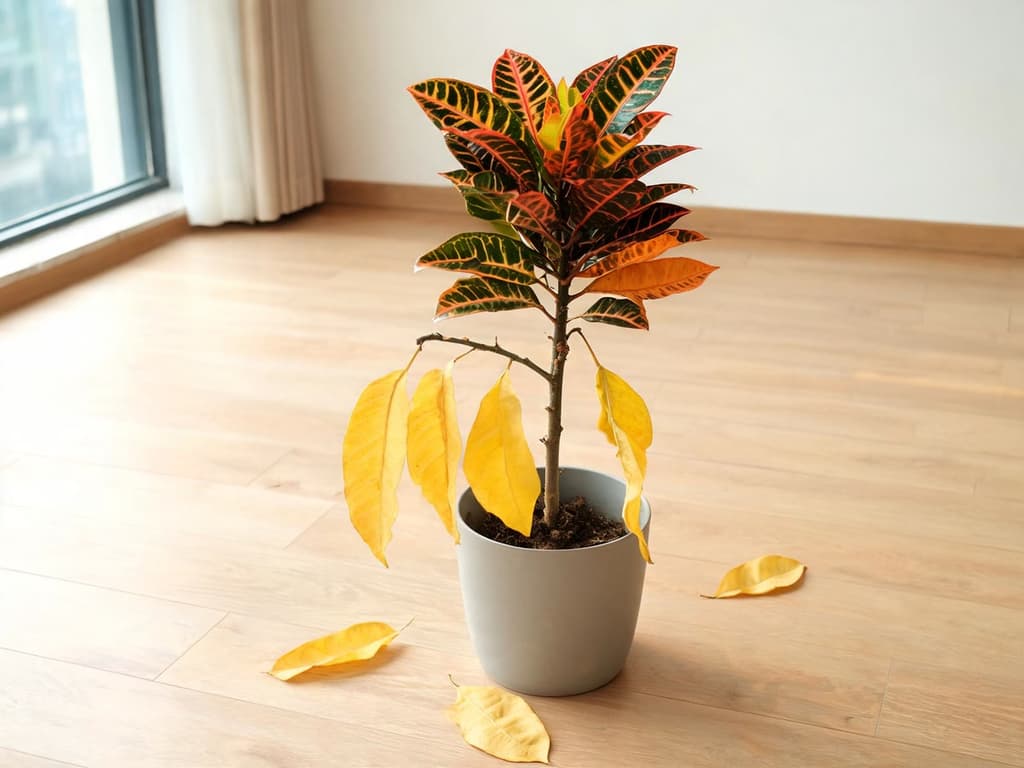
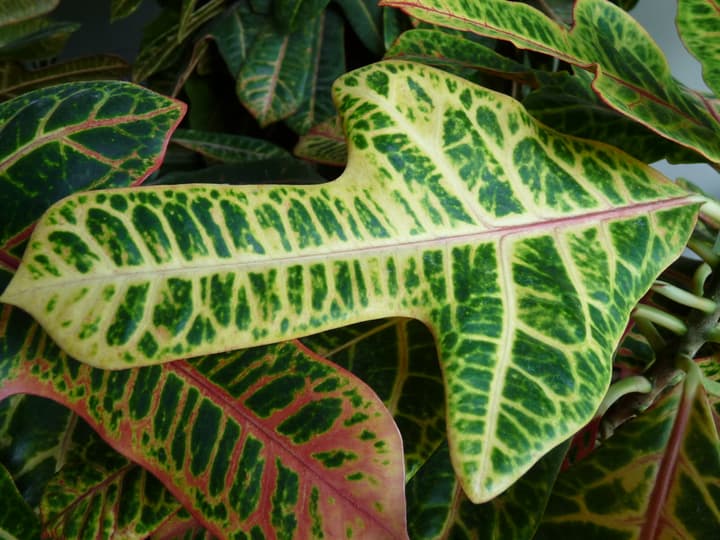
A croton with yellow leaves does not always mean trouble. Crisp yellow splotches, speckles, bands, or veins are usually just the natural pattern of the cultivar. The yellow that signals a real problem happens when a leaf loses its pattern completely, washes out to a solid yellow, softens, and falls off if you barely touch it.
When you see that second kind, the culprit is usually one of four things: the plant moved to a new spot recently, it sat through chilly nights below 50°F (10°C), the watering has been erratic, or spider mites moved in. As long as the stems stay firm, your croton can bounce back and push out fresh growth from the tips.
Quick summary:
Patterned yellow on a firm, glossy leaf: this is natural variegation. Leave it alone.
Leaves yellowing and dropping 1 to 3 weeks after bringing it home: classic relocation shock. Give it the brightest spot you have and do not move it again.
Sudden leaf drop after a cold snap: whenever temperatures dip below 50°F (10°C), crotons shed leaves. Keep them away from drafty windows and exterior doors at night.
Crispy lower leaves falling off, dry soil: underwatering. Crotons drink a lot.
Dull foliage with pale stippling: spider mites, which hide on the leaf undersides. Tap a leaf over white paper to check.
The croton grown indoors and in home gardens is Codiaeum variegatum. It is not actually part of the botanical genus Croton, which covers entirely different plants like dragon's blood. Everything in this guide applies strictly to Codiaeum.
How to tell if your croton's yellow leaves are normal
Yellow on a croton is completely healthy when it follows a clear pattern and the leaf remains firm. Many cultivars feature natural splashes, flecks, stripes, or contrasting yellow veins (NC State Extension). In those cases, the leaf stays rigid, waxy, and firmly attached to the stem.
New growth also starts out looking quite different. Young leaves often unfurl solid green and develop their intense colors gradually as they soak up bright light (UF/IFAS Gardening Solutions). Other varieties do the exact opposite: the leaves start out bright yellow and transition to deep pinks and reds as they mature (UW–Madison Extension). Because of this, a pale green or yellow leaf emerging at the crown is not a sign of nutrient deficiency.
Problem yellowing looks entirely different. A leaf that used to be vibrant red, orange, or deep green bleaches out, losing its distinct pattern and turning a dull, uniform yellow. Soon after, it goes limp, loses its shine, and separates from the branch with the gentlest tug. If several leaves drop this way in a single week, something in the plant's environment is off.
What you see | What it means | What to do |
|---|---|---|
Yellow speckles, bands, or veins on a stiff leaf | Natural variegation | Nothing |
Pale green or yellow leaf emerging at the crown | Young foliage coloring up | Nothing; provide bright light |
A single lower leaf yellows and drops while new leaves sprout | Normal leaf shedding | Gently pluck it off once it loosens |
Multiple leaves yellowing and dropping 1 to 3 weeks after arrival | Acclimation shock | Keep in bright, stable light; do not repot |
Leaf drop following chilly nights | Cold drafts below 50°F (10°C) | Move away from glass and doors at night |
Dry, crispy lower foliage with bone-dry soil | Underwatering | Drench thoroughly until water drains freely |
Limp foliage with soil wet for days | Overwatering | Allow the soil to dry out |
Tiny pale dots, dull sheen, faint webbing | Spider mites | Wash the undersides of the leaves |
This breakdown covers croton-specific quirks. If the yellowing shows up differently, like yellowing solely between green veins, our general guide to yellow leaves helps diagnose the issue in three simple questions.
Yellow leaves dropping after moving your croton
A croton that yellows and sheds leaves during its first few weeks in your home is simply reacting to the change of scenery. UW–Madison Extension notes that moving this plant between environments too abruptly triggers severe stress and rapid leaf drop. For crotons, the biggest shock is almost always the drop in light levels.
Commercial growers raise indoor crotons under 3,000 to 5,000 foot-candles of light, according to UF/IFAS. Foot-candles measure the intensity of light hitting a surface. In an average living room, low-light spots might only offer 100 foot-candles. That means the plant suddenly receives 30 to 50 times less light than it had in the nursery.
How to handle it:
Set the pot in the brightest spot in your home, right next to a sunny window, and let it settle. Shuffling it around only adds more stress.
Hold off on repotting for now. Crotons hate root disturbance and will shed more foliage in protest (Illinois Extension).
Do not pour on extra water trying to fix the leaf loss. Water only when the top layer of soil dries out.
Skip the fertilizer. Plant food cannot fix environmental shock, and excess nutrients actually dull the vivid colors in croton leaves (UF/IFAS).
Look for recovery right at the branch tips: tiny new leaves will start emerging right above where the old ones fell. As long as the stems stay firm, the plant is still kicking. Our guide on why croton leaves drop covers other common culprits that trigger the same reaction.
Leaf drop caused by cold snaps below 50°F (10°C)
Crotons are strictly tropical and suffer cold injury whenever temperatures fall below roughly 50°F (10°C) (UF/IFAS). They thrive best between 60°F and 85°F (16°C to 29°C) and tend to dump their foliage when exposed to anything below 50°F, according to UW–Madison Extension. The same experts emphasize shielding crotons from sudden drafts and rapid temperature swings.
Indoors, cold air typically sneaks up on the plant from three sources:
Window glass at night during the winter (in Brazil, from June to August);
Doors opening to the street or balcony;
Air conditioning vents blowing straight onto the plant.
A leaf damaged by the cold will not return to normal, but the next ones will come in healthy if the plant stays protected. On nights below 10 °C (50 °F), move the pot away from the window pane during the night. In the garden, NC State Extension recommends bringing potted crotons indoors when the temperature reaches 10 °C (50 °F).
Watering: bone-dry soil, soggy soil, or back-and-forth cycles
Crotons are thirsty plants. UF/IFAS points out that they have one of the highest transpiration rates among cultivated foliage plants. Transpiration is the moisture the plant naturally releases through its foliage. Because they lose water so quickly, running too dry is a very common reason crotons turn yellow.
The warning signs look noticeably different depending on the extreme:
Underwatering: tender top leaves droop while the potting mix sits bone dry. UF/IFAS notes this early wilt as the clearest cue that a croton needs a drink. If left dry, the lower leaves crisp up and shed (UF/IFAS Polk County), with the soil parched several inches down.
Overwatering: leaves wilt or turn yellow while the soil is still wet days after watering, and drop. If the base of the stems is soft or dark, the roots may be rotting.
Water when the top 0.5 to 1 inch (1 to 2.5 cm) of soil is dry (UW–Madison Extension). Poke your finger into the soil: if it is dry down to your first knuckle, water until it drains out of the pot's drainage hole. Afterward, empty the water left in the saucer. In winter, the soil takes longer to dry, and waterings become less frequent.
Inconsistent care also leads to shedding. UW–Madison Extension points out that crotons drop leaves when kept either too wet or too dry for extended periods. Skimping on water one week and soaking the pot the next creates the worst of both worlds. Skip the rigid calendar schedule and rely on the finger test instead.
Crotons turning yellow after a vacation
If your croton went 1 or 2 weeks without water and the leaves turned yellow and wilted, check the branches. A branch that is firm and green underneath when scratched with a fingernail is alive. Water until it drains from the bottom and wait until the top 0.5 to 1 inch (1 to 2.5 cm) of soil dries before watering again.
Leaves that have already dried will not recover. Trim these leaves and wait for new ones to emerge at the tips. Do not fertilize until the first new leaf appears.
Dull leaves with yellow stippling: spider mites
The two-spotted spider mite is the main pest of croton, according to UF/IFAS. It is very small, lives on the underside of leaves, and usually goes unnoticed until the infestation gets large. Its feeding leaves the leaf speckled with pale dots and can turn the entire leaf yellow.
On a colorful croton leaf, these specks blend right in with the variety's pattern. To tell mites apart from the leaf pattern, UF/IFAS recommends tapping a leaf over a sheet of white paper and looking at the paper. Moving specks are mites. Fine webbing between the leaf and the stem confirms it.
Mites spread faster in dry air. UF/IFAS Gardening Solutions suggests periodically taking indoor crotons outdoors to a shaded spot and washing the leaves. Washing also helps control mites. Step-by-step treatment instructions are in our guide on how to identify and control spider mites.
Lighting issues: deep shade versus sudden direct sun
Light changes the color of your croton, and can also cause the plant to lose leaves. In too much shade, crotons lose their lower leaves (NC State Extension). In that case, the leaves that remain tend to revert to shades of green (UW–Madison Extension). The solution is to move the pot closer to the brightest window in the house. With more light, the leaf colors become more vivid, and our guide on how to care for a croton shows where to place the pot indoors and in the garden.
The opposite mistake is moving an indoor croton straight into full sun. Too much sun leaves the foliage dull and grayish (UW–Madison Extension) and can bleach the colors, especially red and orange (UF/IFAS). Fading shows up first on the leaves most exposed to the sun. To prevent this, move the plant into the sun gradually: bright shade first, then morning sun only, and finally all-day sun.
Outdoor garden crotons with yellow leaves
In Brazil, croton is also grown as a garden shrub and a full-sun hedge. Outdoors, the most common causes of yellow leaves are different:
Recent planting: moving a shrub from a nursery pot into garden soil stresses the roots, leading to temporary leaf shedding (Illinois Extension). Keep the soil evenly moist without waterlogging until fresh growth takes off.
Cold and frost: in regions with nights below 50°F (10°C), leaf drop is expected in winter. Frost damages the croton, but the plant usually recovers quickly (UF/IFAS Gardening Solutions).
Prolonged drought: well-established crotons in the ground handle dry spells surprisingly well (UF/IFAS), but newly planted specimens still rely on consistent irrigation until their root systems settle in.
Can a yellow croton leaf turn green again?
No. Once an individual leaf turns completely yellow, it will never regain its green color or pattern. It will eventually drop off on its own, or you can prune it away cleanly. Real recovery shows up as fresh, vibrant growth at the tips of the stems.
Slip on gardening gloves before trimming. Croton sap can irritate sensitive skin and eyes, and it leaves permanent stains on clothing (NC State Extension). Crotons are also mildly toxic to pets: chewing the plant can cause mouth irritation, drooling, vomiting, or diarrhea in dogs and cats, according to Pet Poison Helpline.
Frequently asked questions
Will fertilizer fix yellow leaves on a croton?
It is almost never the first step. Most yellowing on a croton comes from moving it, cold, watering, or mites, and fertilizer does not solve any of these. UF/IFAS warns that excess fertilizer reduces the intensity of leaf color. If a plant is in shock or has dry roots, wait until new leaves appear before fertilizing.
Does tap water turn croton leaves yellow?
There is no proof that crotons are sensitive to fluoride in tap water. None of the university extensions consulted place crotons on their lists of fluoride-sensitive plants. Before switching your water, check the causes in this guide. To rule out this hypothesis, water with rainwater or filtered water for a month and watch the new leaves.
How many times a week should I water a croton?
There is no set schedule for every croton. Water when the top 0.5 to 1 inch (1 to 2.5 cm) of soil is dry (UW–Madison Extension). In full sun outdoors, this can happen in a few days; indoors, it can take more than a week. In winter, the soil takes longer to dry and waterings become less frequent.
Will a croton die after dropping almost all its leaves?
Not necessarily. Use your thumbnail to lightly scratch the outer bark: if the layer underneath is green, the branch is alive and will eventually produce new leaves from the tips. Brittle, dry branches can be pruned back to green tissue. A healthy branch tip can even be rooted to start a fresh plant, as detailed in our guide on how to propagate crotons. If the base of the stem feels soft, mushy, or discolored, the roots have likely rotted from overwatering.
What to do with your yellowing croton today
Examine the yellow pattern. Stiff foliage with yellow flecks, bands, or veins is completely normal variegation.
Think back to when the plant arrived or was moved. In the first 3 weeks, leaf drop is shock: keep it in the brightest spot and do not move it again.
Think back to recent cold nights. If the temperature dropped below 10 °C, move the pot away from the glass at night.
Test the soil with your finger. If it is dry an inch down, give it a thorough soak; if it is soggy, hold off until the top dries out.
Tap a leaf over white paper. Tiny moving specks are mites.
If none of these five steps explains the yellowing, the problem might be something else entirely. Our guide on diagnosing sick houseplants walks you through a root-to-leaf inspection for any indoor plant. If you want an instant visual check, Bloom diagnoses plant issues from a photo with its Premium plan.
Bloom is only available on iPhone for now.
Sources
UF/IFAS Extension, Croton Production and Use (Circular ENH878; Stamps and Osborne, 2003): cold damage below about 50°F (10°C), production light levels for interiors (3,000 to 5,000 foot-candles) and tolerance of some varieties down to 100 foot-candles, green new leaves that develop color, high transpiration, excess fertilizer reducing color, excess light fading red and orange, drought tolerance of established garden plants, two-spotted spider mites as the primary pest, and the paper tap test on a light-colored surface.
UF/IFAS Gardening Solutions, Crotons: wilted new growth as a watering indicator, green new leaves, washing leaves and mites, frost.
UF/IFAS Extension Polk County, Colorful and Carefree: Growing Crotons in Your Central Florida Yard (05/10/2025): lower leaves drying out and dropping from underwatering.
UW–Madison Extension, Croton, Codiaeum variegatum: 60 to 85 °F (16 to 29 °C), leaf drop below 50 °F (10 °C), leaf drop from rapid environmental shifts, leaf drop from soil that is too wet or too dry, watering when the top 0.5 to 1 inch (1 to 2.5 cm) dries out, too much direct sun turns leaves gray, varieties that start out yellow.
NC State Extension, Gardener Plant Toolbox, Codiaeum variegatum: yellow variegation, lower leaf drop in shade, bring indoors at 50 °F (10 °C), irritating sap that stains fabric.
Illinois Extension, Croton: leaf drop after disturbing the roots during repotting.
Pet Poison Helpline, Croton: symptoms in dogs and cats, skin irritation from sap.
Related articles
How to Care for a Goldfish Plant: Light, Watering, and Blooms
How to care for a goldfish plant: bright light without strong sun, water when the soil surface dries, and humid air. Learn how to tell a Nematanthus from a Columnea, why it drops leaves, and how to get it to bloom again.
Lavender Leaves Turning Yellow: Where the Yellowing Starts Shows the Cause
Lower leaves turning yellow with moist soil means overwatered roots, the most common cause. Old leaves drying one by one on woody stems is normal. Take the stem and root test, see if your plant can still be saved, and find out what to do today.
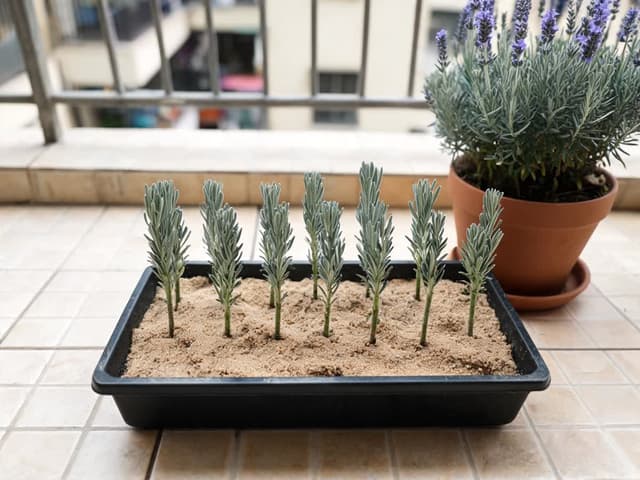
How to Propagate Lavender: Where to Cut and Why Cuttings Rot
A lavender cutting comes from a non-flowering branch tip, about 4 inches long, planted in sandy soil that never stays soggy. Learn where to cut, rooting times, seasonality in Brazil, and what to do if the base turns black.