How Often to Water a Basil Plant (and When Not To)
Water a basil plant when the top 2 to 3 cm (1 inch) of soil feels dry, until water drains through the hole in the pot. Learn what shortens the interval, how much water to give, and how to tell heat wilt from thirst and root rot.
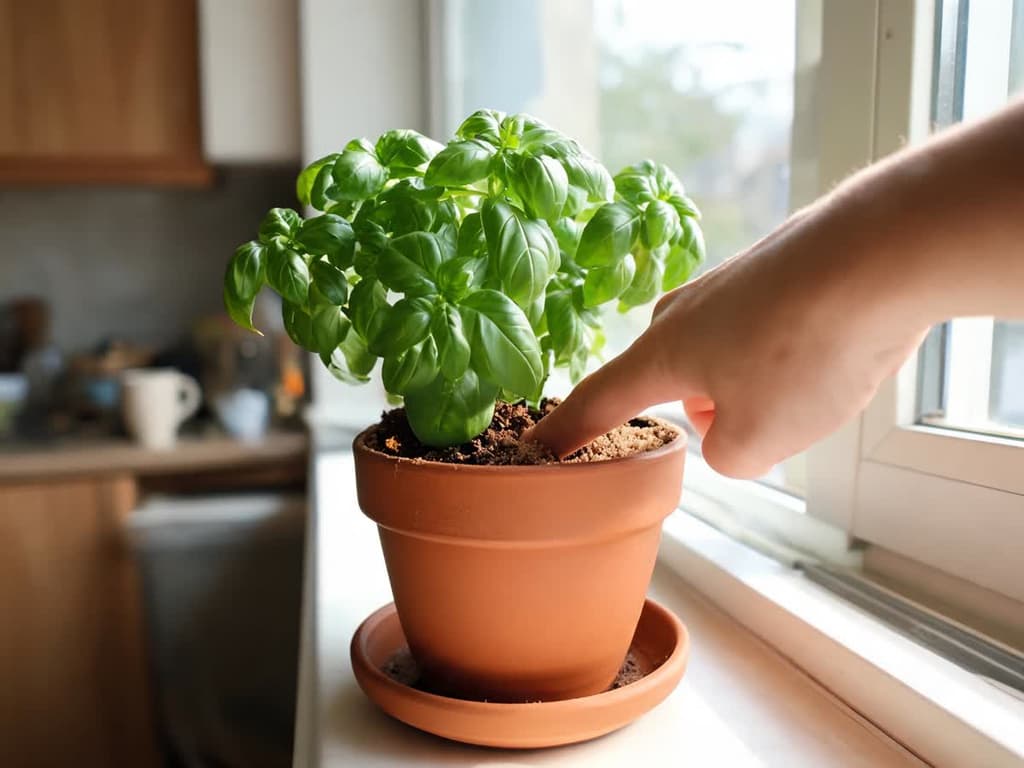
Water basil when the top 2 to 3 cm (1 inch) of soil feels dry to the touch. Water until liquid drains out through the pot's drainage hole. How often to water a basil plant depends on the container, sun exposure, and heat. Small pots, clay pots, full sun, and high temperatures shorten the interval. Cold weather, large plastic containers, and low light extend it. That is why there is no fixed schedule for watering. The finger test determines the day.
Basil (Ocimum basilicum) is a warm-weather annual herb that likes moist, but not soggy, soil. The Clemson Cooperative Extension, part of Clemson University, calls for "a relatively constant supply of moisture" in well-drained soil. Soil that stays dry for too long wilts the plant. Soil that is constantly wet rots the roots.
Quick summary:
When to water: when the top 2 to 3 cm of soil dries out.
How much: until water drains out through the drainage hole. Afterward, empty the saucer.
Time of day: in the morning.
Where: onto the soil, near the base of the plant, without wetting the foliage.
Did it wilt at midday while the soil is moist? Do not water. Check whether the plant perks back up by early evening.
Why there is no fixed schedule for watering basil
Popular English-language gardening guides give different numbers for the same plant. The Spruce website mentions watering once a week, and indoors, every 2 to 4 days. The same page says that soil dries more slowly indoors. Southern Living says every 3 to 4 days. Homes & Gardens ranges from every 1 to 3 days in the summer to every 10 days in cold weather.
Guides do not say which pot and which climate each number applies to. The RHS, the Royal Horticultural Society of the United Kingdom, gives no number: it asks for "consistently moist" soil and regular watering in containers. Clemson also gives no number. We follow Clemson and the RHS, which use soil moisture as the criterion. The calendar only serves to remind you to do the test.
Watering every 2 days without checking the soil can saturate the roots. On an overcast day, the soil might still be wet on day two, leaving extra water sitting in the pot. On a sunny day, the soil in a small pot can dry out even sooner.
How to tell if basil needs water
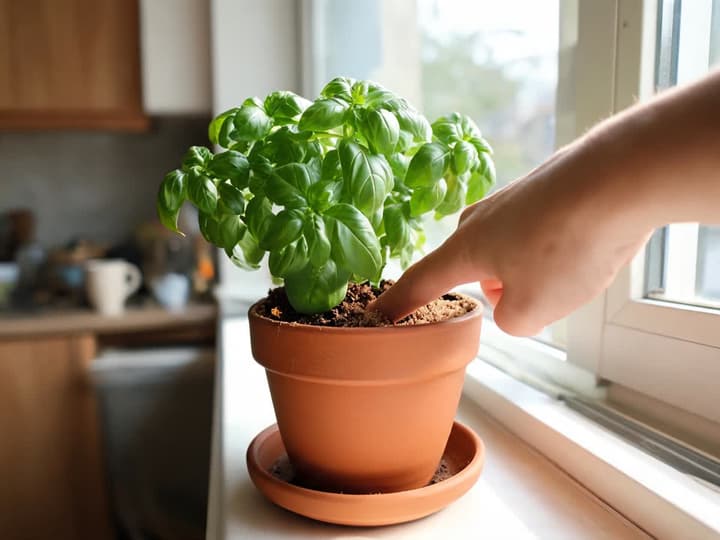
Stick your index finger into the soil near the edge of the pot down to the first knuckle (about 2.5 cm or 1 inch). If it comes out dry with no soil clinging to it, water. If it comes out moist or with dark soil clinging to it, wait and repeat the test the next day. Instructor Kim Roman, cited by Martha Stewart, uses this test. She waters potted basil when the soil is dry to a depth of 2.5 cm (1 inch).
The weight of the pot confirms the test without getting your hands dirty. Pick up the container right after a thorough watering and remember how heavy it feels. Once the pot feels distinctly lighter than it did right after watering, double-check with the finger test and water. Assessing weight works best with small plastic pots. Terracotta pots remain heavy even when dry, which masks the difference.
Soil color only helps on the surface. The topsoil lightens first, while the lower layer can stay wet. That is why the finger test is more reliable than merely looking at the color of the soil.
What changes the interval between waterings
Five factors speed up or slow down how quickly basil soil dries out. Use the table below to figure out whether your container will need water sooner or later than usual. The finger test still decides the watering day.
Condition | Effect on soil | What to do | Source |
|---|---|---|---|
Small pot | Dries out faster than a large pot | Check the soil daily | |
Clay pot (terracotta) or fabric grow bag (felt-like, similar to a tote bag) | Loses water through its walls and dries out faster | Water more frequently than in a plastic pot, always following the finger test | |
Full sun and heat above 32 to 35 °C (90 to 95 °F) | Can dry out within the same day | Water daily, or twice a day, if the test calls for it | Kim Roman, at Martha Stewart |
Indoors, under weaker light and low airflow | Dries out more slowly than outdoors | Test before every watering instead of copying your outdoor routine | The Spruce |
Cool weather | Dries out more slowly | Start checking 5 days after the last watering | Kim Roman, at Martha Stewart |
Soil composition also changes the pace. Clemson explains that organic matter helps sandy soil retain moisture and helps clay soil drain. In garden beds, Clemson recommends mulching the soil with 7.5 cm (3 inches) of shredded leaves or pine needles. This layer of organic mulch reduces the need to water as often.
Supermarket pots: dozens of seedlings in a single root ball
Supermarket potted basil contains dozens of thin seedlings crowded together. The RHS explains that these pots are meant for short-term harvesting. Crowded seedlings often catch fungal diseases or bolt to seed early. The RHS notes that they can survive if you divide and repot them promptly.
Iowa State explains that small pots dry out faster than large ones. Supermarket containers are small and packed with roots, so their potting mix dries out fast. Until you divide the seedlings, check the soil daily. Watering every morning without testing, out of fear of killing the plant, waterlogs the roots on overcast days.
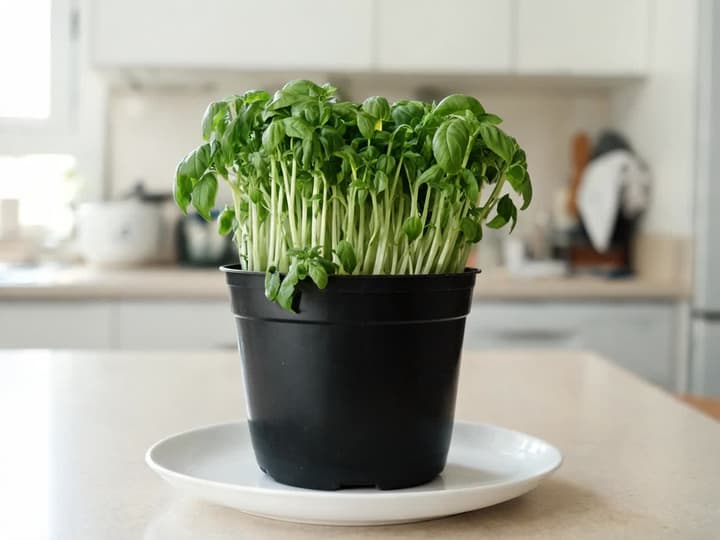
To divide them, slide the root ball out of the pot and tease the seedlings into smaller clusters with your fingers. Plant each group into a container with drainage holes measuring at least 20 cm (8 inches) wide and deep, the minimum size recommended by the RHS. Water until it drains through the bottom and resume the finger test.
How much water to give basil each time
Every time you water, pour water slowly onto the soil until it runs out through the drainage hole at the bottom of the pot. This wets the entire root ball, not just the top 2 cm. The Spruce recommends moistening at least 5 cm (2 inches) of soil so it does not dry out too quickly.
Once water stops draining, empty whatever remains in the saucer. Clemson cautions never to let basil sit in standing water in a tray. Roots sitting in standing water suffocate and rot.
In garden beds, the Utah State University Extension recommends 2.5 to 4 cm (1 to 1½ inches) of water per week. This calculation applies to garden soil. In pots, the finger test replaces the calculation.
Best time and method for watering basil
Water basil in the morning. The RHS explains that basil does not like sitting with wet roots overnight. Morning watering also gives leaves time to dry throughout the day.
Pour water onto the soil near the base of the plant without wetting the leaves. Clemson recommends watering at the base of each plant and keeping the foliage dry. Wet leaves encourage basil downy mildew, a disease caused by Peronospora belbahrii, a fungus-like microorganism. Cornell University advises reducing leaf wetness duration and air humidity to control the disease.
Misting the leaves does not replace watering and increases leaf wetness duration. The Spruce website suggests misting basil, but Clemson, Cornell, and UF/IFAS, from the University of Florida, call for dry leaves. We follow the three extension services, because they are the ones studying the disease.
Downy mildew begins with yellowing leaves and can be mistaken for a lack of fertilizer, warns UF/IFAS. The confirming sign is dark gray, fuzzy growth on the underside of the leaves. Cornell notes that this sporulation develops overnight, making early morning the best time to inspect. Other causes of yellow leaves on basil are collected on the symptom page.
Wilting basil: lack of water, midday heat, or root rot
A wilting basil plant might be thirsty, heat-stressed, or suffering from root rot. Inspecting the soil and the time of day will separate these three causes. Perform the finger test before watering, because watering a plant that has wilted from heat or root rot worsens the issue.
What you see | Soil | Likely cause | What to do |
|---|---|---|---|
Wilts between 12:00 PM and 4:00 PM in strong sun, perks back up by early evening | Moist down to 5 cm | Heat | Do not water; provide shade during peak hours |
Wilts at any time, leaves feel dry and crispy | Dry past 5 cm | Lack of water | Water until it drains through the hole |
Wilts without recovering at night, stem base dark and soft | Moist or waterlogged | Root rot | Stop watering and inspect the roots |
Midday wilting with moist soil: heat stress
Basil wilts in the heat even with water in the soil. NC State Extension, from North Carolina State University, lists basil among the plants that wilt in the heat. The wilting appears between 12:00 p.m. and 4:00 p.m., and the plant perks back up in the early evening. Drooping leaves are less exposed to the sun and lose less water.
To confirm, stick your finger in up to the second knuckle, about 5 cm (2 inches). If the soil is moist, NC State says the wilting is likely temporary and that watering again deprives the roots of air. If the soil is dry in the top 2 to 3 cm and moist at 5 cm, wait until early evening. If the plant does not perk up, water until liquid drains through the hole. If the pot sits in the afternoon sun every day, move the pot to a spot with shade during the hottest hours.
Wilting with dry soil: underwatering
If the soil is dry deeper than 5 cm, your basil is thirsty. Kim Roman outlines the symptoms on Martha Stewart: drooping leaves first, then dry and brittle, and finally brown. Water until moisture runs out through the drainage hole.
If leaves that wilted from thirst firm back up after watering, your watering interval was too long. Check the soil sooner in the days ahead. The RHS points out that basil subjected to repeated drought stress tends to flower prematurely, and flowering alters the flavor of the leaves.
Wilting with moist soil that does not bounce back: root rot
Wilting that persists into the night despite moist soil points to the roots. Clemson highlights root rot caused by Pythium and Rhizoctonia fungi, which leaves basil yellowing and weak. Rot develops when soil stays wet for too long. Take the plant out of its pot: healthy roots are light-colored and firm, whereas rotten roots are dark brown and mushy.
If the base of the stem has turned black and mushy, the plant rarely recovers. Any shoot tips that remain green and firm can become new cuttings. The RHS demonstrates taking a non-flowering tip cutting right below a leaf node and stripping the lower leaves. Place this cutting in a glass of water, and it will root quickly. Then, pot the young plant into fresh mix inside a container with drainage holes.
There is also Fusarium wilt, a soilborne disease that, according to NC State, attacks only sweet basil. The plant grows normally up to 15 to 30 cm (6 to 12 inches) and wilts suddenly, with brown streaks on the stem. There are no registered products to control Fusarium, according to NC State. Discard the plant and its soil, without reusing the soil for another basil plant.
Other causes of basil with wilting leaves, such as aphids and whiteflies, are covered on the symptom page. If you want to compare your plant against a disease, Bloom (available for iOS) provides diagnoses through photos on its Premium plan. Photo plant identification also helps if you received a pot as a gift and are not even certain whether the herb is basil.
Frequently asked questions
Should I water basil every day?
Only if the finger test calls for it. A small pot in full sun with temperatures above 32 to 35 °C (90 to 95 °F) can dry out daily. Indoors or on an overcast day, the soil may stay moist until the next day. Watering daily without checking saturates the soil and promotes root rot.
Is it better to water basil from above or below?
From above, onto the soil near the base, until water runs out the drainage hole. Bottom watering via a saucer also wets the soil, but leftover water sits trapped beneath the root system. If you water using a tray, dump out whatever remains in it. Clemson instructs that basil should never sit in standing water in a saucer.
Can I mist basil leaves?
It is not recommended. Clemson, Cornell, and UF/IFAS advise keeping foliage dry, because wet leaves encourage basil downy mildew. Misting also does not reach the roots, which is where the plant takes in moisture. To increase the water your plant receives, water the soil.
How to water basil in cold weather?
In cold weather, the soil takes longer to dry, and basil drinks less. Test the soil before every watering and wait until the top 2 to 3 cm (1 inch) dries out. Clemson and the RHS only move basil outside once nights stay above 10 °C (50 °F). In Brazil, nights below 10 °C (50 °F) usually occur between June and August. On those nights, keep the pot indoors.
Check the soil before watering basil
Basil drinks when the top 2 to 3 cm of soil dries out, and only the soil tells you when that happened. Water in the morning, at the base, until it drains, and empty the saucer. If basil wilts at midday with moist soil, do not water. Wait for the plant to stand back up in the early evening. How often to water rosemary is different. According to the RHS, rosemary planted in the ground for more than a year needs no watering beyond rain.
Related articles

How to Care for Hibiscus: Sun, Watering, Fertilizer, and Pruning for Flowers
How to care for hibiscus: 6 hours of direct sun, evenly moist soil without waterlogging, half-strength fertilizer in spring and summer, and pruning in early spring. Find out why the flower lasts one day and why buds drop before opening.

Do Ferns Like Sun or Shade? It Depends on the Type
Ferns prefer bright shade: plenty of light, but no direct sun on their fronds. Tuberous sword fern is the exception that handles sun. Here is the ideal light for each type, where to place pots, and how fronds show too much or too little light.

African Violet Yellow Leaves: Causes and What to Do
Yellow leaves on an African violet usually stem from overwatering, and the first place to check is the center of the plant. Losing one lower leaf at a time is normal. Identify whether age, watering, cold water, sunlight, cold drafts, or fertilizer is the culprit based on the yellowing pattern, and see what to do today.