Soil for Basil: Which Potting Mix to Use and How to Mix It
Potting soil for basil needs to be rich in organic matter and drain water well. Learn what to buy, the perlite and coco coir recipe, the right pot size, and how to deal with white mold and gnats in the soil.
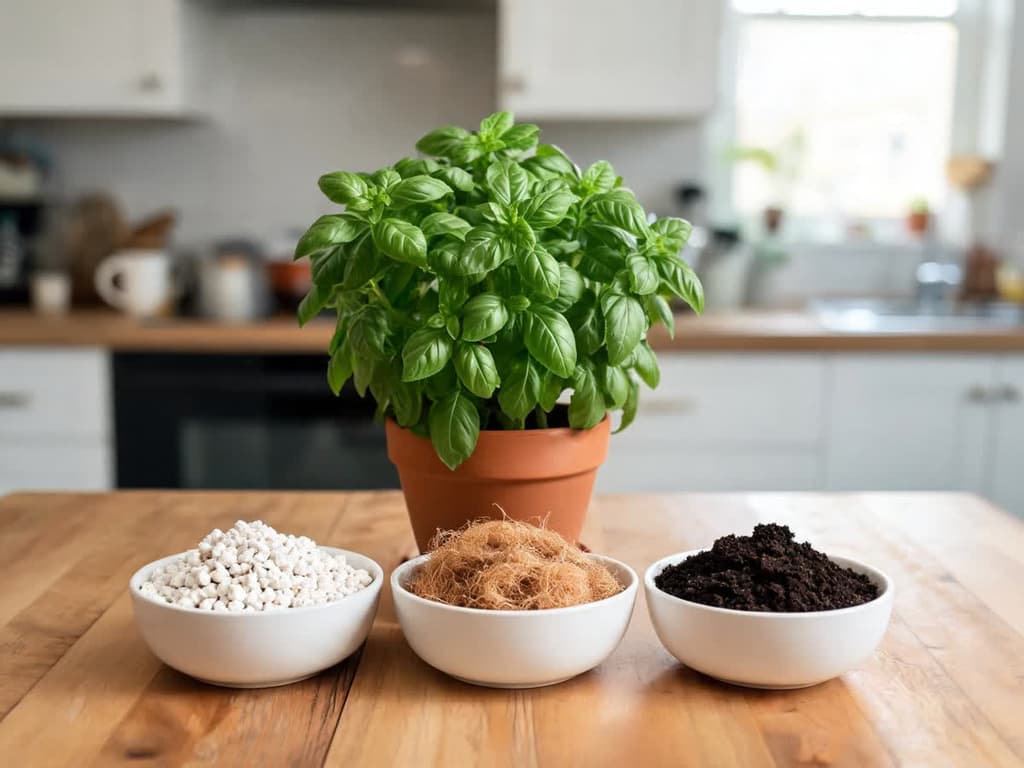
The best soil for potted basil is potting mix (soil formulated for containers) that is rich in organic matter and lets water drain freely. Use commercial potting mix, or combine garden topsoil, coco coir, and perlite (a light white mineral that aerates the soil). Plant in a pot at least 8 inches wide and 8 inches deep, with a drainage hole at the bottom. Avoid sandy mixes designed for cacti or rosemary, as well as straight garden soil.
Basil (Ocimum basilicum) requires two things that seem contradictory: constant moisture and fast drainage. Clemson describes the species as a plant that grows best in rich, well-drained soil. Embrapa describes basil growing in permeable soils rich in organic matter. Soil that holds too much water rots the roots, and soil that is too poor leaves the plant small.
What is the best soil for potted basil
The best soil for potted basil is light, dark, and rich in organic matter (decomposed plant material, such as compost or humus). It needs to hold moisture between waterings and allow excess water to escape through the drainage hole. Commercial potting mix, with or without extra perlite, meets both requirements.
This soil meets three key needs:
Organic matter. Clemson directs gardeners to mix compost, manure, or composted pine bark into garden bed soil before planting, because basil grows best in rich soil.
Consistent moisture. Clemson also states that basil needs relatively constant moisture in the soil. In practice, water when the top layer dries out, without waiting for the entire pot to dry. The University of Maryland includes basil among the herbs that prefer moist soil.
Drainage. Ask Extension, the US extension question service, calls basil a plant very susceptible to root rot.
Container soil drains worse than in-ground soil. The University of Georgia (UGA) explains why: the pot is shallow, and the force pulling the water down is weaker than in the ground. With excess moisture and little air, the roots suffer and root-rotting fungi easily take hold.
Herb soil mix vs. regular potting soil: which one works for basil
Regular potting soil rich in organic matter works well for basil. Mixes containing sand or fine gravel, which the University of Maryland recommends for rosemary, thyme, and oregano, do not work for basil. Culinary herbs do not all require the same soil, and Maryland divides them into two groups.
The first group includes rosemary, thyme, and oregano. These herbs prefer fast-draining soil, and Maryland advises adding sand, perlite, or fine gravel to the mix. They should also dry out somewhat between waterings. Basil falls into the second group of herbs that prefer moist soil, alongside chives and mint.
Because of this, a basil container should not receive the mix used for rosemary, which requires soil that dries out between waterings. For the same reason, do not use cactus and succulent potting mix. Before buying a bag of "herb soil," read the ingredients: if it is based on sand or gravel, the mix suits the rosemary group rather than basil.
Potting mix recipe for basil
The DIY recipe with exact proportions comes from UGA. It applies to potted plants in general: no consulted source tested a recipe specifically for adult basil. Here is the ratio:
Component | Parts (by volume) | Name in Brazil | Purpose |
|---|---|---|---|
Good quality soil | 2 | terra vegetal | provides body and holds nutrients |
Peat moss | 2 | coco coir (used in place of peat, a decomposed moss) | holds water |
Perlite | 1 | perlita | creates pore space for air |
Iowa State confirms that coco coir can replace peat moss. Measure the parts using the same bucket or cup. Perlite is the light white stone, similar to Styrofoam, sold in garden centers.
For basil, add worm castings or compost to the mix. Embrapa and Uniderp tested worm castings in Campo Grande (MS) in a trial published in Horticultura Brasileira in 2002. Two-liter pots received 60 g of worm castings per liter of soil. At this rate, the plants produced half the biomass of those fed with synthetic fertilizer. The essential oil content, which provides the aroma, was nearly double: 1% compared to 0.54%.
Another trial from Universidade Federal do Recôncavo da Bahia (UFRB) added a compost of sheep manure and gliricidia (a legume used as green manure) to potted soil. Compared to unamended soil, leaves and stems gained 64% in dry mass (without water) and 94% in fresh mass (with water). The oil content did not change.
Sand or perlite for basil
Choose perlite. Iowa State explains that sand drains well in the ground, but does not keep soil aerated inside a pot. It serves mostly to add weight to a pot for a tall plant. Maryland and the University of California (UC IPM) cite sand or perlite to improve drainage. This guide goes with perlite: Iowa State explains that sand does not aerate container soil, and UW-Madison says perlite ensures pore space for root air.
How to tell if the mix is ready
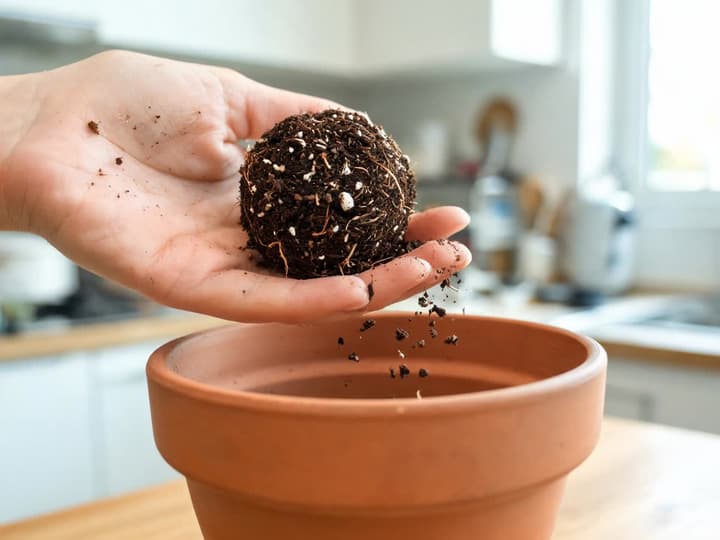
Moisten the mix with a little water and squeeze a handful. Based on the Iowa State squeeze test, it should form a ball that holds its shape and crumbles easily. If water drips when squeezed, the mix is too wet. Fill the container to the rim and wipe away the excess across the top without packing it down. Iowa State warns that tamping down the soil eliminates air pores.
Commercial potting mix: what to look for on the bag
Commercial potting mix works for basil straight out of the bag without alterations. UGA calls commercial mixes ideal for containers and notes that the best options already contain limestone and fertilizer. The RHS, the UK's horticultural society, recommends peat-free multi-purpose compost. If the bag indicates "pre-fertilized" or "includes plant food," do not fertilize during the first 2 to 3 weeks after planting.
Do not fill pots exclusively with garden soil. Iowa State compares the two. High-quality soil has roughly 50% pore space (empty space for air and water), while a good container mix has about 85%. When soil is dug up and placed in a pot, it settles and loses most of the pores that hold air.
Soil pH for basil
You do not need to measure the pH (the soil's acidity level) of your pot. According to UGA, commercial potting mixes have limestone added during manufacturing, which neutralizes acidity and maintains the pH in the proper range. Clemson gives a target range of 6.0 to 6.5 for garden bed basil, adjusted with agricultural lime after a soil test.
Pots for basil: size, drainage holes, and material
Use a pot at least 20 cm wide and deep, with a drainage hole at the bottom. The RHS and the University of Kentucky give the same measurement. Iowa State warns that an oversized pot keeps the soil wet for too long.
A drainage hole is required. UW-Madison explains that watering a pot without a hole becomes guesswork. If you want a decorative pot without a hole, use it as a cachepot: plant in a plastic pot with a drainage hole and set it inside. After each watering, empty the water that collects at the bottom of the cachepot.
Terra-cotta pots help growers who tend to overwater. Iowa State notes that terra-cotta is porous and dries out more quickly. Plastic pots retain moisture longer, so check the soil with your finger and water only when the top layer feels dry.
Growing basil in a balcony planter
In a window box or planter, use the same potting mix as you would in an individual pot and check that it has drainage holes in the bottom. Space seedlings at least 4 inches apart, following RHS recommendations for multiple plants in one container. The RHS also explains that crowded basil plants flower prematurely and end their harvesting window.
Grocery store basil: how to repot into fresh soil
Grocery store basil pots contain many crowded seedlings packed into a small root ball. The RHS notes that these crowded plants are prone to fungal issues or early flowering, but they can survive if you separate and repot them promptly.
To repot grocery store basil into fresh soil:
Moisten the potting mix until it passes the handful squeeze test.
Slide the root ball out of its plastic pot and gently separate it with your fingers into smaller clumps, keeping the roots intact on each section.
Plant each clump into an 8-inch pot at the same depth it sat previously.
Fill in around the root ball with your mix without compacting the soil.
Water thoroughly until liquid drains from the bottom, then place the pot in the sunniest spot in your home.
If planting several clumps in a single large container, keep at least 4 inches between them. Supermarket-purchased plants should stay in indoor pots: the RHS advises this precaution to prevent introducing pests and diseases to outdoor gardens.
White mold on basil soil
White mold on basil potting soil is usually a harmless surface fungus, and there is no need to discard the plant. The University of Maryland explains that harmless fungi create a white-to-gray layer on the surface of the potting media when it stays constantly damp. The soil is not ruined; rather, the top layer simply is not drying out between waterings.
To remove white mold from your pot's soil:
Scrape off the white layer with a fork, or scoop out and discard the top layer of soil with the mold, as Maryland advises.
Allow the surface to dry out between waterings and space containers apart to improve air circulation.
If the plant came from the supermarket, use this opportunity to repot the clumps into fresh potting mix.
Maryland also warns that surface fungal growth attracts gnats to the container. Removing the mold promptly is worthwhile even when your basil appears healthy.
Gnats in basil soil
The small black flies hovering around basil soil are usually fungus gnats. Maryland explains that gnat larvae develop in damp soil rich in organic matter, which is the exact environment basil requires. Overwatering fuels the fungal growth that larvae consume.
Do not wash the soil off the roots: no reviewed source recommends this, and the potential damage remains unmeasured. Take these steps instead:
Allow the top layer of soil to dry out between waterings, as recommended by UC IPM and Maryland. Dry soil kills the developing larvae.
Place yellow sticky traps directly in the pot to catch flying adults.
If gnats persist, Maryland suggests soil drenches containing Bti (Bacillus thuringiensis israelensis), a natural bacterium that targets and eliminates larvae in the soil. Only use products labeled for indoor houseplants.
The guide on fungus gnats provides the complete step-by-step instructions.
If your basil is wilting while gnats are present, slip the plant out of its pot to inspect the roots before watering. UC IPM explains that a wilting plant is not always thirsty. Dense larval populations can feed on roots, and fungal root rots produce identical wilting symptoms even more frequently. Healthy roots are firm and white, according to Ask Extension. Brown, mushy roots indicate root rot. To distinguish root rot from other problems using a photo of your plant, Bloom (available for iOS) provides plant diagnoses with its Premium plan.
Fertilizing potted basil: how much and how often
Fertilize potted basil sparingly and at measured intervals. The RHS notes that basil planted in garden beds rarely needs fertilizer, but potted basil can run out of nutrients. Every leaf harvest removes energy, and container soil holds a limited reservoir.
Follow this timeline:
Initial weeks. If your potting mix contains pre-mixed fertilizer, wait 2 to 3 weeks after planting before adding plant food, as UGA recommends. For homemade unfertilized mixes, no scientific source provides an exact schedule: begin feeding once growth shows signs of slowing.
Later. Use liquid fertilizer every 3 to 4 weeks, according to the University of Illinois. Iowa State suggests half strength or one-quarter of the package dose for herbs. Start with the lower dose.
Signs to feed. Illinois connects fertilizer need to slow growth and pale green foliage. Dark green, vigorously growing basil does not need extra fertilizer.
Fertilizer type. The RHS recommends a balanced, organic-based liquid fertilizer and advises against high-potassium options, such as tomato feed.
Over-fertilizing diminishes the flavor of the foliage, according to Illinois and Clemson. The Embrapa trial points to the same result: chemical fertilizer increased vegetative growth while cutting essential oil content in half. If your goal is rich aroma, prioritize organic matter over heavy synthetic fertilizers. Flowers also alter leaf taste, and our guide on how to encourage basil flowering or prevent blooms explains when to pinch off flower stalks.
Frequently asked questions
Do pebbles in the bottom of the pot help basil?
The evidence on placing rocks at the bottom of the pot is divided. Washington State University states that water does not move from fine soil into a coarse layer until the soil is saturated. A 2025 study in PLOS ONE measured that the coarse layer reduces retained water, but tested pots without plants. Neither study tested living plants, so follow the safer option: an unobstructed drainage hole and the pot filled only with potting mix.
Can I use backyard garden soil for potted basil?
Plain garden soil should not be used on its own. Iowa State and UW-Madison explain that dug-up soil compacts tightly in pots, drains poorly, and risks introducing soilborne diseases and weed seeds. UGA accepts good garden topsoil as part of a balanced container mix, but never by itself. For indoor containers, choose commercial potting mix. Recipes containing garden soil work better in large outdoor balcony containers.
What soil should I use to start basil seeds?
Sow seeds in a dedicated seed-starting mix, as recommended by the RHS. Once seedlings produce true leaves, transplant them into 3-inch pots filled with standard potting mix. A 2011 UFERSA study in Mossoró (RN) evaluated seedlings 30 days after sowing. They grew best in a 1:1:1 mix of aged cattle manure, arisco (a regional sandy soil), and coarse sand. For seed sowing, this guide follows RHS guidelines, as the study measured subsequent seedling development rather than initial germination rates.
When should I repot basil into fresh soil?
Repot your basil when dividing grocery store plants, when roots begin emerging from the drainage hole, or if you suspect root rot. Maryland instructs repotting into a container 2 to 4 inches wider across. No research source dictates a rigid calendar schedule. Basil is an annual plant, so an individual specimen rarely requires more than one repotting.
Soil for basil: your action plan for today
Pick up a bag of standard potting mix, or blend 2 parts topsoil, 2 parts coco coir, and 1 part perlite. Plant in an 8-inch container featuring drainage holes, without packing down the media. Water whenever the top layer feels dry, feed lightly every 3 to 4 weeks, and gently remove any surface white mold. When night temperatures drop, follow our cold-weather basil care guide.
Related articles

How to Care for Hibiscus: Sun, Watering, Fertilizer, and Pruning for Flowers
How to care for hibiscus: 6 hours of direct sun, evenly moist soil without waterlogging, half-strength fertilizer in spring and summer, and pruning in early spring. Find out why the flower lasts one day and why buds drop before opening.

Do Ferns Like Sun or Shade? It Depends on the Type
Ferns prefer bright shade: plenty of light, but no direct sun on their fronds. Tuberous sword fern is the exception that handles sun. Here is the ideal light for each type, where to place pots, and how fronds show too much or too little light.

African Violet Yellow Leaves: Causes and What to Do
Yellow leaves on an African violet usually stem from overwatering, and the first place to check is the center of the plant. Losing one lower leaf at a time is normal. Identify whether age, watering, cold water, sunlight, cold drafts, or fertilizer is the culprit based on the yellowing pattern, and see what to do today.