How Often to Water Dahlias, From Planting to Bloom
A newly planted dahlia receives no water until it sprouts. After that, the established plant needs about 1 inch of water per week, including rain, in one or two deep waterings. Here is how to water in each stage, the difference between pots and garden beds, heat, and what to do with a wilting dahlia.
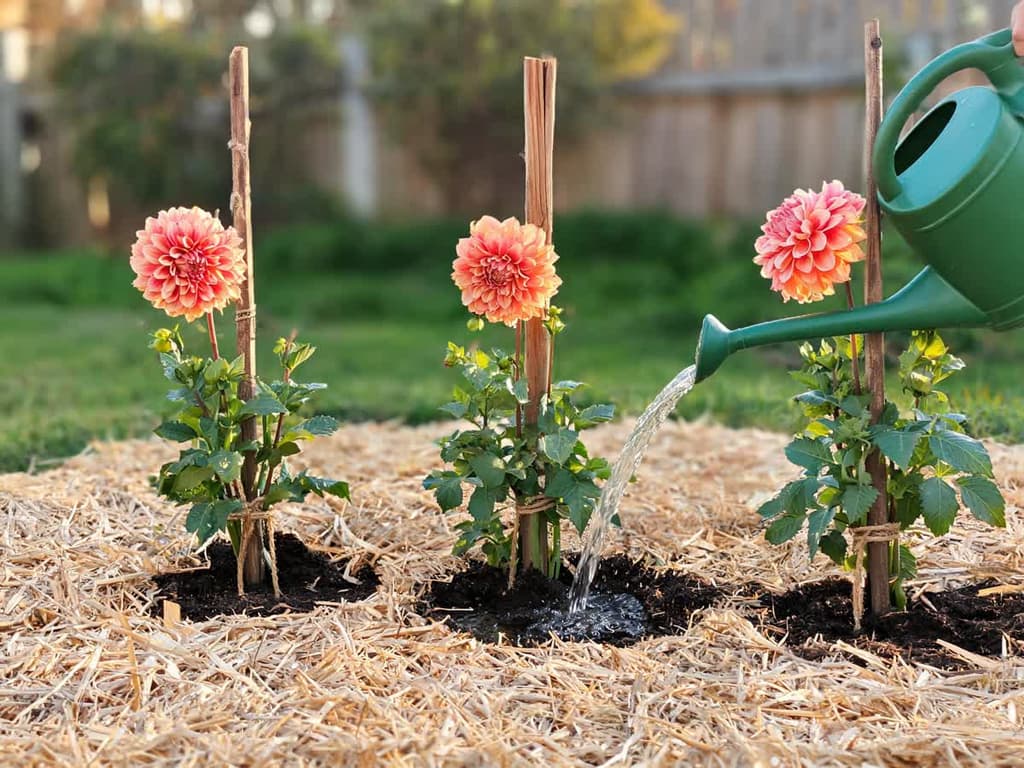
How often to water dahlias depends on the tuber's stage, and the soil decides the day. From planting until the first leaves appear, do not water: the tuber (the thick underground part from which the plant sprouts) rots in wet soil. Afterward, the established plant needs about 1 inch of water per week, including rain, in one or two deep waterings.
On hot days and during blooming, dahlias use more water. In pots, the soil dries out much faster than in garden beds. At the end of the cycle, when the foliage turns yellow, reduce watering until stopping completely.
Quick summary:
Planted tuber with no sprout: no watering, unless the soil is dry as dust.
Small sprout: water lightly, only when the top few inches of soil dry out. Excess moisture at this stage still rots the plant.
Established plant in a garden bed: about 1 inch of water per week, including rain, in one or two deep waterings that moisten the soil down 8 to 10 inches.
Potted dahlia: stick your finger into the soil every day in the heat and water when the top 1 inch is dry.
Water the soil around the base in the morning without wetting the flowers.
Foliage yellowing in the fall: reduce watering gradually until the plant enters dormancy (the top dries out and the tuber rests). The dormant tuber stays dry.
How often to water dahlias at each tuber stage
The dahlia tuber is the thick, fleshy underground part from which the plant sprouts every year. It stores water and energy reserves. Because of this, the dahlia barely needs water at the beginning and needs a lot when it is large and blooming.
The right day to water comes from the soil test (sticking your finger into the soil to check whether it is dry or moist), not from a fixed schedule. The test changes with the tuber's stage:
Stage | How to recognize | Watering | Source |
|---|---|---|---|
Planted, no sprout | Flat soil, nothing in sight | None. If the soil is dry at planting, moisten lightly only | Oregon State |
Sprout up to 8–12 inches | First leaves and thin stem | Light. Water only when the top few inches dry out | American Dahlia Society |
Established plant | Above 8–12 inches, multiple branches | Deep, about 1 inch per week including rain | American Dahlia Society, UGA |
Blooming and heat | Buds and flowers, severe heat days (measured flower damage starts at 95°F / 35°C) | The same deep watering, testing the soil more frequently | NC State, Oregon State |
End of cycle | Few flowers, yellowing leaves | Less water each week until stopping | no published measurements |
In Brazil, tubers usually go into the ground in spring, from September to November, and flowering falls in summer and autumn. In sources from the United States and Europe, planting takes place in April and May, their spring, which corresponds to our period from September to November.
From planting to sprouting: the tuber receives no water
After planting the tuber, do not water until the first two leaves appear. The recommendation comes from the Oregon State University dahlia guide (revised in 2024), which explains why: at this stage, the tuber rots easily. It does not yet have the roots that take up water, so moisture sits around it.
The right soil for planting is slightly moist. If it is dry as dust, Oregon State advises moistening it with a little water and stopping there. The Washington State University extension Master Gardeners program handout says the same: it is better to plant in soil that is a little dry than wet.
Sprouting can take time. Flower farm Five Fork Farms notes that some varieties sprout in 2 weeks while giant-flowered types can take 2 months. As long as nothing appears, do not water "to help." Without these roots to take up water, wet soil rots the tuber.
There are two exceptions:
Hot and dry weather, with no rain in sight: tuber retailer Swan Island Dahlias provides one light watering per week until the sprout appears. The safer option is Oregon State's: only moisten the soil if it is dry as dust.
Tuber planted in a pot: the Royal Horticultural Society (RHS) calls for keeping the potting soil only slightly moist until the sprout appears and giving it a light watering when the leaves emerge. In a pot, excess water rots the tuber quickly.
From sprout to established plant: light water, then deep watering
The young plant needs little water, and excess water still rots the dahlia at this stage. That is according to the American Dahlia Society growing guide. Water the sprout only when the top few inches of soil dry out.
Deep watering begins when the plant is already established. Five Fork Farms sets this point at 8–12 inches (20–30 cm) tall. Between 8 and 12 inches, test the soil and water deeply if the plant already has multiple branches. From then on, the dahlia grows rapidly, branches out, and begins using much more water.
Deep watering is watering that moistens the soil down to a depth of 8–10 inches (20–25 cm), where the roots extending from the tuber reside. Oregon State recommends watering slowly so the water infiltrates rather than running off. Several quick waterings per week wet only the surface and leave the roots dry.
To gauge 1 inch (25 mm) of water, leave an empty wide-mouthed can in the bed during watering or rain. When the water accumulated in the can reaches 1 inch, the soil has received about 5.2 gallons per square yard (25 liters per square meter). With dahlias planted 24 inches (60 cm) apart, as indicated by the RHS, each plant occupies about 4 square feet (0.36 m²). That equals close to 2.4 gallons (9 liters) per plant per week, counting rain (our calculation, based on the 1 inch recommended by the American Dahlia Society). Divide this into 1 or 2 waterings and subtract whatever rain has already fallen.
How many times a week to water dahlias: sources disagree
Frequency recommendations range from one to four waterings per week. Swan Island, an Oregon tuber grower, irrigates production fields with sprinklers. UGA, Rutgers, and Oregon State write for home gardeners.
Source | Type | Recommendation for established plants |
|---|---|---|
Swan Island Dahlias | retailer (Oregon) | 3–4 deep waterings per week, 60 minutes or more of sprinklers |
Longfield Gardens | store | 2–3 deep waterings per week |
extension (New Jersey) | 2–3 deep waterings per week after sprouting | |
extension (Georgia, 2022) | 1 soaking watering per week with mulch (a layer of straw or dry leaves over the soil); 2 without mulch, during the dry period | |
American Dahlia Society | growers' association | water if rainfall totals less than 25 mm in 7 days |
Oregon State University | extension (2024) | soil consistently moist, never waterlogged and never dry |
This guide follows UGA (University of Georgia, in the United States), the American Dahlia Society, and Oregon State. Their rule: about 25 mm per week, including rain, in one or two deep waterings. The soil test decides the day. UGA and Oregon State are university extensions; the American Dahlia Society is the growers' association that gives the measurement in mm. Rutgers, also an extension, indicates 2–3 deep waterings per week: the soil test tells you if the third watering is necessary. Swan Island's 3–4 waterings use a sprinkler or soaker hose running for 60 minutes or more. That is the routine of a production field.
To check the soil, poke your finger in down to the second knuckle (about 2 inches or 5 cm), as Oregon State advises. Dry soil at this depth calls for a deep watering. Moist soil does not. Soil type also changes the frequency. Sandy soil (loose, with a lot of sand) dries out fast and requires more frequent waterings. Clay soil (heavy, with a lot of clay) first needs better drainage.
Rain counts toward the weekly total, but brief, light showers are not enough. Swan Island observes that most passing showers do not moisten the soil down to the roots. After such a rain, check the soil before skipping a watering.
Blooming and heat: when dahlias demand more water
Dahlias struggle in intense heat, and watering is one line of defense. According to the NC State Extension, dahlias can weaken in summer heat, despite their tropical origin. The recommendation is to keep the soil mulched and water deeply, without letting the soil dry out.
In Brazil, the heat that damages dahlias has already been measured in the field. A study in five cities in Rio Grande do Sul (Ornamental Horticulture, 2023) monitored dahlia crops. Irreversible damage to buds and flowers began at an air temperature of 35 °C. The authors point to three ways to protect dahlias: shading, irrigation, and choosing the planting date.
During blooming and on very hot days, maintain deep watering and test the soil more frequently. Oregon State adds an exception: if the soil is above 35 °C (95 °F), watering on a hot day cools the plant and the soil. In very hot climates, the UF/IFAS, in Florida, recommends a spot with light afternoon shade and mandatory mulch.
In much of Brazil, summer is the rainy season, and rain can cover the weekly 1 inch (25 mm) on its own. During a veranico (a dry spell of hot days within the rainy season), resume deep watering.
Dahlias in pots versus dahlias in garden beds
A potted dahlia requires more frequent watering than one in a garden bed, which gets 1–2 deep waterings per week. The RHS explains that potting soil dries out faster. At the peak of summer, a blooming potted dahlia may need water every day, according to Five Fork Farms and Longfield Gardens.
For containers, the test is shallower. The American Dahlia Society recommends not watering while the soil is moist 2.5 cm (1 inch) below the surface. When the top 2.5 cm dries out, water until it drains from the holes in the bottom.
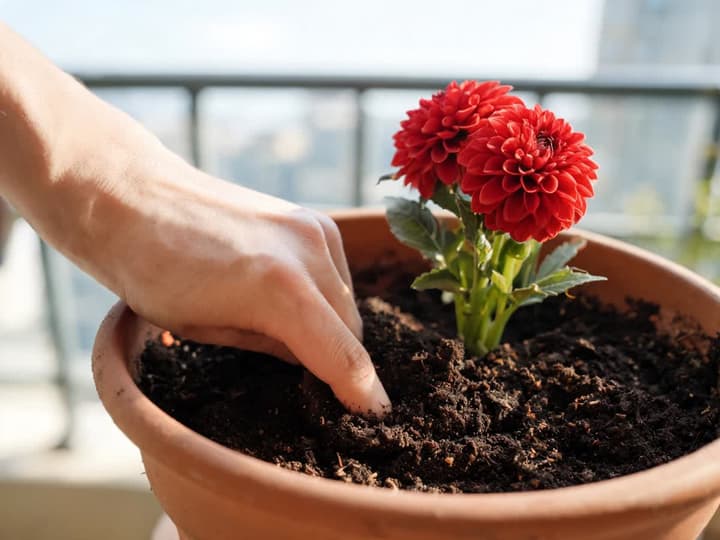
Pot size determines how often you will water. Oregon State calls for a pot 12–18 inches (30–45 cm) deep and wide for compact varieties. The RHS recommends a width of about 20 inches (50 cm) for standard-sized dahlias. Large pots hold more water and space out waterings.
Remove the saucer from under the pot, or empty it after each watering. The American Dahlia Society advises removing the saucer so excess water drains away and the soil does not stay soggy.
In garden beds, one or two deep waterings per week suffice, including rain. The soil test uses a finger inserted to the second knuckle.
Store-bought potted dahlia in bloom: bottom leaves turned yellow
Do not soak the dahlia every morning. Check before every watering: soil dry at 1 inch needs water; moist soil does not. Yellow, drooping lower leaves in the first few days have two common causes, with opposite remedies.
Dry soil and light pot: small nursery pots dry out in a few hours in direct sun. Water until water drains through the holes and move the plant to a pot about 20 inches (50 cm) wide or out into a garden bed in full sun.
Wet soil and water in the saucer: this indicates overwatering. Empty the saucer, wait for the top 1 inch to dry, and only then resume watering.
Small potted dahlias are sold as florist gift plants (purchased in full bloom in temporary store containers), according to NC State, and these pots are too small for the dahlia. The RHS recommends moving dahlias bought in bloom in summer directly to their permanent location. That location is a pot about 20 inches (50 cm) wide or a garden bed in the sun.
Yellow leaves that persist after correct watering have other causes, such as nutrient deficiency or disease: the diagnosis is in dahlia leaves turning yellow and on the page about yellow leaves on dahlias. Light, temperature, and plant size are in the dahlia guide.
Mulch reduces watering needs for dahlias
Mulch is a layer of straw, dry leaves, or shredded bark spread over the soil. It retains moisture and cools the ground. According to UGA, mulched beds need only one deep watering per week during dry spells; unmulched beds need two.
Tuber retailer Swan Island Dahlias does not recommend mulch, claiming it traps water before moisture reaches the tuber. Extension programs at UGA, NC State, UF/IFAS, and Oregon State recommend mulch, as does the RHS. This guide follows those five sources, four university extensions and the RHS (horticultural society), rather than the retailer.
Even Swan Island, while advising against mulch, details how to apply it if used. Spread mulch only after the sprout has grown a few inches above the soil. Leave a clear space around the crown: Oregon State cautions to keep mulch from touching the stem.
Water the soil in the morning without wetting the flowers
Water near the root zone, directly onto the soil around the base. If water will touch foliage, water early so leaves dry during the day. Once flowers open, Oregon State warns against overhead watering cans and sprinklers: waterlogged blooms become spotted, heavy, and bend the stems.
Powdery mildew (the white powder that covers leaves) is prevented through watering in two ways. Clemson Extension explains that the powdery mildew fungus does not need water on the leaf to germinate; high humidity in the air is enough. Longfield Gardens attributes powdery mildew to wet foliage; this guide follows Clemson, which is a university extension. Sprinklers increase this humidity among the plant's leaves and stems, which is why watering goes on the soil.
The second way is not letting the soil dry out too much. The RHS notes that powdery mildew appears in dry conditions and recommends keeping the dahlia well watered. The University of Washington Elisabeth C. Miller Horticultural Library also cites water stress as a factor. Prevention means watering at the base and not letting the soil dry out too much.
Flowers and leaves that stay wet for a long time encourage another fungus, dahlia gray mold. Watering in the morning at the soil level helps in both cases.
Signs of overwatering and underwatering in dahlias
Slight wilting in midday sun is normal and resolves by late afternoon. Oregon State reminds gardeners that some midday wilting in hot weather is natural. The dependable indicator is how the plant looks early in the morning, before direct sun.
Sign | Underwatering | Overwatering |
|---|---|---|
Soil at 2 inches | Dry | Moist or soggy |
Wilting | Persists in early morning and disappears after watering | Persists even with moist soil |
Lower leaves | Dry and brittle, or yellow and drooping in small pots that dried out fast | Yellow, with moist soil |
Stem base | Firm | Dark or soft |
Tuber | Firm | Soft, dark, with a foul smell |
Dahlias are susceptible to root rot, according to NC State. One cause is Phytophthora, a soil organism that attacks roots in waterlogged soil. Therefore, when in doubt between the two columns, wait for the top 2 inches (5 cm) of soil to dry before watering again.
Wilting dahlia with moist soil: stop watering or dig up the tuber?
Stop watering today and do not dig up the entire plant. A dahlia wilting in the morning when the soil is moist 2 inches down is not thirsty, and more water only worsens the condition. The next step is inspecting the tuber.
Carefully dig beside the plant without pulling it up until you locate a tuber. Press it with your finger.
Firm tuber: the root system is alive. Let the soil dry until the top 2 inches feel dry, then resume deep watering once or twice per week, counting rain.
Soft, dark tuber that smells bad: it is rot. The causes and what to do are on the pages for rot in dahlias and root rot in dahlias.
A firm tuber and a wilted plant with good soil can indicate a wilt disease. These diseases clog the channels that carry water inside the plant. The signs are on the pages for Fusarium wilt and Verticillium wilt, and other causes of wilting are in wilting leaves in dahlias.
Bloom (available for iOS) compares a photo of your dahlia with symptoms of these diseases. Diagnosing diseases from photos is part of the Premium plan.
End of cycle: reducing watering when foliage yellows
When flowering ends and foliage begins yellowing in the fall, decrease watering week by week until stopping completely. The plant is entering dormancy (the phase where top growth dies back and the tuber rests) and uses progressively less water.
No university extension has measured the exact pace of this reduction. Retailer Longfield Gardens stops watering or cuts back sharply one to two weeks before cutting plants back at the end of the season to let tubers cure. Oregon State halts fertilizer in late summer for the same reason: tubers harden off and store better. The safest route is following the foliage: less green leaf surface means less water.
The dormant tuber stays dry. Where the ground does not freeze in winter and drains well, the tuber can stay in the bed without water until spring. Where it freezes or becomes waterlogged, it is dug up and stored in a dry place, as the guide to dahlia winter care explains.
Frequently asked questions
Do I need to water dahlias every day?
Dahlias in garden beds do not need daily watering. One or two deep waterings per week, including rain, supply the 1 inch of water that established plants use. Blooming potted dahlias in peak summer heat may need water daily. In either setting, test the soil before watering.
Can I water dahlias at night?
Morning is the best time. Oregon State advises watering the soil, and if water wets the leaves, watering early so they dry during the day. Foliage and blooms that remain wet all night encourage fungi like gray mold. If night is the only time possible, apply water strictly to the soil without wetting the plant.
Do I need to water dahlias after fertilizing?
Yes, when using granular fertilizer. Oregon State explains that watering after broadcasting granular fertilizer dissolves the granules and delivers nutrients down to the root zone. Scatter fertilizer in a ring around the plant, keeping it off the stem, and water the soil immediately afterward.
Are dahlias toxic to dogs and cats?
The ASPCA, an American animal welfare organization, lists the dahlia as toxic to dogs, cats, and horses. The signs are mild: gastrointestinal upset and skin irritation. According to NC State, handling the tubers and leaves excessively can also irritate human skin. If ingested, consult a veterinarian.
Do dahlias do better in pots or garden beds?
Tall dahlias do best in garden beds, where soil retains more moisture and watering is less frequent. The RHS recommends pots for dwarf varieties up to 24 inches (60 cm) tall; most dahlias reach 4 feet (1.2 m). In pots, provide 12–18 inches (30–45 cm) of depth and width for dwarf cultivars (Oregon State) and about 20 inches (50 cm) of width for standard-sized dahlias (RHS). Test the soil daily in the heat.
Before your next dahlia watering
Before your next watering, check your tuber's stage and test the soil. In garden beds, insert your finger to the second knuckle; in pots, down to 1 inch. Unsprouted tubers receive no water unless the soil is dry as dust. Established plants get deep watering that moistens the soil down 8–10 inches. Foliage yellowing in autumn calls for less water every week.
Related articles

How to Care for Hibiscus: Sun, Watering, Fertilizer, and Pruning for Flowers
How to care for hibiscus: 6 hours of direct sun, evenly moist soil without waterlogging, half-strength fertilizer in spring and summer, and pruning in early spring. Find out why the flower lasts one day and why buds drop before opening.

Do Ferns Like Sun or Shade? It Depends on the Type
Ferns prefer bright shade: plenty of light, but no direct sun on their fronds. Tuberous sword fern is the exception that handles sun. Here is the ideal light for each type, where to place pots, and how fronds show too much or too little light.

African Violet Yellow Leaves: Causes and What to Do
Yellow leaves on an African violet usually stem from overwatering, and the first place to check is the center of the plant. Losing one lower leaf at a time is normal. Identify whether age, watering, cold water, sunlight, cold drafts, or fertilizer is the culprit based on the yellowing pattern, and see what to do today.