Dahlia Leaves Turning Yellow: Causes and What to Do
Dahlia leaves turning yellow might just be the natural end of the season or a tuber rotting in soggy soil. Learn how to tell causes apart by plant stage and yellowing pattern, and when to cut back, treat, or discard.
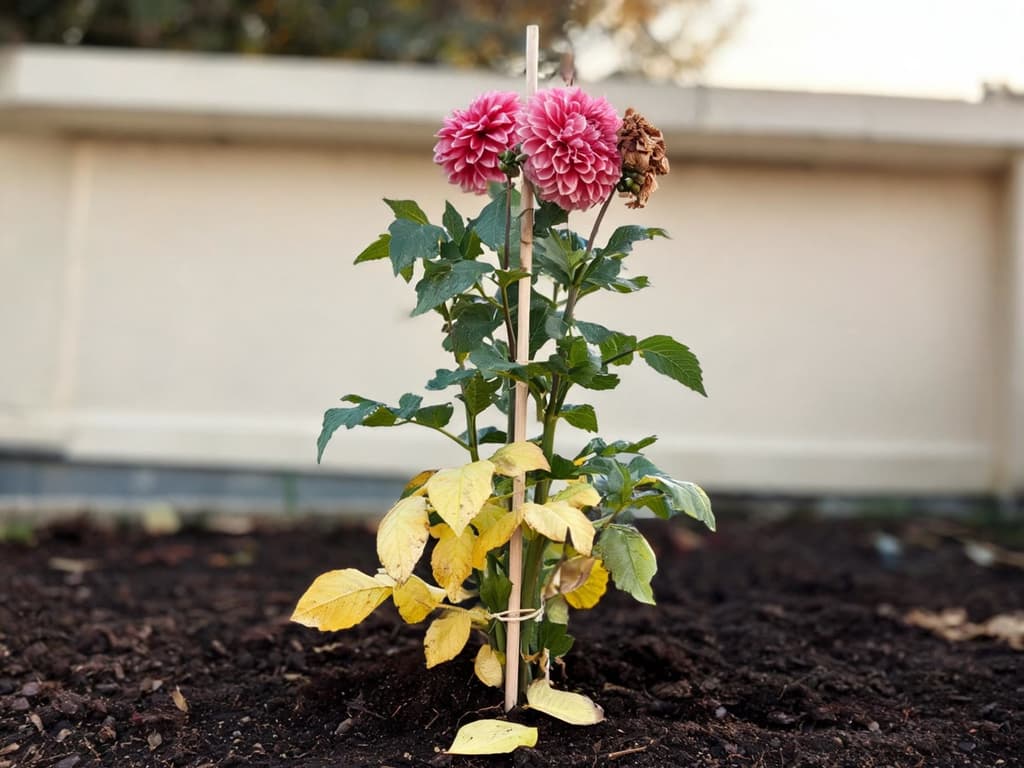
A dahlia with yellow leaves might simply be at the normal end of its cycle, or its tuber may be rotting in wet soil. At the end of blooming, when temperatures drop, the dahlia dies back to the ground. UC ANR advises letting the leaves turn yellow before cutting them back. In waterlogged soil, the tuber (the thick root from which the dahlia sprouts) rots, warns Oregon State. The other causes are mites, leafhoppers, lack of water or fertilizer, fungal leaf spots, viruses, and wilt.
Do not cut down the whole plant or dig up the tuber before answering two questions. First: what stage is the dahlia in? It might be sprouting, in full bloom, or finishing its flowering. Second: where is the yellowing? It could be only on the bottom leaves, in tiny dots, in spots, in a mosaic pattern, or on just one side of the plant.
Viruses and wilt mean you must discard both the plant and the tubers. A tuber that is soft all the way through also belongs in the trash. With the other causes, the dahlia recovers or sprouts again the following year. The page on yellow leaves on dahlias lists pests and diseases one by one. For other plants, the guide on yellow leaves explains how to interpret yellowing on any species.
The sources for this guide are university extensions in the United States, university services that provide guidance to plant growers. The Royal Horticultural Society (RHS) in the United Kingdom is also included. Whenever a source refers to flowering plants in general rather than dahlias specifically, the text notes it.
Yellow leaves on dahlias: identifying the cause by growth stage and pattern
Where the yellowing appears | When it appears | Accompanying signs | Probable cause | What to do |
|---|---|---|---|---|
Whole plant, gradually, from the bottom up | End of blooming, as the weather cools | Fewer blooms, stems drying out | End of cycle | Let it dry and cut back to 4 inches (10 cm) above ground (6 inches where it freezes, after frost) |
Bottom and inner leaves | Sprouting or after heavy rain | Soil soggy for days, stem base soft | Tuber rotting | Stop watering and check the tuber |
Bottom leaves, without spots | In full bloom | Dry soil or container is too small | Lack of water or nitrogen | Water the soil directly and fertilize |
Pale stippling across the whole leaf | Heat and dry weather | Fine webbing on leaf undersides | Spider mites | Spray leaf undersides with a strong stream of water and apply insecticidal soap |
Leaf edges, spreading inward | Summer | Edges dry and brittle | Leafhoppers | Remove heavily infested leaves |
Round yellow spots that turn brown | Humid weather (smut) or dry weather (powdery mildew) | White powder with powdery mildew | Smut or powdery mildew | Remove leaves and improve airflow |
Mosaic pattern, yellow bands, or rings | Any stage | Distorted foliage, stunted growth | Virus | Discard plant and tubers |
One side of the plant, accompanied by wilting | Any stage | Brown streaks inside the stem | Verticillium or Fusarium wilt | Discard and do not replant in that spot |
Yellow leaves at the end of blooming: the dahlia preparing for dormancy
Dahlias bloom from summer to fall and die back to the ground when temperatures drop, according to the UC ANR. The yellowing during this stage is not a disease. The top of the plant dies, and the tuber stays alive underground to sprout the following spring. In Brazil, fall runs from March to June.
Yellowing at the end of the growth cycle typically follows weeks of flowers, when new flower buds start thinning out. It moves slowly up the plant without spots or stippling. If yellowing shows up while the plant still has plenty of buds, something else is causing it: refer to the table above.
UC ANR instructs letting the leaves turn yellow and then cutting the plant back to about 4 inches (10 cm) above the ground. Where it freezes, Washington State waits for frost to kill back the plant, cuts it to 6 inches (15 cm), and only then digs it up. Where it does not freeze, follow UC ANR, which writes for a mild-winter climate. The University of Kentucky explains the reason for waiting: a light frost kills the leaves and flowers, but the tuber continues to mature. For that reason, do not pull up a dahlia that is yellowing at the end of its cycle in the fall.
Digging up tubers is not a blanket rule for all of Brazil. Oregon State and Washington State write for regions where the ground freezes during winter. The University of Washington library notes that excessive moisture kills tubers more often than cold does. Where the soil does not freeze, leave the tubers in garden beds only if the soil drains freely.
Dahlia sprouting with yellow leaves and wet soil: tuber rot
During sprouting, too much water is the greatest risk for dahlias. Oregon State instructs not to water after planting until the first two leaves appear, because the tuber rots easily at this stage. In Brazil, dahlias are planted in the spring, from September to December.
According to the University of Maryland, the primary symptom of excess water in flowering plants is yellow or wilted leaves at the bottom and center of the plant. Excess water depletes oxygen from the soil and kills feeder roots, preventing the plant from absorbing water. For this reason, a dahlia with a rotting tuber wilts even in wet soil. Iowa State summarizes: dahlias tend to rot in soggy, poorly drained soil.
Check the plant in this exact order:
Insert your finger into the soil down to the second knuckle. Soil that remains wet 3 days after the last watering indicates poor drainage.
Squeeze the base of the stem right at the soil line. A stem that feels soft and looks dark at that point indicates rot.
Dig with your hand next to the stem until you see the tuber. A firm tuber is a good sign. A dark, soft, or disintegrating tuber or root indicates rot, describes Utah State.
If the tuber remains firm, withhold water until the soil dries out to the depth of your second knuckle. If the entire tuber has turned soft, the plant cannot recover: dig it up and discard it, and plant your next one in an area where rainwater does not puddle.
Lower leaves turning yellow mid-bloom without spots: underwatering or nitrogen deficiency
On dahlias in full bloom, lower leaves turning yellow without any spots is usually due to a lack of water or fertilizer. Iowa State calls for consistent watering for dahlias, especially in containers, which dry out faster. Prolonged drought leaves foliage yellow with dry edges and causes leaves to drop, according to the University of Maryland, on flowering plants in general.
Water according to soil moisture checks rather than a fixed calendar schedule. Extension guidelines differ on exact numbers: UC ANR suggests watering once or twice per week, while Washington State recommends 2 to 3 deep waterings per week during summer. That variation comes down to regional climate and soil differences. The rule that applies across both is from Oregon State: keep soil evenly moist, never waterlogged, and never parched.
If watering is correct and the yellowing continues to move up from the bottom leaves, the likely cause is nitrogen deficiency. Nitrogen is the fertilizer nutrient that the plant uses to produce foliage. Nitrogen moves within the plant, which is why the deficiency appears first on the older, lower leaves. This applies to plants in general, explains Iowa State.
Apply fertilizer at the application rate indicated on the product label. For dahlias, Oregon State recommends a low-nitrogen fertilizer, such as a 5-10-10 formula (the three numbers represent nitrogen, phosphorus, and potassium). The same extension warns that excess nitrogen produces weak stems, reduces flower yield, and causes tubers to rot or shrivel in storage after digging.
When the yellowing occurs between the veins (the fine lines that pattern the leaf) and the veins stay green, the cause may be a lack of magnesium or iron. The University of Washington horticulture library cites these two nutrients for mature dahlias that turn yellow. Without a soil test, you cannot tell which of the two is missing.
Tiny yellow specks and fine webbing on the leaf underside: spider mites
Scattered light specks make the leaf look faded from a distance and are a sign of spider mites. The mite is a nearly invisible creature related to spiders that feeds on the leaf. Under heavy mite pressure, the plant turns yellow or bronze and a fine webbing appears, describes Clemson, on plants in general. Washington State notes that mites tend to attack dahlias in hot weather.
On plants in general, infestations start on the lower leaves and work their way up, with heavily damaged leaves yellowing, turning brown, and dropping, according to Iowa State. To check, turn over a stippled leaf and hold the underside up to the light. Clemson suggests tapping the leaf several times over a white sheet of paper: spider mites show up as tiny crawling specks.
To manage them, Utah State uses a strong jet of water aimed directly at the mites on the undersides of the leaves. If that does not suffice, Clemson recommends insecticidal soap or horticultural oil. Apply during the late afternoon when temperatures are cooler to avoid burning foliage. Drought-stressed plants suffer more damage from mites, so keep up with watering during dry spells.
Yellow margins advancing inward and drying out: leafhoppers
The leafhopper is a slender, light green insect, about 3 mm long, that sucks sap from the leaf. The description is from the Connecticut Agricultural Experiment Station. On dahlias, it turns the leaf margin yellow, and the yellowing advances toward the midrib, according to UF/IFAS. Later, the yellow area turns brown and brittle. Without control, the plant stops growing.
The University of Washington library notes another symptom of leafhopper damage: foliage becomes stippled before drying out and falling off. The stippling resembles spider mite damage, but leafhoppers produce no webbing, and you can see the insects themselves on the leaf undersides.
Yellow spots that turn brown: smut, powdery mildew, and what neem oil cannot fix
Yellow spots, round or irregular, that later turn brown and dry are the sign of dahlia smut, a leaf fungus. The Pacific Northwest Plant Disease Management Handbook states that high humidity and wet foliage favor smut. The fungus overwinters in plant debris fallen on the ground.
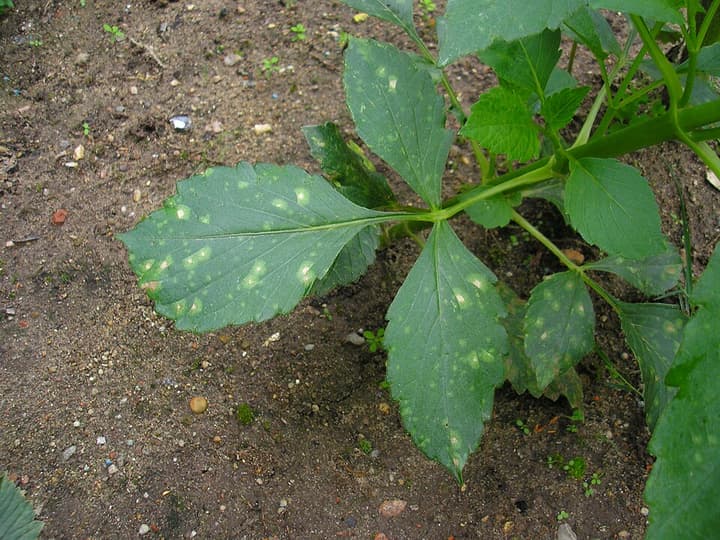
Powdery mildew is another common fungal disease affecting dahlias. It blankets leaves in a white or grayish powdery coating. According to UF/IFAS, powdery mildew intensifies late in the growing season, causing severely infected leaves to distort and drop. RHS notes that powdery mildew can develop during dry spells and emphasizes maintaining regular watering.
For both fungal issues, management is identical:
Remove spotted leaves and throw them in the trash, not the compost bin.
Clean up fallen leaves from the ground around the base of the plant.
Water the soil rather than wetting the foliage, as recommended by Oregon State.
Strip the bottom 2 to 3 pairs of leaves from mature plants to improve air circulation, per Oregon State guidance.
Washington State lists neem oil among organic options for spider mites and powdery mildew. Against viral infections, no chemical spray works: Oregon State notes there is no cure for dahlia viruses. Against vascular wilts, the Connecticut Agricultural Experiment Station states control is difficult. When powdery mildew shows up late in the season, Utah State notes chemical treatments may not be worth applying, as the plant is already approaching the end of its life cycle.
Mosaic patterns, yellow bands, or rings with distorted foliage: viruses
Leaves with a mosaic pattern, mixing light green and dark green, are a sign of a virus. Other signs are pale bands along the veins, yellow rings, small or distorted leaves, and plants that are shorter than the others. Yellow streaks or spots with stunted growth usually indicate a virus, according to Oregon State. One of them is the dahlia mosaic virus, which is spread by aphids, according to Utah State.
The virus has no cure and lives inside the tuber. Every sprout and every new tuber from the diseased plant starts out infected, explains the University of Maine. Because of this, saving the tuber for the following year carries the virus along with it. Some plants with the virus show no signs at all and still pass the disease on.
If your dahlia displays mosaic patterns or yellow ring spots, take these steps:
Dig up the entire plant, including all attached tubers.
Dispose of it in the trash or bury it. Oregon State and the University of Maine advise against composting infected material.
Dip your pruners in a bleach solution before cutting another dahlia, as Oregon State directs.
Inspect new shoots on neighboring dahlias for aphids.
The University of Maine states that the soil does not retain contamination once all infected plant debris is cleared away. A healthy tuber from another source can be planted in the exact same spot. Utah State points out that laboratory testing is the only definitive way to confirm a viral infection.
Yellowing and wilting on one side of the plant: Verticillium or Fusarium wilt
When yellowing and wilting start on just one side of a dahlia, the cause may be Verticillium wilt or Fusarium wilt. These soilborne fungi clog the vascular tissues that carry water up through the plant. On mature plants, foliage turns pale green and lower leaves wilt, often beginning on one side first, describes the Connecticut Agricultural Experiment Station. Eventually, the entire plant wilts and dies.
To check, cut through a wilted branch and look at the interior tissue. A brown ring or streak inside the stem confirms vascular wilt, according to the same source.
Because these fungi persist in the soil, management is difficult. Dig up the plant along with all its tubers and throw them in the trash. Avoid planting dahlias in that bed again: the Connecticut Agricultural Experiment Station advises avoiding soil contaminated with the pathogen.
Potted dahlia bought in bloom with yellow leaves
A potted dahlia purchased in full bloom often turns yellow due to a cramped pot, lack of direct sunlight, or improper watering. Oregon State recommends a container measuring 12 to 18 inches (30 to 45 cm) in width and depth. The RHS suggests a 20-inch (50 cm) pot and notes that compact dahlia varieties, reaching up to 24 inches (60 cm) tall, perform best in containers. If the nursery pot is under 12 inches (30 cm), repot the dahlia into a 12- to 20-inch container.
Dahlias need at least 6 hours of direct sun per day, according to NC State. Indoors, away from a window with direct sun, they do not receive this light. Move the dahlia to the balcony or yard, in a spot with full sun.
Swinging between underwatering and overwatering without checking the soil makes the issue worse. UC ANR waters container dahlias more frequently than in-ground plants. Iowa State also calls for steady watering for potted dahlias. Check the soil daily with your finger: water thoroughly until runoff drains from the bottom holes whenever the top 2 inches (down to your second knuckle) feel dry, and empty the drainage saucer afterward.
When none of these factors explains the yellowing, a clear photo can help. Without an accurate diagnosis, you cannot recommend the proper treatment, notes the University of Washington library. Bloom (available for iOS) identifies plants and, in its Premium version, diagnoses plant health issues directly from a leaf photo.
Should I cut yellow leaves, dig up the dahlia, or wait?
What you should do with the foliage, the plant, and the tuber depends entirely on what caused the yellowing.
Cause | Yellow leaves | Plant | Tuber |
|---|---|---|---|
End of cycle | Let dry completely | Cut back to 4 inches (10 cm) once dry | Leave in the ground where soil neither freezes nor stays soggy |
Tuber rot | Remove dried leaves | Withhold water until soil dries out | Discard if completely soft |
Underwatering or nitrogen deficiency | Remove dried leaves | Adjust watering and fertilizer application | Keep in place |
Spider mites or leafhoppers | Remove the most heavily infested leaves | For mites, spray leaf undersides with a strong jet of water | Keep in place |
Smut or powdery mildew | Strip off and dispose of in the trash | Improve airflow around plant | Keep in place |
Virus | Dig up completely | Trash or bury; never compost | Discard all tubers |
Verticillium or Fusarium wilt | Dig up completely | Trash | Discard and do not replant in that spot |
Frequently asked questions about yellow dahlia leaves
Will yellow dahlia leaves turn green again?
Do not expect them to recover. If the underlying cause persists, yellow leaves eventually turn brown, according to the University of Maryland regarding flowering plants in general. The University of Washington library notes that simply picking off yellowing dahlia leaves may be all you need to do. To tell if your corrective measures worked, watch new growth: if new leaves emerge green and healthy, your fix is working.
What does an overwatered dahlia look like?
An overwatered dahlia develops yellowing on lower and inner foliage first and wilts even while standing in wet soil. The base of the stem becomes soft and dark, and the tuber turns mushy. Oregon State cautions that dahlias cannot tolerate waterlogged conditions. Stop watering until the soil dries to the depth of your second knuckle, and verify that excess water drains away freely.
Do coffee grounds help dahlias with yellow leaves?
None of the sources in this guide tested coffee grounds on dahlias. For gardens in general, Washington State states that no evidence shows coffee grounds repel pests. In tests, grounds also did not prove to be acidic, contrary to what many people think. No source recommends coffee grounds as a solution for the causes in this guide. If you want to use them, mix them into the compost pile, up to 20% of the volume.
Are dahlias toxic to dogs and cats?
Yes, but the toxicity is mild. The ASPCA, an animal poison control center in the United States, lists the dahlia as toxic to dogs, cats, and horses. The signs are mild stomach and intestinal issues and mild skin irritation. If your pet ate leaves and vomits or becomes lethargic, call your veterinarian.
Related articles

How to Care for Hibiscus: Sun, Watering, Fertilizer, and Pruning for Flowers
How to care for hibiscus: 6 hours of direct sun, evenly moist soil without waterlogging, half-strength fertilizer in spring and summer, and pruning in early spring. Find out why the flower lasts one day and why buds drop before opening.

Do Ferns Like Sun or Shade? It Depends on the Type
Ferns prefer bright shade: plenty of light, but no direct sun on their fronds. Tuberous sword fern is the exception that handles sun. Here is the ideal light for each type, where to place pots, and how fronds show too much or too little light.

African Violet Yellow Leaves: Causes and What to Do
Yellow leaves on an African violet usually stem from overwatering, and the first place to check is the center of the plant. Losing one lower leaf at a time is normal. Identify whether age, watering, cold water, sunlight, cold drafts, or fertilizer is the culprit based on the yellowing pattern, and see what to do today.