How to Get Bougainvillea to Bloom: What It Shows and What to Change
To get bougainvillea to bloom, it needs 6 hours of direct sun, new growth, and long nights. Learn from what the plant shows whether it lacks sun, has too much fertilizer, or is just waiting for short days, and what to change in each case.
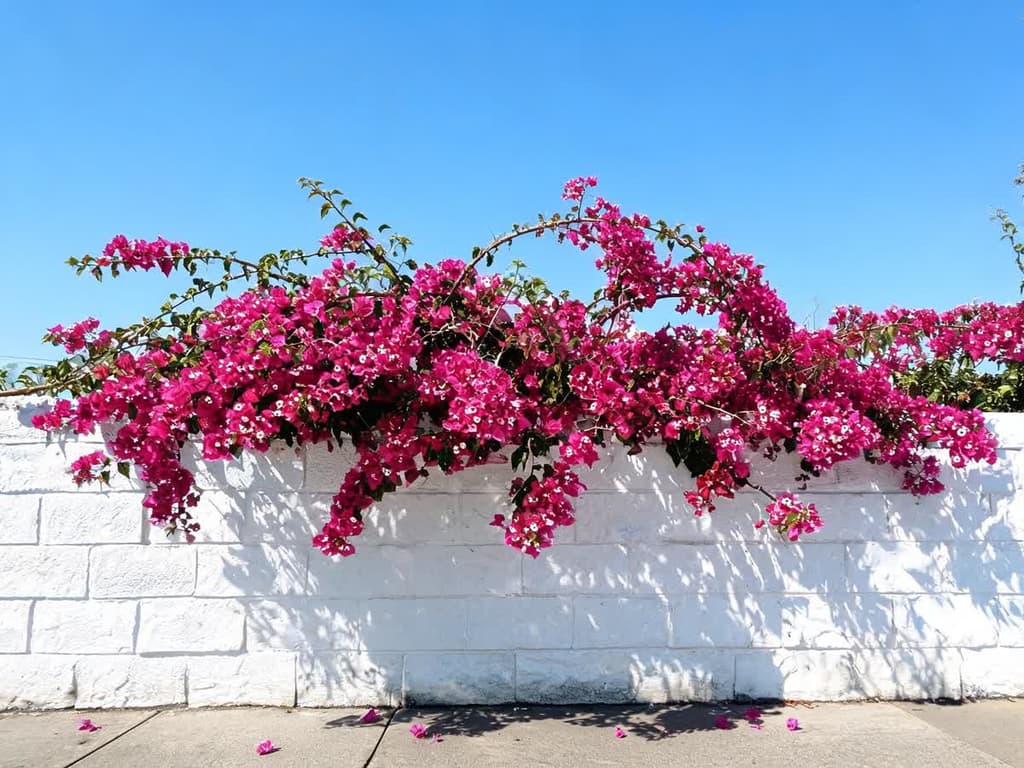
To get bougainvillea to bloom, give it at least 6 hours of direct sun per day. Water only when the surface of the soil dries out and use balanced fertilizer, without excess nitrogen. The flower emerges on new shoots and appears more vigorously when nights get long. In Brazil, nights become longer than days from March to September.
The color you expect to see comes from the bracts, not the flower. Bracts are modified leaves that surround three small white tube-shaped flowers (NC State). The small flowers are tiny and barely noticeable. Because of this, when a bougainvillea appears flowerless, what is actually missing are the bracts. Bougainvillea also requires well-draining soil and protection from frost, and the bougainvillea care guide details each step.
Summary: what the plant shows and what to do
What bougainvillea shows | Probable cause | What to do |
|---|---|---|
Heavy green growth, long stems, and no color | Shade, too much nitrogen, or vigorous water shoots | 6 hours of direct sun, balanced fertilizer without excess, bend long stems |
Healthy and green during Brazilian summer | Long days | Wait for short days, from March to September |
Lost color and leaves after purchase | End of the color cycle or lower light | Direct sun and wait for new growth |
Yellow leaves and no color after repotting | Damaged roots | Do not repot again and water only when the soil surface dries out |
Color only at the tip of a long stem | Vigorous stem lacking side shoots | Bend and tie down the stem |
Wilted leaves and dropping bracts with dry soil | Severe drought | Water thoroughly until water drains from the pot hole |
Why bougainvillea doesn't bloom: start with what it shows
The University of Hawaii (CTAHR) lists four practices that reduce bougainvillea blooming: shade, too much water, too much nitrogen, and frequent pruning. The Master Gardeners (gardening volunteers trained by the University of California) add lack of heat (UC Master Gardeners).
Each cause leaves a sign. Heavy foliage and no color point to sun or fertilizer. Yellow leaves after disturbing the roots point to repotting. Bracts dropping with dry soil point to a lack of water. Look at the plant before changing any care routine.
Bougainvillea with plenty of leaves and no color
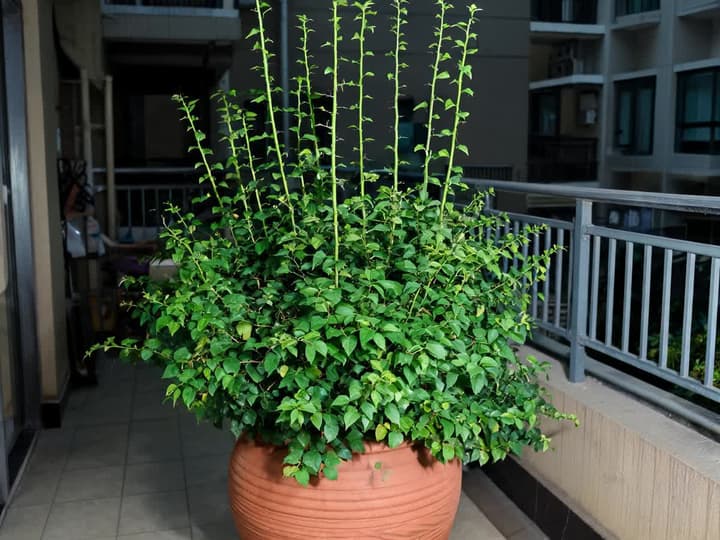
Vigorous, green bougainvillea without any colored bracts usually gets too little sun or too much nitrogen. Do not cut the plant down to the ground: a plant growing this vigorously is healthy. It is simply spending its energy on foliage.
Start with the sun. UF/IFAS (University of Florida Extension) notes that the more sun bougainvillea receives, the more it blooms (UF/IFAS). Without direct sun, it does not bloom. The RHS (Royal Horticultural Society, in the United Kingdom) calls for at least 6 hours of sun per day (RHS).
In Brazil, the window and wall that receive the most sun face north. The RHS mentions a south- or west-facing window because, in the United Kingdom, the sun travels through the south. If your bougainvillea is on a south-facing balcony, move the pot before changing the fertilizer.
After sun, check the fertilizer label. It lists three numbers (NPK), and the first is nitrogen, which makes the plant grow foliage. CTAHR advises avoiding excess nitrogen.
Long stem that only blooms at the tip
Bougainvillea sends out very vigorous, long, straight shoots that grow upward. Nassau County UF/IFAS warns that these shoots, if not trimmed or bent, stop the growth of the rest of the plant (UF/IFAS Nassau). The flower forms on short shoots that emerge from the sides of the main branch, next to the leaves (CTAHR). A long, straight branch usually has few of these short side shoots. This is the likely explanation for color only at the tip, although no source has measured this.
RHS teaches bending new, fast-growing side shoots and tying them down at the start of the growing season. The bend checks growth and stimulates bracts. In Brazil, this season begins in late winter, when the plant starts sprouting again. Use soft twine or cloth tape without squeezing the shoot, and secure the bent shoot to the trellis or wall. CTAHR takes a different approach: cut each side shoot back until 2 or 3 buds (the points where new shoots emerge) remain. No source compared the two methods. This guide starts with bending, because it does not remove any shoots from the plant.
Green bougainvillea in the summer: it waits for short days
Healthy, green bougainvillea in the summer may just be waiting for long nights. In 1935, researcher Allard showed that Bougainvillea glabra forms buds with 12 hours of light per day or less. The test was conducted between 21 and 24 °C. The data appears in a 1962 study from the University of Florida, which confirmed the result. In that study, only plants kept under short days bloomed.
According to CTAHR, days with 8 to 11 hours of light promote blooming. The condition is strong sun and temperatures above 14 to 18 °C. UF/IFAS researchers classify the 'Afterglow' bougainvillea as a short-day plant (which forms flowers when nights are long). It blooms earlier and more heavily with 8 hours of light (Chng and Moore, 2018).
In Brazil, nights exceed 12 hours from March to September, between the two equinoxes. The equinoxes fall around March 20 and September 22, when day and night each have 12 hours. From December to February, with long days and heat, it is normal for bougainvillea to produce less color. A commercial production manual archived by NC State adds that high night temperatures can delay flowering (commercial production manual).
Rain also changes blooming. Epagri is Santa Catarina's agricultural research agency. It cites a 1988 study: bougainvillea blooms several times a year, except during very rainy periods (Epagri/Ciram). In the Central-West and Southeast, summer is the rainy season and the time of long days. Putting both sources together, a summer break in color is expected in these regions, but neither source measured the month.
Near the equator, days last about 12 hours year-round and barely vary. In this zone, drought appears to be what triggers flowering, according to the same UF/IFAS researchers (Chng and Moore, ASHS 2015). The poinsettia, which also has colored bracts, also blooms with long nights.
Primavera (Bougainvillea glabra) or bougainvillea (Bougainvillea spectabilis): when each one blooms
The two most widely cultivated species in Brazil bloom at different rates. In this section, primavera refers to glabra and bougainvillea refers to spectabilis; throughout the rest of the guide, bougainvillea refers to both. According to CTAHR, primavera (B. glabra) blooms several times a year. Bougainvillea (B. spectabilis) blooms during one season of the year, after a dry period or a colder period.
RHS notes that glabra and the hybrid Bougainvillea × buttiana are best suited for containers because they flower while still young. If your plant is a young spectabilis, it may take longer to display color than your neighbor's glabra.
Knowing which of the two you own changes what to expect. Glabra blooms multiple times a year, and spectabilis blooms after drought or cold weather. Bloom (available for iOS) identifies the species from a photo.
Bought bougainvillea in bloom and it lost its color
Losing all its bracts weeks after purchase does not mean the bougainvillea died. Do not throw the plant away. CTAHR explains that bracts can hold their color for several months after the true flowers finish. Later, they fade to a papery color and texture before dropping. If color disappeared within a few weeks of purchase, the bracts might have already reached the end of their cycle, or the plant lost light during the move.
Changing location speeds up bract drop. In low light, bougainvillea drops its bracts, and kept indoors in dim conditions it also sheds its leaves (CTAHR).
UF/IFAS Charlotte County notes that leaf drop after flowering is often natural. New growth follows (UF/IFAS Charlotte). Place the plant where it gets at least 6 hours of direct sun per day, preferably outdoors on a porch or balcony. Color returns on the new branches; none of the consulted sources gives a specific timeframe.
Repotted, cut back on watering, and bougainvillea worsened
Bougainvillea has thin, brittle roots, and repotting can damage the root system so severely that the plant fails to recover. California Master Gardeners warn that roots are sensitive to any disturbance. They may not recover when surrounding soil is heavily worked. CTAHR also urges care with brittle roots during transplanting.
If you repotted and the plant began dropping yellow leaves, do not repot again. First, do the scratch test that UF/IFAS teaches for branches exposed to cold (UF/IFAS). Scratch the bark of a branch lightly with your fingernail. Green underneath means the branch is alive. Brown or black means a dead branch at that spot: do not prune yet, wait for new growth to show what is alive.
Next, keep the plant in the sun and water only when the soil surface dries out. Color will follow later on new growth. If the soil remains constantly waterlogged and the stem base feels soft, suspect root rot.
Withholding water to "stress" bougainvillea helps only to a narrow point. UF/IFAS states that commercial growers allow the plant to dry out to the point of wilting and water as soon as the leaves soften (UF/IFAS, ENH 874). At home, water before that happens, when the soil surface dries out: soft leaves are the limit, not the goal. Drying beyond this point drops the leaves and forces the plant into dormancy. To distinguish yellow leaves caused by root damage from other causes, see bougainvillea yellow leaves. To repot without breaking the roots, the step-by-step instructions are in the bougainvillea care guide.
Fertilizer to make bougainvillea bloom: ratio and dose
Fertilizer to induce bougainvillea blooming should be balanced and applied at a moderate rate. CTAHR recommends fertilizer with a nitrogen, phosphorus, and potassium (NPK) ratio of 1:1:1 or 2:1:2. A 10-10-10 fertilizer has a 1:1:1 ratio, while a 10-5-10 has a 2:1:2 ratio. For containers, apply a balanced slow-release fertilizer (which feeds gradually), such as 10-10-10, every 3 months. Alternatively, use a water-soluble fertilizer at half the label rate every week or every 2 weeks.
The "low nitrogen" rule faces one study to the contrary. The University of Florida tested glabra 'Sander' under short days in 1962. The average number of bracts per plant was 29.1, 35.2, and 61.6. Only the highest rate stood out from the other two in statistical testing. The three figures correspond to increasing levels of nitrogen. The authors wrote that this result refutes most previously published work.
The authors' explanation is that glabra blooms only on new growth. More nitrogen produces more new growth, and more new growth provides more sites for flowers. In the experiment, only plants under short days flowered. This guide follows the moderate rate from CTAHR. The study evaluated only one variety, and no one measured extra nitrogen combined with shade or long days.
Some people recommend high-phosphorus fertilizer or bone meal to make bougainvillea bloom. UF/IFAS (ENH 874) recommends high-phosphorus fertilizer at planting time, followed later by balanced liquid fertilizer. In gardening tips, the same publication directs using bloom-booster fertilizer. None of the consulted sources measured the effect of extra phosphorus on bougainvillea blossoms. If you already have bloom fertilizer (with higher phosphorus, the P in NPK), you can use it at the same moderate dose. Balanced fertilizer remains the safest choice.
Watering and blooming: slight dryness helps, severe drought drops flowers
Slightly dry soil between waterings helps bougainvillea bloom, and severe drought drops leaves and bracts. CTAHR states that drought stimulates flowering even with long days. A short test by UF/IFAS found the opposite: across 35 saplings, over 6 weeks, waterlogged plants bloomed first and more (Chng and Moore, ASHS 2015). This guide follows CTAHR and ENH 874, because too much water rots roots. Water deeply, until water runs out the pot's drainage hole, when the soil surface dries out. Signs of overwatering and underwatering are in how to water bougainvillea.
Pruning and blooming: when to cut without losing the next flush
Bougainvillea flowers on new wood, so proper pruning generates more color. NC State, the RHS, and UF/IFAS agree on this point. CTAHR advises pruning right after flowering ends, because pruning encourages the branches that carry the next bloom cycle. The RHS and UF/IFAS favor late winter or early spring, before bud break. This guide follows CTAHR, matching the care guide: tackle the main pruning right after blooming finishes.
The timing of hard pruning changes the result. UF/IFAS warns that pruning in late summer or early fall reduces flowers the following winter. In Brazil, this corresponds to February, March, and April, right before the short-day season. CTAHR adds that pruning too frequently decreases flowering. To reduce the plant's size, CTAHR directs cutting back about a third and removing thin, weak branches. Cut height and tools are covered in how to prune bougainvillea.
Frequently asked questions
Does Epsom salt help bougainvillea bloom?
There is no evidence that Epsom salt makes bougainvillea bloom. Washington State University (WSU) found no research showing the salt inducing flowering in any plant. The salt is magnesium sulfate and corrects magnesium deficiency. In bougainvillea, UF/IFAS (ENH 874) notes that this deficiency is common and recommends the salt for yellowing older leaves.
Do coffee grounds make bougainvillea bloom?
None of the extension sources reviewed on bougainvillea tested coffee grounds. Without studies, there is no reason to apply coffee grounds to the container to prompt blooms. What helps bougainvillea bloom is direct sun, new growth, long nights, slight dryness between waterings, and balanced fertilizer at a moderate dose.
Does bougainvillea bloom year-round?
No bougainvillea blooms year-round without stopping. Epagri notes pauses during very rainy periods and in the cold, depending on the species. CTAHR states that glabra blooms multiple times a year and spectabilis blooms at one time of the year. In the Central-West and Southeast of Brazil, the expected pause occurs during the rainy summer, from December to February.
Can you force bougainvillea to bloom?
At home, forcing blooms comes down to combining direct sun, slight drying between waterings, and new shoots during the season of short days. Commercial growers regulate light hours in greenhouses, and the 1962 study concluded that glabra can bloom at any time of year under those conditions. The hormones evaluated by UF/IFAS are for commercial use.
Summary: what to do this week
Put the bougainvillea where it gets at least 6 hours of direct sun per day. In Brazil, that is a north-facing window or wall.
Swap high-nitrogen fertilizer for a balanced formula, such as 10-10-10. Use water-soluble fertilizer at half the label rate, or slow-release fertilizer every 3 months.
Bend and tie down long, straight shoots when the plant resumes growth in late winter.
Water only when the surface of the soil dries out.
Do not prune hard in February, March, and April.
If the plant looks green and healthy in summer, wait for the long nights from March to September.
Bougainvillea needs direct sun and outdoor conditions, and Bloom brings together other plants with the same requirements.
Related articles
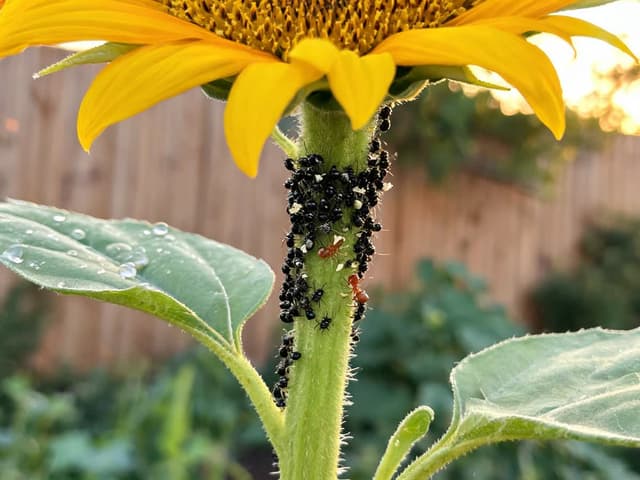
Bugs on Sunflowers: What They Are and What to Do
The bordered patch caterpillar is the main pest among the bugs on sunflowers in Brazil. Learn how to recognize this caterpillar, aphids, leaf beetles, stink bugs, and birds by the damage, when to treat, and when to let the plant finish its cycle.
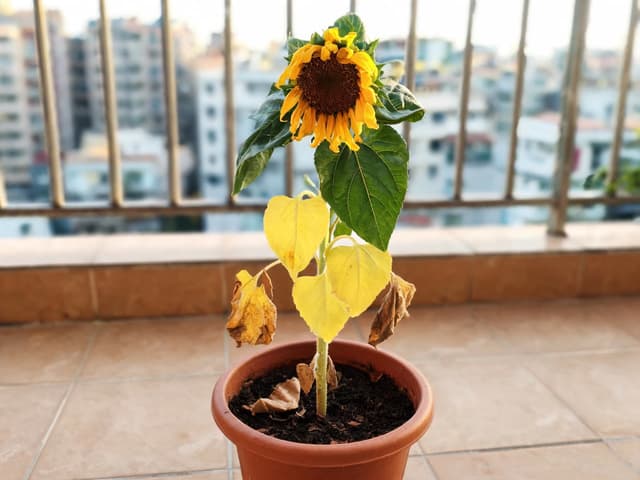
Yellow Leaves on Sunflowers: Causes and What to Do
Yellow leaves on sunflowers: use the plant's stage and where the yellow sits to tell end of life cycle, watering, low fertilizer, fungus or mites apart, plus the test that confirms each cause.
How to Prune Bougainvillea: When, How Much, and Where to Cut
How to prune bougainvillea: cut after flowering, right above a node, and save hard pruning for when the plant starts growing again. See how much to remove, the three types of pruning, and how to train potted bougainvillea.