Jabuticaba saplings: how to grow from seed, air layering, or grafting
Jabuticaba saplings are grown from seed, air layering, or grafting. Seed-grown plants take 8 to 15 years to bear fruit, and cut branches root poorly. Learn how to plant fresh seeds without letting them dry, air layer, graft, and identify grafted saplings when buying.
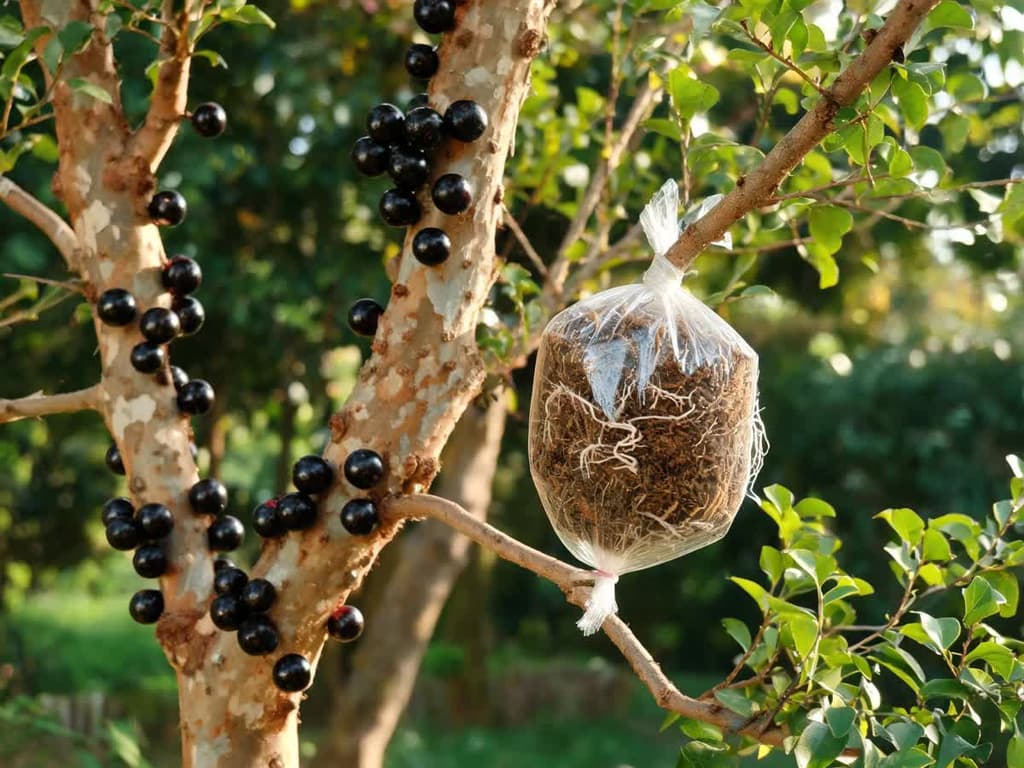
Jabuticaba saplings come from three methods that work: seed, air layering, and grafting. Growing from seed is the most common and the slowest way, taking 8 to 15 years until the first fruit. Air layering makes a branch grow roots while still attached to the tree. Grafting joins a branch from an adult jabuticaba tree to a young seed-grown sapling.
A grafted sapling bears fruit earlier than a seed-grown one, according to Revista Ceres. None of the Brazilian studies consulted gives this timeframe in years. A branch cut and stuck in the ground roots poorly: in the studies, green tips (the soft, new part of the branch) rooted at most 10%.
Quick summary:
Seed: take it out of ripe fruit, wash it, and plant it within 5 days. Do not let it dry out, because dried jabuticaba seeds die.
Air layering: pick a branch 2 to 2.5 cm thick, remove a ring of bark, and wrap it with moist moss and plastic. Wait up to 6 months for roots.
Grafting: requires a seed-grown jabuticaba sapling as a base. On pitanga and cerejeira-do-mato trees, no jabuticaba graft took.
When buying, ask whether the sapling is seed-grown or grafted. A sapling sold as "already producing" may have come from seed.
How long a jabuticaba sapling takes to bear fruit
A seed-grown jabuticaba tree takes 8 to 15 years to start producing, according to research by Danner and colleagues cited in Ciência Rural. Revista Ceres cites other research indicating about 10 years. The long timeframe comes from the juvenile period: the phase in which the tree grows, but does not yet flower.
The exception is the hybrid jabuticaba, a small tree widely sold in nurseries, mainly in the South and Southeast. The hybrid bears fruit in about 4 years, even when grown from seed, according to a study published in the journal of Embrapa Florestas. The study is from the Federal University of Santa Maria and cites another research paper for this timeframe. It also states that the hybrid flowers and fruits several times a year. The origin of the cross is unknown.
Propagation method | Time until first fruit | Does the fruit match the mother tree? | Difficulty at home |
|---|---|---|---|
Seed (Sabará, paulista, de cabinho) | 8 to 15 years | In Sabará, in part of the seedlings. In the others, no published data | Easy |
Hybrid jabuticaba seed | About 4 years | No published data | Easy |
Air layering | No published data | Yes, it is a copy of the tree | Moderate |
Grafting | Before a seed sapling, no published timeframe | Yes, the canopy is a copy of the scion's tree | Difficult |
Cutting (severed branch) | Roots poorly: up to 10% on green softwood tips, up to 50% on hardwood with hormone | Yes, if it roots | Very difficult |
You may have read that the jabuticaba tree takes 20 years to bear fruit. That number appears in the caption of a jabuticaba tree photo in Embrapa's image bank. The caption does not state the species or whether the tree came from seed. Research specifying species and method falls between 8 and 15 years for seed-grown saplings.
The jabuticabas sold in Brazil come from different species. Sabará (Plinia jaboticaba) is the most widely planted in the country. Paulista or açu is Plinia cauliflora, and jabuticaba-de-cabinho is Plinia trunciflora (some studies call it Plinia peruviana). Before buying or sowing, know which species the tree is: the research results below vary from one species to another.
How to grow jabuticaba saplings from seed
To grow a jabuticaba sapling from seed, plant the seed fresh, at most 5 days after removing it from the fruit. The jabuticaba seed is recalcitrant: it loses the ability to germinate as it dries. In paulista jabuticaba, all seeds die when their moisture level reaches close to 10%, according to the Revista Brasileira de Fruticultura.
The same study stored the seed in a normal environment, without a vacuum: it germinated well for only 5 days. Because of this, do not leave seeds drying out for days before planting. A study on Sabará saplings dried seeds in the shade for 48 hours and they germinated, but it did not measure how much water they lost. In laboratory tests with paulista, the washed seed sits for at most 24 hours on paper towels in the shade, just to drain water. Since water loss kills the seed, follow the shorter timeframe: a few hours.
Step by step:
Pick well-ripened fruit and discard seeds measuring 6 mm or less. In jabuticaba-de-cabinho, only 43.7% of seeds this size germinated, according to the Embrapa Florestas study.
Squeeze the fruit and remove the seeds. Rub them in a fine mesh sieve under the faucet until the clinging pulp comes off.
Leave the seeds on paper towels in the shade for a few hours, just until they stop dripping.
Sow in a tray or a plastic cup with drainage holes, filled with sand or seed-starting soil, and cover with about 0.5 cm of soil. None of the studies we read measured planting depth. Because drying kills the seed, use a thin layer and keep the soil moist.
Keep the soil moist, without waterlogging it, in a shaded spot away from strong sun.
When each seedling reaches about 1.5 cm, transplant it into a 650 ml nursery bag.
Temperature changes the outcome. In a test by Revista Ceres, at 24 °C, 78% of Sabará seeds and 88% of paulista seeds germinated. At 40 °C, almost none germinated. So do not leave the seed tray in strong summer sun. In the laboratory, germination of paulista and de cabinho began at 7 days. In the tray, expect 10 to 40 days, the range cited in the same study.
For the nursery bag soil, a test on Sabará compared soil, sand, mixtures with manure, and ready-to-use potting mix for saplings. The ready-to-use mix is commercial substrate sold in agricultural supply stores. The ready-to-use mix produced the largest saplings, and the others had equal results among themselves, according to the Revista Brasileira de Agrociência.
A jabuticaba seed can produce more than one seedling
A single jabuticaba seed can sprout two or more seedlings, a trait called polyembryony. The Revista Brasileira de Agrociência study says that, in Sabará, the seedlings repeat the mother tree. Another study, from Revista Ceres, says seeds produce plants with wide variation. None of the studies we read measured how many seedlings are exact copies. For fruit that matches the mother tree, use air layering or grafting.
When separating the seedlings for the nursery bag, you can damage the roots and lose some. Separate them carefully with moist soil and plant each one in its own bag.
The little sprout growing near the base of the jabuticaba tree
A shoot appearing on the ground near a jabuticaba tree probably sprouted from a fallen fruit seed. The tree multiplies mainly by seed, according to Revista Ceres. None of the studies we read addresses this scenario. If it is a seed sapling, the time to fruit matches the table: 8 to 15 years.
To tell if it is jabuticaba or a weed, wait for the shoot to grow new leaves and compare them to the tree's foliage. Bloom (available for iOS) identifies plants by photo, and the free version includes 2 identifications per month. If it is jabuticaba, dig a circle about 10 cm around it. Remove the shoot with the entire root ball intact without loosening the root. Plant it in a pot the same day.
Air layering: how to grow a jabuticaba sapling on the branch without cutting
Air layering makes the branch grow roots while still attached to the tree, and only then do you cut it. The sapling turns out an exact copy of the mother tree. In a study with Paulista jabuticaba, under the best treatment, 87.5% of the branches rooted, according to the Revista Brasileira de Fruticultura.
Thicker branches rooted better. Branches 2 to 2.5 cm thick produced more roots and larger roots than branches 1 to 1.5 cm thick.
Step by step:
Pick a healthy branch 2 to 2.5 cm thick.
Using a clean pocket knife, cut and peel away a ring of bark 1.5 to 3 cm wide until the bare wood is exposed.
Wrap the girdled ring with a fist-sized ball of moist moss or moist seed-starting soil.
Wrap clear plastic around it and tie both ends securely.
Cover the plastic with aluminum foil. In a study on paulista jabuticaba, plastic covered with aluminum produced more roots than other coverings, according to the Revista Brasileira de Fruticultura.
Every 2 or 3 weeks, open the aluminum foil and check if the moss stays moist. If dry, moisten it with a syringe and wrap it back up.
When white roots fill the plastic wrap, cut the branch right below the ball. Remove the plastic and foil and plant in a pot without breaking up the moss ball.
Wait up to 6 months: studies checked roots 180 days after air layering, and none checked earlier. If roots have not filled the plastic at 6 months, close the foil and leave the branch on the tree.
Outcomes vary widely. In the aluminum foil study, air layering performed in April rooted only 20% of branches. Do 3 or 4 air layers at a time on different branches.
Rooting hormone (IBA, a powder or liquid sold at agricultural supply stores) is optional. In the aluminum foil study, the tested doses of IBA did not change the result. In a study with jabuticaba-de-cabinho, IBA helped in almost every month, and in December it made no difference, according to the Revista Brasileira de Fruticultura. Because the studies differ, treat IBA as optional.
A fig tree sapling comes from a cut and planted branch, called a cutting. On jabuticaba trees, cuttings work poorly, and air layering is the way to clone the tree without needing to graft.
Do jabuticaba branch cuttings take root?
A cut jabuticaba branch roots poorly. In a study from the Revista Brasileira de Fruticultura, green tips rooted at most 10%. Pieces of already hardened branch reached 50%. For this, they needed hormone at the highest tested dose, 6,000 mg per liter, and a vertical cut at the base. Without hormone, they rooted less.
Jabuticaba branches kept in a glass of water have no measured outcomes: none of the studies we read tested this. The cuttings in the studies went into soil, and even so most did not root.
If the tree is dying and one green branch remains, taking a cutting is the least promising option. Follow these steps, ordered from the highest chance of copying the tree to the lowest:
If the tree can survive 6 months, air-layer that branch while it is attached and alive.
If the tree is not flowering or fruiting, take pieces of that branch to a nursery that does grafting. The branch serves as the top part of a new sapling (the scion).
If the tree has fruit, plant the seeds the same day. In Sabará, some seedlings can duplicate the mother tree.
How to make a grafted jabuticaba sapling
Grafting joins a piece of branch from a mature jabuticaba tree, the scion, to a young seed-grown sapling. This lower sapling, with roots, is the rootstock. In a study from Revista Ceres, grafts took in 78% of saplings on average: the scion united with the rootstock and pushed new growth. The scion clones the tree it came from.
The rootstock must be a jabuticaba tree. In a study from Ciência Rural, no jabuticaba grafts took on pitanga or bush cherry rootstocks. Two studies used paulista as the base, and a study from Revista Ceres recommended it as a possible base because it germinated better and faster. Seed-grown saplings with a stem about 6 mm thick work. The Ciência Rural study used 2 to 3-year-old saplings. Revista Ceres used 6-month-old saplings that had already reached that thickness.
Step-by-step cleft grafting, the most common graft method in the research, where the scion sits inside a split cut in the rootstock:
Cut the rootstock straight across at a height of 12 to 25 cm from the ground.
Make a downward vertical cut down the center of the cut stem using a clean pocket knife.
Select a semi-hardwood scion (already firm, but still pliable), 3 to 5 mm thick and 10 cm long. Take it from an adult jabuticaba tree that is not flowering or fruiting.
Cut the base of the scion into a wedge (V-shape) on both sides. Insert the scion into the split, aligning its bark with the rootstock bark.
Wrap grafting tape (elastic plastic tape sold in garden centers) tightly around the union and over the tip of the scion.
Cover the graft with a clear plastic bag to keep humidity high, and keep the sapling in shade.
The 3 to 5 mm scion took in 80% of grafts, and the thin green scion in 45%, according to Ciência Rural. Scions from fruiting trees sprout less, according to the Revista Brasileira de Fruticultura.
The scion sprouts 30 to 85 days after grafting. Once it sprouts, remove the plastic bag. Also prune any shoots coming off the rootstock below the tape.
Splice grafting also works. In it, the scion and the rootstock have the same thickness, are cut diagonally, and are joined against each other. On Sabará, it initially took in 97% of the grafts, and cleft grafting in 69%, according to Revista Ceres. On Paulista jabuticaba, both initially took in 94%. Another study on Sabará, from Comunicata Scientiae, found cleft grafting more suitable when the graft was secured with parafilm and a clip. Because the studies differ, the step-by-step guide uses cleft grafting, which appears in more research.
A grafted avocado sapling produces fruit years earlier than a pit-grown seedling. On jabuticaba trees, grafted saplings develop smaller crowns and produce less fruit than seed-grown trees, according to Revista Ceres. The advantage of grafting is reaching the first harvest sooner.
How to recognize a grafted jabuticaba sapling when shopping
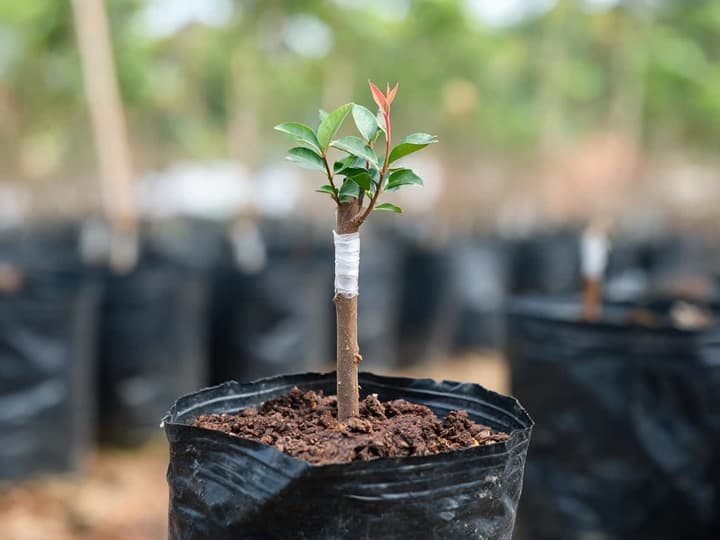
None of the technical sources we read explains how to spot a grafted jabuticaba sapling in retail nurseries. What you can inspect on the plant comes directly from how grafting is done in the research:
Look 12 to 25 cm above the soil line for a point where the trunk thickens or changes color. Sometimes remnants of grafting tape remain: that is where the scion was joined.
A seed-grown sapling has a smooth, uninterrupted stem from the soil up to the first branches.
Ask the seller if the sapling is "grafted" or "grown from seed" (also called an ungrafted seedling). Ask for this to be written on the plant tag or receipt.
Ask which jabuticaba variety it is: Sabará, paulista, de cabinho, or hybrid. The time until first fruit varies by type.
"Already producing" or "bearing age" is retail marketing without a technical definition in the studies we read. One large nursery explains on its website what the label means: the sapling has produced fruit at least once or will fruit in the upcoming harvest season. The sapling will not arrive with fruit solely because of that label. A hybrid jabuticaba marked as "producing" may have grown from seed: the hybrid bears fruit in about 4 years even without grafting.
Grafted saplings cost more because propagating jabuticaba trees without seed is difficult, according to Ciência Rural and Revista Ceres.
When to propagate jabuticaba in Brazil
Timing varies depending on your propagation method:
Seed: during the harvest season, because seeds germinate well for only 5 days after removal from the fruit. In São Paulo, jabuticaba bears fruit from August to September and from January to February, according to the Agricultural Economics Institute.
Grafting: in Paraná, grafting done in May sprouted in 64% of cases, and in August, in 45%. The study did not consider this difference reliable. Grafting done right after harvest, in February, took in only 20%.
Air layering: the Paraná studies carried out air layering in several months, from August to June, and none identified a single best month.
Outside the South and Southeast, none of the studies we examined tested propagation timing. Use the same guideline: seeds during harvest season; for grafting, scions from trees neither flowering nor fruiting; for air layering, any of the tested months.
Care for a young jabuticaba sapling
The jabuticaba tree is a slow-growing tree, according to the Institute of Agricultural Economics, and the young sapling also grows slowly. If growth stopped completely, with pale leaves, see the causes of slow growth in jabuticaba trees.
None of the research we read measured the optimal sun exposure for young saplings. The saplings in the studies were kept in greenhouses, shielded from excessive light. For this reason, keep newly planted saplings in partial shade away from harsh midday sun, keeping soil evenly moist without waterlogging.
Plant the sapling in its permanent spot once roots fill the nursery bag and it pushes new foliage. The root ball should come out intact when you remove the nursery bag.
Frequently asked questions about jabuticaba saplings
Do jabuticaba branches root in water?
No research shows jabuticaba branches rooting in water. Even in soil treated with hormone, green softwood branch tips rooted at 10% at most, according to Revista Brasileira de Fruticultura. To clone a jabuticaba tree from a branch, use air layering while the branch remains attached to the tree: in a study on paulista jabuticaba, up to 87.5% of branches rooted in the top-performing treatment.
How many years does a jabuticaba tree take to bear fruit?
A seed-grown jabuticaba tree takes 8 to 15 years to produce its first fruit, according to research cited in Ciência Rural. Hybrid jabuticaba bears fruit in about 4 years, even from seed, according to an Embrapa Florestas study. A grafted sapling produces earlier than a seed-grown one according to Revista Ceres, but research does not establish a specific timeframe. For air layering, we found no published data.
Which jabuticaba produces fruit year-round?
The closest is the hybrid jabuticaba: it flowers and fruits multiple times throughout the year, according to a study published by Embrapa Florestas. It is a small tree that fruits early, in about 4 years, even when grown from seed. The same study refers to the plant as a hybrid of unknown parentage.
Does jabuticaba grown in a pot get very large?
That depends on the species. Hybrid jabuticaba features a compact tree size, which makes planting in containers and small gardens easier, according to the Embrapa Florestas study. The studies we read do not measure mature heights for other species, such as Sabará. For container growing, pick the hybrid and verify on the label that the sapling is indeed a hybrid.
Summary: how to propagate jabuticaba
Jabuticaba saplings come from seed, air layering, or grafting. Plant seeds fresh in soil within 5 days, expecting 8 to 15 years to fruit, except for hybrids. Air layering on a 2 to 2.5 cm branch can take up to 6 months to root and produces a direct clone. Grafting requires a seed-grown jabuticaba sapling as rootstock. Severed branch cuttings rarely root. If your backyard jabuticaba tree is fruiting today, take 10 seeds from ripe fruit and plant them the same day.
Sources
Danner, M. A. et al. Armazenamento a vácuo prolonga a viabilidade de sementes de jabuticabeira. Revista Brasileira de Fruticultura, vol. 33, no. 1, pp. 246-252, 2011: doi.org. Accessed October 23, 2026.
Wagner Júnior, A. and colleagues. Efeito da temperatura na germinação de sementes de três espécies de jabuticabeira. Revista Ceres, v. 54, n. 314, p. 345-350, 2007: ojs.ceres.ufv.br. Accessed on October 23, 2026.
Hossel, C. and colleagues. Viabilidade de sementes de jabuticabeira açu em função da condição e período de armazenamento. Colloquium Agrariae, v. 15, n. 5, p. 88-96, 2019: journal.unoeste.br. Accessed on October 23, 2026.
Pio, R. and colleagues. Substrates in the production of jabuticaba saplings. Revista Brasileira de Agrociência, v. 11, n. 4, p. 425-427, 2005: periodicos.ufpel.edu.br. Accessed on October 23, 2026.
Stefanel, C. M. et al. Germinação e desenvolvimento inicial de mudas de Plinia peruviana. Pesquisa Florestal Brasileira (Embrapa Florestas), v. 43, 2023: pfb.sede.embrapa.br. Accessed on October 23, 2026.
Sasso, S. A. Z.; Citadin, I.; Danner, M. A. Jabuticaba propagation by grafting and air layering. Revista Brasileira de Fruticultura, v. 32, n. 2, p. 571-576, 2010: doi.org. Accessed on October 23, 2026.
Sasso, S. A. Z.; Citadin, I.; Danner, M. A. Propagação de jabuticabeira por estaquia. Revista Brasileira de Fruticultura, v. 32, n. 2, p. 577-583, 2010: doi.org. Accessed on October 23, 2026.
Cassol, D. A. et al. Packaging, season, and indolebutyric acid in the propagation of jabuticaba by air layering. Revista Brasileira de Fruticultura, v. 37, n. 1, p. 267-272, 2015: doi.org. Accessed on October 23, 2026.
Danner, M. A. et al. Rooting of jabuticaba (Plinia trunciflora) through air layering. Revista Brasileira de Fruticultura, v. 28, n. 3, p. 530-532, 2006: doi.org. Accessed on October 23, 2026.
Baptista, R. S. and colleagues. Grafting methods and use of fasteners in monoembryonic, polyembryonic, and multi-stemmed jaboticaba seedlings. Comunicata Scientiae, v. 11, e3158, 2020: doi.org. Accessed October 23, 2026.
Malagi, G. et al. Interspecific grafting of jabuticaba: influence of scion type. Ciência Rural, v. 42, n. 2, p. 221-224, 2012: redalyc.org. Accessed on October 23, 2026.
Franco, L. R. L. and colleagues. Pegamento e crescimento inicial de mudas de jabuticabeiras 'Açu' e 'Sabará' submetidas a dois tipos de enxertia. Revista Ceres, v. 57, n. 4, p. 535-538, 2010: redalyc.org. Accessed October 23, 2026.
Cassol, D. A. and colleagues. Grafting and rootstock species in the propagation of Plinia cauliflora. Ciência Rural, v. 47, n. 2, 2017: redalyc.org. Accessed on October 23, 2026.
Baptistella, C. S. L.; Coelho, P. J. Jabuticaba do quintal para produção de mercado. Análises e Indicadores do Agronegócio, v. 14, n. 12, Instituto de Economia Agrícola, 2019: iea.agricultura.sp.gov.br. Accessed on October 23, 2026.
Embrapa. Jabuticaba tree, image database, 2013: embrapa.br. Accessed on October 23, 2026.
Related articles
How to Care for Hibiscus: Sun, Watering, Fertilizer, and Pruning for Flowers
How to care for hibiscus: 6 hours of direct sun, evenly moist soil without waterlogging, half-strength fertilizer in spring and summer, and pruning in early spring. Find out why the flower lasts one day and why buds drop before opening.
Do Ferns Like Sun or Shade? It Depends on the Type
Ferns prefer bright shade: plenty of light, but no direct sun on their fronds. Tuberous sword fern is the exception that handles sun. Here is the ideal light for each type, where to place pots, and how fronds show too much or too little light.
African Violet Yellow Leaves: Causes and What to Do
Yellow leaves on an African violet usually stem from overwatering, and the first place to check is the center of the plant. Losing one lower leaf at a time is normal. Identify whether age, watering, cold water, sunlight, cold drafts, or fertilizer is the culprit based on the yellowing pattern, and see what to do today.