How to Care for an Avocado Tree in a Pot: Light, Pruning, and When It Fruits
How to care for an avocado tree in a pot, from pit to grafted sapling: direct sun, well-draining soil, topping for branching, frost protection, and fruiting time.
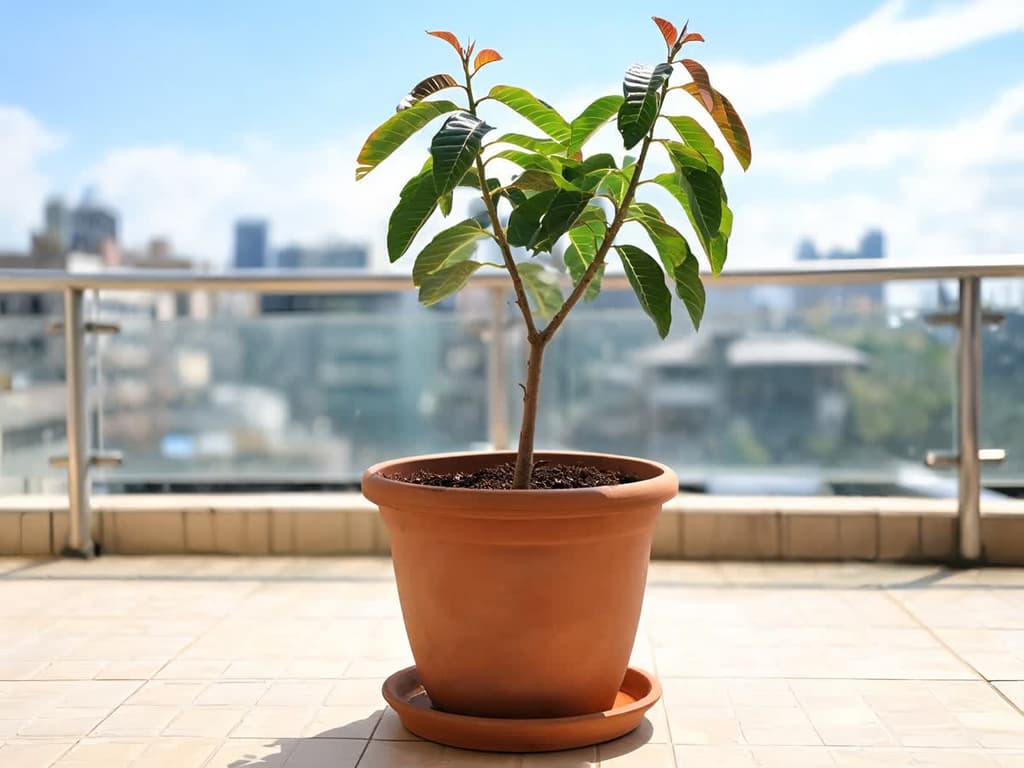
To care for a potted avocado tree, provide direct sunlight, use a container with drainage holes, and plant in soil that does not get waterlogged. Water when the soil loses about half of its moisture. Pinch or cut back the top of the seedling early to encourage branching, and protect the plant from frost. Care is identical for a seedling grown from a pit in a glass of water and a nursery-grafted sapling. A grafted plant consists of a branch from a known variety joined to the rootstock of another plant. The difference between them lies in the likelihood of harvesting avocados.
The data in this guide come from Embrapa, the Royal Horticultural Society (RHS, UK), and university extension services. An extension service is a university program that advises growers. Nearly all sources originate in the Northern Hemisphere. Months and window orientations have already been converted for Brazil.
Quick summary:
A pit-grown avocado tree takes anywhere from 6 to 20 years or more to produce fruit, depending on the source. The resulting fruit will not be identical to the one you ate. A grafted sapling produces fruit within 2 to 4 years.
The most serious avocado disease stems from waterlogged soil, according to UC IPM. Roots rot from Phytophthora, a soil-borne microorganism that attacks root systems in wet conditions.
Cut the stem back by half once the seedling reaches 15 cm (6 in), according to the RHS. This prompts lateral branching and keeps the plant shorter.
Dry, brown leaf tips on a pit-grown seedling may indicate salt accumulation in the soil, according to Texas A&M. Flushing with extra water leaches out the salt.
Potted avocado care: quick reference table
Care factor | Action | Source |
|---|---|---|
Light | Direct sun. Indoors, place by the brightest window | UF/IFAS, Iowa State |
Pot | 15 to 20 cm (6 to 8 in) diameter for seedlings; upsize slightly when roots emerge from drainage holes | Iowa State, RHS |
Soil | Well-draining potting mix blended with coarse sand | RHS |
Watering | When the soil loses about half its moisture (pot feels lighter), until water runs out the drainage hole | University of Illinois Extension |
Fertilizer | Diluted liquid fertilizer, from September through March | Iowa State, Colorado State |
Pruning | Cut the stem by half at 15 cm (6 in); thereafter, pinch tips after every 15 cm (6 in) of new growth | RHS |
Cold tolerance | Young seedlings suffer injury between −1 and −4 °C (25 and 30 °F); bring pots indoors on freezing nights | UF/IFAS |
Pets | Non-toxic to dogs and cats; toxic to birds, rabbits, and horses | Pet Poison Helpline, ASPCA |
Pit vs. grafted sapling: when do avocado trees produce fruit?
A pit-grown avocado tree takes many years to bear fruit and may never produce at all. Sources differ on the timeline. Embrapa, UF/IFAS, and Texas A&M refer to trees planted in the ground, whereas RHS and Colorado State discuss houseplants:
Source | Pit-grown seedling | Grafted sapling |
|---|---|---|
Embrapa Environment, 2025 | from 6 years | 4 years |
UF/IFAS (Florida) | not reported | 3–4 years |
10–15 years | 2–3 years, few fruits | |
RHS (UK) | 10 years or more | not reported |
Colorado State | 20 years or more | not reported |
A grafted sapling produces the same avocado as the tree the branch came from. The pit does not do this. According to the UF/IFAS, most avocado varieties do not grow true from seed.
The underlying reason involves flower biology. Embrapa reports that avocado blossoms rarely receive pollen from the same tree. The seed carries genetic material from two distinct trees, making the fruit of a seed-grown specimen unpredictable.
Indoors, the chance of fruit drops further. According to the RHS, an avocado tree grown as a houseplant usually does not flower or set fruit. It would require more humid air, more light, and plenty of space, because the tree reaches several meters in height before flowering. The same RHS notes that a grafted sapling sold commercially may have a better chance of fruiting.
Anyone who wants to harvest avocados in Brazil plants a grafted sapling in the ground. Embrapa lists Breda, Fortuna, Fucks, Geada, Margarida, and Quintal as the most sold varieties at Ceagesp, São Paulo's wholesale food market. The Hass avocado tree is also grown here. The step-by-step guide to germinating the pit in a glass of water is in the avocado tree care guide.
Type A and Type B flowering: do you need two avocado trees?
An avocado flower opens twice over two days. On its first opening, the blossom is receptive to pollen; on its second opening, it sheds pollen. In Type A cultivars, the first opening occurs in the morning; in Type B cultivars, it occurs in the afternoon. Because of this timing, a single isolated tree rarely has receptive flowers when its other blossoms shed pollen.
Embrapa recommends planting varieties from both groups together, such as Fortuna (A) with Quintal (B) or Breda (A) with Margarida (B). UF/IFAS views this differently: certain varieties bear fruit reliably when planted alone. Embrapa also records self-pollination (flowers receiving pollen from the same tree) on cold, overcast days. For a pit-grown tree, no source outlines a way to identify its flowering group. For those wanting fruit, this guide follows Embrapa, which focuses on the Brazilian climate and offers the most reliable route. Plant one grafted Type A tree and one Type B tree. If avocado trees already grow nearby in the neighborhood, a single tree may suffice.
Light requirements for avocado trees
Avocados grow best in full sun (direct sunlight for most of the day), according to UF/IFAS. None of the consulted extension services specifies an exact number of sun hours. Therefore, this guide recommends the sunniest spot you have: a yard, balcony, or rooftop patio.
Indoors, Iowa State recommends a very bright spot near an east- or west-facing window. In Brazil, a north-facing window receives the most hours of sun: use this one if the avocado tree stays indoors. After a few years indoors, the avocado tree usually becomes spindly with yellow leaves. The RHS attributes this to a lack of light and air humidity. Colorado State suggests starting a new seedling every 3 or 4 years if the house is small.
Sources differ regarding indoor-grown seedlings. The RHS advises shifting the pot outdoors in summer into partial shade (sunlight filtered by surrounding plants). UF/IFAS specifies full sun for trees planted in the ground. This guide follows UF/IFAS (full sun), as it is a university extension service and Florida's climate closely mirrors Brazil's. Colorado State, focusing on houseplants, calls for bright indirect light. Acclimate indoor-grown seedlings by moving them first into partial shade, then into full sun.
On the same full-sun balcony, bougainvillea blooms only with direct sunlight. Jasmine tolerates less: indoors, it blooms with 4 hours of direct sunlight per day.
Pot, soil, and drainage: why potted avocado trees rot
Phytophthora root rot is the most serious disease of the avocado tree, according to UC IPM, from the University of California. Phytophthora is a soil microorganism, similar to a fungus, that attacks fine roots. It thrives in waterlogged, poorly drained soil.
Leaves wilt and develop brown tips even while the potting mix remains wet. The canopy thins out, and new flush stalls. When sliding the plant out of its pot, fine roots appear black and brittle, or are almost entirely absent. UF/IFAS adds pale green foliage and dieback of branch tips in advanced stages.
In a Chilean study (Besoain et al., 2005), soil of deliberately infected plants was kept saturated for 24 hours every two weeks, resulting in roughly 50% root rot. A 1987 UF/IFAS review cites California trials where healthy avocado trees survived 9 days of flooding, while infected trees died after 2 days or more. The fatal factor is the combination of waterlogged soil and Phytophthora. Both metrics derive from research on seedlings and orchard trees rather than domestic containers.
Four container practices prevent waterlogged soil:
Use a container with drainage holes at the bottom. Iowa State recommends a 15 to 20 cm (6 to 8 in) diameter for a seedling freshly moved from a water cup.
Pot up to only a slightly larger container once roots begin emerging through the drainage holes, per the RHS. Oversized containers leave excess wet soil unoccupied by roots.
Use a well-draining potting soil. The RHS recommends blending coarse sand into the mix.
Do not let the bottom of the pot sit submerged in runoff water. The RHS advises ensuring the water level stays below the pot base.
How to water an avocado tree
Water the potted avocado tree when the soil loses about half of its moisture, a guideline from the University of Illinois Extension for containers in general. No source provides a frequency in days for potted avocado trees. Iowa State calls for moist, but not waterlogged, soil, and this guide adopts the drier guideline because of root rot. The pot feels lighter as the soil dries out. Water slowly until water drains through the hole, and discard the water that collects in the saucer.
The plant displays clear symptoms of watering mistakes. According to Colorado State and the RHS, overwatering causes curled leaves and a soft, limp stem. Underwatering causes wilting, followed by dry, brown foliage that drops prematurely.
How to fertilize a potted avocado tree
Fertilize the potted avocado tree with diluted liquid fertilizer, only during the growing season. Sources disagree on the frequency. Iowa State indicates 1 to 2 times a month in spring and summer. Colorado State indicates a small amount every 3 months, and the RHS follows the package dosage.
This guide follows the lighter baseline from Iowa State: diluted fertilizer once a month, from September through March. If leaf tips dry out, space feedings out to every 3 months, as Colorado State indicates. The reason is salt. UC IPM says avocado roots are sensitive to salt and ammonia, and that this damage promotes rot. The same source advises avoiding large amounts of manure and products high in ammonia or salt.
UF/IFAS states that avocados develop iron chlorosis in alkaline soils (the opposite of acidic, with a high pH). The fix is chelated iron (iron bound in an absorbable form) applied directly to the soil. Before treating pale leaves as an iron deficiency, rule out root rot, which produces a very similar pale green cast.
Training and pruning: when to top an avocado tree
Formative pruning involves heading back a young tree to shape its branch framework. Cutting the top forces the plant to push lateral shoots. Sources differ on when to make the first cut:
RHS: when the stem reaches 15 cm (6 in), cut it back by half just above a leaf node. For every subsequent 15 cm (6 in) of new growth, pinch out the 2 newest leaf pairs at the tip.
Iowa State: pinch out the growing terminal bud once the seedling stands 30 to 38 cm (12 to 15 in) tall.
UC IPM: begin pinching shoot tips starting in the plant's second year, continuing until the canopy framework takes shape.
For container culture, this guide follows the RHS, the only source specifying exact measurements for the first cut and follow-up prunings. Topping early keeps the plant more compact with fuller branching. Iowa State, as a university extension, advises simply pinching the tip at 30 to 38 cm (12 to 15 in); choose this approach if you prefer not to cut the main stem. Texas A&M states that in-ground avocados do not require pruning to establish and bear fruit. The RHS adds that older, tall, leggy specimens tolerate hard pruning and regenerate readily.
Nursery-grafted saplings already arrive at 60 to 120 cm (2 to 4 ft) tall, according to UF/IFAS. Consequently, the 15 cm (6 in) topping rule applies only to pit-grown seedlings. On grafted trees, a different priority applies. UC IPM instructs growers to remove any suckers emerging below the graft union (the swollen joint where the cultivar branch meets the rootstock). These suckers originate from rootstock tissue and will not produce the desired avocado variety.
Avoid pruning in autumn, from March through May. UC IPM explains that pruning late in the growing season stimulates tender new growth, which frost easily damages.
Cold and frost: protecting avocado trees
Young avocado seedlings suffer cold damage between −1 and −4 °C (25 and 30 °F), depending on their botanical race (horticultural grouping). Figures come from UF/IFAS:
Race | Young seedling | Mature tree |
|---|---|---|
West Indian | −2 to −1 °C (28 to 30 °F) | −4 to −1 °C (25 to 30 °F) |
Guatemalan | −3 to −2 °C (26 to 28 °F) | −4 to −2 °C (25 to 28 °F) |
Mexican | −4 to −3 °C (25 to 26 °F) | −8 to −3 °C (18 to 26 °F) |
In Brazil, winter runs from June to August, and frost is common in the South and at high elevations. With a pit-grown tree, you do not know the race, so protect the plant as if it belongs to the race most sensitive to cold, the West Indian. On nights with frost in the forecast, bring the pot indoors. The RHS keeps potted avocado trees between 13 and 18 °C (55 and 64 °F) in winter.
Cover in-ground seedlings during frost events. Texas A&M instructs growers to drape a blanket, tarp, or plastic sheet loosely over the tree rather than wrapping it tightly. Avoid pruning prior to cold weather. Following a hard freeze, the University of California avocado manual advises waiting roughly 6 months before removing dead wood. This waiting period allows you to determine the true extent of freeze dieback.
Mild, non-freezing cold also triggers floral development. According to Embrapa, avocado flower initiation occurs following winter dormancy. Embrapa cites a study on 'Hass' avocados showing no flowering at 24 °C (75 °F) daytime and 19 °C (66 °F) nighttime temperatures, while trees flowered successfully at 18 °C (64 °F) day and 15 °C (59 °F) night.
Scorched leaf tips: salt, drought, or root rot
Leaves with dry, brown tips stem from three common causes in avocados. Before adjusting your watering habits, insert a finger into the soil and gently pull the root ball from the pot to inspect the roots. The combination of symptoms identifies the cause:
Saturated soil with black, brittle roots: root rot. Withhold water until the soil dries to half its moisture content, then repot into a free-draining potting mix, as outlined in the container section.
Dry soil with a wilting plant: underwatering. Water thoroughly until liquid flows from the drainage hole.
Normal moisture, firm plant, but dry leaf tips and margins: likely soil salt buildup. No cited source differentiates salt burn from drought stress based solely on leaf appearance.
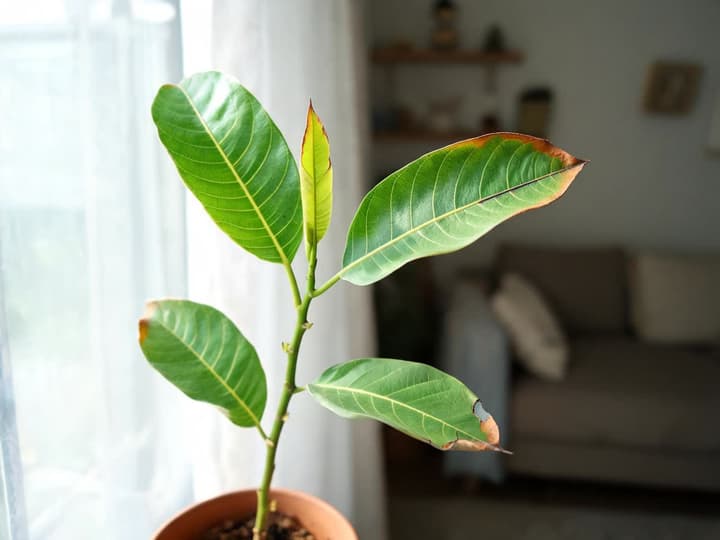
Texas A&M notes that seedlings grown from supermarket fruit pits often display salt-burned leaf tips and margins. The University of California avocado manual explains the mechanism. Chloride from the water travels up with the sap and accumulates at the leaf tip. Above 0.25% chloride in the leaf, tissue begins to die.
Chloride is a dissolved salt, distinct from the swimming pool chlorine smell found in treated tap water. According to the same manual, only leaching with excess water extracts built-up salts from the substrate. The manual focuses on commercial orchards, notes that this topic has seen limited avocado research, and advises applying excess water at every irrigation cycle. In containers, water slowly until runoff exits the drainage holes, then empty the collection saucer immediately. Desiccated leaf tissue cannot turn green again; monitor emerging foliage for signs of recovery.
Other causes of dry leaves on avocado trees can be found on the page about dry leaf tips on avocado trees.
Are avocado trees toxic to dogs and cats?
The risk for dogs and cats is low. The Pet Poison Helpline, an American animal poison control service, states that avocado is not toxic to dogs and cats. The danger described is a dog swallowing the pit, which can obstruct the intestines. As a precaution, do not let your dog chew on leaves or the pit.
Persin, a substance present in the avocado tree, is toxic to birds, rabbits, horses, and ruminants, such as cattle and goats. The ASPCA, an American animal welfare organization, lists the avocado tree as toxic to horses, causing respiratory distress and heart failure. Anyone who keeps a cockatiel or a rabbit roaming free in the home must keep the avocado tree out of reach. The list of plants toxic to dogs and cats details household species that require this precaution.
Frequently asked questions about avocado trees
How long does an avocado tree take to bear fruit?
In-ground grafted saplings yield their first crop within 2 to 4 years, according to data from Embrapa, UF/IFAS, and Texas A&M. Seedlings grown from a pit take anywhere from 6 years (Embrapa) to over 20 years (Colorado State), and they may fail to bear fruit entirely. Indoors, the RHS notes that avocados generally do not bloom.
Can you keep an avocado tree indoors?
Yes, for a few years. The RHS and Colorado State treat the avocado as a short-lived houseplant. It demands the brightest possible position in the home along with tip pruning to encourage branching. Over time, indoor trees grow thin and display yellowing foliage; the remedy is moving the pot outdoors or germinating a new seedling.
Are used coffee grounds good for avocado trees?
No source has measured the effect of coffee grounds on avocado trees. Arizona Extension measured a pH between 4.6 and 8.4 in decomposing grounds, so they do not reliably acidify the soil. Maine Extension reports a neutral pH (6.5 to 6.8) and low nutrient levels. In a pot, coffee grounds do not replace fertilizer. The safest option is to add the grounds to a compost pile, at no more than 20% of the volume (Arizona).
How can you identify a volunteer seedling as an avocado?
Gently dig with a finger around the base of the stem. Avocado seedlings emerge from a large seed pit. When potting, Iowa State and Colorado State leave the tip of the pit exposed, so it usually turns up quickly when probing the soil. The leaves are large, ovate, and glossy. On Mexican-race varieties, crushed foliage releases an anise scent (UF/IFAS). When in doubt, Bloom (available for iOS) can identify the plant from a photo of its leaf.
Avocado tree care summary
Direct sunlight, a pot with drainage holes, and soil that drains well are the basics. Water when the soil loses half of its moisture and fertilize lightly from September through March. Cut the stem in half at 15 cm and protect the young sapling from frost. If you want to harvest avocados, the right choice is a grafted sapling in the ground. A pit-grown tree is a plant with attractive foliage and may never produce fruit.
Related articles
How to Care for Hibiscus: Sun, Watering, Fertilizer, and Pruning for Flowers
How to care for hibiscus: 6 hours of direct sun, evenly moist soil without waterlogging, half-strength fertilizer in spring and summer, and pruning in early spring. Find out why the flower lasts one day and why buds drop before opening.
Do Ferns Like Sun or Shade? It Depends on the Type
Ferns prefer bright shade: plenty of light, but no direct sun on their fronds. Tuberous sword fern is the exception that handles sun. Here is the ideal light for each type, where to place pots, and how fronds show too much or too little light.
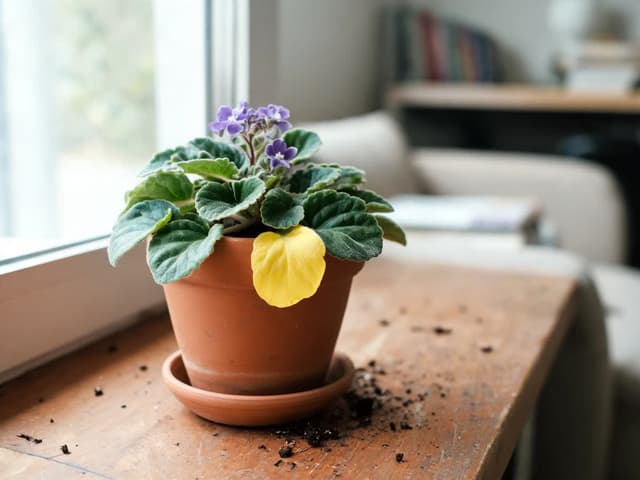
African Violet Yellow Leaves: Causes and What to Do
Yellow leaves on an African violet usually stem from overwatering, and the first place to check is the center of the plant. Losing one lower leaf at a time is normal. Identify whether age, watering, cold water, sunlight, cold drafts, or fertilizer is the culprit based on the yellowing pattern, and see what to do today.