How to Store Tulip Bulbs After Flowering (and Make Them Bloom Again)
To store tulip bulbs after flowering, wait for the foliage to turn yellow, dig up the bulb, dry it in the shade, and keep it in a dry, ventilated spot. Learn why it should not go straight into the fridge, how many weeks of cold it requires, and what to expect from the next bloom in Brazil.
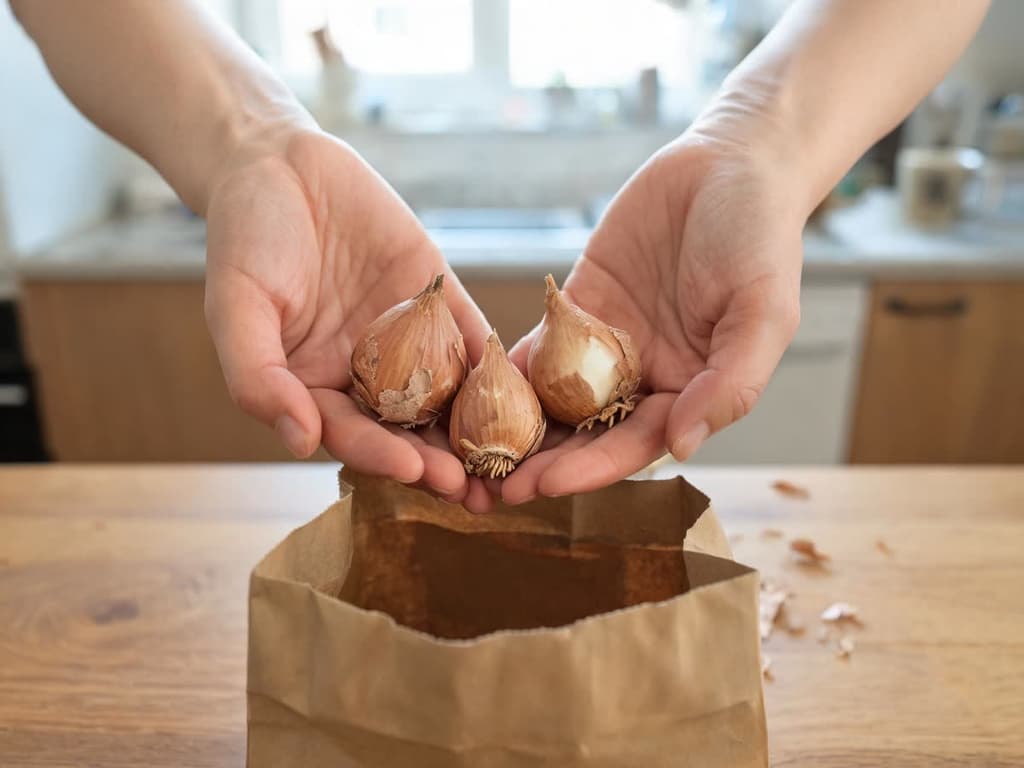
To store tulip bulbs after flowering, wait for the leaves to turn yellow on their own, about 6 weeks after the petals drop. Then dig up the bulb, clean it, and let it dry in the shade for 1 to 3 weeks. Store the dry bulb in a paper bag in a dark, cool, ventilated place, out of the refrigerator.
To bloom again, the bulb needs cold: 15 to 16 weeks in the vegetable crisper drawer of the refrigerator before planting. The bulb only goes into the refrigerator after spending at least 6 weeks out of it, because the following year's flower forms during this waiting period. In Brazil, a potted tulip bought in bloom rarely blooms again, and most commonly, the bulb produces only leaves in the first year.
Tulip bulb calendar in Brazil
The table shows the path of a tulip bulb from flowering to planting. The example uses a tulip that dropped its petals in early September and will be planted in early April, during the Brazilian autumn.
Stage | Duration | Example in Brazil |
|---|---|---|
Green leaves in the pot, in a bright spot | About 6 weeks, until the leaves turn yellow | From September to mid-October |
Drying the bulb in the shade | 1 to 3 weeks | Until early November |
Waiting outside the refrigerator (drying counts) | At least 6 weeks, counted from the day the bulb was dug up | From mid-October to mid-December |
Refrigerator | 15 to 16 weeks | From mid-December to the end of March |
Planting | In autumn, between March and June | Early April |
These timeframes come from US university extension services, the university programs that provide guidance to plant growers. They also come from the Royal Horticultural Society (RHS), the horticulture society of the United Kingdom.
After the flower fades: what to do before digging up the bulb
Cut only the wilted flower and leave all the leaves in the pot. Iowa State University Extension explains why. The seed the flower would form uses up the bulb's reserves and reduces blooms in following years.
The green leaves produce the food that fills the bulb for the next bloom. Do not cut or tie up these leaves, as advised by University of Illinois Extension and the RHS. Keep the pot in a bright spot and water the tulip while the leaves are green. The RHS recommends watering the plant for about 6 weeks after flowering, until the foliage dries out.
Cutting the flower and deciding when to stop watering follow their own step-by-step process. See what to do with tulips after the flowers die.
When to dig up tulip bulbs
Dig up the bulb when the foliage turns yellow or straw-colored (light yellow and dry). The RHS states this happens about 6 weeks after flowering. Clemson University Extension calls for at least 6 weeks. University of Arkansas Extension recommends 6 to 8 weeks of green foliage in the sun.
A soft stem and uniformly yellowing foliage are the normal end of the cycle. The sign of trouble lies in the bulb. Squeeze the bulb with your thumb when digging it up: the RHS recommends discarding bulbs that are soft or covered in blue or white mold.
If you need to dig up the bulb before the foliage turns yellow, lift the entire plant, including leaves and roots. The RHS advises leaving the plant on a tray until the leaves turn straw-colored. Only then separate the bulb.
Leaves that turn yellow with spots, mold, or before flowering ends do not indicate the natural end of the cycle and require a different diagnosis. A photo of the leaf in the Bloom app (available for iOS) pinpoints the likely disease. Photo diagnosis is part of the Premium plan.
Dig up the bulb or leave it in the ground?
In Brazil, take the bulb out of the soil. Left in the garden bed, the bulb spends the summer in warm, moist soil. In a pot, it only stays dry if you stop watering, and no extension service has tested this with tulips. In both cases, the bulb does not get the cold it needs for the next flower. The RHS explains that tulips prefer a dry summer rest, like the one in the regions where they originated. According to the RHS, in soil that does not dry out in the summer, garden bed tulips rarely bloom again.
In the United States and the United Kingdom, many people leave tulips in the garden from one year to the next. There, winter provides the cold on its own. This advice applies to those who have winters with frost. In most of Brazil, the cold that tulips need only comes from the refrigerator, and the bulb only gets there if you take it out of the ground.
How to clean and dry tulip bulbs
Gently turn the pot over and loosen the bulb with your fingers without cutting or bruising it. Remove the soil by hand or with a soft brush. Separate bulblets (the small bulbs attached to the main bulb) only if they come off easily, as advised by the University of Illinois.
Immediately discard any bulb showing one of these signs:
soft when squeezed with your thumb;
blue-green, white, or pink mold on the skin or base;
a sour smell;
very light in your hand compared to other bulbs.
A sour smell and a lightweight bulb are signs of Fusarium, a fungus that rots the bulb from the inside. That is according to Cornell University's bulb research program. Blue-green mold is from Penicillium, another stored-bulb fungus, according to the University of Maryland Extension.
Dry the bulb in the shade, in a well-ventilated spot, arranged in a single layer over newspaper or cardboard. Iowa State recommends 2 to 3 weeks of drying, and 1 to 2 weeks for potted tulip bulbs. Texas A&M AgriLife mentions about 1 week. Follow the 1 to 3 week window, which covers all three sources. The bulb is dry when the brown skin becomes papery, the indicator used by the RHS.
Why tulip bulbs do not go straight into the refrigerator
The following year's flower forms inside the bulb during the waiting period outside the refrigerator, not during the cold period. South Dakota State and UF/IFAS write that the cold initiates the flower. We follow Cornell, the University of Maryland, and the Glasgow thesis, which describe flower formation inside the bulb, viewed under a microscope. The bulb research program at Cornell University describes the process in Dutch production. The bulb comes out of the ground with no flower inside and is stored dry between 17 and 20 °C. During these weeks, it builds the parts of the new flower.
Cornell warns about what happens when the cold period starts too early. The plant remains very short, the flower emerges deformed, and petal tips dry out. According to University of Maryland Extension, the bulb only moves to the cold once flower formation is complete.
In the Netherlands, many bulbs dug up in early or mid-July reach the G stage between August 20 and 25, according to Cornell. At this stage, all parts of the flower are fully formed. Based on these dates, the process takes about 6 weeks. Therefore, keep the bulb outside the refrigerator for at least 6 weeks, counted from the day it was dug up.
These measurements come from commercial bulb production. No extension service has measured the exact timeframe for home-stored bulbs. For this reason, treat 6 weeks as the bare minimum. Cornell notes that some varieties require an additional 1 to 6 weeks or more at 17 °C before cold storage.
Where to store tulip bulbs until refrigerator time
Store dry tulip bulbs in the coolest, darkest spot in the house, outside the refrigerator. Use a paper bag or a mesh bag (such as an onion bag). Sources differ on the storage temperature for this waiting period:
Source | Storage temperature for dry bulbs |
|---|---|
RHS | 18 to 20 °C, in a warm, dark, and ventilated spot |
Iowa State | 10 to 18 °C, in a cool, dry place |
Texas A&M AgriLife and University of Georgia | 16 to 18 °C |
University of Maryland | Never above 25 °C or below 0 °C |
These ranges sit close to 16 to 20 °C and intersect at 18 °C. Cornell describes flower formation occurring at 17 to 20 °C. We follow this range and the 25 °C ceiling from the University of Maryland, which comes from commercial bulb producers.
During Brazilian summers, many rooms exceed 25 °C in the afternoon. We found no studies on tulip bulbs stored at home under that temperature. A University of Glasgow dissertation compiled research on this phase. According to it, flower formation happens between 5 and 31 °C, with the best results between 17 and 20 °C. Given the choice between a warm room and chilling too early, keep the bulb in the room. The damage Cornell describes stems from premature chilling.
To choose the right location and container:
Pick a closet or cabinet in a room that gets no direct sun, far from the stove, oven, and the back of the refrigerator. These spots generate heat.
Never leave bulbs in a car, on a sunny porch, or directly under a roof.
Use a paper bag, mesh bag, or a cardboard box with ventilation holes. Virginia Tech Extension advises against plastic bags because bulbs will develop mold.
If using a box, pack no more than 3 layers of bulbs, as Texas A&M AgriLife advises, to allow air circulation.
Write the harvest date on the bag. That is the date you use to count the 6 weeks.
How long can tulip bulbs be stored?
Stored tulip bulbs last until the following autumn, when they return to the ground, and no longer than that. Iowa State notes that bulbs not planted before winter usually shrivel and die. Those that survive flower poorly. The RHS also warns that bulbs stored for too long produce few flowers.
No extension provides this timeframe in months. Longfield Gardens, a US bulb retailer, states that bulbs perform best when planted within 6 months of being harvested. According to the same retailer, they can survive about 12 months under ideal conditions. Use this figure as a retail reference point, not as a research finding.
The storage window varies depending on when the flower dropped. A tulip that lost its petals in September waits only a short time before entering the refrigerator in December. A tulip that lost its petals in April waits from June to December, putting that bulb at a higher risk of shriveling before chilling begins.
Every 2 weeks, squeeze each bulb with your thumb, check its smell, and inspect the skin for mold. Virginia Tech recommends checking for mold periodically. Immediately discard bulbs that feel soft, show mold, smell sour, or feel unusually light. According to Cornell, bulbs infected with Fusarium release ethylene, the gas emitted by ripening fruit, which can damage flowers forming in neighboring bulbs.
Tulip bulbs in the refrigerator: weeks, temperature, and what not to store together
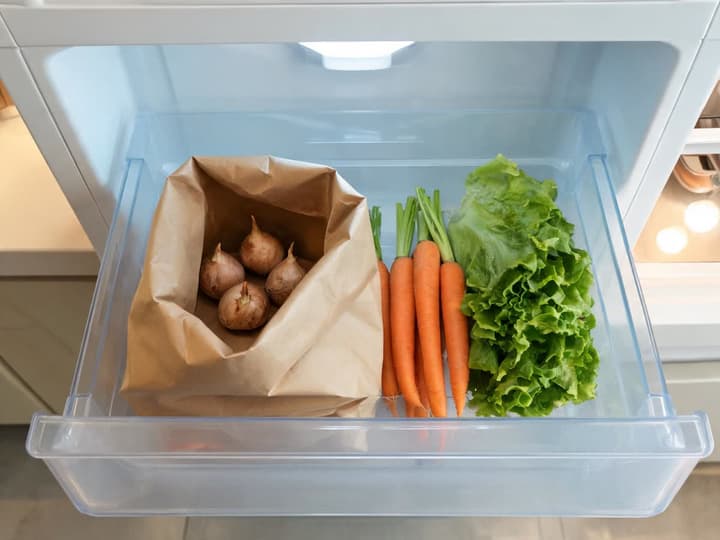
Keep the tulip bulb in the refrigerator crisper drawer for 15 to 16 weeks, between 2 and 7 °C. Tulips are spring-flowering bulbs. For these bulbs, Iowa State, Clemson, and the University of Maryland recommend 12 to 16 weeks of cold. Specific tulip charts from the University of Wisconsin and Penn State call for 15 to 17 weeks. The 15 to 16 weeks satisfy both recommendations. Some sources give shorter timeframes: UF/IFAS cites about 8 weeks for Florida. The University of Georgia states that 2 months in the refrigerator usually produces worse results. We follow the tulip charts, which call for more.
Wisconsin notes that home refrigerators typically stay between 2 and 7 °C and work well for this chilling period. Iowa State recommends 4 to 7 °C. Store the bulb in the same paper or mesh bag, since it also requires airflow while refrigerated.
Do not store fruit in the same drawer. The University of Arkansas advises storing the bulb alone, away from fruits and vegetables. Ripe fruit, especially apples, releases ethylene, the natural ripening gas. Texas A&M AgriLife says that this gas kills the flower bud inside the bulb. Wisconsin and Penn State say that it disrupts flower formation. We follow the stronger warning, because removing fruit from the drawer costs nothing.
Never put bulbs in the freezer. University of Arkansas and University of Georgia extensions instruct never to let bulbs freeze. If you have young children at home, seal the bag inside a container with ventilated holes and write "tulip bulbs, do not eat" on the label. Mississippi State University Extension does not recommend storing bulbs in home refrigerators with young children because some bulbs are toxic.
When to take the bulb out of the refrigerator and plant in Brazil
In Brazil, plant the tulip bulb in the fall, between March and June, as soon as it completes 15 to 16 weeks in the refrigerator. The sources for this guide are from the Northern Hemisphere, where fall runs from September to November. In Brazil, the seasons are opposite: fall runs from March to June, and winter begins in late June.
First pick your planting date, then count the weeks backward. To plant in early April, the bulb goes into the refrigerator in mid-December. To plant in early June, the bulb goes into the refrigerator in mid-February.
Plant the bulb immediately after removing it from the refrigerator, pointing upward in a pot with drainage holes. Depth, soil mix, and pot placement are covered in our guide on how to care for potted tulips.
Is it worth saving florist tulip bulbs?
It is worth a try, but expect few blooms. Florist tulips are forced: growers chilled the bulb so the flower would open out of season. That process depletes the bulb's reserves. Iowa State notes that forced tulips are typically discarded after blooming, and most do not flower again.
Sources are divided on the outcome:
Discard: Iowa State, University of Arkansas, Virginia Tech, Mississippi State, and University of Georgia extensions advise throwing forced tulips away.
Try it: the University of Wisconsin notes that forced bulbs grown in pots with soil can rebloom. The most likely scenario, it states, is spending 1 year producing only foliage. The University of Illinois mentions foliage in the first year and blooms in the second or third year.
Warm climate: UF/IFAS, the University of Florida Extension, states that tulips bloom once there and usually do not bloom again.
We side with the majority of extension services: treat the following year's bloom as a bonus. Storing the bulb costs only a paper bag and crisper drawer space.
Bulb size also plays a deciding role. South Dakota State University Extension states that bulbs under 6.4 cm (2.5 inches) in circumference will not produce flowers. To guarantee a bloom, it requires a bulb with a circumference of at least 10 cm (4 inches). Measure the bulb around its widest point using a soft sewing tape. Save bulbs measuring 10 cm or larger. Below 6.4 cm, do not expect flowers.
Two situations are not worth using refrigerator space for:
Tulips flowered in water, in a glass vase or over pebbles, without soil. Iowa State instructs discarding these bulbs after blooming.
Small bulblets separated from the main bulb. They will not flower the following year. The University of Illinois states they take 1 to 2 years, while South Dakota State estimates about 2 seasons. The RHS estimates 3 to 4 years for small bulblets. Expect 2 years or more.
Mistakes that prevent stored tulip bulbs from blooming
Sealed plastic bag: traps moisture, causing the bulb to rot. Use paper or mesh.
Chilling right after drying: chilling too early deforms the flower and shortens the stem. Wait at least 6 weeks outside the refrigerator.
Fruit in the same drawer: ethylene from ripening fruit interferes with flower development and can kill the bud.
Freezer: University of Arkansas and University of Georgia extensions instruct never to let the bulb freeze. Use only the crisper drawer.
Cutting green foliage too early: deprives the bulb of energy for next year's bloom.
Diseased bulb stored with healthy ones: bulbs infected with Fusarium emit ethylene and spoil neighbors.
Are tulip bulbs toxic?
Yes, for dogs, cats, and horses. The ASPCA, an American animal protection association, states that the toxic substances in tulips are tulipalin A and B. The bulb has the highest concentration of them. Signs include vomiting, depression, diarrhea, and hypersalivation. Store the bag of bulbs in a closed cabinet, out of the animal's reach.
Bulbs can also irritate some people's skin. NC State Extension describes tingling, redness, and blisters, sometimes appearing a while after contact. The RHS recommends gloves for anyone with skin sensitivities. Poison Control records an incident from 1978 where six adults ate tulip bulbs mistaking them for onions and fell ill. Write "tulip bulbs, do not eat" on the bag label.
The tulip toxicity chart summarizes the risk for each animal:
Frequently Asked Questions
Can I leave tulip bulbs in the pot until next year?
In Brazil, it is not the best path. In a pot, the bulb gets no cold at all. The RHS states that, in soil that does not dry out in summer, tulips rarely flower again. Remove the bulb when the foliage turns yellow, dry it in the shade, and store it in a paper bag until it is time for the refrigerator.
Can I put tulip bulbs straight into the refrigerator after drying?
No. According to Cornell University, next year's flower develops inside the bulb while stored outside the refrigerator between 17 and 20 °C. Premature chilling produces short plants and deformed blooms. Keep the bulb out of the refrigerator for at least 6 weeks, counted from the day it was dug up.
How long do tulip bulbs last out of the ground?
Stored tulip bulbs last until the following autumn, when they are planted back into the ground. Iowa State notes that bulbs unplanted in their proper cycle usually shrivel and die. Longfield Gardens, an American bulb retailer, points to best results within 6 months of harvest. It sets the outer limit at about 12 months.
Can tulips flowered in water be saved?
It is not worth the effort. Iowa State instructs discarding tulip bulbs flowered in water, without soil, once blooms fade. The University of Wisconsin states that soilless forced bulbs are harder to re-establish and often fail to rebloom. To attempt a repeat bloom, save only tulip bulbs grown in potted soil.
Sources
Iowa State University Extension: Is it possible to save tulip bulbs that have been forced indoors?
Iowa State University Extension: Care of spring-flowering bulbs after bloom
Iowa State University Extension: How to manage potential problems growing tulips
Iowa State University Extension: How to force spring-flowering bulbs indoors
Cornell Flower Bulb Research Program: The upcoming tulip forcing season and the G-stage (2013)
University of Maryland Extension: Production of tulips as cut flowers
South Dakota State University Extension: Tulips bring early-season color to the garden each year
University of Illinois Extension: Caring for spring-blooming bulbs after flowering (2022)
Texas A&M AgriLife Extension, Travis County: One and done bulbs (2020)
Texas A&M AgriLife Extension, Bexar County: Autumn planting for next year's bulbs
Penn State Extension: Forcing flowering bulbs for indoor beauty
University of Georgia Extension: Flowering bulbs for Georgia gardens (B918)
Virginia Tech Cooperative Extension: Forcing flower bulbs for indoor bloom (HORT-76NP)
Mississippi State University Extension: Forcing cold-hardy bulbs indoors
Related articles
How to Care for Hibiscus: Sun, Watering, Fertilizer, and Pruning for Flowers
How to care for hibiscus: 6 hours of direct sun, evenly moist soil without waterlogging, half-strength fertilizer in spring and summer, and pruning in early spring. Find out why the flower lasts one day and why buds drop before opening.

Do Ferns Like Sun or Shade? It Depends on the Type
Ferns prefer bright shade: plenty of light, but no direct sun on their fronds. Tuberous sword fern is the exception that handles sun. Here is the ideal light for each type, where to place pots, and how fronds show too much or too little light.

African Violet Yellow Leaves: Causes and What to Do
Yellow leaves on an African violet usually stem from overwatering, and the first place to check is the center of the plant. Losing one lower leaf at a time is normal. Identify whether age, watering, cold water, sunlight, cold drafts, or fertilizer is the culprit based on the yellowing pattern, and see what to do today.