What to Do with Tulips After They Bloom: Care and Bulb Storage
Your tulip is not dying: when petals drop and leaves yellow, the bulb is going dormant. Learn how to care for tulips after blooming, how to chill the bulb in the fridge, and when it can flower again.
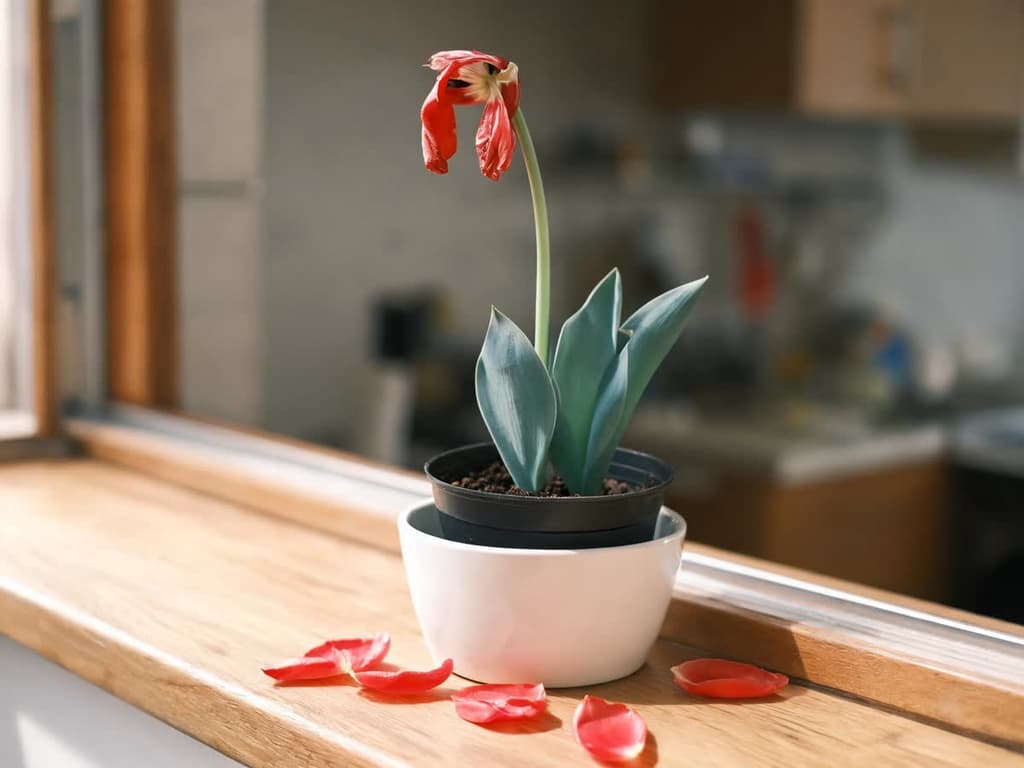
Your tulip is not dying. When the petals fall and, in the following weeks, the leaves turn yellow and dry up, the plant is ending its yearly cycle. The living part remains underground, in the bulb. Here is how to care for the tulip after the flowers die: cut off only the wilted flower. Leave the leaves in the pot until they dry, which takes about 6 weeks.
When the leaves start turning yellow, stop watering. When they turn straw-colored (light yellow and dry), remove the bulb from the soil and let it dry. To flower again, the bulb needs 15 to 16 weeks in the refrigerator before going back into the soil. Even so, a tulip bought already in bloom rarely flowers again the following year.
What to do | When | Why |
|---|---|---|
Cut off the wilted flower | As soon as the petals fall | Seed formation depletes the bulb's reserves |
Leave the leaves | Until they dry, about 6 weeks | The leaf produces the food for the bulb |
Watering | Only while the leaves are green | A resting bulb rots in wet soil |
Removing and drying the bulb | When the leaves turn straw-colored | The dry bulb can withstand the wait without getting moldy |
Put in the refrigerator | 15 to 16 weeks before planting | The cold prepares the flower inside the bulb |
Planting again | May or June, in Brazil | It is when the nights cool down |
Why the tulip seems to die after the flower drops
The tulip (Tulipa gesneriana) grows from a bulb, a kind of onion where the plant stores food from one year to the next. After the flower, the green leaves continue producing food with sunlight (photosynthesis), and this food goes to the bulb. Illinois Extension, the gardening service of the University of Illinois, explains that this food is what forms the following year's buds.
When the bulb is full, the leaves turn yellow, dry up, and the plant goes dormant. Dormancy is the bulb's rest period: it stays alive and still underground, without any leaves, until the next cold spell. Because of this, yellow leaves after the flower are the expected sign, and pulling everything out at this point throws away the living part of the plant.
If you received the potted plant as a gift and are not sure that it is a tulip, confirm the species before following the steps. The timelines in this guide apply to tulips. Other bulb plants sold in bloom, such as the amaryllis, require different care. In Bloom, a photo of the plant is enough to identify the species, and the free plan includes 2 identifications per month.
What to do with the tulip after the flowers die, step by step
Cut off only the wilted flower. Use clean scissors and cut the stem right below the flower as soon as the petals fall. Iowa State University Extension recommends this because seed formation weakens the bulb and reduces flowers in subsequent years.
Leave the leaves until they dry. Do not cut, fold, or tie the green leaves. Clemson Extension recommends leaving them for at least 6 weeks after the flower ends or until they turn brown. Illinois Extension warns that tying the leaves reduces the light they receive.
Water while the leaves are green. The Royal Horticultural Society (RHS), the United Kingdom's gardening charity, states that bulbs need water during the 6 weeks after flowering. When the leaves start turning yellow, stop watering, as Illinois Extension recommends for potted tulips.
Remove the bulb from the soil when the leaves turn straw-colored. Turn the pot carefully and loosen the bulb with your fingers. Clean off the soil and squeeze the bulb with your thumb: the RHS advises discarding any bulb that is soft or has blue or white mold.
Dry the bulb for 2 to 3 weeks. Leave the bulb in a dry, shaded place with circulating air. It is dry when the brown skin becomes papery thin. Iowa State gives this 2 to 3 week timeframe, and the RHS describes the papery skin as the sign that it dried.
Store it in a mesh or paper bag. The RHS recommends a mesh or paper bag in a dark, ventilated place. Iowa State uses a mesh bag in a dry place.
The two sources differ on the temperature for this waiting period. The RHS directs you to store the bulb in a warm place, between 18 and 20 °C (65 and 68 °F). Iowa State directs a cool place, between 10 and 18 °C (50 and 65 °F). This guide follows Iowa State, which is a university extension: store the bulb between 10 and 18 °C. Neither source measured the waiting period in a Brazilian summer. If the house exceeds 18 °C, use the coolest, driest, and darkest corner.
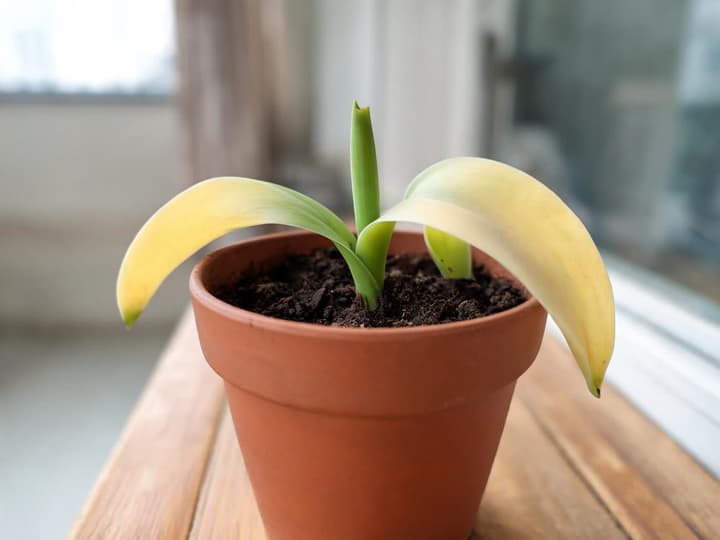
How long the tulip bulb stays in the refrigerator
The tulip bulb needs 15 to 16 weeks in the refrigerator before being planted. Clemson Extension and the University of Georgia (UGA) Extension call for 12 to 16 weeks of cold for spring bulbs. For tulips, Penn State Extension and the University of Wisconsin give 15 to 17 weeks. The 15 to 16 weeks fit within both ranges. South Dakota State University explains that this cold period is what initiates flower formation inside the bulb.
The right temperature is between 4 and 10 °C (40 and 50 °F), according to UGA, at the bottom of the refrigerator. Penn State points to 4 to 7 °C (40 to 45 °F) as the ideal range. The University of Wisconsin says a home refrigerator usually stays between 2 and 7 °C (35 and 45 °F). The three ranges overlap at 4 to 7 °C: set the refrigerator to this range. Mississippi State recommends the crisper drawer.
Store the bulb in a paper bag or mesh bag, because the packaging needs to allow air circulation. UGA and Clemson call for ventilated packaging.
Do not keep fruit in the same refrigerator during these weeks. Ripe fruit, especially apples, releases ethylene, a natural ripening gas. Clemson Extension states that ethylene from fruit can prevent flowering. Illinois Extension cites ethylene as a cause of aborted flowers, meaning they die while still inside the bulb.
The tulip bulb is toxic. Mississippi State University Extension does not recommend storing bulbs in the refrigerator in homes with small children. If there is a child or pet in the home, store the bulb in a container with a perforated lid and a toxic bulb label, on a shelf away from food.
When to replant the tulip in Brazil
In Brazil, plant the bulb in May or June, at the end of fall and the beginning of winter. The sources for this guide are from the United States and the United Kingdom, in the northern hemisphere, where the seasons are opposite to those in Brazil. Clemson writes for the warm coast of South Carolina and directs planting from November to the end of December. In the southern hemisphere, this same time of year falls in May and June.
Count the refrigerator weeks backward from the planting date. To plant in mid-May, the bulb goes into the refrigerator at the end of January. If the flower fell in October, the leaves dry until the end of November and the bulb dries until mid-December. It waits outside the refrigerator until the end of January.
When planting, bury the bulb with the tip pointing up, in a pot with a drainage hole at the bottom. Clemson recommends a depth of 15 to 20 cm (6 to 8 inches) in the garden. Use soil that drains water well: Iowa State warns that tulips do not tolerate waterlogged soil.
Will the tulip bloom again?
Expect little chance of a flower the following year, especially if you bought the tulip already in bloom. That flower shop or supermarket tulip was forced: the grower exposed the bulb to the cold to make the flower open out of season. Iowa State says that forced tulips do not flower again when planted in the garden. Illinois Extension, responding about a potted plant received as a gift, says that it is very unlikely to flower the following year.
Two sources allow that the flower may return. The University of Wisconsin says that a bulb forced in a pot with soil can bloom the following spring. The same source warns, however, that it will most likely spend 1 year with leaves only before blooming. Illinois Extension speaks of trying again in 2 to 3 years.
Warm weather also reduces the chance. UF/IFAS, from the University of Florida, says that Florida's winter is too warm for tulips. There, it must be treated as a single-season plant. Clemson says the same for South Carolina: the tulip blooms once and is discarded. In Brazil, Junkes Garden Center is a gardening company in Santa Catarina. It told the magazine Globo Rural that saving the bulb is unfeasible even in the South of Brazil.
This article takes the side supported by most extension sources: treat the next year's flower as a bonus, without counting on it. Cutting the flower, waiting for the leaves, and providing the cold period in the refrigerator cost little and give the bulb the best chance it has. The small bulblets that form attached to the main bulb take longer: Illinois Extension says they take 1 to 2 years to start flowering.
When it is a disease and not the tulip's normal cycle
Yellow leaves after the flower are the normal cycle. Leaves turning yellow before the flower, with spots or mold, point to disease. In tulips, what separates the two cases is the condition of the bulb and the leaf.
What you see | Normal cycle | Sign of disease |
|---|---|---|
When the leaf turns yellow | After the flower falls | Before or during flowering, or the plant does not even sprout |
How the leaf turns yellow | Evenly, from the tip to the base, until it turns straw-colored | Brown spots, crooked or twisted leaves |
Mold | None | Fuzzy gray mold on the leaf or flower |
Bulb squeezed with the thumb | Firm, with thin brown skin | Soft, with a bad smell or blue, white, or pinkish mold |
Petals | Solid color | Stripes of another color on a flower that used to be a solid color |
Tulip gray mold is caused by the fungus Botrytis tulipae. The RHS describes distorted leaves that wither soon after sprouting, brown spots, and, with moisture, a fuzzy gray mold. Iowa State says that wet, overcast weather favors the fungus. The RHS recommends not planting tulips for 3 years where the disease appeared.
Basal rot is caused by the fungus Fusarium. Penn State Extension describes dark brown spots on the bulb and a white or pinkish mold over it. The PNW Handbook is a plant disease guide for the Pacific Northwest of the United States. It states that symptoms appear more on stored bulbs than on the plant. Because of this, squeeze and look at each bulb before putting it in the refrigerator.
A soft, discolored bulb with a bad smell is rotten. Iowa State links this rot to cold, waterlogged soil and cites black or bluish mold on the bulb. Petals with stripes of another color are a sign of a virus, transmitted by aphids, according to the PNW Handbook. The RHS instructs destroying a plant with the virus to keep it from spreading to other tulips.
In tulips, yellow leaves with soggy soil can also be overwatering, and the yellow leaves guide helps separate this cause from the others. If the symptom does not appear in the table, the what's wrong with my plant guide takes you from the symptom to the cause in 3 questions.
Are tulips toxic to cats and dogs?
Yes. The ASPCA, the American animal protection association, classifies the tulip as toxic to dogs, cats, and horses. Signs include vomiting, depression, diarrhea, and hypersalivation. The highest concentration of the toxin is in the bulb, the part you will handle and store.
NC State Extension, from North Carolina State University, says that tulips can cause skin irritation in some people. Wear gloves to clean and store the bulbs.
Frequently asked questions
How long does a potted tulip last?
Cut tulips in a vase with water last about a week, according to Iowa State. In tulips planted in a pot with soil, the flower also falls off, and this does not mean the plant has died. The leaves stay green for about 6 weeks, feeding the bulb for the next cycle.
How many times a year does a tulip bloom?
Each tulip bulb flowers at most once a year, and a tulip bought already in bloom rarely flowers again the following year. Each bulb produces a flower after going through a period of cold. It only flowers again after another winter or another 15 to 16 weeks in the refrigerator. Outside of this cycle, the bulb remains dormant underground, without leaves.
Can I leave the tulip bulb in the pot?
You can, while the leaves are green. After they dry, Illinois Extension advises storing the entire pot, without watering, in a cool, dark place. In Brazil, however, the bulb still needs 15 to 16 weeks in the refrigerator to have a chance of flowering. Because of this, remove the bulb from the soil when the leaves turn straw-colored.
How to revive a tulip?
The flower that fell will not return, and the plant does not need to be revived. If the leaves are turning yellow after the flower and the bulb is firm, the tulip is alive and resting. Only a soft bulb, with mold or a bad smell, is lost. In that case, throw the bulb away along with the soil from the pot.
In short
A falling flower and leaves that turn yellow after it mark the end of the cycle, with the bulb alive underground. Cut off only the flower and leave the leaves until they turn straw-colored, about 6 weeks. Water while they are green. Afterward, dry the bulb and give it 15 to 16 weeks in the refrigerator, away from fruit, before planting in May or June. A tulip bought already in bloom rarely flowers again the following year. A soft bulb, mold, and spots are signs of disease, not the normal cycle.
On the Premium plan, Bloom compares the photo of your tulip's leaf or bulb with disease symptoms. Then, it tells you what to do. It is available for iPhone and iPad.
Sources
Illinois Extension: Caring for spring-blooming bulbs after flowering (2022)
Iowa State University Extension: Care of spring-flowering bulbs after bloom
Iowa State University Extension: How to manage potential problems growing tulips
Penn State Extension: Forcing flowering bulbs for indoor beauty
Mississippi State University Extension: Forcing cold-hardy bulbs indoors
South Dakota State University Extension: Tulips bring early season color to the garden each year
Related articles
How to Care for a Goldfish Plant: Light, Watering, and Blooms
How to care for a goldfish plant: bright light without strong sun, water when the soil surface dries, and humid air. Learn how to tell a Nematanthus from a Columnea, why it drops leaves, and how to get it to bloom again.
Lavender Leaves Turning Yellow: Where the Yellowing Starts Shows the Cause
Lower leaves turning yellow with moist soil means overwatered roots, the most common cause. Old leaves drying one by one on woody stems is normal. Take the stem and root test, see if your plant can still be saved, and find out what to do today.
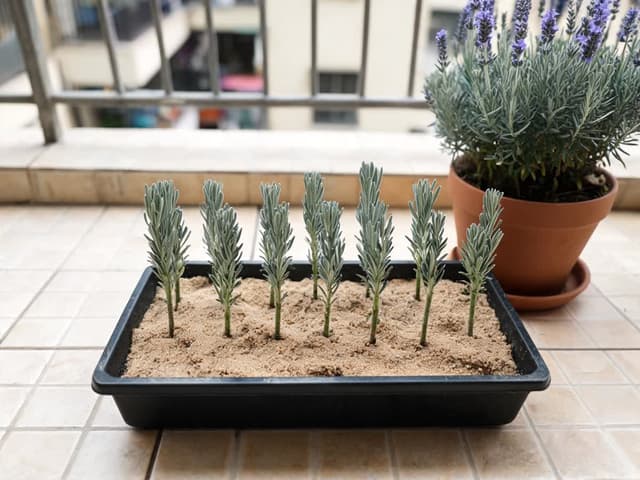
How to Propagate Lavender: Where to Cut and Why Cuttings Rot
A lavender cutting comes from a non-flowering branch tip, about 4 inches long, planted in sandy soil that never stays soggy. Learn where to cut, rooting times, seasonality in Brazil, and what to do if the base turns black.