How to Water Calathea: When, How Much, and Which Water to Use
Water calathea when the top inch of soil feels dry, until water drains from the bottom, using rainwater or distilled water. Learn how to test with your finger and pot weight, what tap water fluoride does, and how to tell thirst, dry air, and overwatering apart.
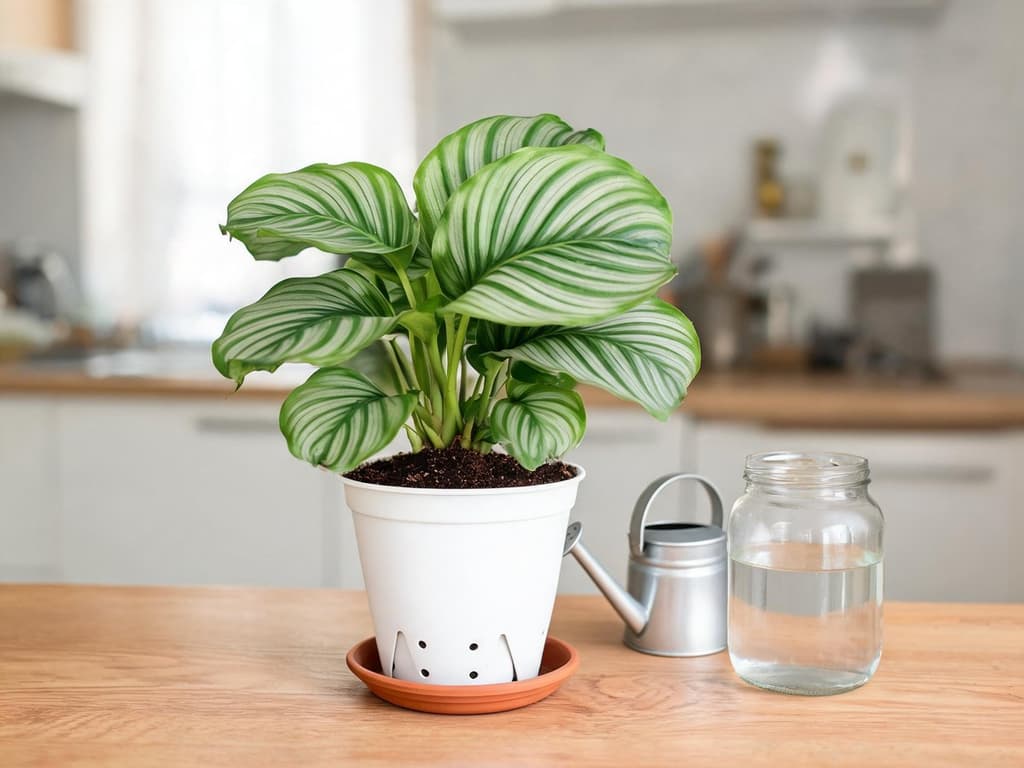
To water calathea, wait until the top inch (2.5 cm) of soil dries out, and then soak it until water drains out of the pot's drainage hole. Use rainwater or distilled water, because fluoride in tap water can burn leaf tips over time. There is no set watering day: the right time is whenever the soil test tells you.
Does your calathea have curled leaves and dry tips, leaving you unsure whether it has had too much or too little water? Stick your finger into the soil before doing anything else. Dry soil an inch deep means thirst: water it. If the soil is moist, the most likely cause is dry air, and watering again will only waterlog the roots.
Calathea watering at a glance:
What | How to do it | Source |
|---|---|---|
When to water | When the top inch (2.5 cm) of soil is dry to the touch | Brooklyn Botanic Garden |
How much to water | Until it drains through the hole; then discard saucer water | Colorado State, RHS |
Water type | Rainwater or distilled; tap water has fluoride | NC State, Iowa State |
Warm season | Water when the top inch dries out, without letting the soil dry out completely | RHS |
Cold season | Top inch dry before watering, without letting the soil dry out completely | RHS |
Bottom or top | Top watering is standard; bottom water occasionally, flushing from above | Colorado State |
Misting | Does not replace watering and does not raise air humidity | Penn State |
Light, fertilizer, temperature, and the rest of the plant's routine are in the complete calathea care guide.
How to tell if calathea needs water
Calathea needs water when the top inch (2.5 cm) of soil is dry to the touch. The Brooklyn Botanic Garden provides this guideline and notes that calathea does not like drying out between waterings. Colorado State University lists three cues to know when to water: pot weight, the soil to the touch, and soil color.
The finger test. Insert your index finger into the soil up to the first knuckle from the tip, about an inch (2.5 cm). The first time, verify the depth with a ruler. If your fingertip comes out dry and clean, water. If it comes out moist or with soil clinging to it, do not water, and test again at the next check.
Pot weight. Check small and medium pots by their weight. Lift the pot right after a thorough watering to get a feel for the weight of wet soil. Lift it again when the finger test reads dry to feel the weight of dry soil. In the future, whenever the pot feels close to that lighter weight, use the finger test to confirm. With a kitchen scale, jot down both weights in grams.
Wooden skewer. In deep pots, soil can be dry at the surface while remaining wet at the bottom. Push a wooden barbecue skewer down to the bottom of the pot and pull it out. A skewer that comes out with dark, clinging soil indicates moist soil underneath.
Soil color. Wet soil is dark, while dry soil is lighter. Surface color helps, but it only reflects the very top layer.
Check the soil twice a week until you get a feel for how many days it takes your calathea to dry out. The Brooklyn Botanic Garden recommends this monitoring routine for anyone just starting out with the plant.
How often to water calathea
Calathea has no set watering schedule. Colorado State University lists factors that change the interval between waterings: species, light, temperature, air humidity, air movement, potting soil, and pot type. The exact same calathea dries out much faster in a warm, breezy apartment than in a cool room.
A guideline like "every 7 days" only works for the home of the person who wrote it. In another home, that same timeframe could either leave the soil waterlogged or bone dry. The rule that holds true in any home is the 1-inch (2.5 cm) finger test.
Allowing the soil to dry out completely is a frequent mistake with calatheas. Iowa State Extension points out that leaving the soil dry for too long between waterings browns the leaf tips and edges. According to the Brooklyn Botanic Garden, soil compacted by irregular watering is the primary cause of dry, brittle leaves on calathea.
How much and how to water calathea
Water calathea until the entire root ball is moist. Pour water slowly over the soil surface, around the stems, until it begins running out through the pot's drainage hole. Colorado State University advises checking with your finger after watering to make sure the soil beneath the surface is moist as well.
Empty any water sitting in the saucer or cachepot (the decorative outer pot without drainage holes that holds the nursery pot) as soon as the pot stops dripping. The RHS (Royal Horticultural Society, in the United Kingdom) warns that calathea roots rot easily if left sitting in water. Pots must have a hole in the bottom: without one, excess water has nowhere to go.
Colorado State University explains that severely dry soil shrinks away from the inner sides of the pot. Water then runs straight down the sides, pours out the drainage hole, and barely wets the root ball (the mass of roots and soil inside the pot). If water runs out of the hole just seconds after you start watering, the root ball is dry inside. In that case, use bottom watering, described below.
Top watering vs bottom watering
Top watering is the standard way to water calathea. Sources offer differing views on bottom watering:
Colorado State University prefers top watering. With bottom watering, the soil pulls water up from the tray, causing fertilizer salts to build up on the surface. If you do bottom water, that same source advises top watering periodically to flush those salts through the drainage hole.
The RHS recommends bottom watering to tackle fungus gnats, small black flies that breed in moist potting soil. Bottom watering keeps the soil surface drier, which is where they lay their eggs.
This guide follows Colorado State University: top watering as your regular routine. Calathea tolerates soil salts poorly (UF/IFAS), and top watering washes those salts away. Bottom watering comes into play in two situations: a parched root ball that fails to take in water, or fungus gnats emerging from the soil.
How to bottom-water calathea:
Set the pot in a basin with a shallow layer of rainwater or distilled water.
Wait until the surface of the soil turns dark and moist: this indicates the water has wicked up through the entire root ball.
Lift the pot from the basin and let it drain in the sink until it stops dripping.
For the following watering, water from the top until it drains freely from the hole, carrying away accumulated salts.
What water to use for calathea
The best water for calathea is rainwater or distilled water. NC State Extension recommends both for multiple calathea species. The reason comes down to fluoride in tap water, which can brown leaf tips and margins. Iowa State Extension includes calathea among fluoride-sensitive plants, right alongside spider plants and dracaenas.
How much fluoride causes spots on calathea
A 1996 North Carolina State University (NC State) bulletin lists calatheas (Calathea spp., now mostly reclassified as Goeppertia) among plants sensitive to fluoride. According to that same bulletin, watering with as little as 1 mg of fluoride per liter can trigger symptoms in these plants. The earliest sign is yellowing at the tips and margins of older leaves, which later dries out and turns brown.
In Brazil, treated water has received fluoride by law since 1974 (Law 6,050). The maximum permitted limit in drinking water is 1.5 mg per liter (Consolidation Ordinance No. 5/2017, Annex XX). In the state of São Paulo, the concentration considered optimal is 0.7 mg per liter (Resolution SS 250/1995).
A concentration of 0.7 mg/L is below 1 mg/L, but fluoride builds up. The plant disease guide from Oregon State University explains that fluoride gradually accumulates along leaf edges over time. University of Missouri Extension notes the same about municipal water supplies: a sensitive plant watered with it long enough builds up fluoride until symptoms appear. That is why NC State and Missouri Extension advise using rainwater or distilled water for fluoride-sensitive plants.
Rested water and filtered water
Letting water sit removes chlorine, not fluoride. The RHS notes that calathea tolerates tap water that has been left to stand for at least 24 hours, since chlorine evaporates during that period. Fluoride stays behind: none of the consulted sources suggest letting water sit to get rid of fluoride. The RHS, a horticultural society, accepts rested water, whereas university extensions advise only rainwater or distilled water. This guide aligns with the extensions, because letting water stand does not remove fluoride.
Filtered water depends on the filter. A 2008 study in India (Prabhakar and colleagues) evaluated 5 household water purification systems using both tap and well water. Reverse osmosis (a filter forcing water across a semipermeable membrane) reduced fluoride the most, followed by distillation and activated carbon. Ceramic candle filters reduced it the least. The amount removed varied from unit to unit and between water sources.
Rainwater, distilled water, and dehumidifier water
The three fluoride-free waters cited by sources are rainwater, distilled water, and water collected from a dehumidifier (RHS). Collect rainwater in a clean bucket and store it in a covered container.
The RHS also mentions lime in tap water. It leaves a white crust on the soil and pot. No one has measured lime's direct effect on calathea, and water hardness varies from town to town. Fluoride is added to treated water by law, and extension offices directly link it to scorched tips. Rainwater and distilled water avoid both issues.
Fertilizer also introduces fluoride
The same NC State bulletin measured soluble fluoride across fertilizers and potting mix components: 2,600 mg per kilogram in single superphosphate and 1,600 mg per kilogram in triple superphosphate. Oregon State University advises steering clear of high-phosphate fertilizers for sensitive plants. For calathea, opt for a liquid foliage plant fertilizer and check the label to ensure the formula does not contain superphosphate, a phosphorus-heavy fertilizer.
Perlite, the small white specks used to lighten potting soil, divides sources. University of Missouri Extension recommends using perlite-free potting mixes for fluoride-sensitive plants. The 1996 NC State study, on the other hand, grew three sensitive plants in mixes containing up to 50% perlite. None of them suffered fluoride damage. This guide follows the study, since it measured real outcomes on plants. Perlite can stay in the potting mix, though the study did not test calathea specifically. Those who prefer not to take risks can choose a perlite-free soil.
Watering calathea in summer vs winter
In summer, water as soon as the finger test comes up dry, keeping the soil lightly moist without letting it dry out completely (RHS). During hot weather, the plant loses more water through its leaves and the soil dries out faster. Test the soil with your finger more frequently, instead of simply watering more often just because it is hot.
In winter, wait for the surface (the top inch [2.5 cm]) to dry out before watering, and never let the soil dry out completely (RHS). UF/IFAS, from the University of Florida, also instructs to let the surface dry out a bit before watering. In Brazil, winter runs from June to August.
Overwatering in cold conditions triggers edema in calathea. Edema is a disorder where the plant cannot transpire properly, meaning it cannot release through its leaves the water its roots absorb. The RHS describes the symptom as water-soaked spots scattered across the leaves. According to the RHS, edema occurs most commonly in winter when the soil is kept too wet.
Dry interior winters in Brazil and indoor air conditioning speed up drying of both the soil and the leaves. In these situations, check the soil more frequently, but water only when the finger test reads dry.
Air humidity does not replace watering
Watering more will not fix dry air: leaves lose moisture faster than roots can replace it, even if the soil is wet (RHS). Watering more in that scenario only drowns the roots without fixing the dry air.
Calathea keeps its best indoor appearance when relative humidity is between 40% and 60%, according to UF/IFAS. A hygrometer, a tool that measures ambient humidity, will reveal if your home falls below that range. To raise humidity, run a humidifier or group plants together: the calathea care guide provides measured data for each method.
Misting leaves with water does not hydrate the plant or increase ambient humidity. Penn State Extension explains that misting effects last only until the water evaporates, which takes just minutes. NC State associates wet leaves with leaf spot diseases, caused by fungi and bacteria that leave dark patches on calathea. Always water the soil directly, keeping leaves dry.
Curled leaves on calathea: thirst or dry air
Daytime leaf curling has two main triggers: lack of water or low air humidity. NC State cites these two culprits in its profiles for Goeppertia zebrina, G. orbifolia, and G. roseopicta. Checking the potting soil distinguishes between them.
Soil at 1 in (2.5 cm) | Leaf condition | Probable cause | What to do |
|---|---|---|---|
Dry, or pulling away from the pot wall | Curled, still green | Thirst | Water until it drains; if water runs straight through, bottom water |
Moist | Curled, still green or with dry edges | Dry air, likely | Do not water; check humidity and increase it to 40% or higher |
Soggy for days | Wilting, soft, turning yellow | Overwatering | Stop watering and inspect roots |
Leaves that fold upward in the late afternoon and reopen in the morning are not curling out of distress. Calatheas naturally perform this movement every day (Brooklyn Botanic Garden). The warning sign is a leaf that stays rolled up along its length throughout the daytime.
Signs of overwatered calathea and what to do
An overwatered calathea wilts while sitting in wet soil. Lower leaves turn yellow, stems lose their stiffness, and the potting mix stays wet several days after watering. NC State notes that overwatering triggers root rot in calathea. UF/IFAS connects yellow foliage to excess water and instructs to water less frequently.
Before rushing to repot the plant, slip the root ball out of the pot and look at the roots. Healthy roots are firm and light in color. Rotted roots are dark, mushy, and fall apart when gently tugged.
Roots are firm and light: place the plant back into its pot and let the top inch (2.5 cm) dry out before watering again. You do not need to replace the potting mix.
Some roots are rotted: trim off dark roots using clean shears and repot into fresh mix in a container with drainage. Do not water again until the top inch dries.
Stem bases are soft and dark, with a foul smell: rot has reached the rhizome, the underground stem. Separate only the firm sections of the rhizome and replant those pieces.
As long as the rhizome remains firm, calathea can sprout new leaves once the issue is corrected. Leaves that have turned completely yellow will not turn green again: cut them off at the base. Yellow leaves also stem from causes beyond watering. The guide to yellow leaves on calathea breaks down each cause based on where the discoloration begins on the leaf.
Frequently asked questions
Can I water calathea with filtered water?
It depends on the filter. In a 2008 study testing domestic purifiers, reverse osmosis reduced fluoride in water the most. Ceramic candle filters reduced it the least. Most home filtration units do not state how much fluoride they remove: for calatheas, the safest choices are rainwater or distilled water.
Can I mist instead of watering my calathea?
No. Misting wets only the leaves and never reaches the roots, where the calathea actually takes in water. Penn State Extension explains that misting effects vanish within minutes, and NC State links wet foliage to fungal and bacterial leaf spot. Water the soil until it drains from the bottom hole.
Why are my calathea leaf tips turning brown despite proper watering?
When watering is on schedule, brown tips usually stem from tap water fluoride, dry air, or excess fertilizer. NC State and Iowa State link brown tips to fluoride, while the RHS connects them to low humidity. The browned area will not recover; healthy growth will appear on new leaves instead.
I inherited a large-leafed plant that is green on top and purple underneath. Is it a calathea?
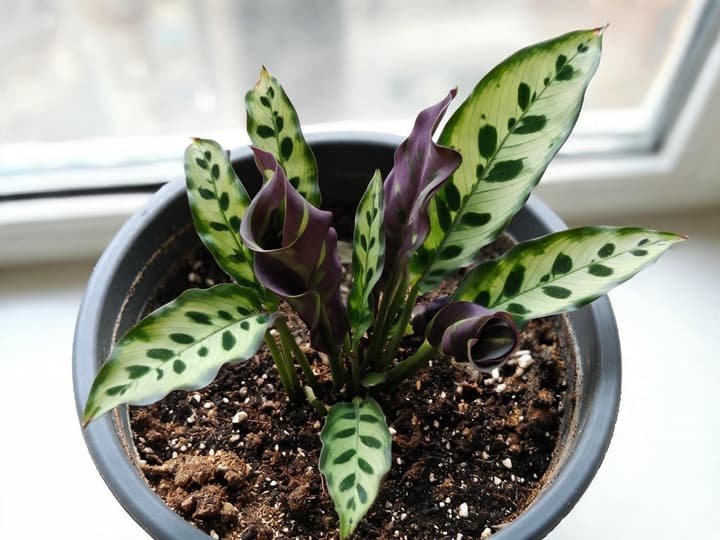
It could be. Several calatheas display purple undersides, like the peacock plant (Goeppertia makoyana) and the rattlesnake plant (G. lancifolia), two calatheas often sold under the name maranta (NC State). To know for sure before adjusting its watering, take a picture of the foliage: the Bloom app (available for iOS) identifies species from a photo, and the free version includes 2 plant identifications per month.
How to water calathea: action steps for today
Do the finger test: water only if the top inch (2.5 cm) of soil feels dry.
Water thoroughly until water drains from the hole, and pour out excess water from the tray once the pot stops dripping.
Switch from tap water to rainwater or distilled water.
If leaves curl while the soil is moist, check air humidity instead of watering.
Check the soil twice a week until you learn how many days your calathea takes to dry out.
The free tier of Bloom includes a watering schedule: use the reminder to perform the finger test before every watering.
Sources
Colorado State University Extension, PlantTalk 1318: Houseplants: Watering
Iowa State University Extension: Why does my houseplant have brown leaf tips and edges?
Oregon State University, PNW Plant Disease Management Handbook: Fluorine Toxicity in Plants
University of Missouri Extension, IPM: Leaf Tipburn on Houseplants
UF/IFAS EDIS EP285: Cultural Guidelines for Commercial Production of Interiorscape Calathea
Related articles

How to Care for Hibiscus: Sun, Watering, Fertilizer, and Pruning for Flowers
How to care for hibiscus: 6 hours of direct sun, evenly moist soil without waterlogging, half-strength fertilizer in spring and summer, and pruning in early spring. Find out why the flower lasts one day and why buds drop before opening.

Do Ferns Like Sun or Shade? It Depends on the Type
Ferns prefer bright shade: plenty of light, but no direct sun on their fronds. Tuberous sword fern is the exception that handles sun. Here is the ideal light for each type, where to place pots, and how fronds show too much or too little light.

African Violet Yellow Leaves: Causes and What to Do
Yellow leaves on an African violet usually stem from overwatering, and the first place to check is the center of the plant. Losing one lower leaf at a time is normal. Identify whether age, watering, cold water, sunlight, cold drafts, or fertilizer is the culprit based on the yellowing pattern, and see what to do today.