Calathea Care: Watering, Humidity, and Curled Leaves
Calathea requires bright, indirect light, consistently lightly moist soil, fluoride-free water, and at least 40% humidity. Here is how to distinguish curled leaves, brown tips, and the plant's normal night movements.
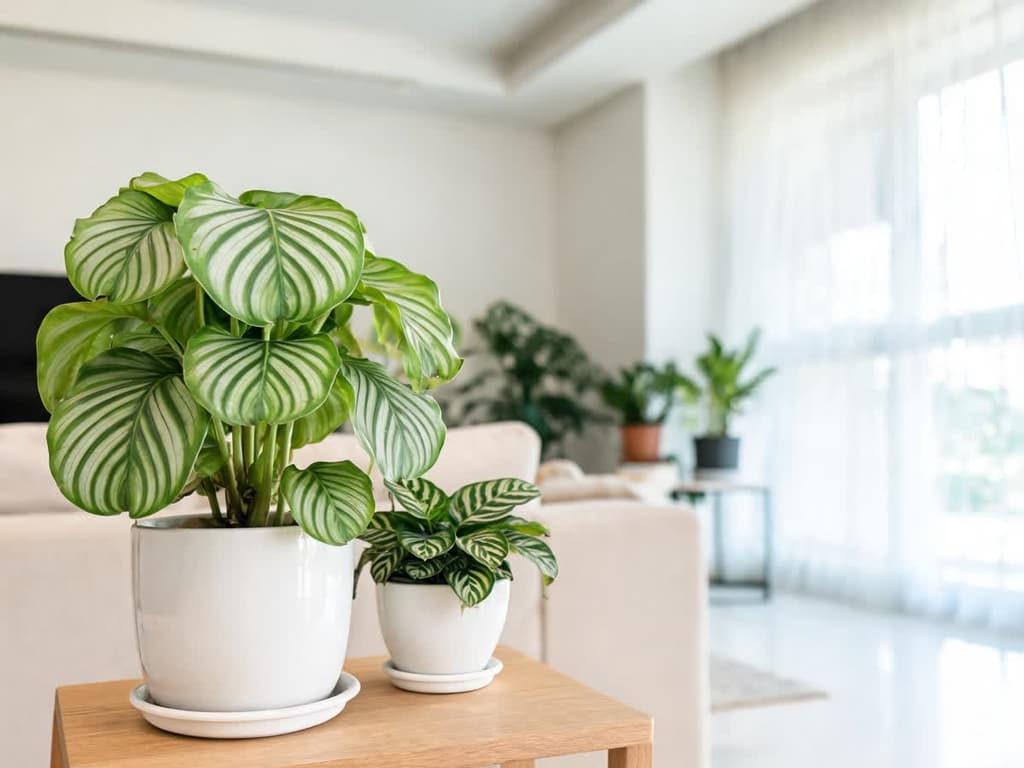
To care for a calathea, balance four key factors: light, watering routine, water quality, and ambient humidity. It needs bright light without direct sun, consistently lightly moist potting mix, fluoride-free water, and air with at least 40% humidity. Almost every problem you run into traces back to one of these four. Curled leaves and brown tips look alarming, but they rarely kill the plant.
If your calathea leaves are rolling up like cigars, there is still hope. The plant grows from an underground stem called a rhizome. As long as that rhizome stays firm, it will push out new foliage once you fix the underlying issue.
Quick summary:
Factor | How to do it | Source |
|---|---|---|
Light | Bright all day, no direct sun hitting the foliage; ideally around 150 to 200 foot-candles (1,600 to 2,150 lux) | UF/IFAS, RHS |
Watering | When the top inch (2.5 cm) of soil feels dry; never let the pot dry out completely | Brooklyn Botanic Garden, RHS |
Water quality | Rainwater or distilled water; tap water contains fluoride, which burns leaf margins | NC State, Iowa State |
Air humidity | At least 40%; NC State recommends 60% or higher | UF/IFAS, NC State |
Temperature | 65 to 70 °F (18 to 21 °C), where NC State and RHS guidelines overlap; cold damage occurs below 55 °F (13 °C) | NC State, RHS, UF/IFAS |
Fertilizer | Once a month, from April to September; nothing in the fall and winter | NC State, RHS |
Pets | Non-toxic to dogs and cats, according to the ASPCA | ASPCA |
What is calathea (Calathea and Goeppertia)
Calathea is a foliage plant belonging to the Marantaceae family, prized for leaves patterned with green, silver, pink, and purple. In 2012, a DNA study split the former genus Calathea in two (Borchsenius, Suárez, and Prince, Systematic Botany). Most potted calatheas sold today were moved to Goeppertia, though people still widely refer to them as calatheas.
Many of them are native to Brazil. According to NC State Extension, Goeppertia makoyana comes from Espírito Santo, G. orbifolia from the Northeast and Southeast, and G. zebrina and G. lancifolia from the Southeast. G. roseopicta hails from the upper Amazon basin (Missouri Botanical Garden). They are tropical forest floor species, thriving under the canopy of taller trees (Brooklyn Botanic Garden).
The maranta (Maranta leuconeura) is another genus in the same family, a close relative of the calathea (New York Botanical Garden). In Brazil, the confusion stems from the trade: several calatheas are sold under the name maranta, such as the peacock maranta (G. makoyana) and the rattlesnake maranta (G. lancifolia). The care in this guide applies to both, but the numbers come from calathea data sheets.
Leaves closing at night: calathea's natural movement
Calathea raises and folds its foliage in late afternoon and opens it up again the next morning. This movement is called nyctinasty: a plant response that tracks the cycle of day and night. It does not indicate illness, and all calatheas do it (Brooklyn Botanic Garden).
This movement relies on a joint at the base of every leaf, known as the pulvinus. The plant shifts water pressure inside this joint, prompting the leaf to move up or down. NC State describes G. zebrina folding its leaves "like hands in prayer" at night in response to shifts in light and temperature.
What sets natural behavior apart from trouble is timing and shape. A leaf that rises at night and opens in the morning is healthy. A leaf that stays rolled lengthwise like a cigar during the day is calling for water or higher ambient humidity.
Light: where to place your calathea
Place your calathea in the brightest spot in your home where direct sunlight will not strike the leaves. Direct sun fades the vivid patterns (UF/IFAS) and burns the foliage (Brooklyn Botanic Garden). Too little light causes weak growth, especially across Goeppertia species (RHS).
According to the University of Florida (UF/IFAS), calathea tolerates indoor light down to 75 foot-candles (about 800 lux). It thrives best between 150 and 200 foot-candles (about 1,600 to 2,150 lux). A light meter app on your phone, pointed at the pot's spot at midday, gives you a good estimate.
The RHS recommends a north- or east-facing window. In the northern hemisphere, a north-facing window receives little direct sun, and an east-facing window receives only morning sun. A south- or west-facing window receives strong sun. There, use a sheer curtain or move the pot back to where the sun cannot reach the leaves.
How to water calathea
Water your calathea whenever the top inch (2.5 cm) of soil feels dry to the touch. Poke your finger into the potting mix: if the tip comes out dry, it is time to water; if it feels damp, hold off. Brooklyn Botanic Garden recommends this test and cautions that calathea dislikes drying out between waterings.
In spring and summer, keep the soil lightly moist at all times (RHS). In fall and winter, let the surface dry before watering again, but never let the soil dry out completely.
Pour water until it runs out the pot's drainage holes, then empty any liquid left sitting in the saucer. Roots sitting in standing water rot easily (RHS), and root rot is the main risk of overwatering (NC State). There is no set watering calendar: a calathea drinks faster in a warm, breezy apartment than in a cool room.
Tap water, fluoride, and chlorine
Calathea is sensitive to fluoride in water. NC State Extension advises using distilled water or rainwater. Fluoride in tap water discolors leaf margins and tips. Iowa State Extension includes calathea among sensitive species, along with spider plants and dracaenas. UF/IFAS lists fluoride toxicity as a cause of dead patches near the leaf margins.
In Brazil, this precaution matters even more, because treated water is fluoridated by law. Law 6,050 of 1974 mandates fluoridation in public systems with water treatment plants. The maximum permitted limit in drinking water is 1.5 mg of fluoride per liter (Consolidation Ordinance No. 5/2017, Annex XX).
Leaving water out takes care of chlorine. The RHS notes that calathea tolerates tap water left standing for at least 24 hours because the chlorine dissipates. For fluoride, none of the sources recommend letting water stand: NC State, UF/IFAS, and Iowa State advise switching water sources altogether.
The options the sources suggest are rainwater, distilled water, and water collected from a dehumidifier (RHS). The RHS also cites limescale in tap water. In Brazil, however, the law mandates fluoride in treated water, and fluoride is what sources link to burned leaf edges on calathea.
Air humidity for calathea
Sources provide different targets for calathea humidity requirements. UF/IFAS notes that the plant stays attractive indoors with humidity between 40% and 60%. NC State recommends at least 60%.
This guide uses 40% as the baseline minimum, matching the UF/IFAS recommendation for indoor plants. The 60% cited by NC State serves as the target if you run a humidifier.
Measure your space before making changes. A hygrometer placed right by the pot reveals the humidity your plant actually experiences. Air conditioning and heaters drop the reading sharply, and a plant near a vent suffers far more than one elsewhere in the room.
If your reading is low, two methods show proven results:
Room humidifier. This is the method recommended by the Brooklyn Botanic Garden for calathea care.
Grouping plants together. A study published in PLOS ONE in 2024 measured enclosed office spaces. Median humidity was 29.1% without plants, 38.9% with 5 plants, and 49.2% with 18 plants.
Pebble trays with water receive mixed reviews across sources. The RHS suggests them, keeping the water level below the base of the pot. Penn State Extension explains that evaporating vapor disperses throughout the entire room, barely raising local humidity. A tray might provide a tiny boost right around the pot, but it does not replace a humidifier.
Misting leaves does not raise air humidity. While the RHS and UF/IFAS mention misting calathea, neither states how much it actually raises moisture levels around the foliage.
Penn State Extension points out that the effect lasts only until the droplets evaporate, which takes minutes. Brooklyn Botanic Garden also labels misting ineffective, and NC State links wet leaves to leaf spot on calathea. Following these three sources that explain the moisture dynamics: skip misting.
Temperature and cold tolerance
NC State recommends 65 to 75 °F (18 to 24 °C) for calathea, while the RHS suggests 60 to 70 °F (16 to 21 °C). The ranges overlap between 65 and 70 °F (18 to 21 °C), marking the safest zone for the plant. UF/IFAS notes cold damage occurs below 55 °F (13 °C).
Avoid drafts, heaters, and sudden temperature swings (RHS). On colder winter nights, move the pot away from windows and doors. If your calathea spends the summer on a porch or balcony, NC State advises bringing it indoors before temperatures drop below 60 °F (16 °C).
Calathea with curled leaves: underwatering or dry air
Leaves curling during the day stem from two primary triggers: underwatering or low air humidity (NC State). Checking the pot's soil distinguishes between them.
Soil dry 1 inch (2.5 cm) deep: the plant needs water. Water until liquid flows from the drainage hole and return to the finger-test routine.
Moist soil and humidity below 40%: the air is too dry. Raise ambient humidity using a humidifier or by grouping plants together.
Soggy soil and wilting leaves: root rot may be developing. Unpot the plant and inspect the root system: healthy roots look firm and pale; rotted roots are dark and mushy.
To tell if your calathea can still recover, gently squeeze the base of the stems near the soil line. A firm base indicates a living rhizome, meaning the plant can produce new growth. A soft, dark base with a foul smell signals rot. In that case, separate whatever firm tissue remains and replant only those parts.
Brown tips and margins on calathea
Brown tips and edges on calathea arise from four common causes, each creating a distinct pattern on the foliage.
Leaf symptom | Likely cause | What to do |
|---|---|---|
Dry, crispy margins across multiple leaves, accompanied by dry air | Low humidity (RHS, Iowa State) | Measure humidity and raise it to 40% or higher |
Dead patches near the edges with dark tips creeping inward | Fluoride in water (NC State, UF/IFAS) | Switch to rainwater or distilled water |
Dry tips appearing after the potting mix completely dried out | Irregular watering (Iowa State) | Water using the finger check without letting the mix dry out entirely |
Scorched margins appearing after fertilizing | Excess fertilizer (UF/IFAS) | Flush the soil thoroughly with water to wash out excess salts, then resume feeding next month at label strength |
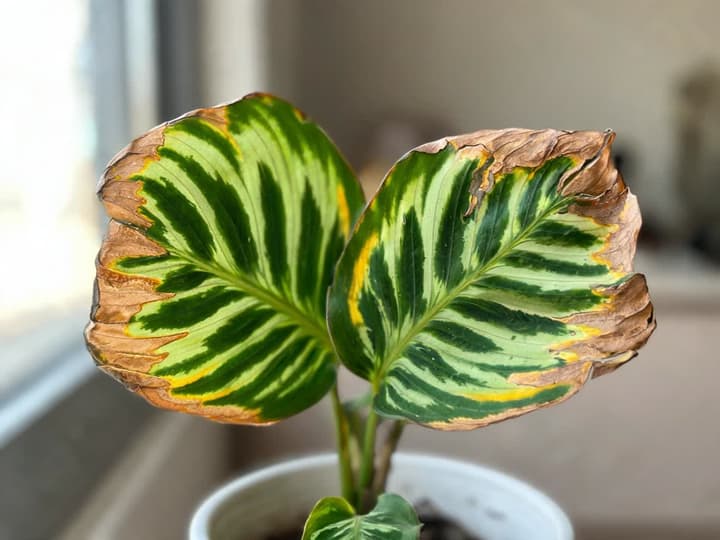
Brown leaf tissue will not turn green again. Iowa State explains that trimming dry tips improves appearance, but it does not fix anything if the root cause persists. Snip only the dead parts with clean shears. Cut entire dead leaves off right at the soil line (RHS).
Yellow leaves have a different list of causes, and the guide to yellow leaves separates each one by where the yellowing begins. On a calathea, yellow lower leaves with consistently wet soil usually mean overwatering, and the guide to yellow leaves on calathea shows how to tell this cause apart from the others.
Fertilizing calathea
Fertilize calathea once a month during the growing season with a balanced liquid houseplant fertilizer (NC State, RHS). The RHS recommends April to September. In fall and winter, stop fertilizing (NC State).
Excess fertilizer scorches leaf tips and margins (UF/IFAS). Follow the packaging instructions and never exceed the suggested dose. If you potted with slow-release fertilizer mixed into the soil, the RHS notes that your plant will not need liquid fertilizer during its first year.
Soil, pot, and repotting calathea
Use a potting mix rich in organic matter, amended with perlite to ensure good drainage (NC State). The mix should retain moisture without turning waterlogged. Make sure the container has drainage holes at the bottom.
Repot every 2 years (NC State), or when the clump fills the entire pot (RHS). Choose a pot 1 or 2 sizes larger than the root ball and keep the top of the root ball just below the surface of the new potting mix (RHS). The best time is spring or summer (RHS).
How to propagate calathea
Calathea propagates through rhizome division, and spring is the best window to do it (NC State, RHS). Lift the plant from its pot, gently work the soil away from the roots, and divide the clump into sections. Each section needs roots and a few leaves (RHS; UF/IFAS notes at least one leaf will work).
Pot each section into its own container with fresh mix and water thoroughly. Keep divisions in a warm spot with humid air and consistently moist soil until new leaves emerge (RHS). NC State suggests dividing every 2 years to maintain strong vigor.
Calathea pests and diseases
Spider mites pose the most serious pest threat to calathea. UF/IFAS notes they strike more often when the plant sits in sunny conditions. The giveaway sign is very fine webbing under the leaves, accompanied by light or silvery speckles on the surface (RHS). The spider mite guide explains how to confirm them using a sheet of white paper and how to manage the outbreak.
NC State also lists aphids, scales, and mealybugs. Scale insects leave behind a black coating on foliage known as sooty mold (RHS). The two diseases highlighted by sources are root rot and leaf spot. Root rot stems from overwatering; leaf spot develops from wet foliage combined with poor air circulation (NC State).
If your plant's symptoms do not match any of these, the plant diagnostic guide breaks down causes step-by-step by symptom.
Is calathea toxic to cats and dogs?
The ASPCA classifies calathea as non-toxic to dogs, cats, and horses. Its database entry, "Prayer Plant", groups calathea alongside maranta. This non-toxic status applies strictly to the plant itself, not to fertilizers or pest sprays applied to the leaves.
Frequently asked questions
Can calathea live in the bathroom?
Yes, provided the bathroom has a window. The RHS suggests a steamy bathroom for calathea because the air has higher humidity. The challenge in many bathrooms is light: lacking a window, the plant produces weak growth. With a bright window shielded from direct sun, it makes one of the best rooms in the house.
Why does my calathea always die?
The most frequent culprits are soil staying dry for multiple days, overly dry air, and waterlogged roots. Calathea cannot handle drying out between waterings, yet it quickly rots if left sitting in saucer runoff. Water using the finger check, track ambient humidity, and supply fluoride-free water.
Do curled calathea leaves unroll again?
None of the consulted sources report that curled leaves reopen, and crispy margins never turn green again. The real indicator of recovery is fresh growth. Address the underlying cause and watch the emerging leaves: they should unfurl flat and free of blemishes. If new foliage also curls up, the problem remains uncorrected.
Is calathea easy to care for?
Brooklyn Botanic Garden regards calathea as easy to care for once you understand what it demands. It cannot tolerate dry mix, direct sunlight, dry air, or water containing fluoride. Once you nail these four points, your routine boils down to checking the soil with your finger, watering with fluoride-free water, and monitoring humidity.
Can I water calathea with filtered water?
None of the consulted sources state that home water filters remove fluoride. They recommend rainwater, distilled water, and dehumidifier water, as these options contain no fluoride. When in doubt, collect rainwater, which costs nothing and contains neither fluoride nor chlorine.
Calathea care: action steps for today
Check lighting: pick a bright spot where direct sunlight does not hit the leaves.
Test with your finger and water only if the top inch (2.5 cm) feels dry.
Switch your watering routine to rainwater or distilled water.
Measure humidity right by the pot; if it sits under 40%, group plants together or start a humidifier.
Examine leaf undersides: fine webbing with tiny dots indicates spider mites.
If you spot a blemish that does not match these examples, the Bloom app can help. It compares your symptom photo against similar cases to pinpoint the probable cause. Photo diagnosis is part of the Premium plan, and the app is available exclusively for iPhone (iOS).
Sources
UF/IFAS EDIS EP285: Cultural Guidelines for Commercial Production of Interiorscape Calathea
Iowa State University Extension: Why does my houseplant have brown leaf tips and edges?
New York Botanical Garden: Prayer Plant (Maranta leuconeura)
Borchsenius F, Suárez LS, Prince LM (2012). Molecular Phylogeny and Redefined Generic Limits of Calathea (Marantaceae). Systematic Botany 37(3):620–635.
Related articles
How to Care for a Goldfish Plant: Light, Watering, and Blooms
How to care for a goldfish plant: bright light without strong sun, water when the soil surface dries, and humid air. Learn how to tell a Nematanthus from a Columnea, why it drops leaves, and how to get it to bloom again.
Lavender Leaves Turning Yellow: Where the Yellowing Starts Shows the Cause
Lower leaves turning yellow with moist soil means overwatered roots, the most common cause. Old leaves drying one by one on woody stems is normal. Take the stem and root test, see if your plant can still be saved, and find out what to do today.
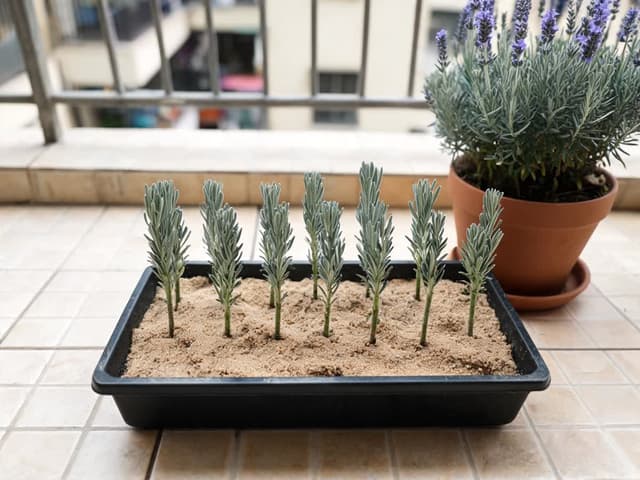
How to Propagate Lavender: Where to Cut and Why Cuttings Rot
A lavender cutting comes from a non-flowering branch tip, about 4 inches long, planted in sandy soil that never stays soggy. Learn where to cut, rooting times, seasonality in Brazil, and what to do if the base turns black.