Calathea with Yellow Leaves: How to Find the Cause and What to Do
One or two outer leaves turning yellow on a calathea is just age. Several turning at once has a cause: watering, tap water, cold below 13 °C, or too much light. Here is how to tell them apart and what to do today.
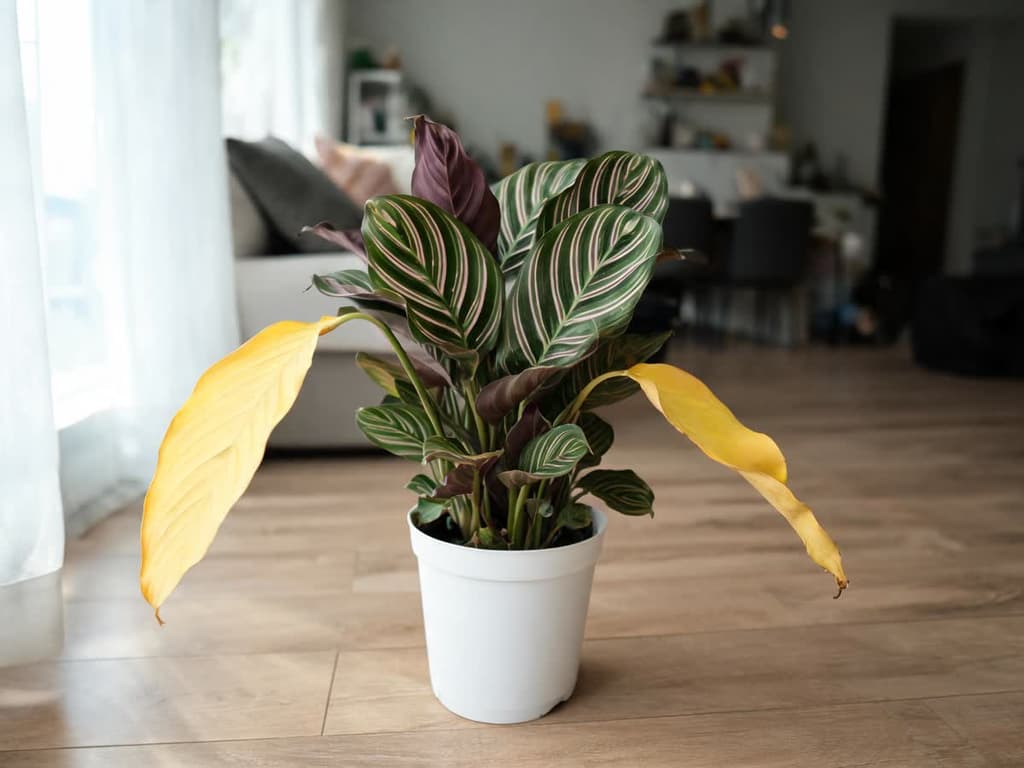
A calathea with yellow leaves is not always sick. If one or two leaves on the outer edge of the clump turn yellow while new leaves keep emerging from the center, that is simply age. The plant is shedding its oldest leaves for new ones. If several leaves turn yellow in the same week, something in its care routine has changed.
In that second case, the cause is usually watering, tap water, cold, or excess light. Cutting off a yellow leaf will not kill the plant: cut the stem flush with the base once the leaf is more yellow than green.
Quick summary:
One outer leaf at a time, with new leaves emerging from the center: natural aging. You do not need to do anything.
Several yellow, drooping leaves, soil wet for days: overwatering. Wait for the soil to dry out and check the roots.
Brown, dry edges and tips, bordered by a yellow band: tap water or fertilizer salts built up in the soil.
Yellowing after cold nights: calatheas suffer below 13 °C. Move the pot away from the windowpane at night.
Faded, washed-out leaves near a sunny window: too much light. Move the plant back until the sun no longer hits the leaves.
The common name calathea comes from the genus Calathea. Most potted species were moved to the genus Goeppertia in 2012 following a genetic study (Borchsenius and colleagues, Systematic Botany). Several of them are native to Brazil: the zebra plant, peacock plant, and orbifolia are native to the forests of eastern and southern Brazil (NC State Extension). The prayer plant (Maranta leuconeura) belongs to another genus in the same family, and this guide does not cover it.
How to figure out why your calathea has yellow leaves
The cause reveals itself through three observations: which leaves turned yellow, the pattern of the yellowing, and the condition of the potting soil. Match what you see against the table below.
What you see | Probable cause | What to do |
|---|---|---|
One outer leaf turns yellow at a time, new leaf emerging from the center | Leaf age | Nothing; cut it off when it dries up |
Several yellow, soft leaves, soil wet for days | Overwatering | Wait for the soil to dry out; inspect the roots |
Yellow, curling leaves, dry soil | Underwatering | Water until it drains from the hole |
Brown edges and tips with an adjoining yellow band | Fluoride in tap water or fertilizer salts | Switch water source; flush the soil |
Yellowing after cold nights or leaf touching the windowpane | Cold below 13 °C | Move away from the glass at night |
Faded, yellowed leaf, direct sun hitting the plant | Too much light | Move away from the sunny window |
Pale light green leaves across the whole plant, unfertilized for months | Nutrient deficiency | Fertilize during the growing season |
Yellow spots with a brown or dark center | Wet-foliage disease | Stop getting the leaves wet |
Pale stippling, dull leaf, fine webbing underneath | Two-spotted spider mites | Wash the undersides of the leaves |
Yellow zigzag pattern, irregular for the variety | Virus | Isolate the plant |
The table covers the most common causes for calatheas. Other yellowing patterns, such as yellowing between the veins of a new leaf, have different causes. The general guide to yellow leaves narrows down those causes using 3 questions.
Old leaves turning yellow: when it is normal
On a calathea, the oldest leaf is the one on the outer edge of the clump, not the lowest leaf. A calathea grows in clumps (NC State Extension): new leaves emerge from the center of the clump, while older leaves stay along the perimeter. University of Maryland Extension (UMD) describes this growth pattern in the prayer plant, a member of the same family that grows the same way. These outer leaves turn yellow and die off from time to time, and that is completely normal.
UMD explains that losing a few old leaves throughout the year is expected on a plant that continues to push out new growth. A sudden drop of multiple leaves at once indicates the plant is under stress. A plant that just moved to a new home can also drop older leaves while it adjusts to the new spot (UMD).
The telltale sign separating age from a problem is new growth. A new leaf emerging from the center, firm and with crisp markings, indicates a healthy plant. Leaves in the middle of the clump yellowing alongside the outer ones show that the cause stems from the environment.
Watering: soggy or overly dry soil
A calathea needs moist soil, without staying waterlogged. According to NC State Extension, the soil must stay moist, and overwatering leads to root rot. UF/IFAS, from the University of Florida, recommends letting the soil surface dry slightly before watering again.
Stick your finger into the soil before every watering. For the prayer plant, a member of the same family, UMD recommends watering when the top 2.5 cm (1 inch) of soil starts to feel dry to the touch. Water until liquid runs out of the drainage hole, and discard any water that collects in the saucer. Standing water in the saucer seeps back through the hole and keeps the roots waterlogged (UMD).
Each extreme produces different symptoms:
Overwatering: multiple soft, yellow leaves, soil that stays wet days after watering, sometimes tiny gnats flying out of the soil.
Underwatering: curled, yellowing leaves, dry soil pulling away from the sides of the pot. NC State notes that leaves curl from a lack of water or dry air.
Watering more one week and less the next also turns a calathea yellow. The finger test, rather than a set day of the week, keeps the soil right. In fall and winter (in Brazil, from March to August), the plant grows less and the soil takes longer to dry. The Missouri Botanical Garden recommends reducing watering during this period.
A calathea suffers in dry soil, unlike other plants prone to yellow leaves. A snake plant with yellow leaves usually yellows from too much water. A calathea yellows from both extremes: sitting in waterlogged soil or staying completely dry for many days.
How to tell if calathea roots have rotted
Take the plant out of its pot if the leaves keep yellowing while the soil is moist. Healthy roots are firm and light in color. Rotted roots are mushy, brown or black, and fall apart when you tug on them.
Trim away the rotted roots with clean shears and repot into a container with drainage holes using fresh potting mix. After that, water again only when the top 2.5 cm (1 inch) of soil begins to dry out. Leaves that have already turned yellow will not recover; signs of improvement will show in the new leaves coming from the center.
Tap water: brown edges with a yellow halo
Tap water will not turn the entire calathea leaf yellow. Tap water damage concentrates on the edges and the tip. There, you will find a strip of dead, brown, dry tissue, bordered by a yellow band separating the dead zone from the green area. UF/IFAS lists dead patches near the leaf margin as a symptom of fluoride toxicity in calatheas.
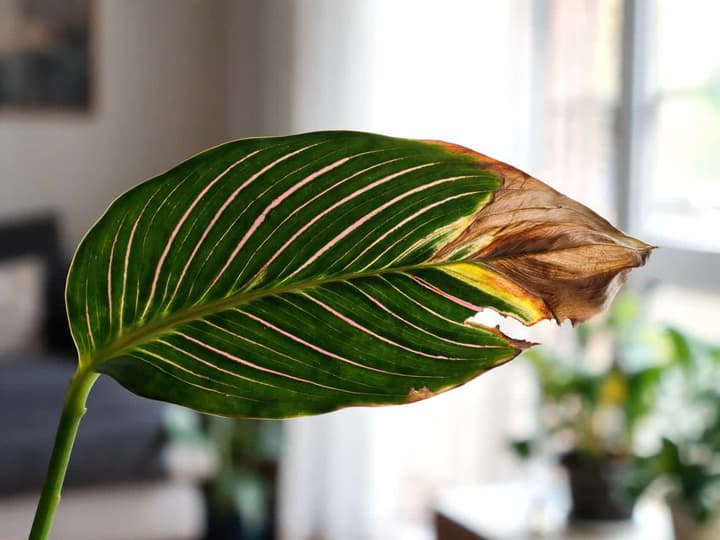
Fluoride is the primary suspect. Iowa State Extension ranks calatheas among plants sensitive to fluoride in water, alongside dracaenas and spider plants. NC State provides the same advice for four calathea species. Fluoride in tap water scorches leaf tips and margins. The damage accumulates gradually because fluoride builds up at the leaf edges (OSU, PNW Plant Disease Management Handbook).
In Brazil, tap water has been fluoridated by law since 1974 (Law 6,050) to prevent tooth decay. In the state of São Paulo, the ideal concentration is 0.7 mg/L (Resolution SS 250/1995). Anyone watering with tap water from a city with a treatment plant is using fluoridated water.
Standard pitcher filters may not solve the problem. UMD warns that this type of filter might not remove fluoride. Calcium and magnesium in hard water also slip past the filter and build up in the soil. Water options that eliminate fluoride include:
rainwater, gathered in a clean bucket;
distilled water;
reverse osmosis water (OSU/PNW).
Overfertilizing creates the exact same pattern, because fertilizer salts also burn leaf margins. UF/IFAS links dead margins and tips on calatheas to excess fertilizer and overly acidic potting mix. The same source recommends keeping the soil pH around 6.5. To flush out accumulated salts, bring the pot to the sink and pour plenty of rainwater or distilled water through the soil until it streams out of the drainage hole. UF/IFAS advises repeating this flushing several times in succession. For the prayer plant, UMD suggests repotting with fresh soil once a year, preferably in spring.
The brown tissue will not turn green again. You can trim off just the dried edge with scissors, following the natural contour of the leaf. Iowa State points out that the browning will return on new leaves if the underlying issue continues.
Cold below 13 °C
Calatheas suffer chilling injury below roughly 13 °C (55 °F), according to UF/IFAS. Indoors, the same source recommends keeping the plant between 18 and 27 °C (65 to 80 °F). NC State advises bringing calatheas inside before temperatures dip below about 15 °C (60 °F).
Cold reaches a calathea through three primary avenues:
a leaf touching the windowpane at night, in winter (in Brazil, from June to August);
an exterior door opening to the street or balcony;
an air conditioning vent blowing straight onto the plant.
UMD notes the first scenario on a prayer plant: a leaf touching a freezing window can yellow directly at the point of contact. NC State advises avoiding abrupt temperature swings and chilly drafts.
A croton with yellow leaves begins dropping leaves below 10 °C (50 °F); calatheas suffer as soon as temperatures drop below 13 °C (55 °F). On cold nights, move the pot about 30 cm (12 inches) away from the windowpane.
Too much light also yellows calatheas
Calatheas turn yellow from too much light, not just from too little light. UF/IFAS ranks high light levels among the top three causes of yellow foliage in calatheas. The other two are nutrient deficiency and overwatering. In greenhouse settings, light levels higher than recommended caused dead leaf tips and faded patches on the foliage (UF/IFAS).
Indoors, UF/IFAS identifies 150 to 200 foot-candles as the ideal light level for calatheas. A foot-candle is a unit measuring the amount of light reaching a surface. This level corresponds to the bright indirect light near a window, without direct sunlight striking the foliage. NC State confirms that direct sun scorches calathea leaves.
Under low light, leaf markings lose contrast and colors fade (NC State Extension). UF/IFAS notes the same effect: pale foliage and washed-out patterns. If your plant is sitting in a dim corner, move it closer to the window step by step.
Fertilizer: too little causes yellowing, too much burns the edges
A lack of fertilizer turns the entire calathea pale green with washed-out leaves. UF/IFAS advises increasing fertilizer, especially nitrogen and occasionally iron. This condition occurs in plants that have spent months in the same container without any feeding.
NC State recommends fertilizing once a month with a balanced liquid fertilizer, only during the growing season. In Brazil, this period runs from spring to the end of summer, from September to March. In winter, stop fertilizing.
Extra fertilizer will not make the leaves greener. Excess salts lingering in the potting mix scorch leaf margins, as explained in the tap water section. Use the dose stated on the product label or dilute it to half strength, never exceeding the recommended amount.
Yellow spots with brown centers: wet-foliage disease
A yellow spot with a brown or dark center on the leaf blade indicates disease rather than a watering routine mistake. UF/IFAS describes a calathea leaf spot that starts out as a water-soaked fleck. The lesion turns yellow and eventually dies in the center, encircled by a yellow halo. These spots can merge and cover large portions of the leaf.
These pathogens require lingering moisture on the leaf surface. NC State explains that splashing water on the leaves during watering promotes calathea leaf spot. UF/IFAS notes that simply keeping foliage dry proved sufficient to control one of these leaf spots. Water directly into the potting mix beneath the foliage, and prune away heavily spotted leaves.
Misting the leaves to raise air humidity creates the same problem. UMD recommended halting misting on a prayer plant, a member of the same family, because water on foliage makes it easier for fungal and bacterial pathogens to invade. Some plant shops still recommend misting, but university extension offices advise against it, and this guide follows the extensions.
Humidity recommendations vary depending on the reference source. UF/IFAS states that calatheas stay healthy indoors at humidity levels between 40% and 60%. NC State and the Missouri Botanical Garden advise maintaining high humidity, around 60% or higher. Keeping humidity near 60% meets both criteria simultaneously. Dry indoor air browns leaf margins and curls foliage (NC State), and UMD notes it is hard to tell how much dry air contributes to leaf yellowing. If your home air is very dry, run a room humidifier or place a pebble tray filled with water beneath the pot instead of misting.
Yellow stippling and dull leaves: two-spotted spider mites
Two-spotted spider mites cause calathea foliage to turn yellow or become speckled with fine pale dots. UF/IFAS reports that these mites are so small they frequently go unnoticed until substantial damage occurs. Heavy infestations produce fine webbing, cause defoliation, and can kill the plant.
Webbing and cast mite skins can easily be mistaken for ordinary dust on the undersides of the leaves (UF/IFAS). Wipe a white tissue across the underside of a yellowed leaf: tiny specks moving across the paper are spider mites. Find step-by-step treatment in our guide on how to identify and control spider mites.
Yellow zigzag pattern: viral infection
A vivid yellow zigzag pattern alternating with normal leaf tissue can indicate cucumber mosaic virus. UF/IFAS documents this symptom on calatheas and prayer plants. There is no cure for the virus, though the same source notes the damage appears purely cosmetic.
Do not take cuttings or divide an infected plant, as division transmits the virus to the new plant (UF/IFAS). Certain cultivars naturally display creamy or yellow stripes and variegation with uniform, consistent patterning across all foliage. Those markings are part of the natural leaf pattern, not a disease.
Should I cut off yellow leaves on my calathea?
You can prune them off, and doing so will not harm the plant. Wait until the leaf is more yellow than green, because as long as green tissue remains, it continues generating energy for the plant. Cut the leaf stem flush with the base, close to the soil line, using clean pruning shears.
Cut immediately, without waiting, if a leaf is heavily infested with spider mites or if a disease spot covers most of the leaf surface. For the prayer plant, UMD recommends pruning away diseased foliage when damage spreads across most of the leaf blade. If only the edge has dried out, trim off just the brown zone and leave the rest of the leaf intact.
Can a calathea with yellow leaves be saved?
In most situations, yes. As long as fresh new leaves keep emerging from the center of the clump, the plant remains alive and can bounce back. Do not discard the plant just because of a few yellowing leaves.
The most critical scenario is root rot. If the base of the stems turns soft and the roots are brown and mushy, root rot has set in. Prune away all rotted root tissue and repot into fresh potting mix, following the steps in the watering section. If no firm roots remain, saving the plant is difficult.
Frequently asked questions
Do yellow calathea leaves turn green again?
No. A leaf that has turned completely yellow has lost its chlorophyll and cannot regain its color. It will dry up and can be snipped off at the stem, close to the base. The plant will show recovery through new leaves emerging from the center of the clump a few weeks after you correct the underlying cause.
Does filtered water prevent yellow leaves on calatheas?
It depends on the filter. UMD warns that a standard pitcher filter may not remove fluoride from water. Rainwater, distilled water, and reverse osmosis water do. Changing the water only helps if the issue is brown tips and edges; a leaf that turns completely yellow has a different cause.
How often should you water a calathea?
There is no set schedule of days that works for every calathea. Water when the top 2.5 cm (1 inch) of soil starts to feel dry to the touch, pouring until water runs freely from the drainage hole. UMD provides this recommendation for prayer plants, which belong to the same family. During summer, this may happen every few days; during winter, the soil dries out more slowly and waterings become spaced further apart.
Are calatheas toxic to cats and dogs?
According to the ASPCA (American Society for the Prevention of Cruelty to Animals), calatheas are non-toxic to dogs, cats, and horses. Nevertheless, if a pet ingests a large quantity of leaves and exhibits vomiting or other symptoms, contact your veterinarian.
What to do today for a calathea with yellow leaves
Identify which leaves are yellowing. A single outer leaf at a time, paired with new growth pushing out from the center, is natural aging.
Check the soil with your finger. If it has stayed wet for days, let it dry and inspect the root system; if bone dry, water thoroughly until liquid exits the drainage hole.
Examine the leaf margin. Brown edges bordered by a yellow halo call for a switch to rainwater or distilled water.
Consider the temperature over recent nights. If it dipped below 13 °C, move the pot back from cold window glass.
Check whether direct sun hits the foliage. If so, pull the calathea back until sunlight no longer strikes the leaves directly.
If your plant is not a calathea, the causes will differ. The guide on how to diagnose houseplant problems offers a complete troubleshooting process, from leaf to root, for any indoor houseplant. The diagnostic guide for calathea yellow leaves lists other pests and diseases that trigger this symptom. If you are unsure of your plant's species, take a photo of the leaf using Bloom, which identifies plants by photo. On the Premium plan, the app also diagnoses specific plant health symptoms.
Bloom is currently available only for iPhone.
Sources
UF/IFAS Extension, Cultural Guidelines for Commercial Production of Interiorscape Calathea (ENH1030; Chen and McConnell, 2006, archival copy): yellow leaf from lack of fertilizer, excess water, or high light; dead spots on the margin from fluoride; dead margin and tip from acidic substrate and excess fertilizer; cold damage below 55 °F (about 13 °C); 18 to 27 °C, 150 to 200 foot-candles, and 40% to 60% humidity indoors; soil surface drying slightly before watering.
UF/IFAS, Central Florida Research and Education Center, Calathea Production Guide (research note RH-91-9; Poole, Chase, and Osborne): high light and dead, bleached tips; low light and faded patterns; fluoride sensitivity and pH near 6.5; leaf spot with a yellow halo; dry leaves in spot control; cucumber mosaic virus; twospotted spider mites.
NC State Extension, Gardener Plant Toolbox: Goeppertia zebrina, Goeppertia makoyana, Goeppertia roseopicta, and Goeppertia orbifolia: Brazilian origin, clumping growth habit, fluoride and brown edges, moist soil without waterlogging, wet foliage and leaf spot, direct sun, low light and faded color, humidity of 60% or higher, monthly fertilizer during the growing season, bring indoors before 60 °F (about 15 °C).
University of Maryland Extension (Home and Garden Information Center), response on Ask Extension regarding a prayer plant, with a mention of calathea in the 2nd response (October and November 2023): older leaves at the edges of the clump, fluoride and hard water, pitcher filter, stop misting, watering when the top 1 inch is dry, empty saucer, leaf touching cold glass, annual soil change.
Iowa State University Extension, Why does my houseplant have brown leaf tips and edges?: calathea among plants sensitive to fluoride.
Oregon State University, PNW Plant Disease Management Handbook: Fluorine Toxicity in Plants (March 2024 review): fluoride accumulation along the leaf margin, reverse osmosis, and distillation.
Missouri Botanical Garden, Calathea makoyana: native to eastern Brazil, high humidity, reduced watering from fall to late winter.
Borchsenius, Suárez, and Prince, Molecular phylogeny and redefined generic limits of Calathea (Marantaceae), Systematic Botany 37 (2012): transfer of most species to Goeppertia.
Law 6,050 of May 24, 1974: fluoridation of public water supplies; Resolution SS 250/1995 of the state of São Paulo, cited by DAE Jundiaí: 0.7 mg/L.
ASPCA, Calathea: nontoxic to dogs, cats, and horses.
Related articles
How to Care for a Goldfish Plant: Light, Watering, and Blooms
How to care for a goldfish plant: bright light without strong sun, water when the soil surface dries, and humid air. Learn how to tell a Nematanthus from a Columnea, why it drops leaves, and how to get it to bloom again.
Lavender Leaves Turning Yellow: Where the Yellowing Starts Shows the Cause
Lower leaves turning yellow with moist soil means overwatered roots, the most common cause. Old leaves drying one by one on woody stems is normal. Take the stem and root test, see if your plant can still be saved, and find out what to do today.
How to Propagate Lavender: Where to Cut and Why Cuttings Rot
A lavender cutting comes from a non-flowering branch tip, about 4 inches long, planted in sandy soil that never stays soggy. Learn where to cut, rooting times, seasonality in Brazil, and what to do if the base turns black.