Soil for Hydrangeas: The Mix That Decides Flower Color
Hydrangea potting mix is rich in organic matter, holds moisture without getting waterlogged, and has a pH that decides flower color: acidic yields blue, near neutral yields pink. See which bag to buy, why azalea soil alone won't turn blooms blue, and how to prep pots and garden beds.
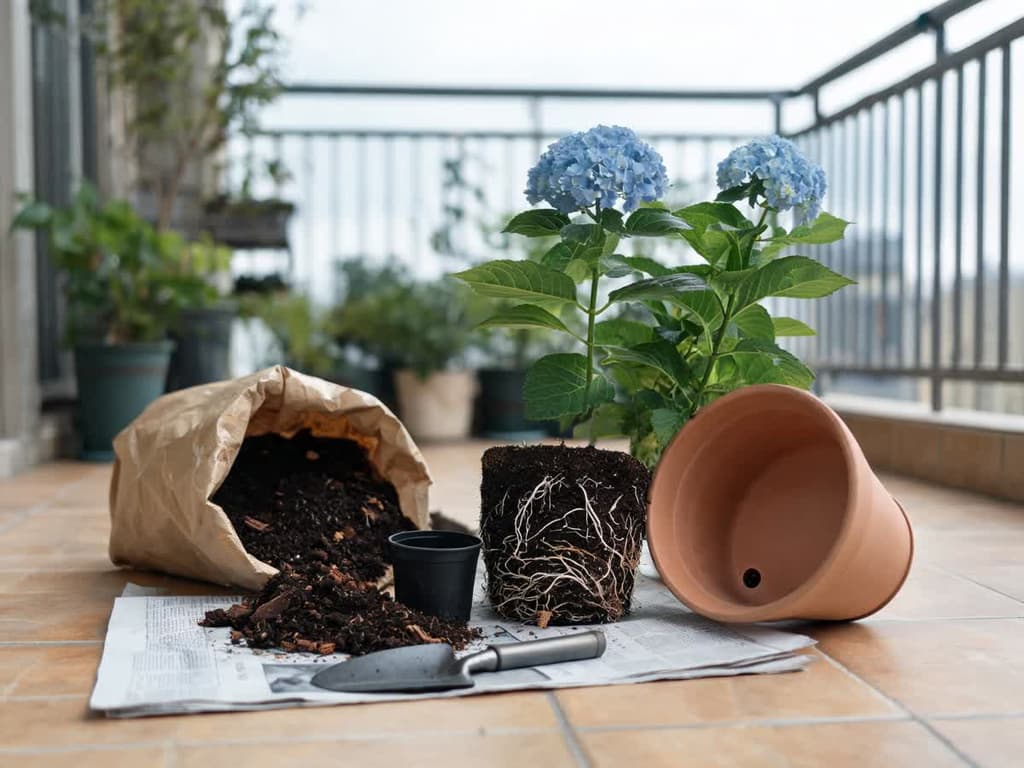
Hydrangea potting mix is rich in organic matter, holds moisture, and lets excess water drain away. Potting mix is the ready-to-use bagged soil sold for containers. For bigleaf hydrangeas (Hydrangea macrophylla), pH, which measures the acidity of the potting mix and garden soil, also decides bloom color. The lower the number, the more acidic the soil: between 5.0 and 5.5 the flower turns out blue, and from 6.0 and up it turns out pink.
pH alone does not create blue. The flower only turns blue if the root finds aluminum, and bagged potting mix typically does not have aluminum. That is why your choice starts with the color you want: pink or white hydrangeas do well in all-purpose potting mix, while blue hydrangeas call for acidic soil with aluminum.
Quick summary:
Pink or white hydrangeas: all-purpose potting mix with a pH between 6.0 and 6.5 on the label.
Blue hydrangeas: azalea mix (acidic soil) with a pH of 5.5 or lower, plus aluminum sulfate diluted in container waterings.
Garden beds: Brazilian soil tends to be acidic and contains aluminum, so garden hydrangeas naturally lean toward blue without amendments.
To keep them pink: lime in the garden bed, fertilizer with higher phosphorus, and a pH that stays below 6.5. Above that level, new leaves turn yellow.
Drainage: a pot with drainage holes and a 30 to 40 cm diameter; in garden beds, loosened soil mixed with organic compost (decomposed plant scraps and manure).
Which potting mix to buy: all-purpose, azalea, or "hydrangea mix"?
Choose your bag based on the flower color you want to keep. Pink hydrangeas and white hydrangeas grow well in all-purpose potting mix. Blue hydrangeas need azalea potting mix, also sold as mix for acid-loving plants (plants that prefer acidic soil). On a bag sold as blue hydrangea potting mix, check whether the ingredient list includes aluminum. The product name does not produce the blue; the aluminum does.
Your hydrangea | Potting mix | pH on label | What to add |
|---|---|---|---|
Pink | All-purpose | 6.0 to 6.5 | Nothing; fertilizer with higher phosphorus helps maintain pink |
White | All-purpose | 6.0 to 6.5 | Nothing; color does not change with pH |
Blue | Azalea or acid-loving mix | 5.5 or lower | Aluminum source in spring waterings |
Color unknown | All-purpose | 6.0 to 6.5 | Wait for the first bloom to decide |
The pH comes printed on the bag. In Brazil, the Ministry of Agriculture rule allows a difference of up to 1 point between the label and the product. For blue blooms, measure the potting mix pH after repotting with a garden center pH kit. The guide on camellia potting mix explains how to read this label and how to use the kit.
Do not use azalea potting mix on a pink hydrangea. The lower pH pushes the flower toward purple and provides no benefit to the plant.
Why azalea potting mix alone does not turn hydrangeas blue
Bagged potting mix typically does not have aluminum, and without aluminum the flower does not turn blue. Washington State University Extension describes the mechanism in a 2018 publication. Low pH releases aluminum from the soil, the root absorbs the metal, and it binds with the flower's pigment. Without aluminum, the pigment's default color is red.
The same publication notes that soilless potting mix "typically does not contain aluminum." That is why container-grown blue hydrangeas are hard to maintain. Azalea potting mix lowers the pH and leaves the root ready to absorb aluminum, but it does not supply the metal. A blue hydrangea repotted into it may bloom purple or pink the following season.
Commercial growers solve this with aluminum sulfate, a salt sold at garden centers to turn hydrangeas blue. According to Penn State Extension, growers producing blue hydrangeas add aluminum sulfate to the container mix. Garden beds are different. On the same page, Penn State notes that the salt is unnecessary in soil that already has aluminum and can injure roots.
Extension services are divided regarding garden beds. The University of Georgia and Clemson use aluminum sulfate in the garden as well; WSU and Penn State advise against it. This guide follows WSU and Penn State for garden beds and uses the salt only in containers. Bagged potting mix is where aluminum is missing.
How to turn container hydrangeas blue with aluminum sulfate
The University of Georgia Extension gives the dilution: 1 tablespoon (15 ml) of aluminum sulfate for every 3.8 liters of water. Use this solution instead of plain water in a normal watering of the pot. UGA applies it once a month, for three consecutive spring months, which in Brazil are September, October, and November.
Wet only the soil. UGA warns that the solution burns foliage it splashes onto.
Use aluminum sulfate only in pots. WSU notes that excess aluminum harms other plants, animals, and soil organisms living in garden ground. Its recommendation is to keep blue hydrangeas in large containers when garden bed soil lacks aluminum, rather than pouring the metal onto the garden. Store the bag away from children and pets.
What pH is needed for blue, purple, or pink hydrangeas
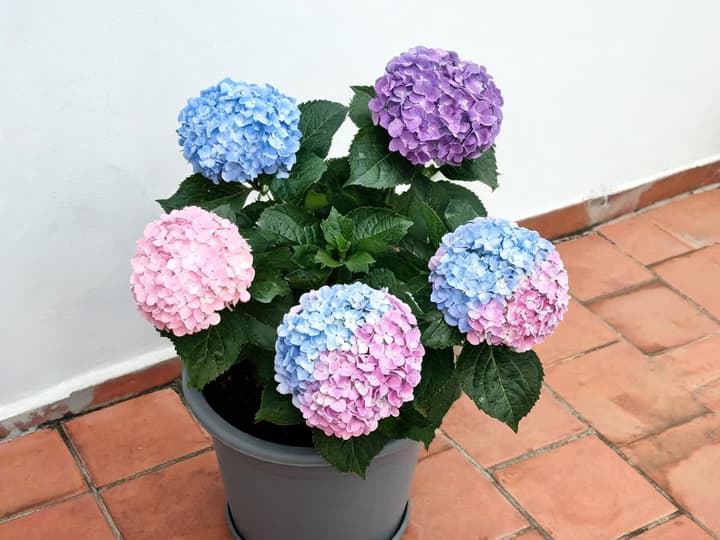
For blue blooms, keep the pH between 5.0 and 5.5. For pink blooms, keep it between 6.0 and 6.5. Between 5.5 and 6.0, the same plant often produces purple blooms or flower heads with blue, pink, and purple together. University extensions agree on the overall pattern and differ slightly on the exact numbers:
Source | Blue flowers | Pink flowers |
|---|---|---|
Washington State University (2018) | pH 3.5–5.5 | pH 5.5–7.5 |
NC State Extension | pH 5.0–5.5 | pH 6.0 or higher |
Clemson Extension | pH 5.0–5.5 | pH 6.0 or higher |
Penn State Extension | pH 5.2–5.5 | pH 6.0–6.2 |
University of Georgia Extension | pH 5.5 or lower | pH 7.0 or higher |
The 5.0 to 5.5 range for blue fits four of the five sources, and Penn State narrows it to 5.2 to 5.5. For pink, this guide uses 6.0 to 6.5, below UGA's 7.0 and WSU's 7.5. Above pH 6.5, iron in the soil takes a form that the roots cannot absorb, according to the University of Illinois Extension. New leaves turn yellow between the veins, which remain green.
Among the hydrangeas sold in Brazil, Hydrangea macrophylla and mountain hydrangea (Hydrangea serrata) change color, according to the RHS. NC State Extension notes that white- or cream-flowered hydrangeas, like panicle hydrangeas, do not change with pH. WSU explains the reason: white flowers lack the pigment that reacts to aluminum. For pink and white hydrangeas, WSU recommends slightly acidic to slightly alkaline soil (pH just above 7).
The panicle hydrangea, with cone-shaped flowers, is the one most often confused with bigleaf hydrangeas:
Pink or white hydrangeas: all-purpose potting mix works
If your hydrangea is pink and you want to repot it, all-purpose potting mix with a pH between 6.0 and 6.5 is the right choice. Acidic potting mix, like azalea mix, pulls the bloom toward purple.
One of the main characteristics of Brazilian soils is high acidity, according to a technical circular from Embrapa Dairy Cattle. This acidity comes mainly from aluminum, iron, and manganese dissolved in the ground. NC State notes the same effect in North Carolina: with the acidic soil there, most hydrangeas turn out blue. In Brazil, a hydrangea bought pink and planted in a garden bed can turn blue in subsequent blooms.
To keep the pink in a garden bed, raise the pH with lime. The RHS, the UK horticultural society, applies 75 to 100 g of ground limestone per square meter in winter. In Brazil, that is between June and August. The University of Georgia uses a larger dose of 1 cup of dolomitic limestone per 10 square feet (0.9 m²) to turn a hydrangea back to pink in acidic soil. Start with the smaller dose, from the RHS, because going over pH 6.5 yellows new leaves. Test the pH again before repeating.
The change is slow. Penn State warns that color can take more than a year to shift after treatment. NC State adds that soil tends to revert to its original pH and calls for an annual soil test after amending. Clemson tests every 2 to 3 years when no adjustments have been made. Once you amend the soil, follow NC State and test once a year.
What shifts hydrangea color without you realizing it
Nearby concrete, tap water, and fertilizers alter pH or aluminum availability, even when you start with the right potting mix.
House foundations and concrete walkways. Lime from concrete leaches from building foundations and walkways into the surrounding ground. Penn State notes that blue becomes difficult or impossible in these spots. A hydrangea up against a house wall can stay pink while another out in the middle of the garden bed turns blue.
Tap water. The RHS recommends watering blue hydrangeas with rainwater to protect their color. Tap water can be hard, carrying dissolved lime, which is the very material used to make blooms pink. When rainwater is unavailable, use tap water anyway: letting the plant dry out is worse for it.
Fertilizer phosphorus. Phosphorus ties up aluminum in the soil and prevents roots from taking it up. Penn State recommends avoiding high-phosphorus fertilizers on blue hydrangeas and using fertilizers higher in phosphorus specifically for pink ones. Phosphorus is the middle number in the formula printed on the fertilizer bag (the 10 in "10-10-10").
Potting mix for container hydrangeas and garden bed soil
Hydrangeas want soil that holds moisture while letting excess water drain away. Clemson describes the ideal ground as well-drained and rich in organic matter. In a container, that depends on your potting mix and drainage hole. In a garden bed, it depends on loosening the soil and mixing in compost.
Hydrangeas in containers
Use a container 30 to 40 cm in diameter with a drainage hole at the bottom. The RHS suggests setting the container on pot feet or bricks so water drains through the hole without collecting underneath.
For containers, the RHS mixes two parts soil-based potting compost (John Innes No. 3 type, common in the UK) with one part all-purpose potting mix. Soil adds weight to the pot and retains water longer. For blue hydrangeas, the RHS switches the blend to ericaceous potting mix.
The practice of adding a layer of gravel or expanded clay pebbles to the bottom of the pot has mixed evidence, and the guide to camellia potting mix presents both sides. When in doubt, skip the drainage layer and ensure you have an open drainage hole: without a hole, standing water collects and rots roots.
Hydrangeas in garden beds
Bigleaf hydrangeas tolerate clay soil and sandy soil, according to NC State, provided water does not pool. Before planting, the University of Georgia mixes organic compost into the top 20 to 30 cm of soil. Its rate is about 23 kg of compost for every 0.9 m² of planting bed.
The root ball is the block of roots and soil that slips out of the container in one piece. Dig a planting hole at least twice as wide as the root ball, as UGA instructs; the RHS goes up to three times as wide. Plant with the top surface of the root ball level with the surrounding ground, without burying it deeper.
After planting, mulch the ground with 5 to 8 cm of organic material, such as dry leaves or bark. Clemson uses this mulch layer to conserve moisture and keep roots cool.
Yellow leaves from the bottom up after changing potting mix
Do not repot the plant again. Foliage yellowing from the bottom up while the potting mix stays constantly wet points to standing water in the container, and a second repotting stresses roots all over again. First check where your drainage water is going.
Lift the pot and look for three signs of overwatering: a pot without a drainage hole, water standing in the saucer, and surface potting mix still wet two days after watering. If you find any of these, empty the saucer and let the surface dry out before watering again. If the container lacks a hole, move the plant into one that has one.
The pattern of the yellowing distinguishes the causes. Soft, fully yellow leaves starting at the bottom with constantly wet soil mean overwatering. New leaves turning yellow between green veins mean a pH above 6.5. The page on hydrangeas with yellow leaves lists the other causes.
Prolonged waterlogging rots roots. Rotted roots turn brown and mushy, and the plant wilts even while standing in wet soil:
When symptoms do not match any of these descriptions, a photo helps pinpoint the cause. Bloom (available for iOS) diagnoses plant issues from photos on its Premium plan.
Frequently asked questions
Do coffee grounds turn hydrangeas blue?
There is no evidence for this: none of the university extensions cited here use coffee grounds to alter hydrangea color. To lower pH, Penn State, Clemson, and UGA use elemental sulfur, and WSU cites ammonium sulfate. For blue blooms, the hydrangea still requires aluminum in the soil. Coffee grounds work as organic matter mixed into compost.
Does pine bark make potting mix acidic?
Not enough to guarantee blue blooms. A 2019 analysis by UNOESC evaluated three commercial substrates, including one based on pine bark. All three had a pH between 5.5 and 7.0. Pine bark improves drainage and aeration in potting blends. To find the pH of your specific bag, test it with a pH kit, because the label can be off by up to 1 point.
Can you use peat-free potting mix for hydrangeas?
Yes, provided the labeled pH matches the range for the color you want. The RHS recommends peat-free blends (mixes without decayed moss and plant material, which form the base of many potting soils) for container hydrangeas. For blue blooms, peat-free mix also typically lacks aluminum, so you supply the aluminum through sulfate in your waterings.
Is aluminum sulfate dangerous for dogs and cats?
Aluminum buildup in soil poses risks to household members and pets, according to WSU. Keep bags of aluminum sulfate sealed and stored away from animals. The hydrangea itself is also toxic. The ASPCA reports vomiting, lethargy, and diarrhea in dogs and cats that chew on the plant:
Hydrangea potting mix: what to do now
Decide on the color before buying the bag. For pink or white, buy all-purpose potting mix with a pH between 6.0 and 6.5. For blue, buy azalea mix with a pH of 5.5 or lower and water the container with the aluminum sulfate solution in spring, which in Brazil runs from September to November.
In garden beds, test the soil pH before amending anything. If foliage turns yellow after repotting, inspect the pot's drainage hole and saucer before disturbing the soil mix again.
Sources
Washington State University Extension, Linda Chalker-Scott, How Are Hydrangea Flower Colors Determined? (FS309E, 2018): pH ranges, role of aluminum, aluminum-free potting mix, white color, risk of aluminum in the garden.
NC State Extension, How to Change Hydrangea Color (Wayne County, 2025) and Gardener Plant Toolbox, Hydrangea macrophylla: pH ranges, white blooms that do not change, clay and sandy soil.
Clemson Cooperative Extension, HGIC 1067, Hydrangea Care in South Carolina (revised 10/2025): pH 5.0 to 5.5 and 6.0 or higher, soil rich in organic matter, 5 to 8 cm of mulch, pH testing every 2 to 3 years.
Penn State Extension, Mary Jo R. Gibson, Why Doesn't My Hydrangea Bloom?: pH 5.2 to 5.5 and 6.0 to 6.2, sulfur, aluminum sulfate in commercial potting mix, phosphorus, foundation and sidewalk lime.
University of Georgia, CAES Field Report, Hydrangea blooms turn colors based on soil pH levels: application rate for aluminum sulfate, lime, sulfur, and compost.
Royal Horticultural Society (RHS), How to grow shrubby hydrangeas: 75 to 100 g of lime per m², rainwater for blue, potting mix, planting hole three times the root ball.
University of Illinois Extension, Chlorosis: iron unavailable above pH 6.5.
Embrapa Dairy Cattle, Carlos Eugênio Martins, Technical Communication 47, Agricultural practices related to soil liming: high acidity of Brazilian soils.
Maldaner, Christ, and Klein, Caracterização da qualidade de diferentes substratos agrícolas para a implantação de espécies ornamentais, Anuário Pesquisa e Extensão UNOESC, 2019.
ASPCA Animal Poison Control, Hydrangea: signs of toxicity in dogs and cats.
Related articles
How to Care for Hibiscus: Sun, Watering, Fertilizer, and Pruning for Flowers
How to care for hibiscus: 6 hours of direct sun, evenly moist soil without waterlogging, half-strength fertilizer in spring and summer, and pruning in early spring. Find out why the flower lasts one day and why buds drop before opening.

Do Ferns Like Sun or Shade? It Depends on the Type
Ferns prefer bright shade: plenty of light, but no direct sun on their fronds. Tuberous sword fern is the exception that handles sun. Here is the ideal light for each type, where to place pots, and how fronds show too much or too little light.

African Violet Yellow Leaves: Causes and What to Do
Yellow leaves on an African violet usually stem from overwatering, and the first place to check is the center of the plant. Losing one lower leaf at a time is normal. Identify whether age, watering, cold water, sunlight, cold drafts, or fertilizer is the culprit based on the yellowing pattern, and see what to do today.