Can Hydrangeas Handle the Cold? Winter Care to Save Your Blooms
Hydrangeas tolerate cold and frost, but the flower buds already formed on their stems freeze before the plant does. Learn what not to prune, how to protect garden beds and pots, and how to water in winter.
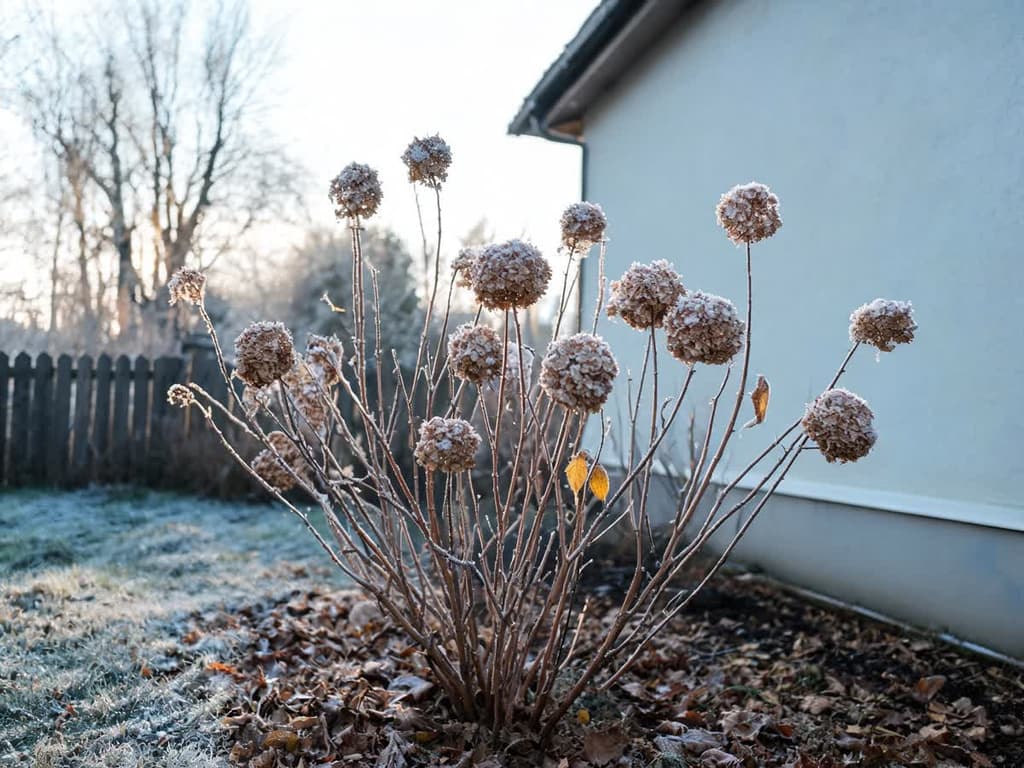
Hydrangeas tolerate cold and frost: the plant survives winters far harsher than those in Brazil. What freezes before the plant does are the flower buds, which are already formed at the tips of the stems during winter. Without these buds, the plant spends the entire summer with leaves alone.
Because of this, winter care for hydrangeas aims to protect the bloom. This is the rule for the common hydrangea with blue or pink mophead blooms (Hydrangea macrophylla). It applies to garden beds, containers, and pruning time.
Quick summary:
The plant tolerates temperatures in USDA zone 6 (the American cold scale), from -23 to -18 °C. The flower bud is more sensitive to cold.
Do not prune bigleaf hydrangeas after late summer. The buds for the next bloom are right at the tips of the stems.
Leave dried blooms on the plant throughout winter. They protect the buds directly beneath them.
On frost nights, cover bed-grown plants and shelter potted ones in a cold, ice-free spot, such as an unheated garage or shed.
Black new leaves after a frost do not mean the plant is dead. Wait for new growth before cutting any stems.
Can hydrangeas tolerate frost?
Yes. Common hydrangea tolerates frost and severe cold, but the flower bud cannot tolerate the same cold as the plant. The NC State Extension recommends the species for USDA zones 6 to 11. That is the cold scale of the United States Department of Agriculture. In zone 6, the average winter minimum is between -23 and -18 °C.
The plant's survival does not guarantee flowers. The American university extension network (Ask Extension) explains that flower buds are more sensitive to cold than leaf buds. A single freezing night can kill summer blooms while leaving the entire shrub green.
The most common damage does not even come from the coldest part of winter. The University of Washington's Miller Library points to frost that arrives after the plant has already broken dormancy. At this stage, new leaves and buds that have begun to open freeze with minimal cold.
In Brazil, frost concentrates in the mountain ranges and plateaus of the South and the high-elevation parts of the Southeast. One example is the Mantiqueira Mountains, according to forecasts from the National Institute of Meteorology (Inmet). Across the rest of the country, the hydrangea's winter is mild. There, the question is whether autumn gets cold enough for the plant to form flower buds.
Where next year's hydrangea blooms are located
Next season's flowers are already on the plant during winter. The University of Maryland Extension explains that bigleaf hydrangea forms flower buds in the summer and autumn prior to blooming. In Brazil, this occurs from late summer to autumn, from February to May.
The buds remain dormant (resting, unopened) at the tips of the stems that grew during the previous season, known as old wood. The University of New Hampshire Extension (UNH) summarizes it: if these buds die during winter, blooming declines.
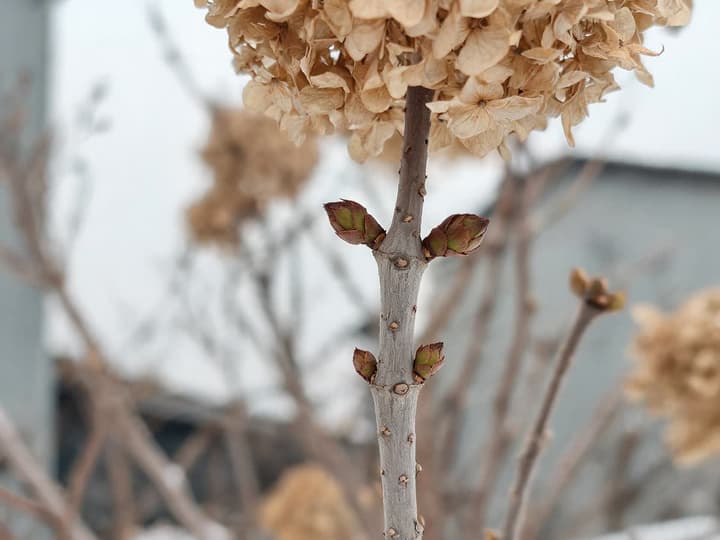
To find the flower buds, look at the tips of the previous year's stems, directly below the dried flower head. That is where you will find the first pair of plump, healthy buds on the stem. This is the pair that the RHS, the British gardening society, instructs you to preserve when removing dried flowers.
The dried flower above this bud serves as protection. The Royal Horticultural Society (RHS) recommends leaving dried flowers on the plant during winter. According to the RHS, they provide some frost protection to the buds right below.
Winter hydrangea pruning: what to cut and what to keep
Do not prune common hydrangeas in the fall or winter. UNH states that Hydrangea macrophylla should never be pruned in late summer or fall. Cutting removes the buds for the next bloom. In Brazil, that means no pruning from March onward.
Some Brazilian guides say the opposite. The plant glossary from ESALQ, the agronomy school of USP, states that hydrangeas "are usually pruned hard in late winter." American extensions (UNH, Maryland, NC State) and the RHS state that this pruning eliminates blooms on macrophyllas. This article follows the extensions, as they explain where the bud sits, while ESALQ does not.
In spring, wait for new growth before cutting any stems. UNH recommends waiting until new leaves appear, because only then can you tell which tips died from the cold. To check a stem, scratch the bark with your fingernail: green inside means living wood, brown means dead wood.
The proper cut after winter is minimal:
Stems with dead tips: cut right above the first pair of healthy buds, as recommended by the RHS.
Stems dead all the way to the base: cut flush with the ground, according to UNH.
Dried flowers: cut only the flower head, right above the first pair of plump, healthy buds, following RHS guidance. Do not cut further down the stem.
Do not cut bigleaf hydrangeas flush to the ground in spring. Doing so removes every bud and leaves the plant without flowers for a year. The exceptions are hydrangeas that bloom on new wood: smooth hydrangeas (Hydrangea arborescens) and panicle hydrangeas. The University of Maryland Extension prunes both of these in late winter.
Stop fertilizing before the cold weather sets in, too. The University of Maryland Extension recommends against fertilizing shrubs in late summer or early fall. At that time of year, fertilizer spurs new growth while the plant is preparing for dormancy. The University of Georgia (UGA) applies its last hydrangea fertilizer in July; in Brazil, that corresponds to January.
Panicle, smooth, and reblooming: cold-hardier hydrangeas
Panicle hydrangeas and smooth hydrangeas handle more cold than bigleaf hydrangeas, and winter does not strip away their blooms. Both bloom on stems that sprout during the same spring, so no flower buds sit on the branches through the winter.
Species | USDA Zones (NC State) | Average minimum of coldest zone | Blooms on | What winter can take away |
|---|---|---|---|---|
Bigleaf hydrangea (H. macrophylla) | 6 to 11 | -23 to -21 °C (zone 6a) | Previous year's wood | Summer flower buds |
Panicle hydrangea (H. paniculata) | 3 to 8 | -40 to -37 °C (zone 3a) | New wood | Almost nothing: flowers develop after the cold |
Smooth hydrangea (H. arborescens) | 3 to 9 | -40 to -37 °C (zone 3a) | New wood | Almost nothing: flowers develop after the cold |
NC State describes the panicle hydrangea as a plant that withstands harsh winters. According to the extension, it makes a great substitute for bigleaf hydrangeas in areas where bigleaf varieties cannot survive the winter. Its bloom is a creamy cone that gradually turns pink:
Smooth hydrangeas produce large white mopheads that do not shift color based on the soil. Of the three, it tolerates the hardest prune: down near the ground in late winter, according to NC State:
Reblooming hydrangeas, such as the Endless Summer series, are bigleaf hydrangeas that bloom on both old wood and new wood. The Clemson Extension states that, in a cold winter, they lose only their first buds and bloom later on the new stems. UNH notes a caveat: in New Hampshire, harsh winters still tend to kill the buds of this series anyway. Nobody has measured this in Brazil. To be safe, treat reblooming varieties like regular bigleaf hydrangeas and do not prune them after late summer.
If your hydrangea arrived without a tag, bloom shape differentiates the species. A blue or pink mophead is bigleaf, a cone is panicle, and a large white mophead is smooth. The Bloom app (available for iOS) also identifies the species from a photo, even when the plant is out of bloom in winter.
How to protect garden bed hydrangeas on frost nights
Cover garden hydrangeas when the forecast calls for temperatures below 0 °C. UGA Extension recommends covering the plant with an old sheet, a blanket, or a cardboard box on these nights. The goal is to protect the buds, which suffer in winter and from frost after budding.
For locations with frequent frost, UGA offers an all-season protection method:
Build a chicken-wire cylinder around the plant.
Fill the cylinder with dry leaves, covering the branch tips.
Remove the wire and leaves only when the danger of frost has passed, as recommended by UNH.
Also maintain a 2 to 3-inch layer of dry leaves or bark over the soil, the depth suggested by Clemson Extension. According to Ask Extension, this mulch reduces soil temperature fluctuations and moisture loss. Spread it close to the base without touching the stems.
The sheet and cardboard box come off in the morning, once the sun warms the air. According to the University of Washington, frost after spring bud break causes the most frequent damage. For this reason, cover the plant every freezing night until spring frosts conclude.
Potted hydrangeas in winter
Potted hydrangeas tolerate less cold than in-ground hydrangeas. Ask Extension from the University of Maryland explains that container roots have far less insulation than roots in the ground. Consequently, potted plants face a higher risk of winter injury, even within the identical species.
The camellia faces the same problem: in potted camellias in winter, the roots also freeze before the canopy. The difference with hydrangeas is the flower bud, which sits exposed at the tips of the branches.
Move containers when frost is expected. The University of Maryland Extension suggests setting the pot against a sheltered wall or placing the plant in a garage or shed overnight. Gardeners with open soil can sink the container into the ground for winter, according to Ask Extension, allowing surrounding soil to insulate the roots.
Do not bring your hydrangea into a heated home. Ask Extension recommends keeping the plant cold, in an unheated shed or garage, rather than inside the house. Warmth can trigger growth too early. None of the referenced extension services cites a specific temperature threshold for this shelter. Select a cool spot that remains above freezing.
Containers also dry out faster than garden beds in winter. Ask Extension warns that allowing the soil to dry out completely can kill the plant, even in temperatures it could otherwise survive.
How to water hydrangeas in winter
In winter, water hydrangeas only when the soil feels dry, and never while the ground is frozen. Extension services from Colorado State University and the University of Illinois share a baseline guideline for shrubs in general, without addressing hydrangeas specifically. Water only when air and soil temperatures exceed 4 °C. Frozen soil prevents roots from taking up water.
For potted hydrangeas, use the Ask Extension finger test weekly. Insert your finger roughly 1 inch deep into the soil. Once the mix feels nearly dry at that depth, water thoroughly until it drains from the bottom hole.
In the garden bed, a leafless shrub consumes far less water than in summer. During a rainy winter, rainfall is usually adequate. During a dry winter, test the soil weekly with the same finger check.
Black leaves after frost: is the hydrangea dead?
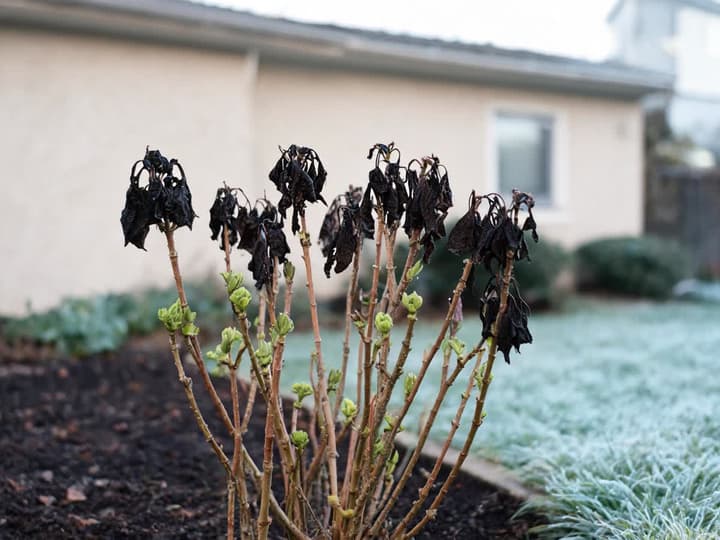
Usually not. Black, limp new growth following a freeze indicates frost damage on foliage. The University of Maryland Extension explains that bigleaf hydrangeas break dormancy early as soon as the weather warms, leaving soft new leaves vulnerable to subsequent cold snaps. The shrub stays alive and will push new growth.
Do not prune anything the next day. The University of Maryland Extension notes that you do not need to remove damaged foliage. If unsightly, take it off once the plant puts out more fresh growth.
Wait until the plant resumes active growth, then perform the scratch test:
Scratch the bark with your fingernail. Green tissue underneath means healthy, live wood.
Dead tip: cut directly above the first pair of healthy buds, as recommended by the RHS.
Stem brown entirely to the soil line: cut flush to the ground.
Adjust your summer bloom expectations. The University of Maryland Extension warns that late frosts after bud break also harm flower buds. This injury is less apparent than blackened leaves. The hydrangea may fail to flower for the season. UMD points to another common culprit behind missed blooms: cutting off bare stems before knowing whether they were truly dead.
Winter without cold: do hydrangeas bloom in warm climates?
They do: NC State lists bigleaf hydrangeas through USDA zone 11, which experiences no frost. However, cool autumn weather encourages flower bud formation. A 1975 study published in Acta Horticulturae (Litlere and Strømme) evaluated temperatures during bud initiation for Hydrangea macrophylla. The optimal range for most cultivars was 15 to 18 °C.
Above this temperature window, the plant still sets buds, but does so later: it develops additional leaf pairs before initiating flowers. A 2023 study in the same journal outlines the process: plants switch to floral initiation when cool temperatures and shorter autumn days arrive.
No one has measured this in hydrangeas grown in Brazil. Based on the 1975 study, what is expected where autumn is warm is that buds form later, after more leaf pairs. The hydrangea is traditional in the mountain ranges of the South and Southeast, where autumn is cool.
In warm cities, keep your hydrangea in a location shaded during the hottest hours of the day. Water whenever the top 1 inch of soil is nearly dry. And refrain from pruning after late summer, as formed buds remain positioned at the tips of the stems.
Frequently asked questions
Can I bring my hydrangea indoors for the winter?
It is not the best environment. Ask Extension recommends keeping hydrangeas cold during winter, inside an unheated shed or garage, rather than in living quarters. Heated indoor conditions may force early leafing out, which then dies during the first freeze once returned outside. On freezing nights, an unheated shelter provides ample protection for pots.
Do hydrangeas lose their leaves in the winter?
Yes, in cold areas. NC State classifies bigleaf hydrangeas as deciduous shrubs. Foliage turns yellow and drops in autumn, leaving bare stems through winter. Autumn leaf drop reflects natural dormancy, not disease. To confirm your plant remains alive, scratch a stem lightly: green tissue below the surface indicates living wood.
When should I remove winter protection from my hydrangea?
Only after the threat of frost has passed, as advised by UNH. Pulling covers away on the first warm afternoon exposes tender new growth to future cold snaps. For overnight protection like sheets or boxes, remove them each morning and recover the plant on subsequent freezing nights.
Should I cut off dried hydrangea blooms before winter?
No. The RHS recommends leaving spent flower heads on bigleaf hydrangeas through winter, as they shield the buds directly beneath. Prune off dried blooms in spring after growth begins, cutting right above the top pair of healthy buds without moving further down the branch.
Hydrangeas in winter: what to do now
If you grow the bigleaf variety with mophead blue or pink blooms, winter care boils down to four actions. Do not prune past late summer. Leave spent flowers on the shrub. Cover beds and shelter pots during freezing nights. Come spring, wait for bud break and run the scratch test before making cuts.
If you do not know which hydrangea you have, find out before winter. Panicle and smooth types do not lose blooms to cold and allow different pruning. Bloom identifies the plant from a photo and sets up its watering schedule.
Sources
NC State Extension, Gardener Plant Toolbox: Hydrangea macrophylla (zones 6a to 11b, deciduous leaves), Hydrangea paniculata (zones 3a to 8b, blooms on new wood, withstands harsh winters) and Hydrangea arborescens (zones 3a to 9b, prune near the ground in late winter).
USDA, Plant Hardiness Zone Map: minimum temperature range for each zone.
University of Washington, Elisabeth C. Miller Library, Increase flowering on hydrangeas: frost after bud break as the most common damage in zone 6 and above.
Ask Extension, Hydrangea not giving many blooms: flower buds are more sensitive to cold than leaf buds.
Ask Extension (University of Maryland), response on potted hydrangeas in winter: roots less protected, pots dry out faster, burying the pot, unheated storage shed or garage, finger check in the soil.
University of Maryland Extension: Pruning hydrangeas (buds formed in summer and fall), What damaged my hydrangea? (frost on new growth, damaged leaves, affected bud, sheltered wall or garage), and Fertilizing trees and shrubs (do not fertilize in late summer).
University of New Hampshire Extension: How do I protect my Endless Summer hydrangea over winter? and Should I prune my hydrangeas now or wait until spring? (no pruning in late summer and fall, wait for new growth, branch green inside, remove protection after frosts).
Royal Horticultural Society, Hydrangea pruning: dried flowers protect the buds in winter; cut frost damage back to the first pair of healthy buds.
University of Georgia Extension, C973 Growing Bigleaf Hydrangea: cover with a sheet, blanket, or cardboard below 0 °C, wire cage filled with leaves, fertilize until July.
Clemson Cooperative Extension, Repeat blooming hydrangeas: Endless Summer blooms on old and new wood.
Colorado State University Extension, Fall and Winter Watering, and University of Illinois Extension, Watering trees and shrubs in fall and winter: water only above 4 °C (40 °F), stop when the ground is frozen.
Litlere, B.; Strømme, E. (1975). Acta Horticulturae 51: 285–298: bud formation in H. macrophylla is best at 15–18 °C.
Acta Horticulturae 1383 (2023), Two mechanisms of remontant flowering in Hydrangea macrophylla: flower formation with cool temperatures and short days in autumn.
ESALQ/USP, plant glossary, Hydrangea macrophylla: hard pruning at the end of winter.
Revista Cultivar and Jovem Pan, Inmet forecasts: frost in the mountains and plateaus of the South and in the high-elevation areas of the Southeast.
Related articles

How to Care for Hibiscus: Sun, Watering, Fertilizer, and Pruning for Flowers
How to care for hibiscus: 6 hours of direct sun, evenly moist soil without waterlogging, half-strength fertilizer in spring and summer, and pruning in early spring. Find out why the flower lasts one day and why buds drop before opening.

Do Ferns Like Sun or Shade? It Depends on the Type
Ferns prefer bright shade: plenty of light, but no direct sun on their fronds. Tuberous sword fern is the exception that handles sun. Here is the ideal light for each type, where to place pots, and how fronds show too much or too little light.

African Violet Yellow Leaves: Causes and What to Do
Yellow leaves on an African violet usually stem from overwatering, and the first place to check is the center of the plant. Losing one lower leaf at a time is normal. Identify whether age, watering, cold water, sunlight, cold drafts, or fertilizer is the culprit based on the yellowing pattern, and see what to do today.