Do Hydrangeas Like Sun? Which Ones Can Take It and How Many Hours
Hydrangeas like morning sun and afternoon shade, with 2 to 6 hours of direct sun. Panicle hydrangea tolerates the most sun. See how much sun each species needs, signs of too much sun and shade, and how the higher summer sun in Brazil changes where you place the plant.
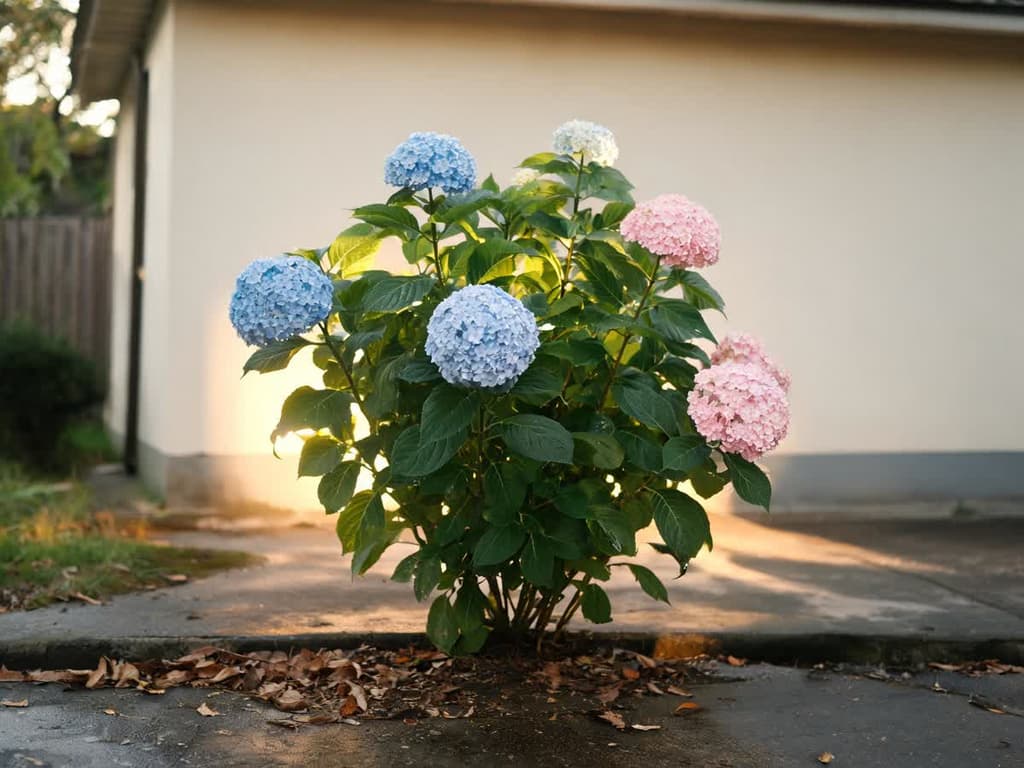
Hydrangeas like sun, but the bigleaf hydrangea only likes morning sun. The bigleaf hydrangea, with mophead blue or pink flowers (Hydrangea macrophylla), requires morning sun and afternoon shade. NC State Extension recommends 2 to 6 hours of direct sunlight per day. Panicle hydrangea, with cone-shaped flowers, tolerates the most sun. Smooth hydrangea accepts full sun (6 hours or more of direct sun per day) only when the soil stays consistently moist.
A "full sun" recommendation designed for summer in Germany does not apply the same way in Brazil. Here, the midday sun in December sits much higher in the sky and reaches the leaf more intensely. For this reason, in a hot city, even panicle and smooth hydrangeas do better with afternoon shade.
Quick summary:
Bigleaf hydrangea: morning sun and afternoon shade, 2 to 6 hours of direct sun per day (NC State).
Panicle hydrangea: the most sun-tolerant among hydrangeas, yet it still prefers afternoon shade (NC State).
Smooth hydrangea: full sun only with consistently moist soil (NC State); afternoon shade mandatory in hot climates (Mississippi State).
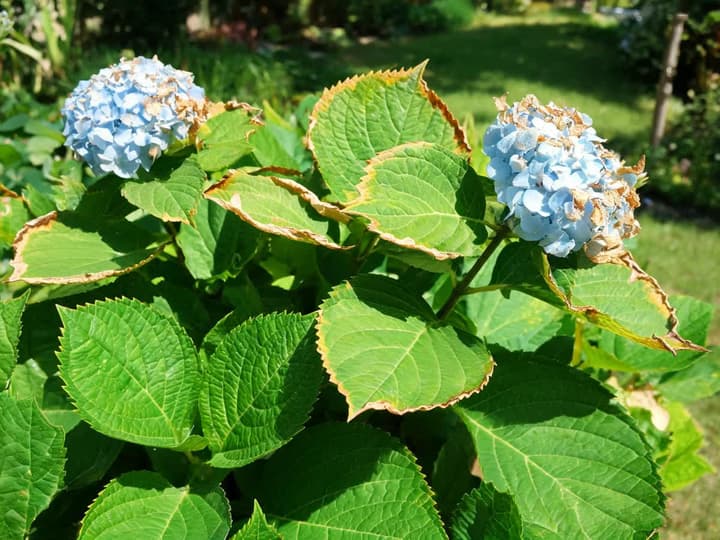
Too much sun: leaf margins turn brown and dry, starting at the top of the plant and on the sunny side.
Too much shade: few flowers. Flowering improves with about 5 hours of direct sun (Mississippi State).
More sun calls for more water, but you decide on watering by checking the soil at a depth of 6 inches (15 cm), not by the wilting afternoon leaves.
Which hydrangea can take full sun?
The panicle hydrangea (Hydrangea paniculata) is the hydrangea that tolerates the most sun. NC State Extension describes it as more tolerant of full sun than other hydrangea species. University extension is the service of a university in the United States that researches and guides plant cultivation. The same factsheet says that the panicle hydrangea prefers morning sun and afternoon shade. Mississippi State and the University of Maryland accept full sun for it. In a hot city, this guide follows NC State's preference, because no one has measured the panicle hydrangea in full sun in Brazil.
Six species are sold under the name hydrangea, and each tolerates a different amount of sun. The flower and leaf show which one you have. In the table, full sun means 6 hours or more of direct sun per day, and partial shade means direct sun during only part of the day:
Species | How to recognize | How much sun it tolerates | In hot climates |
|---|---|---|---|
Bigleaf hydrangea (H. macrophylla) | Large blue, pink, or white mophead ball, or a flattened lacecap bloom; broad, glossy leaf | 2 to 6 hours of direct sun, in the morning (NC State, UGA, Clemson) | Afternoon shade mandatory (Mississippi State); in Florida, needs shade (UF/IFAS) |
Mountain hydrangea (H. serrata) | Lacecap bloom, narrow and serrated leaf | Full sun to partial shade; grows best with light shade (NC State) | Sheltered from harsh sun, so leaves and flowers do not burn (NC State) |
Smooth hydrangea (H. arborescens) | Large white ball, like the 'Annabelle' variety | Partial shade; full sun only with consistently moist soil (NC State) | Afternoon shade mandatory (Mississippi State) |
Panicle hydrangea (H. paniculata) | Elongated cone, cream-colored, turning pink | Full sun to partial shade; the most sun-tolerant (NC State) | Prefers morning sun and afternoon shade (NC State) |
Oakleaf hydrangea (H. quercifolia) | Lobed leaf like an oak, white cone-shaped flower | Full sun to partial shade (NC State) | In Florida, needs some shade (UF/IFAS) |
Climbing hydrangea (H. anomala subsp. petiolaris) | Climbing vine with flattened white flowers | Sun or shade (NC State) | Consulted sources do not cover hot climates |
The blue or pink mophead hydrangea found in Brazilian gardens is the bigleaf hydrangea, and it needs afternoon shade. Mississippi State sums up the rule for most species: gentle morning sun, afternoon shade, and no deep shade.
If your location receives sun during most of the day, panicle hydrangea is the safest choice among hydrangeas:
Smooth hydrangea, with its white mophead flowers, handles full sun only as long as the soil never dries out. NC State only endorses smooth hydrangea in full sun with constant moisture in the soil. Mississippi State takes a stricter stance and requires afternoon shade for both smooth and bigleaf hydrangeas:
Without flowers, bigleaf hydrangea, smooth hydrangea, and mountain hydrangea look very similar by their leaves. The Bloom app (available for iOS) identifies the species from a photo. The species determines how many hours of sun the plant can handle.
Bigleaf hydrangea: morning sun and afternoon shade
The right spot for bigleaf hydrangea gets direct sun until late morning and stays in the shade starting in the early afternoon. NC State Extension calls for protection against afternoon sun. University of Georgia and Clemson Extension add another precaution: avoid hot, dry, and exposed locations.
In Brazil, the east side of the house gets morning sun and stays in the shade in the afternoon, which is best for it. The west side catches the afternoon sun, the hottest of the day. In the Southern Hemisphere, the north side gets the most sun throughout the year, and the south side gets the least.
The gardening guide from OBI, a German home-improvement store chain, recommends a west-facing wall for bigleaf hydrangea. For OBI, afternoon sun is enough for it. Four university extensions (NC State, UGA, Clemson, and Mississippi State) call for the opposite: shade specifically in the afternoon. This guide follows the university extensions, because all four provide the same recommendation and the OBI guide cites no source.
Dappled sun works as well. NC State notes that bigleaf hydrangea does well with dappled sun, the light filtered through the canopy of a tall tree.
A pot tag marked "full sun" does not make bigleaf hydrangea resistant to sun. University of Maryland Extension notes that some tags state that the hydrangea can tolerate full sun. A hydrangea planted in full sun, according to the same extension, will require more water and may bloom for a shorter time.
The azalea calls for the same spot: morning sun, afternoon shade, and 2 to 6 hours of direct sun. The camellia has the same range of hours and also avoids harsh afternoon sun. All three require soil that stays moist without getting waterlogged, which is why they share an east-facing garden bed well.
The summer sun in Brazil is higher than in Germany
On the longest day of the year, the midday sun reaches an altitude of 90° in São Paulo and 61° in Berlin. The higher the sun stands, the more energy reaches each square meter of leaf area. The calculation comes from geometry and uses latitude, the city's distance from the equator in degrees. On the longest day of the year, the midday sun altitude is 90° minus the distance between the city and the tropic (23.4°).
City | Latitude | Midday sun altitude on the longest day of the year |
|---|---|---|
Hamburg (Germany) | 53.6° N | 60° (June 21) |
Berlin (Germany) | 52.5° N | 61° (June 21) |
Munich (Germany) | 48.1° N | 65° (June 21) |
Porto Alegre | 30.0° S | 83° (around December 21) |
Curitiba | 25.4° S | 88° (around December 21) |
São Paulo | 23.5° S | 90°, sun almost directly overhead (around December 21) |
Belo Horizonte | 19.9° S | 86° (around December 21) |
The consulted sources provide no sun-hour measurements for hydrangeas in Brazilian cities. The extensions are from the United States. The guidelines they provide for their own warm south come closest to Brazil's climate. Mississippi State requires afternoon shade for bigleaf and smooth hydrangeas. NC State points out that even panicle hydrangea prefers afternoon shade.
In practice, when a European or American source says "full sun" for a hydrangea, read it, in Brazil, as sun until late morning. In a warm city, this also applies to panicle and smooth hydrangeas. Without measurements taken in Brazil, this is the safest option for the plant.
Signs of too much sun on hydrangeas
The first sign of too much sun is a brown, dry leaf edge. The University of Maryland Extension describes the damage on hydrangeas planted in too much sun: it starts along the leaf margin, which turns brown and dry. Washington State University (WSU) calls the problem leaf scorch and points out where to look: at the top of the plant and on the sunniest side.
WSU explains the cause: the leaf loses water faster than the roots can replace it. Intense light, heat, dry wind, and insufficient watering produce the same damage. Walls and fences that reflect light leave the leaf more vulnerable to scorch, according to the same extension.
Flowers burn as well. UMD notes that intense heat combined with a lack of water during flowering can scorch and darken flower buds and blooms. NC State, in its profile for mountain hydrangea, notes that in hot climates strong sun makes leaves and flowers fade or scorch prematurely.
A late frost also leaves the edges of new leaves brown and crispy, according to UMD. The season distinguishes the two types of damage. Frost damage appears right after a cold night when fresh leaves have just emerged. Sun damage appears during heat on leaves on the sun-exposed side.
Do hydrangeas wilt at midday from heat or thirst?
A hydrangea that wilts in the heat of the day, recovers at night, and has moist soil is suffering from heat. It does not need extra watering. University of Maryland Extension describes this scenario: bigleaf hydrangea wilts on hot days even when the soil is moist, especially in full sun. If it returns to normal at night and the soil is not dry, heat is the cause.
UMD explains the mechanism: leaves lose water faster than the roots can take it up. At night, the plant recovers the missing water. According to the same extension, short-term wilting does not harm the plant. If the wilting repeats every day, the leaf margins can dry out. WSU describes wilting as the signal that precedes leaf scorch.
Check the soil before watering. UMD directs you to dig near the base and check the soil about 15 cm (6 inches) deep. Moist soil there does not call for water, even with drooping leaves. Dry soil at that depth means thirst: water until the 15 cm are moist. Leaves that are still wilted in the morning, before the heat, also call for checking the soil: if dry, water; if wet for several days, see the root case below.
University of Georgia offers a shorter instruction: water whenever the plant begins to wilt, unless it rains. That instruction conflicts with UMD's guidance on a hot day. This guide follows UMD, because only UMD offers the test that distinguishes heat from thirst. Watering because of midday wilting adds excess water to soil that was already moist.
Wilting with soil that has been wet for several days represents a third case, and the one that worsens most with added water. Oxygen-deprived roots rot, stop absorbing water, and the leaves wilt as if parched. Potting soil that develops mold on the surface receives more water than the plant can use:
Signs of too much shade on hydrangeas
A hydrangea in too much shade blooms poorly. University of Georgia, Mississippi State, and Clemson list too much shade as a cause of bloom failure in hydrangeas. Mississippi State provides a number: flowering improves with about 5 hours of direct sun.
Before moving the plant to a sunnier spot, check whether pruning occurred at the wrong time. University of Maryland Extension pinpoints pruning at the wrong time as the number one cause of bloom failure in hydrangeas. Clemson identifies winter injury to flower buds as the most common cause. The two extensions diverge, and neither has quantified the order of causes: verify pruning first, because that is the cause you control.
With at least 2 hours of direct sun and pruning done at the right time, a hydrangea that fails to flower needs a spot with more morning sun. The target is the roughly 5 hours that Mississippi State associates with better flowering.
Full shade all day, without a single hour of direct sun, is the case where relocating solves the problem. Mississippi State advises avoiding dense shade for most hydrangeas.
More sun calls for more water
UMD states that a hydrangea in full sun will demand more water. WSU calls for increased watering in sunny and windy spots. Mississippi State notes that bigleaf and smooth hydrangeas consume large amounts of water.
German magazine Mein schöner Garten cites up to 50 liters of water per day for a mature hydrangea in high heat, split across two waterings. It does not provide the source of this number. University extensions do not specify daily volumes. Water based on the soil at 6 inches (15 cm): if it feels moist at that depth, the plant does not need more water that day.
Cover the soil with 2 to 3 inches (5 to 8 cm) of organic mulch, such as pine bark or dry leaves. Clemson and Mississippi State recommend this layer to conserve moisture and keep roots cool. University of Georgia suggests 3 to 5 inches (8 to 13 cm). This guide uses 2 to 3 inches (5 to 8 cm), the range where two extensions agree. Spread it near the base without letting it touch the stems.
When the soil is dry at a depth of 6 inches (15 cm), water early in the morning at the base of the plant until that 6-inch layer is moist. The water reaches the roots before the heat arrives, and the foliage avoids sitting wet overnight.
Potted hydrangeas on a sunny balcony or terrace
A potted bigleaf hydrangea on an unshaded terrace will suffer leaf scorch even with watering. Soil in pots dries out faster than garden bed soil, and the foliage takes the same intense afternoon sun.
In Brazil, a north-facing balcony gets sun for most of the day. A west-facing balcony gets the afternoon sun. Both are difficult spots for bigleaf hydrangea. An east-facing balcony is best for it. A south-facing balcony receives less direct sun and protects against the heat. If the sun does not reach 2 hours per day there, flowering may decrease.
For an unshaded terrace, two options exist. The first is to provide shade. Commercial hydrangea nurseries routinely use black shade cloth that blocks 30% to 50% of light. Shade cloth protects foliage from excessive sun. This appears in the abstract of a 2026 study in the journal HortTechnology. The study tested colored shade cloth and measured shrub growth, not flowering or scorch. Fasten a piece of shade cloth above the pot and on the west side to block afternoon sun.
The second option is to change species. Panicle hydrangea, in a large pot with soil checked every day in summer, has the best chance on a sunny terrace. Even panicle hydrangea does better with the shade cloth from the first option.
If neither option works, choose another plant. The dipladenia needs at least 6 hours of direct sun per day to bloom well. It does better on the terrace that the common hydrangea cannot handle.
What to do with a hydrangea already planted in harsh sun?
Do not prune the hydrangea down to the ground. Bigleaf hydrangea develops next year's flower buds on existing stems, and cutting it to the ground eliminates flowering for an entire year. Remove only dry wood. To check, scratch the bark with a fingernail: brown underneath means dead wood, green underneath means live wood.
Provide shade now and move the plant later. A shade cloth or an umbrella positioned on the afternoon side protects the hydrangea throughout the summer. Clemson warns that hydrangeas struggle when planted during summer heat. Once summer heat subsides, transplant the plant to a spot that receives only morning sun.
Scorched leaves do not turn green again. New leaves that emerge under the shade cloth or in the new spot show whether the adjustment worked.
Frequently asked questions
Can hydrangeas stay in the sun all day?
Not the bigleaf hydrangea. In full sun it requires more water and blooms for a shorter period, according to the University of Maryland Extension. Mississippi State calls the panicle hydrangea the only species that grows best in full or partial sun. NC State notes that even it prefers afternoon shade. Smooth hydrangea tolerates full sun only with consistently moist soil, according to NC State, and Mississippi State requires afternoon shade for it.
Do hydrangeas bloom in the shade?
They bloom very little. In full shade all day, a hydrangea develops few flowers. Mississippi State notes better flowering with about 5 hours of direct sun and recommends avoiding dense shade. NC State notes that bigleaf hydrangea does well with dappled sun, the light that filters through the canopy of a tall tree. The same plant profile also accepts full shade. Three extensions include excessive shade among the causes of bloom failure, and this guide aligns with all three.
Can a flowering hydrangea bought in a pot go straight into full sun?
Not into full sun. The plant comes from a nursery where it grows under shade cloth with frequent watering. Place the container in a spot with morning sun. In a garden bed, University of Maryland Extension instructs watering nursery plants at least every 2 days for the first 2 weeks. After that, return to checking the soil at 6 inches (15 cm) to decide when to water.
Do white hydrangeas tolerate more sun?
That depends on the species, not flower color. A white bigleaf hydrangea requires the same afternoon shade as blue or pink varieties. The white hydrangeas that tolerate more sun are panicle hydrangea, which has cone-shaped blooms, and smooth hydrangea, which has round mophead blooms. Smooth hydrangea performs well in full sun only with consistently moist soil.
Where to place your hydrangea: what to do today
Identify which hydrangea you have by its blooms and leaves, and choose its location based on sun exposure hours. For bigleaf hydrangea, choose an eastern exposure that receives sun until late morning. For panicle hydrangea, select a site with ample morning sun and, in hot climates, afternoon shade. For any hydrangea, check the soil at 6 inches (15 cm) before watering in response to wilting foliage.
If your hydrangea came without a label and has not bloomed yet, Bloom identifies the species from a photo and sets up its watering schedule.
Sources
NC State Extension, Gardener Plant Toolbox: Hydrangea macrophylla, H. paniculata, H. arborescens, H. serrata, H. quercifolia, and H. petiolaris (sun exposure by species, dappled sun, protection from afternoon sun).
University of Georgia Extension, C973, Growing Bigleaf Hydrangea: morning sun and afternoon shade, hot and exposed location, too much shade as a cause for lack of flowering, watering when the plant wilts.
Clemson Cooperative Extension, HGIC 1067, Hydrangea Care in South Carolina: light, 2 to 3 inches of mulch, plant that struggles if planted in summer heat, winter damage as the most common cause of not blooming.
Mississippi State University Extension, P2574, Hydrangeas for Mississippi Gardens: about 5 hours of direct sun, afternoon shade mandatory for bigleaf and smooth hydrangeas, panicle hydrangea as the species that grows best with sun.
University of Maryland Extension, Hydrangea: Identify and Manage Problems, Drought and Excessive Heat Stress, and Watering Trees and Shrubs: scorch that starts at the margin, full sun tag, heat wilt, scorched bloom, soil checked at 6 inches (15 cm), pruning as the #1 reason for lack of blooms.
Washington State University Extension, Hortsense, Hydrangea: Leaf scorch: cause, location of the scorch on the plant, and reflective surface.
UF/IFAS Gardening Solutions, Hydrangeas and Oakleaf Hydrangea: shade for bigleaf hydrangea and oakleaf hydrangea in Florida.
Stallknecht, E. J. and Pounders, K., HortTechnology 36(2), 2026, Effects of Colored Shade Materials on the Shoot Growth and Morphology of Hydrangea macrophylla in Virginia (doi 10.21273/HORTTECH05811-25): 30% to 50% shade cloth in production.
Mein schöner Garten (German magazine), Hortensien in die Sonne pflanzen? (Hydrangeas in the sun?), 2026, and OBI Magazin, Hortensien Standort (Location for hydrangeas).
Related articles

How to Care for Hibiscus: Sun, Watering, Fertilizer, and Pruning for Flowers
How to care for hibiscus: 6 hours of direct sun, evenly moist soil without waterlogging, half-strength fertilizer in spring and summer, and pruning in early spring. Find out why the flower lasts one day and why buds drop before opening.

Do Ferns Like Sun or Shade? It Depends on the Type
Ferns prefer bright shade: plenty of light, but no direct sun on their fronds. Tuberous sword fern is the exception that handles sun. Here is the ideal light for each type, where to place pots, and how fronds show too much or too little light.

African Violet Yellow Leaves: Causes and What to Do
Yellow leaves on an African violet usually stem from overwatering, and the first place to check is the center of the plant. Losing one lower leaf at a time is normal. Identify whether age, watering, cold water, sunlight, cold drafts, or fertilizer is the culprit based on the yellowing pattern, and see what to do today.