Palm Pests: How to Identify Signs and Treat Potted and Garden Palms
Potted palm pests include scale, spider mites, and thrips, and they wash off with water, a cotton swab, and soap. In the garden, sawdust on the trunk and a collapsed crown point to borers, which have no home remedy. Learn to tell them apart by their signs.
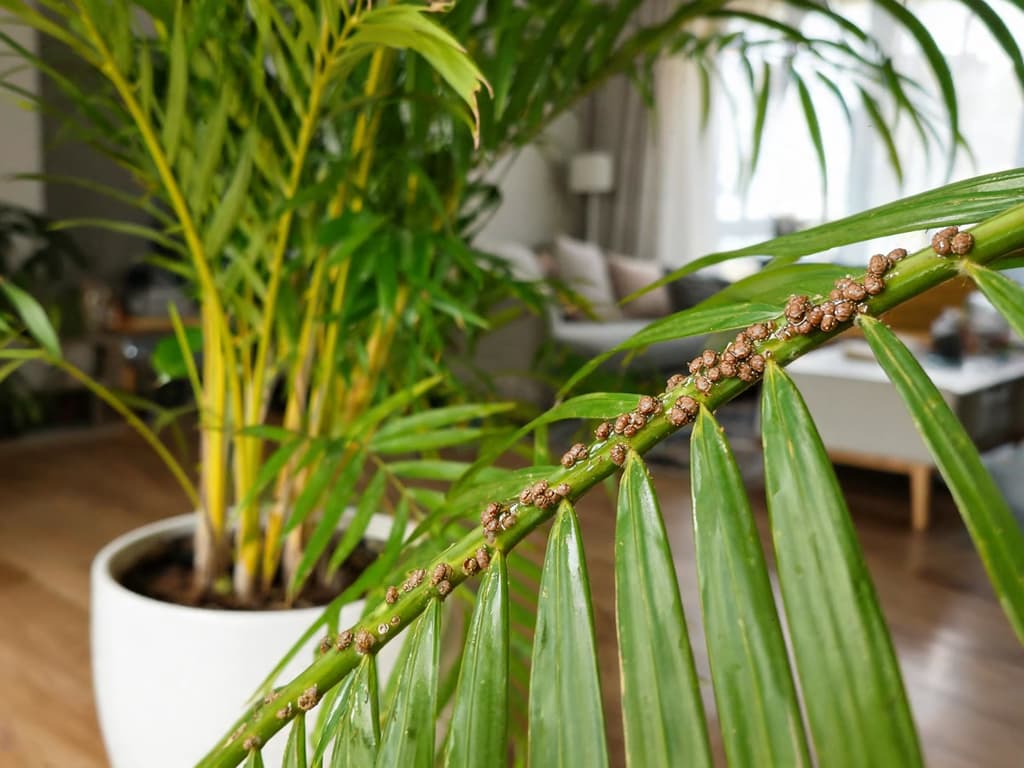
Palm pests depend on where the palm lives. On potted palms, the usual culprits are scale insects, two-spotted spider mites, and thrips, and you can treat all of them at home with water, cotton swabs, and soap. On garden palms, sawdust on the trunk, holes, and a drooping crown point to borers. A borer is a larva that eats the plant from the inside out, and it has no home remedy.
The symptom in front of you decides your first move. Bugs on the frond are your job. Bugs inside the trunk are an agronomist's job, and sometimes an agricultural inspector's.
Quick summary:
Stuck-on brown bumps, white cotton, or pale speckles with fine webbing: frond pests, which wash away with rinsing, a cotton swab dipped in alcohol, and soap.
Sawdust or chewed fibers pushing out of the trunk, paired with a fermented smell and collapsed center fronds: suspected borer. Soap and neem oil cannot reach a larva tucked inside the trunk.
A brand-new, unopened frond that pulls out in your hand with a mushy base points to a dead center bud. A single-trunk palm cannot recover from that.
Which pest is on your palm: identify it by its signs
You can almost always recognize a palm pest by the trace it leaves behind, long before you spot the bug itself. The frond divides into leaflets, the slender strips growing along a central rib, and that is where most symptoms show up. The table pairs the most common signs with where each pest turns up and whether you can handle it yourself.
What you see | Likely pest | Where it appears | Can you treat it at home? |
|---|---|---|---|
Brown or beige bumps 2 to 5 mm long stuck to the midrib and stem | Armored or soft scale | Pot and garden | Yes |
White cottony tufts in the frond folds and at the base of the stems | Mealybug | Pot and garden | Yes |
Sticky fronds later coated in black powder | Scale honeydew and sooty mold | Pot and garden | Yes, by treating the scale |
Pale speckles on the fronds and fine webbing between leaflets | Two-spotted spider mite | Pots in dry air | Yes |
Silvery streaks paired with tiny black dots across the frond | Thrips | Pot | Yes |
Chewed leaflets, fronds tied together with silk nests, droppings on the ground | Brassolis sophorae caterpillar | Garden | Yes, by removing the nests |
Sawdust or fibers on the trunk, holes, fermented smell, collapsed center fronds | South American palm weevil or another borer | Garden | No: call an agronomist |
Rotted trunk base without sawdust or holes | Trunk rot (disease, not a pest) | Garden | No: call an agronomist |
Scale insects and spider mites hide on the underside of the leaflets, so flip the frond over before assuming your palm is clean.
If what you see does not match any row, run Bloom photo diagnosis (Premium plan). It checks the symptom against known pests and diseases. The guide on what is wrong with my plant helps sort pests apart from watering and lighting issues.
Potted palm pests
The most common pests of potted palms are the two-spotted spider mite, mealybugs, and armored scale insects. The University of Florida (UF/IFAS) cites these three as the most common pests of the kentia palm (Howea forsteriana), especially indoors. North Carolina State University (NC State) Extension also advises watching for mites and scales on the bamboo palm (Chamaedorea seifrizii) and the majesty palm (Ravenea rivularis).
Scale insects
Armored scale, also called scale insect, looks like a small brown or beige shell stuck to the vein, stem, or underside of the leaflet. The adult insect does not move: it stays still under this shell and sucks sap. Iowa State University Extension describes these scales as small bumps lined up along stems and veins.
There are two types. Soft scale secretes honeydew and leaves the leaf sticky. Armored scale does not secrete honeydew, and the leaf stays dry. On palms, one armored scale is the coconut scale (Aspidiotus destructor). UF/IFAS records this scale on more than 60 plant families, causing yellowed and deformed leaves.
Ants running up and down the stem are another sign of soft scale, because ants march in to gather honeydew. On olive trees, Florida Extension uses ants as an indicator for scale, as outlined in the guide to olive tree pests.
Mealybugs
Mealybugs produce white tufts that look like bits of cotton. They settle into the tight folds where the frond clasps the stem and on the undersides of the lowest leaflets. A white powdery wax covers the insect's body, creating that cottony appearance, according to Iowa State University. The honeydew they secrete leaves the lower fronds, your table, and the floor sticky. Over time, that honeydew turns black with sooty mold, a fungus that feeds on the sugars.
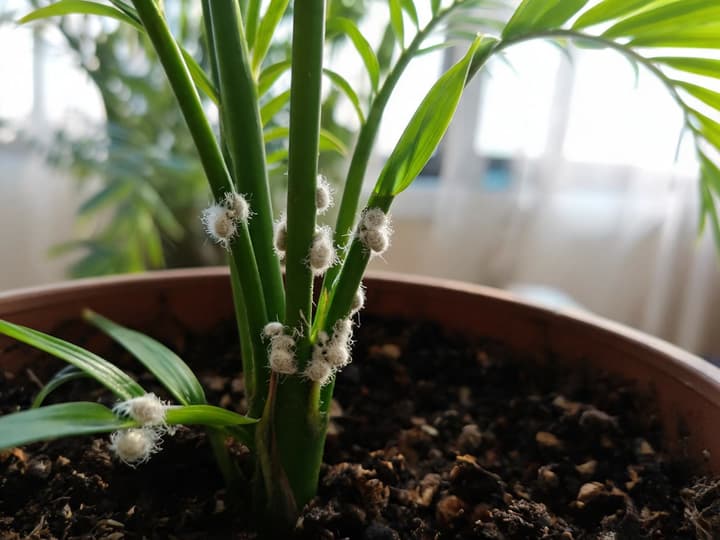
You do not need to discard a small palm with mealybugs. The pest is treatable with a cotton swab and water, as long as you repeat the treatment until newly laid eggs stop hatching. If your palm is in a pot, move it away from your other houseplants until the pest is gone.
Two-spotted spider mites
The two-spotted spider mite (Tetranychus urticae) is an arachnid under 1 mm long that feeds on fronds from the underside. It leaves behind pale yellow speckles, followed by a washed-out or bronzed look across the frond. As the population grows, the mites spin fine webbing between the leaflets. On indoor palms, UF/IFAS highlights spider mites as the most frequent pest on fishtail palms (Caryota).
Dry indoor air is what sparks spider mite flare-ups. Iowa State University explains that spider mites favor dry environments and that raising air humidity slows the population down. Air conditioning and heaters strip moisture from living rooms, leaving palms nearby prone to mite outbreaks.
To verify, hold a sheet of white paper beneath a frond and tap it several times. Specks that drop and start crawling are spider mites. Specks that sit still are ordinary dust.
Thrips
Thrips are slender, elongated insects, under 1.3 mm long, that scrape the leaf surface. The damage appears as silvery or bronze streaks on the upper side of the leaf, with black specks on top. The specks are the insect's droppings (UC IPM). NC State lists thrips among the common insects of bamboo palms and majesty palms.
How to treat pests on potted palms
Manage potted palm pests in four steps: isolate the plant, wash the fronds, remove bugs by hand, and repeat the treatment. The same workflow applies to scale, spider mites, and thrips. The only variable is the schedule of your retreatments.
Isolate the palm. Move the pot away from other plants, as Iowa State University recommends, so the pest does not spread to neighboring plants.
Wash the fronds in the shower. Use room-temperature water on both sides of the leaflets and at the base of the stems. UF/IFAS notes that water on the leaves reduces two-spotted spider mites, and the spray also knocks off loose mealybugs.
Dab with an alcohol-soaked cotton swab. Dip a cotton swab in 70% rubbing alcohol and touch each visible scale insect. Iowa State University recommends using a cotton swab with alcohol when there are few insects. Pry off the hard shells with your fingernail or an old toothbrush.
Use insecticidal soap only after testing. UF/IFAS directs applying the soap to a small area and waiting 1 day to see if the leaf burns. Actively growing plants call for the lowest dose on the label.
Repetition is what makes this work. For scale, inspect the entire palm every 5 days for 3 weeks, because eggs you overlooked will hatch during that window. For spider mites, repeat the shower rinse and soap every 4 to 7 days, 3 times. Step-by-step guidance for each pest is in our articles on how to get rid of scale and spider mites on houseplants.
Broad-spectrum chemical insecticides frequently make spider mite problems worse, because they kill off the mites' natural predators. The guide to houseplant pests explains this dynamic and covers what fails against each pest.
Once the bugs are gone, keep them away with consistent everyday care. Provide bright indirect light, water whenever the top layer of potting mix dries out, and rinse the fronds in the shower periodically. The palm care guide outlines the lighting and watering needs for each species.
Garden palm pests
The most dangerous garden palm pests are borers, large larvae that tunnel galleries through the trunk and central bud. By the time signs appear on the outside, the larva is already deep inside, sheltered from any spray applied to the fronds.
South American palm weevil and red ring disease
The South American palm weevil (Rhynchophorus palmarum) is one of the most significant palm pests in Brazil, according to the Instituto Biológico de São Paulo. The adult is a black beetle 4.5 to 6 cm long, with a curved "snout" of about 1 cm, according to Embrapa. The larva eats the central bud of the palm, which growers call the "eye."
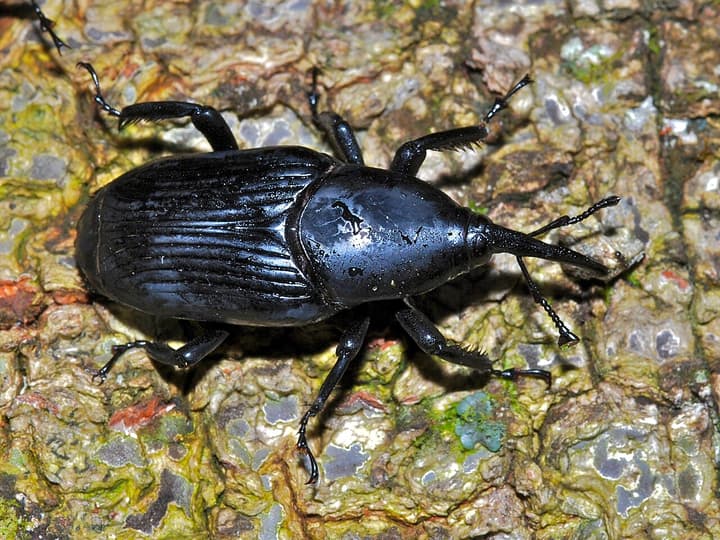
According to Embrapa, an infested palm first reveals a deformed, shredded spear leaf. Next, the youngest fronds turn yellow, wilt, and bend downward, signaling the death of the plant. The adult beetle also transmits the nematode Bursaphelenchus cocophilus, a microscopic roundworm that triggers red ring disease.
Red ring disease is a lethal condition. On the outside, the fronds wilt and turn golden-yellow, starting at the tips of the leaflets. On the inside, the cut trunk shows a reddish band 2 to 4 cm wide, according to Embrapa.
For the borer and for red ring disease, Embrapa does not recommend spray treatments. The recommendation is to quickly remove the diseased palm and reduce the beetle population with pheromone traps. An agronomist or a palm management company handles this work safely.
The beetle is attracted to the fermentation smell of a wounded palm. The Biological Institute of São Paulo reports that cutting fronds or the trunk releases this smell and attracts adults. In the garden, cut only completely dry fronds and do not damage the trunk unnecessarily.
Red palm weevil (Rhynchophorus ferrugineus)
The red palm weevil (Rhynchophorus ferrugineus) is an Asian species in the same genus as the South American palm weevil, and it kills palms in Europe, Asia, and the Middle East. In Brazil, it is an absent quarantine pest: it has not yet been found in the country, and the government works to prevent its entry. SDA/MAPA Ordinance No. 1,291 of 2025 places the red palm weevil on this list, according to the Ministry of Agriculture (MAPA).
MAPA records the red palm weevil in Argentina, Uruguay, and Caribbean countries. MAPA lists these signs of attack: small holes in the trunk, oozing sap or chewed fibers, and a strong smell. The center fronds turn yellow or droop, and the crown becomes deformed.
If you suspect the red palm weevil in Brazil, do not touch the palm and do not transport parts of it. MAPA asks that you report any suspicion to the Federal Superintendency of Agriculture in your state or to the state plant health inspection agency.
Palm borer moth (Paysandisia archon)
Paysandisia archon is a large moth whose caterpillar tunnels galleries through the palm trunk and leaves. It is native to Rio Grande do Sul, Argentina, Uruguay, and Paraguay. EPPO, the European plant protection organization, does not list the moth as a pest in South America. In France, Italy, and Spain, it has killed palms.
The signs described by EPPO are sawdust at the top or on the trunk, holes and tunnels, and perforated fronds. On fan palms, the holes appear in a row when the new leaf opens. Palms attacked include the windmill palm (Trachycarpus fortunei), Chamaerops humilis (a palm native to the Mediterranean), Washingtonia, and the jelly palm (Butia).
Palm caterpillar (Brassolis sophorae)
The palm caterpillar (Brassolis sophorae) feeds on leaflets by night and shelters by day inside communal nests woven from leaflets bound with silk. According to the Instituto Agronômico de Campinas (IAC), its presence reveals itself through droppings on the ground and the sound of droppings pattering down onto lower foliage. In the state of São Paulo, the caterpillar is active from September or October through March, spanning the spring and summer of the Southern Hemisphere.
Control recommended by the IAC starts with mechanical methods: remove the nests and destroy the caterpillars. The IAC also cites biological control, using the bacterium Bacillus thuringiensis and the fungus Beauveria bassiana.
Sawdust on the trunk or a leaning crown: can the palm still be saved?
A palm showing trunk sawdust and a crown leaning to one side can rarely be saved when borers are the cause. Every palm stem grows from a single terminal bud at the top, and the South American palm weevil larva eats straight through that bud. According to Embrapa, once the youngest fronds yellow, wilt, and curl over, the palm is dying.
Try the spear leaf test. Gently pull the center frond, the one that is still closed. If it resists, the bud is alive. If it pulls out in your hand with a soft, dark base, the bud has died. UF/IFAS uses this same test to assess palms after a freeze.
What you do depends on how the palm grows:
Single-trunk palms with a dead bud: cannot recover. Embrapa instructs removing palms killed by borers or red ring disease right away, because they become breeding sites for the beetles.
Multi-stem clustering palms: only the stem with the dead bud dies, while the other stems keep growing. Have an agronomist cut out the affected stem.
Firm center bud, with sawdust at only one spot on the trunk: there is still something to evaluate. Call an agronomist before the borer reaches the growing top.
Soap, neem oil, and homemade sprays do not reach the larva, which lives inside the trunk. Italian agronomist Fiorenzo Pandini tracks Paysandisia at Lake Garda. He writes that spraying from the outside is useless, because the product does not reach the inside of the trunk. Embrapa also does not recommend spraying for the South American palm weevil.
Large palms with borer infestations can collapse. The Instituto Biológico lists tree fall among the symptoms of an attack. If the palm stands close to a house, parked cars, or where people walk, keep everyone clear of the fall zone until an agronomist inspects it.
Not every rotted trunk comes from borers. According to the same agronomist, fungal rot decays the trunk wood without leaving chewed debris like sawdust or boreholes behind. In that situation, the problem is a disease requiring different management, again evaluated by an agronomist.
Frequently asked questions
What pests attack palm trees?
On potted palms, the most common insects are armored scale and mealybugs, along with the two-spotted spider mite, which is an arachnid, and thrips. In garden palms in Brazil, the most serious pests are the South American palm weevil, which transmits red ring disease, and the palm caterpillar. The red palm weevil, common in Europe, has not yet been found in Brazil.
Does neem oil work on palm borers?
No. Borer larvae live deep inside the trunk and terminal bud, and no topical foliage spray can touch them. For the South American palm weevil, Embrapa advises pheromone traps and removing infested palms. Neem oil and insecticidal soap work against foliage pests like scale and spider mites.
What is the sticky white stuff on my palm?
White cottony tufts surrounded by sticky fronds indicate mealybugs. White wax coats the insect's body, while the sticky film is honeydew that it excretes. Remove the tufts with a cotton swab dipped in 70% rubbing alcohol, wash the fronds, and recheck the palm every 5 days for 3 weeks.
Are ants on a palm a pest?
Ants rarely harm palms on their own, but they point to soft scale. They climb up to harvest honeydew, the sugary liquid soft scale secretes across fronds and stems. Check the undersides of leaflets and along the stems for small brown shells or white tufts. Treating the scale puts an end to the ant trail.
Conclusion
Pests on potted palms stay on the leaves and come off with a wash, a cotton swab dipped in alcohol, and 3 weeks of repeated treatments. Garden palm pests that kill stay inside the trunk. Sawdust, holes, a fermented smell, and a drooping crown call for an agronomist, and suspected red palm weevil calls for notifying MAPA.
To confirm which pest is on your palm, Bloom diagnosis (Premium plan, iPhone app) inspects a photo of the symptom.
Related articles
How to Care for a Maidenhair Fern: Light, Water, and Revival Tips
Learn how to care for a maidenhair fern indoors: bright indirect light, consistently moist soil, high humidity, and how to revive it if it dries out completely.
How to Propagate Spider Plants: Root the Pup Before Cutting
The safest spider plant cutting comes from a pup still attached to the mother plant: rest the plantlet on soil in a small pot, wait for roots to establish, and only then cut the stolon. Learn when the pup is ready, whether rooting in water is worth it, how to divide the clump, and why plants fail to produce babies.
Banana plant fertilizer: fertilizing potted and backyard plants
Banana plant fertilizer needs more potassium than nitrogen, in a 3-1-6 ratio. For a potted plant on a balcony, use the label dose in spring and summer. In the backyard, fertilize every 2 months, adjusting the amount by mat age. Learn the formula, timing in Brazil, and signs of deficiency or excess.