How to Propagate Petunias: Cuttings in Water or Soil and Seeds
To propagate petunias, take a soft, non-flowering tip cutting of 2 to 3 inches and remove the lower leaves. Place the cutting in a glass of water or moist soil. Learn how long roots take, why seeds stay uncovered, and when to propagate in Brazil.
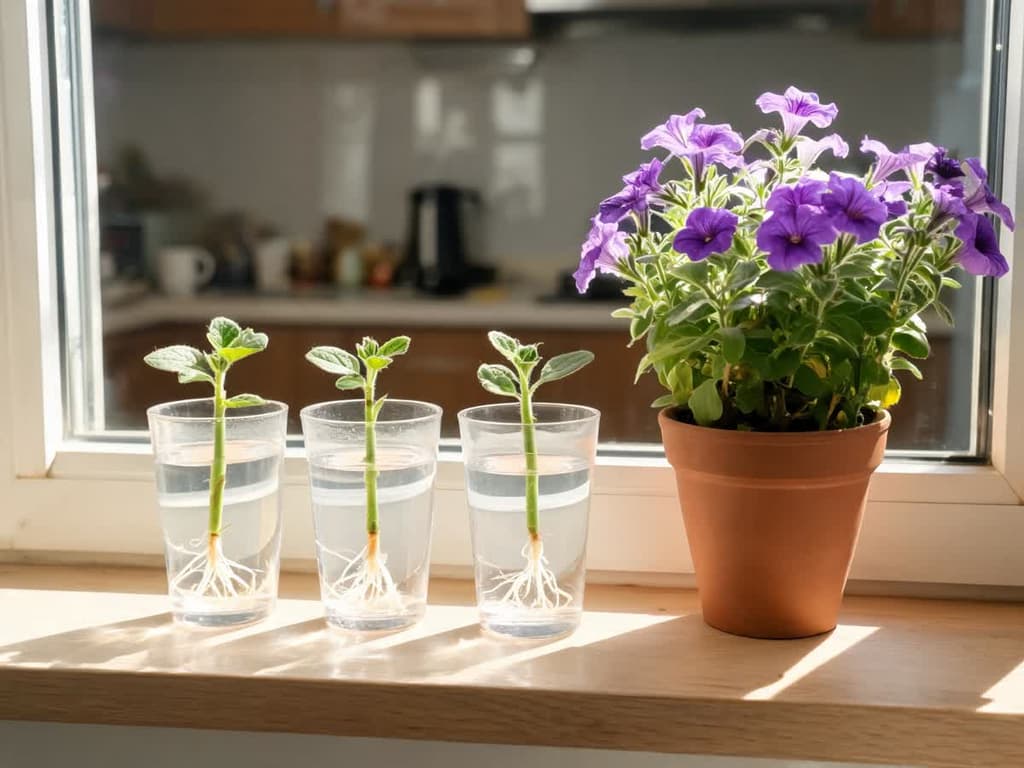
To propagate petunias, the easiest way is taking cuttings: a piece of a stem tip that turns into a new plant. Cut a soft, non-flowering tip measuring 5 to 7.5 cm (2 to 3 inches). Strip off the lower leaves and place the cutting in a glass of water or a pot with moist soil in a very bright spot. Roots usually appear in 2 to 3 weeks. The mother plant does not die from the cut: it sprouts new growth right below it.
The measurement of 5 to 7.5 cm (2 to 3 inches) and the glass of water come from an expert answer from the United States extension network. This network is the universities' agricultural extension service. Seeds also work, but seeds collected from a hybrid petunia (a cross between two plants) do not produce the same flower as the mother plant.
Quick summary:
Cutting: soft tip, without flowers or buds, 5 to 7.5 cm (2 to 3 inches) long, keeping only the top leaves.
Water or soil: both methods work. In water, place one cutting per glass and transfer to soil when the roots reach 2.5 to 5 cm (1 to 2 inches).
Seed: dust-fine, spread over the soil surface without covering, and germinates in 7 to 10 days at 24–27 °C (75–80 °F).
Where frost occurs, spring is a great season for both methods. Cuttings taken in autumn before the first frost preserve the plant indoors. In hot climates, prefer the cooler season.
Cuttings or seeds: which method to use for propagating petunias
Use cuttings when you want an exact copy of the plant you already have. Because the cutting is a piece of the original plant, the new start will produce flowers identical in color and shape. Use seeds when you want to start many plants at once from a purchased seed packet.
Seed saved from your petunia does not produce the same flower as the mother plant. The Clemson Cooperative Extension notes that petunias reseed on their own in the garden, but do not come back true to the parent plant. They usually return as a mix of small white, lavender, and pink flowers. The NC State Extension, from North Carolina State University, calls the garden petunia a hybrid (Petunia x hybrida). Hybrid means it resulted from crossing two different plants.
Cuttings | Purchased seed | Seed saved from your plant | |
|---|---|---|---|
What grows | Exact copy of the mother plant | The packet variety | Flowers different from the mother plant |
Time to roots or germination | 2 to 3 weeks | 7 to 10 days | 7 to 10 days |
Time until transplanting to the final location | 5 to 6 weeks | About 10 weeks | About 10 weeks |
Difficulty | Easy | Moderate: very tiny seeds | Moderate, with uncertain results |
How to propagate petunias from cuttings, step by step
You will need clean scissors, a glass of water or a small pot with seedling mix, and 15 minutes. Take several cuttings at once as a backup in case any rot.
Choose the stem. Look for a fresh, green, and flexible tip. The website Gardening Know How recommends soft tips rather than old, woody parts of the stem. Choose a non-flowering stem.
Cut the mother plant right above a node. A node is the point on the stem where leaves emerge. The website Epic Gardening explains that cutting above a node triggers the remaining stem on the plant to branch out again.
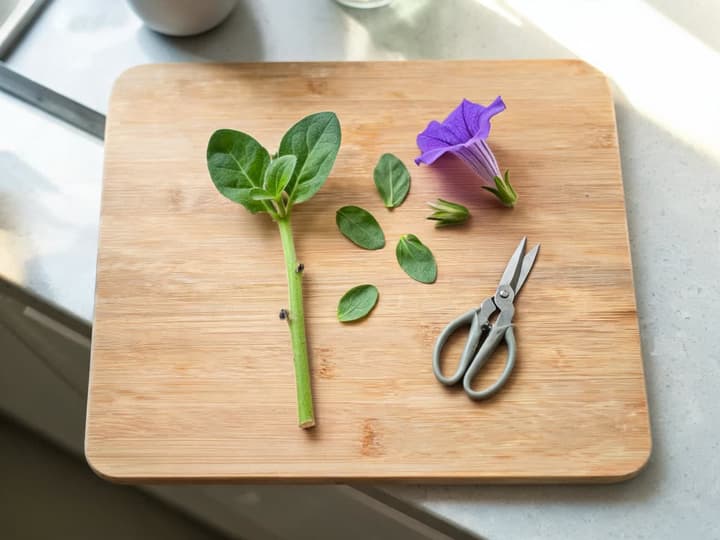
Check the size. Measure the cutting from the tip to the cut end: it should be 5 to 7.5 cm (2 to 3 inches). If it is longer, trim the excess from the base.
Remove flowers and buds. If only flowering stems are available, snip off all flowers and buds from the cutting. Do this before setting the cutting in water or soil.
Strip the lower leaves. Leave only 1 or 2 pairs of leaves at the very top. The bare nodes will stay submerged in water or buried in soil.
Set it to root. Use water or soil (see the next section) and keep it in a bright spot near a window. If the leaves wilt under direct sunlight, move the cutting to bright, indirect light.
Cutting sizes vary depending on who is teaching. The extension network's answer uses 5 to 7.5 cm. A commercial greenhouse cuts only the 2.5 to 3.8 cm (1 to 1.5 inch) tip. The method is in a petunia patent, the registration that protects a new variety. The Epic Gardening website uses 10 to 15 cm. None of the sources measured which size roots best at home. This guide follows the 5 to 7.5 cm because it comes from the extension source.
More light helps the cutting root. In a study published in Acta Horticulturae in 2006, petunia cuttings that received more light developed more roots. Over 16 days, the average increased from 17 to 36 roots per cutting. The study did not test direct summer sun, only light in a greenhouse. One of the Gardening Know How tutorials says to keep the tray in the dark for 3 weeks: follow the study and choose a bright spot.
Rooting hormone, available as a powder or liquid that stimulates root formation, is optional. The patented commercial greenhouse dips the base of the cutting into rooting hormone. A homemade recipe from Gardening Know How uses no hormone: you just strip the bottom leaves and stick the cutting into soil. Another recipe on the same website recommends the powder, and no source has systematically compared both methods on petunias. For a single pot, start without hormone.
Petunia cuttings in water vs. soil
Both methods work, and no published study has compared the two directly for petunias. If you are unsure, start in water: it is the method recommended by the extension network, and you can watch the roots develop.
In water. The extension response recommends placing each cutting in an ordinary glass of water. Keep only one cutting per glass, as roots from multiple cuttings can tangle together. Epic Gardening recommends changing the water regularly, though without a set schedule. Change the water whenever it turns cloudy.
In soil. Use a small pot filled with seedling mix. Bury the base of the cutting deep enough to cover the bare nodes, at most 4 to 5 cm (1.5 to 2 inches). The top leaves should remain above the soil. Keep the soil evenly moist without waterlogging it. Always use a pot with drainage holes so excess water can drain away.
From water to soil. Once the roots reach 2.5 to 5 cm (1 to 2 inches), plant the cutting in a pot with soil. Bury up to 4 to 5 cm (1.5 to 2 inches) of the stem and keep the leaves above the soil surface. Water thoroughly right after planting.
A cutting with a soft, darkened base has likely rotted. Discard that cutting and take a fresh one, placing it in clean water or drier soil. Warning signs of rot on mature plants can be found in our guide on petunia rot.
How long petunia cuttings take to root
Expect roots to appear within 2 to 3 weeks, whether in water or in soil. This is the timeline given by Gardening Know How for soil cuttings and by Epic Gardening for water cuttings. In the 2006 study, cuttings were kept in a greenhouse at 25 °C (77 °F) under a fine mist spray. Researchers counted roots at 8, 12, and 16 days.
From taking the cutting to planting it in its final location, the entire process takes about 5 to 6 weeks, including the rooting period in water or a small pot. This matches the timeline reported in both the commercial greenhouse patent and by Epic Gardening. In soil, you cannot see the root growth directly: wait 3 weeks and check for fresh leaves developing at the tip of the cutting.
How to use leggy petunia prunings for cuttings
Petunias that grow tall, leggy, and bare at the base need pruning, and those trimmed stem tips make great cuttings. NC State recommends cutting back tips on leggy plants. Use only the soft tips for cuttings. Avoid using the old, woody lower sections of the stems.
Pinching the young plant also helps. Pinching means removing the tip of a stem with your fingers or scissors, encouraging the plant to send out more side branches. UF/IFAS, the University of Florida extension, recommends removing the top 2.5 cm (1 inch). Clemson recommends pinching before planting the seedling in its final spot. A 2.5 cm pinch is too short for a cutting: for a cutting, cut 5 to 7.5 cm.
Not every petunia needs pinching. Iowa State University recommends pinching grandifloras, which have large flowers, and multifloras, which have medium-sized flowers and abundant blooms. Millifloras, which have small flowers, and spreading Wave petunias do not need it. If you do not know the type of your petunia, pinch it: NC State, UF/IFAS, and Clemson recommend pinching for petunias in general.
How to grow petunias from seed
Petunia seeds are fine as dust. Clemson describes them this way, and Iowa State University reports that 28 g (1 ounce) contains about 250,000 to 300,000 seeds. To make things easier, buy pelleted seed: this is seed coated with a layer that makes it larger and easier to handle.
Petunia seeds need light to germinate, so do not bury them. Both Iowa State and Clemson state this outright. Do not dig planting holes or cover the seeds with soil. The website Epic Gardening suggests covering the seed lightly. This guide follows Iowa State and Clemson, which are university extension programs and confirm that the seeds require light.
Fill a tray or shallow container with seed-starting mix from a freshly opened bag and moisten the soil.
Scatter the seeds across the surface without covering them.
Cover the container with clear plastic wrap to retain moisture while letting light through. Do not place the covered container in direct sunlight.
Keep the container in a bright, warm location at 24 to 27 °C (75 to 80 °F).
Expect seeds to germinate in 7 to 10 days.
Transplant each seedling into an individual small cup once it develops 3 true leaves. True leaves have the shape characteristic of petunia foliage; the first two seedling leaves that appear look different.
Iowa State recommends sowing seeds roughly 10 weeks before moving plants into their final location. In their setup, seedlings stay under grow lights for 12 to 16 hours daily. The lights hang no more than 10 to 15 cm (4 to 6 inches) above the seedlings. At home, choose the brightest spot available. Recommendations differ slightly across sources: NC State advises 22 to 24 °C (72 to 75 °F) for germination, while an Iowa State publication from 1999 notes 10 to 12 days. This guide follows the 2023 Iowa State publication, which is the most recent.
Damping-off in seed trays
Damping-off is a disease caused by fungi that live in the soil. Utah State University describes two signs. In the tray, circular bare patches appear where seeds failed to sprout. On emerged seedlings, the base of the stem turns brown or black and the seedling collapses.
To prevent this, Utah State recommends:
sterile soil (seed-starting mix from a newly opened bag is a good option);
avoiding waterlogged soil;
never burying the seed;
using a new tray or container, or sanitizing your container with a bleach solution.
Seedlings affected by damping-off cannot recover: discard them along with their potting mix and keep a close eye on neighboring seedlings.
When to propagate petunias in Brazil
In Brazil, spring (September to December) is a good time for cuttings and seeds where winters bring frost. Petunias bloom in the heat, and seedlings started in spring move to their permanent spot while it is still blooming season. Sow seeds about 10 weeks before the day you plan to move the seedling outdoors.
Petunias cannot tolerate frost. NC State classifies petunias in hardiness zones 10a to 11b, which are regions with milder winters. That is why they grow as annuals in freezing areas. Where frost does not occur, the exact same plant survives through the winter.
South and mountain ranges, where it freezes. Take seedlings outdoors after the danger of frost has passed. To save your plant, take cuttings before the first frost in the fall (March to June). The extension network's response advises rooting these cuttings in water. NC State recommends keeping the petunia indoors during the winter, in a bright spot away from heated air.
Warm, frost-free regions. UF/IFAS recommends planting petunias in October and November in Florida. The winter there is mild, and these months open the cool season. In Brazil, the equivalent season begins in April and May. No source has measured this timing here: where it is hot year-round, the safest option is to plant during the coolest season.
Hardening off seedlings before full sun exposure
A cutting that rooted indoors needs to get used to the sun gradually. Iowa State University recommends placing the cutting in a shaded, protected spot first. Then, increase the direct sunlight time a little each day until the cutting stays in the sun all day. In 7 to 10 days, the cutting is ready for its permanent spot.
The final outdoor location should be in full sun. NC State defines full sun for petunias as receiving 6 hours or more of direct sunlight daily. Indoors, NC State recommends keeping petunias only for overwintering, in a bright spot away from heated air blowing from radiators.
For mature petunias, our plant care sheet outlines light, watering, and temperature requirements:
How to confirm your plant is actually a petunia
Mexican petunias are not true petunias
The purple trumpet-shaped flower that grows on its own in a backyard garden bed may be the Mexican petunia (Ruellia simplex), a different plant. NC State Extension classifies it in the Acanthaceae family, while the garden petunia is in the Solanaceae family. Mexican petunia leaves are long and narrow, measuring 15 to 30 cm (6 to 12 inches), and each flower lasts a single day.
Mexican petunia roots easily from cuttings, division, and seed, according to NC State. It also spreads on its own by rhizomes, stems that run underground, and by seeds that the capsule shoots far away. In Florida, the UF/IFAS classifies it as a highly invasive plant that escapes gardens and takes over natural areas. Before propagating, compare the leaves: Mexican petunia leaves are long and narrow, and the flower lasts a single day.
Branded petunias sold only as starter plants
Certain commercial lines are never grown from seed. Garden Crossings, a retailer offering the Supertunia line, states that these varieties are not cultivated from seed. According to the nursery, every plant looks virtually identical to the next. The RHS profile for a Supertunia lists seed propagation. Because sources conflict, do not rely on seed to replicate the parent plant. Calibrachoa, which looks like a miniature petunia, is a distinct plant. NC State notes that it produces very little seed and must be propagated from cuttings. The same resource warns that most hybrid cultivars are patented, meaning legal registrations prohibit propagating them by cuttings. Because of this, avoid taking cuttings from store-bought calibrachoas without checking the plant tag.
Before taking cuttings from a branded plant, look for the word "patent" (or "patente" in Portuguese) on its label. Gardening Know How recommends verifying whether a plant is patented before taking cuttings from it.
To propagate a petunia that has no cultivar name or plant tag, start by identifying the plant. Bloom (available for iOS) identifies plants from photos, and the free version includes 2 plant identifications per month.
Frequently asked questions about petunia propagation
Can you root petunia cuttings in water?
Yes. Petunia cuttings root in an ordinary glass of water in about 2 to 3 weeks. Place one cutting per glass, keeping bare nodes submerged and leaves above water. Change the water whenever it turns cloudy. Once roots grow 2.5 to 5 cm (1 to 2 inches) long, pot the cutting into soil, burying 4 to 5 cm (1.5 to 2 inches) of the stem.
Can I save seeds from my petunias and sow them?
Yes, but the resulting blooms will not match the parent plant. Clemson notes that petunias grown from self-sown garden seed typically revert to a random mix of small white, lavender, and pink flowers. To get identical flowers, propagate by cuttings, provided your petunia is not a patented brand name. For seeds, stick to purchased seed packets of your chosen variety.
How long do petunia plants live?
Where freezing temperatures occur, petunias live for one season: frost kills the plant. In frost-free climates, the same plant can survive winter and flower again, although sources do not give a specific lifespan. To maintain your chosen variety, take stem cuttings once a year in autumn and replace old plants with new rooted starts.
Are petunias toxic to dogs and cats?
No. The ASPCA, an American animal protection association, lists the petunia as non-toxic to dogs, cats, and horses. You can take cuttings and keep the pots within the animal's reach.
Summary: how to propagate petunias
To propagate petunias, cut a soft, 5 to 7.5 cm (2 to 3 inch) non-flowering tip just above a node on the mother plant. Strip the lower leaves and root the cutting in a glass of water or moist soil in a very bright location. Roots emerge in 2 to 3 weeks, and the start is ready for its permanent home in 5 to 6 weeks. Seeds must sit right on the soil surface without any covering. Cut five non-flowering tips from your petunia today and place each in its own glass of water.
Related articles

How to Care for Hibiscus: Sun, Watering, Fertilizer, and Pruning for Flowers
How to care for hibiscus: 6 hours of direct sun, evenly moist soil without waterlogging, half-strength fertilizer in spring and summer, and pruning in early spring. Find out why the flower lasts one day and why buds drop before opening.

Do Ferns Like Sun or Shade? It Depends on the Type
Ferns prefer bright shade: plenty of light, but no direct sun on their fronds. Tuberous sword fern is the exception that handles sun. Here is the ideal light for each type, where to place pots, and how fronds show too much or too little light.

African Violet Yellow Leaves: Causes and What to Do
Yellow leaves on an African violet usually stem from overwatering, and the first place to check is the center of the plant. Losing one lower leaf at a time is normal. Identify whether age, watering, cold water, sunlight, cold drafts, or fertilizer is the culprit based on the yellowing pattern, and see what to do today.