How to Prune Leggy, Woody Petunias: How Much and Where to Cut
To prune leggy petunias with hard stems and flowers only at the tips, cut the stems back by half, just above a leaf. Learn how far down you can cut woody stems, when to prune in Brazil, and how quickly the plant blooms again.
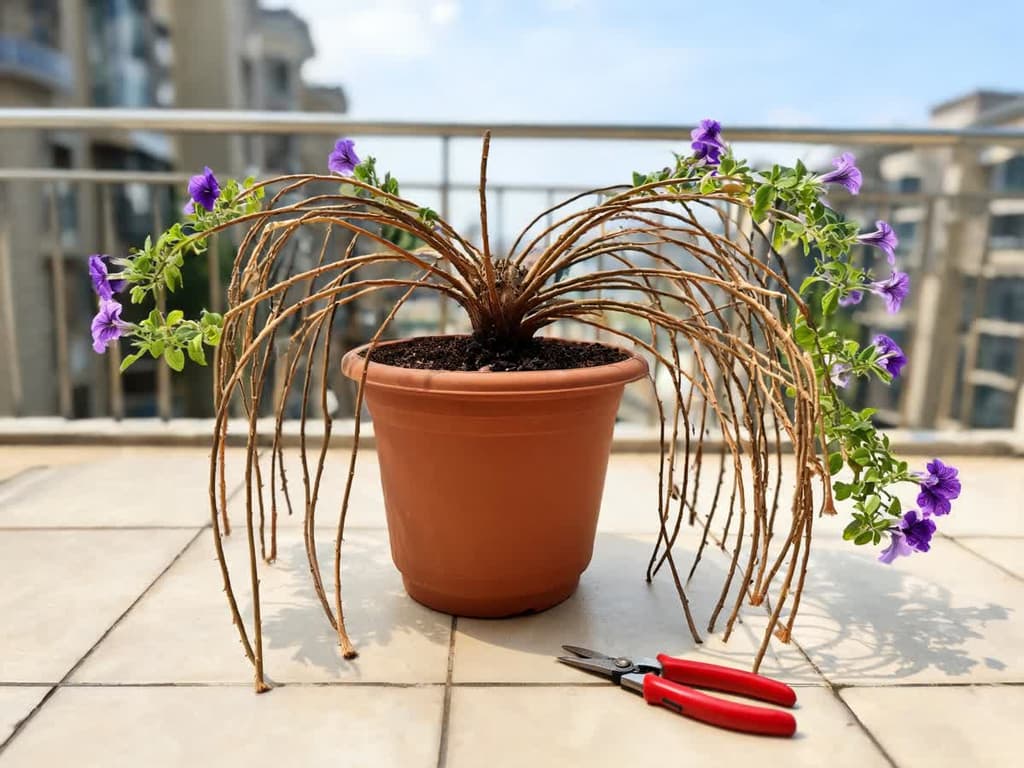
To prune leggy, woody petunias, cut each stem back by half, just above a leaf. On a very stretched plant that still has foliage near the base, you can cut down to 3 to 5 inches (7.5 to 12.5 cm) above the soil. With that cut, leave 4 or 5 nodes (the points along the stem where leaves emerge) and several leaves on each stem. Fertilize and water thoroughly right after. The plant will have few blooms for 1 to 2 weeks, then fill out with new branches and flowers in 2 to 4 weeks.
Rejuvenation pruning shortens a stretched stem by half or more. It triggers the plant to send out new shoots from the nodes along the stem. Agricultural extension services from universities across the United States recommend this cut.
In Brazil, prune when the stem stretches, generally in January, in the middle of summer. Where petunias survived the winter without freezing, prune in August. On a bare, hard stem, cut just above the lowest surviving leaf.
Quick summary:
How much to cut: half the stem. On a very stretched plant with leaves or buds near the bottom, cut down to 3 to 5 inches above the soil, always leaving leaves behind.
Where to cut: just above a leaf or a bud, because that is where the new branch sprouts.
What to expect: 1 to 2 weeks with few blooms, and a full plant again in 2 to 4 weeks. Fertilize and water right after cutting.
Why petunias get leggy and woody-stemmed
Petunias stretch for four reasons: low light, intense heat, age, and lack of pruning. In the shade, they become spindly with few blooms, according to Clemson, Clemson University's extension service. Start with light: in the shade, the plant tends to stretch again after pruning. Move the pot to a spot with direct sun before cutting. The guide on how to care for petunias recommends about 6 hours of direct sun per day.
Heat also exhausts the plant. Ohio State describes warm-weather petunias growing and flowering so quickly that they become spent by late July. At that point, what remains is a thin stem, small leaves, and few flowers. In Brazil, the northern late July corresponds to late January. The University of Missouri notes that petunias struggle in hot, humid summer weather.
Age takes a toll even with good sun. Many petunias spend months in a pot before being sold and arrive already mature. That comes from a Michigan State specialist on Ask Extension, the extension network's question service. Over time, the lower stem sheds its leaves and hardens, and flowers only appear at the tip.
That hard stem is woody growth: the lower section turns brown, firm, and wood-like. A woody stem does not mean a dead stem, and the scratch test tells them apart.
How much to prune: one-third, half, or close to the soil
Cut a leggy petunia back by half the length of each stem. Extension offices differ on the exact measurement:
Light pruning, up to one-third: Cornell directs you to cut long stems back by about one-third in midsummer. The brand Proven Winners calls for removing at most 20% of the plant, though that limit applies to maintenance trimming for Supertunia, the brand's petunia line.
Medium pruning, by half: Clemson advises cutting stems back by half once the plant has stretched out or stopped blooming. The Michigan State response on Ask Extension provides the same measurement.
Hard pruning, near the ground: Penn State leaves only 3 to 5 inches (7.5 to 12.5 cm) of stem, with 4 or 5 nodes. The University of Nebraska leaves 3- to 4-inch (7.5 to 10 cm) stubs with leaves.
This guide uses cutting by half as its standard rule, following Clemson and Michigan State. Hard pruning is reserved for severely stretched plants. Five extension services support hard pruning: Penn State, Nebraska, Missouri, Ohio State, and Clemson. Penn State notes that many petunia varieties respond well to it. One gardening website, Garden Design, states that petunias do not benefit from hard pruning, but cites no source.
A node is the spot on a stem where a leaf attaches. Once the leaf drops, a ring or small scar remains in its place. Penn State counts the nodes remaining on the stem, but no source indicates whether a leafless node on the woody section will resprout.
Stem condition | Where to cut |
|---|---|
Long, with leaves down near the base | By half, just above a leaf |
Severely stretched, with leaves or buds low down | Down to 3–5 inches from the soil, with 4 or 5 nodes and several leaves |
Bare and woody at the base, leaves only at the tip | Above the lowest surviving leaf or bud, in two stages |
Dry, brittle, and showing no green inside | At the base, because the stem is already dead |
How far down to cut woody stems without killing the petunia
Cut woody stems just above the lowest green leaf or bud. Clemson allows cutting petunias back to within a few inches of the base, but cautions against removing every single leaf. An Ask Extension response from an Ohio specialist explains where to make the cut: new growth emerges right above a leaf.
No extension source has tested whether petunias resprout from completely bare, woody stem tissue. Because of that, the safest approach is to decide stem by stem:
With a leaf or bud near the base: cut right above that leaf, even if only a short stub remains.
Bare, with leaves only at the tip: cut just above the lowest surviving leaf and do not cut down into the bare section. If the stem has no leaves or buds anywhere, use the scratch test in the next point.
Dry, brittle: gently scratch the bark with your fingernail. Green underneath is live tissue; brown or black is dead tissue, according to UF/IFAS. A stem with no green at any point can be cut back flush with the base.
For a plant with many bare stems, split the pruning into two stages. Cornell suggests that anyone hesitant should prune just a few long stems at a time. That leaves foliage and flowers intact while the cut stems push new growth. Cut half the stems now and the rest once the first ones begin resprouting, in about 2 weeks.
Cutting every stem down to the ground all at once leaves the plant with no leaves. Clemson warns not to strip all foliage, and no source has documented regrowth starting purely from bare wood.
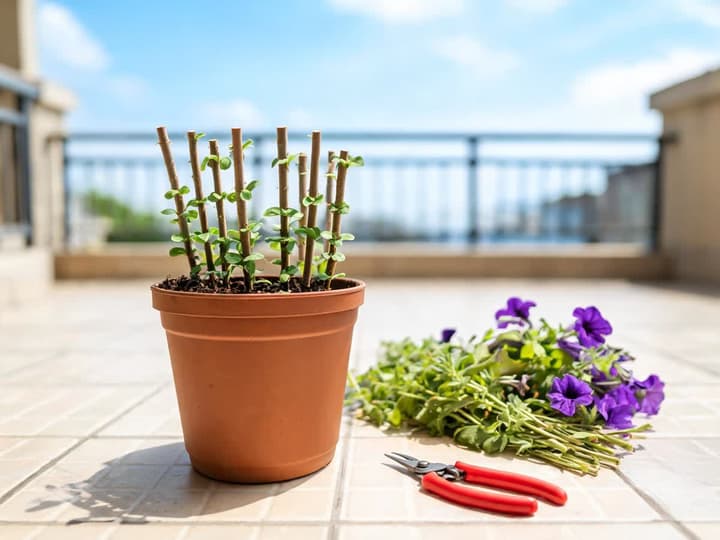
Step-by-step petunia pruning
Get a clean, sharp pair of shears. Pruning shears or kitchen scissors work well. Wash the blades with soap and water beforehand.
Check every stem. Look from the bottom up and locate the lowest green leaf or bud.
Cut 1/4 to 1/2 inch (0.6 to 1.3 cm) above the leaf or lateral bud. Penn State recommends this clearance above a side shoot.
Remove spent blooms and seed pods from any stems you left uncut. The seed pod is the small swelling right under the flower where seeds develop.
Clear debris out of the pot and off the ground. Penn State notes that fallen leaves and flowers sitting on moist soil encourage gray mold (Botrytis), the fungus that rots blossoms and stems.
Fertilize and water deeply. Apply water-soluble fertilizer at the package rate and water until moisture drains from the bottom hole.
If the sun is intense, shelter the plant for 1 or 2 days. An Ask Extension answer notes that moving freshly pruned plants out of harsh sun for a couple of days can help. Then return them to direct sun.
Gray mold develops on petunias when rotting flower debris rests on damp soil:
After pruning, check the soil before watering. Petunias in pots and hanging baskets dry out faster than those in garden beds, according to Proven Winners. See how to water petunias using the soil test in pots, hanging baskets, and garden beds.
When to prune petunias in Brazil
Prune when the stems get leggy with flowers only at the tip, at any time the petunia is growing. Cornell and the University of Nebraska state that petunias begin to stretch in midsummer, which is July there. In Brazil, midsummer is January.
For warm-climate petunias, Ohio State recommends hard pruning in late July or early August. In Brazil, this corresponds to late January and early February. Pruning at this time brings back blooms in late summer and fall, according to the same source.
Where it does not freeze, petunias can survive the winter and emerge leggy in the spring. For this plant, do a renewal pruning in late winter, which in Brazil is August, as explained in the petunia winter care guide. Where it freezes, prune only after the last frost.
How long petunias take to bloom again after pruning
Pruned petunias bounce back full of branches and flowers in 2 to 4 weeks. Cornell warns, for a one-third cutback, that you lose some flowers for 1 to 2 weeks. The University of Nebraska states that in 2 to 4 weeks the plant is full of side branches and blooming again.
Light trims bounce back faster: Proven Winners cites 7 to 10 days for Supertunia plants trimmed by no more than 20%. Hard cutbacks need the longer timeframe reported by the University of Nebraska.
When starting fresh from petunia cuttings makes more sense
Start over from cuttings (a piece of stem cut to root and form a new plant) when nearly all stems are bare and woody. In that state, too few leaves remain for the plant to push new growth. The tips removed during pruning work as cuttings right away. Learn how to propagate petunias from stem cuttings using only soft stem growth.
Petunias are tender perennials, according to NC State: they live more than a year only where it does not freeze. No source states how many years the same plant continues to flower well. Taking cuttings during pruning and keeping the old plant until the cutting roots is the safest option.
Pinching young starts to encourage branching
Pinching means removing just the stem tip with your fingers so the seedling branches out from the sides. On a young seedling, remove the top 1 inch (2.5 cm) before planting. UF/IFAS, the University of Florida extension, and Clemson give this measurement.
The University of Nebraska offers another guideline: remove the first and second sets of leaves from the top. In both approaches, make the cut directly above a leaf. The University of Illinois explains that pinching keeps the plant shorter and bushier.
Deadheading is not the same as pruning petunias
Deadheading means pulling off the wilted flower along with the stem, because the seed develops right below the flower. Pruning cuts back the length of the stem. Mississippi State instructs removing the entire stem at the base, because the seed pod sits right below the flower. Deadheading extends blooming, according to the same source, and the guide on how to make petunias bloom shows what else matters most.
Not every petunia needs this. UF/IFAS says that large-flowered and double petunias need it, and that many small-flowered varieties are self-cleaning: the dried flower drops on its own. The Wave series blooms all summer without pruning, according to the University of Missouri and the factsheet from Ball, the company that produces the seed.
Proven Winners advises trimming all of its petunias several times a season, including Supertunia, which drops spent blooms on its own. No source has tested rejuvenation cutbacks on Wave or Supertunia petunias. If either becomes stretched and bare at the base, the safest path is the rule in this guide: cut the stem by half, right above a leaf.
Is your plant really a petunia?
Not every long-stemmed purple potted flower is a petunia. Calibrachoa belongs to a different genus and is confused with petunias, according to NC State. Cornell groups the two together for the one-third pruning cut.
Lavender and sage also develop woody stems, but the pruning method in this guide applies strictly to petunias; do not use it on them. Before cutting deeply into an unlabeled plant, confirm the species. Bloom (available for iOS) identifies plants from a photo, and the free version includes 2 identifications per month.
Frequently asked questions about pruning petunias
Can I cut petunias all the way to the ground?
Do not cut all stems down to ground level. Penn State leaves 3 to 5 inches above the soil, with 4 or 5 nodes and several leaves per stem. Clemson stresses never removing every leaf. Dry stems with no green tissue inside are the only ones you should cut down to the base.
How do you prune petunias in hanging baskets?
Prune basket petunias just like potted ones: cut trailing stems back by half, right above a leaf. If the entire basket is bare, prune half the stems today and the rest in about 2 weeks. That keeps the basket from losing every flower at once. Fertilize and water thoroughly afterward.
What happens if you do not deadhead petunias?
Large-flowered petunias set seed and produce fewer blooms. Mississippi State explains that spent blossoms leave a seed pod directly underneath them. On small-flowered petunias and the Wave series, plants clean themselves naturally and continue blooming.
Are trailing petunias different from regular petunias?
Trailing petunias have long stems that spill over the edges of containers, as seen in the Wave series. The Wave series flowers without pruning, according to the University of Missouri. No published source has tested pruning on Wave petunias. If a trailing petunia stretches out and drops its lower leaves, the safest option is the same rule: cut stems back by half, above a leaf.
Summary: how to prune leggy petunias
To prune leggy, woody petunias, cut the stems back by half, directly above a leaf. On very stretched plants, cut down to 3 to 5 inches above the soil, preserving 4 or 5 nodes and several leaves. Prune bare stems above the lowest leaf in two separate stages. Fertilize and water deeply: within 2 to 4 weeks the plant will be bushy and blooming again.
Related articles
How to Care for Hibiscus: Sun, Watering, Fertilizer, and Pruning for Flowers
How to care for hibiscus: 6 hours of direct sun, evenly moist soil without waterlogging, half-strength fertilizer in spring and summer, and pruning in early spring. Find out why the flower lasts one day and why buds drop before opening.

Do Ferns Like Sun or Shade? It Depends on the Type
Ferns prefer bright shade: plenty of light, but no direct sun on their fronds. Tuberous sword fern is the exception that handles sun. Here is the ideal light for each type, where to place pots, and how fronds show too much or too little light.

African Violet Yellow Leaves: Causes and What to Do
Yellow leaves on an African violet usually stem from overwatering, and the first place to check is the center of the plant. Losing one lower leaf at a time is normal. Identify whether age, watering, cold water, sunlight, cold drafts, or fertilizer is the culprit based on the yellowing pattern, and see what to do today.