How to Care for Amaryllis: Planting Bulbs, Light, Watering, and Reblooming
How to care for potted amaryllis: bulb planting, bright sun, watering by growth phase, what to do after flowers fade, and the cool resting period for repeat blooms.
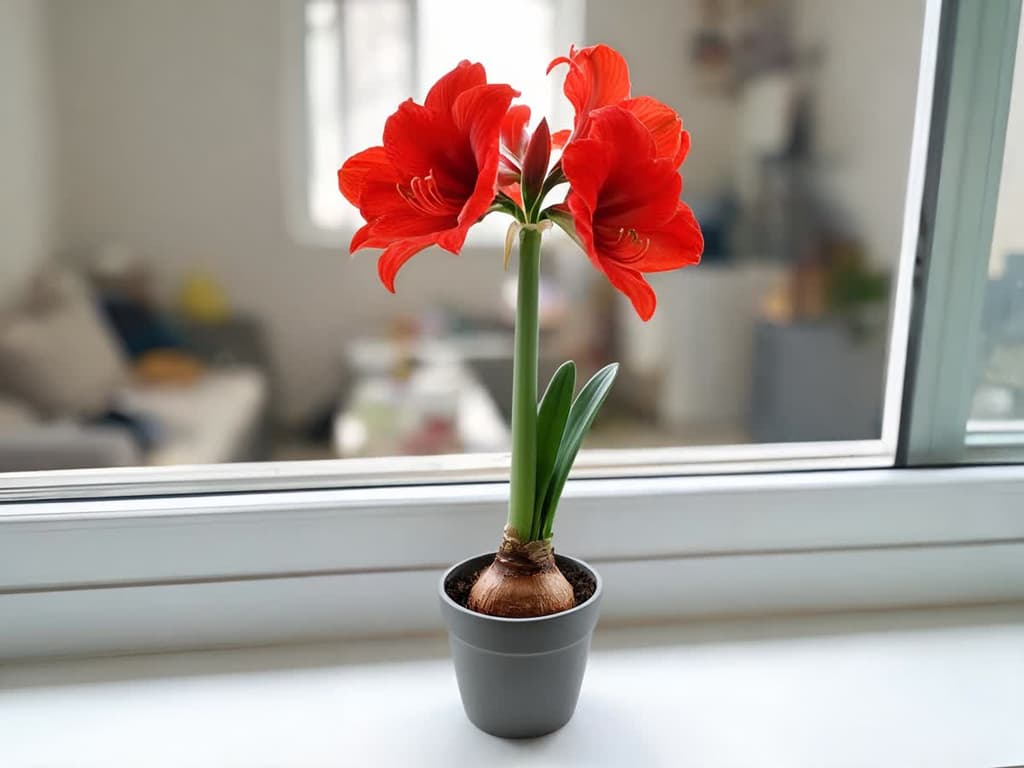
To care for an amaryllis, plant the bulb in a pot only slightly larger than itself, leaving the top part of the bulb out of the soil. Place the pot in the brightest spot in the house, with a few hours of direct sun while the plant is growing. Water sparingly until the shoot appears, and then water whenever the top layer of soil dries out. Once the flower fades, cut off the stalk and keep the leaves intact: they produce the food the bulb stores for the next bloom cycle.
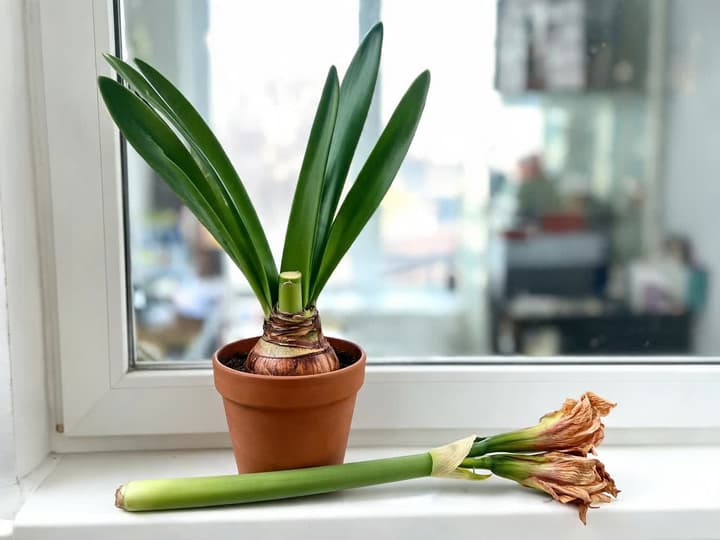
If your amaryllis flowers have withered and only the green stalk with leaves remains, your plant is not dying. Cut the flower stalk, keep watering, and place the pot in the sun. Do not throw the bulb away if its base feels firm when squeezed. A firm bulb can bloom again, provided the leaves spend a few months in the sun and it goes through a cool period afterward.
The numbers in this guide come from university extension services in the United States, university programs that publish guidance for plant growers. The main ones are NC State (North Carolina State University), Iowa State, UF/IFAS (University of Florida), and UW-Madison (University of Wisconsin). They also come from the Royal Horticultural Society (RHS, the British horticultural society) and the New York Botanical Garden. These sources are from the Northern Hemisphere. For this reason, the guide refers to seasons and only cites a month when it specifies "in Brazil."
Quick summary:
Light: a few hours of direct sun while the plant grows; no direct sun while it is in bloom.
Watering: sparingly until the shoot appears; after that, when the top of the soil dries out; little to none during dormancy (the phase where the bulb stops growing).
Planting: a pot with a drainage hole that is only 1 to 2 inches wider than the bulb; one-third to one-half of the bulb above the soil.
After flowering: cut the stalk, keep the leaves, fertilize every 2 to 4 weeks.
To bloom again: 8 to 10 weeks at around 50 to 55 °F (10 to 13 °C).
Pets: toxic to dogs and cats.
Care | What to do |
|---|---|
Light | Direct sun for a few hours during growth; bright light without direct sun during flowering |
Watering | Sparingly until sprouting; when the soil surface dries during growth; little to none during dormancy |
Temperature | 70 to 75 °F (21 to 24 °C) for growth; 60 to 65 °F (15 to 18 °C) prolongs blooms; damage below 35 °F (1.7 °C) |
Fertilizer | Only after flowering, as long as green foliage is present |
Toxicity | Toxic to dogs, cats, and horses (lycorine) |
Size | Up to around 24 inches tall (University of Maryland) |
Which amaryllis do you have: Hippeastrum or Amaryllis belladonna
Potted amaryllis, sold as a gift bulb or already in bud, is a Hippeastrum (its scientific name), a plant native to South and Central America. In Brazil, it is also called açucena. The common name causes confusion because there is another genus (a group of related species) called Amaryllis, with two species from South Africa, according to NC State.
Amaryllis belladonna is a full-sun bulb, most often planted in gardens, according to the plant profile from NC State. Its leaves dry up before the stalk appears, and the flowers are light pink and fragrant, with 6 to 12 per stalk. If your plant has large red, white, pink, or striped flowers and came in a pot, it is a Hippeastrum. That is what this guide covers. To check which one you have, compare the profile for Amaryllis belladonna with the one for the genus Hippeastrum, the amaryllis, which describe both plants separately.
Hippeastrum has two regions of origin: eastern Brazil and the Andes of Peru, Bolivia, and Argentina, according to UW-Madison. Brazil has about 35 recognized species, most of them in the Atlantic Forest, and 15 of them are endemic, meaning they exist nowhere else. This data comes from a study on new Atlantic Forest species. The hybrids (plants crossed to produce larger flowers) sold in pots come from only a few species, and the same study cites the Netherlands and South Africa among the major exporters. Brazil also produces amaryllis bulbs, according to UF/IFAS.
The amaryllis bulb cycle
An amaryllis lives in a four-stage cycle, and every care step in this guide depends on the phase the bulb is currently in:
Bloom: the stalk rises and opens 2 to 4 flowers (University of Maryland); each flower lasts about 2 weeks, according to UF/IFAS.
Leaves: after the flowers fade, the long leaves produce food that the bulb stores. This is the longest phase, lasting several months.
Dormancy: the bulb stops growing during a cool period. The leaves may wither or stay green.
Reblooming: returned to warmth and water, the bulb sends up another stalk in 4 to 6 weeks, according to UW-Madison.
The bulb you buy has already gone through dormancy and is ready to bloom, according to the University of Maryland. In the Northern Hemisphere, it is prepared to open at Christmas, which falls in winter there. In a Northern Hemisphere garden, the amaryllis returns to its natural rhythm and blooms in spring there, according to NC State. In Brazil, spring begins in September, but no source in this guide has measured when a potted amaryllis blooms on its own in the Brazilian climate.
How to plant an amaryllis bulb
Choose a large, firm, dry bulb without mold, soft spots, or dark blemishes. Larger bulbs usually produce 2 or 3 stalks, according to Iowa State. To plant the amaryllis bulb:
Pot: with a drainage hole at the bottom and only 1 to 2 inches wider than the bulb (Iowa State). Amaryllis blooms better when roots are slightly snug (University of Maryland). Choose a heavy pot: the flowering stalk easily tips lightweight containers.
Soil: well-draining potting soil (potting mix). Moisten it before planting, as bone-dry soil repels water (Michigan State).
Planting depth: leave one-third to one-half of the bulb above the soil line, with the pointed end facing up. The neck (the narrow top part) must always stay exposed.
Watering: water thoroughly once and do not water again until the shoot emerges. If the soil dries out completely before that, moisten it just enough so it becomes barely damp (Iowa State).
How much of the bulb remains exposed is the point where sources disagree the most. UF/IFAS advises leaving one-fourth to one-third exposed so water does not enter through the top. Iowa State, UW-Madison, and NC State advise leaving half, and the RHS mentions two-thirds. This guide follows the range of one-third to one-half, which falls between UF/IFAS (the lower extreme) and Iowa State, UW-Madison, and NC State (the upper extreme). In pots, all sources instruct keeping the neck out of the soil.
Gift kits typically include a coir disc that yields too little growing medium for the bulb, according to Iowa State. If the kit's pot lacks a drainage hole, remove the bulb and plant it in a pot with drainage. A newly purchased bulb blooms 6 to 8 weeks after planting (Iowa State).
Waxed bulb and bulb in a glass vase with water
A waxed bulb is an amaryllis bulb coated in colored wax that blooms without soil and without water. Just place it in bright indirect light and rotate it every few days so the stalk grows straight. Stalks appear in 4 to 6 weeks, according to Iowa State. Do not buy a waxed bulb that already has an open flower or a dry stalk.
Iowa State treats the waxed bulb as single-use and advises discarding it after the bloom. The same university explains how to try saving it. Carefully remove the wax without tearing off the small roots at the base, and discard the bulb if there are soft, sunken, or dark areas. A firm bulb can go into a pot like any other. NC State suggests first placing it in a shallow dish of water until it puts out roots, with no guarantee that it will bloom again. This guide follows what both extension services share: it is only worth trying with a firm bulb, and without counting on blooms the following year.
The bulb also blooms in a glass vase over pebbles. The University of Vermont instructs placing 2 to 3 inches of pebbles at the bottom and resting the bulb on top. Water comes up only to touch the roots. In glass with pebbles, the base of the bulb never sits in water. During blooming, top off the water every 2 to 3 days, always keeping it below the base, according to the University of Kentucky.
Light and temperature for amaryllis
Amaryllis needs bright light and a few hours of direct sun while growing. Thin, floppy leaves are a sign of low light, and this weakened bulb may not bloom the following year, according to the University of Maryland. The same source calls strong sun the most important factor for the plant to bloom year after year. In Brazil, north-facing windows receive the most sun. The Chicago Botanic Garden suggests bright indirect light, but this guide follows the University of Maryland and Iowa State, which call for direct sun: they are university extensions, and Maryland links strong sun to yearly blooming.
During flowering, the rule shifts. Move the pot out of direct sun and place it in a cooler spot, between 60 and 65 °F (15 to 18 °C), to make blooms last longer (RHS). Heat above 65 °F (18 °C) shortens the flowering period, according to the University of Maryland. While shoots and leaves develop, Iowa State and NC State recommend 70 to 75 °F (21 to 24 °C), and UW-Madison recommends 65 to 70 °F (18 to 21 °C). Both ranges overlap at 70 °F (21 °C), a standard indoor room temperature.
Below 35 °F (1.7 °C), amaryllis suffers damage, according to NC State. UF/IFAS and UW-Madison recommend amaryllis in the garden only for zones 8 through 10 in the United States, regions with mild winters. Where frost occurs, keep the pot indoors on cold nights.
When moving the pot outdoors after flowering, acclimate the plant gradually. Start in sheltered shade and increase the sun over 7 to 10 days (Iowa State). Provide morning sun and afternoon shade, with no direct midday sun, according to the Chicago Botanic Garden.
Watering amaryllis in each bulb phase
Watering amaryllis shifts with the bulb's phase, and a fixed schedule in days does not work across all phases shown in the table below. Most sources cited in this guide judge watering time by the soil, not calendar days.
Phase | How to water |
|---|---|
Planting until shoot emergence | Water thoroughly once; after that, nothing or just enough so the soil does not dry out entirely |
Shoots, leaves, and flowers | Water when the top of the soil dries out; never leave standing water in the saucer |
Leaves after flowering | Continue watering when the top dries out and apply fertilizer |
Dormancy | Dry dormancy (foliage dies back): completely dry soil until the tip of a new stalk appears. Green dormancy (foliage stays): reduced watering and bright light (RHS) |
Before shoots emerge, the bulb is still establishing roots and uses little water (NYBG). UF/IFAS instructs not to water again until the bulb sprouts, and UW-Madison warns that overly wet soil rots the bulb. Iowa State and the University of Maryland allow minimal watering to keep the soil barely moist. This guide follows the safest route against rot: no watering until sprouting occurs, and if the soil dries out completely, only the bare minimum to moisten it. Once the shoot exceeds 2 to 3 inches, let the top half-inch of soil dry between waterings (University of Maryland). When watering, soak the surrounding soil without pouring water onto the top of the bulb.
Fertilizing amaryllis
Do not fertilize before blooming, according to the University of Maryland and UF/IFAS. The time to fertilize is after flowering, while the foliage remains green. Iowa State recommends a balanced fertilizer (with equal parts nitrogen, phosphorus, and potassium) diluted to half strength, applied every 2 to 4 weeks.
Sources vary on feeding frequency: the RHS recommends fertilizing weekly, while the Chicago Botanic Garden and UW-Madison advise once a month. This guide follows Iowa State, a university extension service whose 2-to-4-week interval sits between both extremes. Excessively strong fertilizer builds up salts and scorches roots, according to UW-Madison. Stop fertilizing once dormancy begins.
What to do when amaryllis flowers fade
When blooms wither, cut off the stalk and preserve all green leaves. The leaves produce the food stored by the bulb to bloom again (Iowa State). The steps are:
Faded flowers: remove each flower as it withers, along with the swollen part just beneath it where the seed would form (UW-Madison). Setting seed depletes the bulb's energy, and the subsequent bloom can be greatly reduced, according to UF/IFAS.
Stalk: trim the flower stalk 1 to 2 inches above the bulb using a clean knife or pruners, being careful not to nick the leaves (Iowa State).
Leaves: do not cut away any green leaves.
Location: move the pot to the sunniest spot you have and water when the top of the soil dries out.
Fertilizer: feed every 2 to 4 weeks with a balanced fertilizer diluted to half strength (Iowa State) until dormancy begins.
Sources diverge on the timing for cutting the stalk. Iowa State, the University of Maryland, and the RHS cut it as soon as the blossoms finish. NDSU (North Dakota State University) and the New York Botanical Garden wait until the stalk turns yellow. This guide trims the stalk promptly, matching Iowa State, the University of Maryland, and the RHS, because UF/IFAS warns that a stalk setting seed can substantially reduce subsequent flowering. No source ever advises cutting green leaves.
Dormancy and reblooming amaryllis
For an amaryllis to bloom again, the bulb needs months of leaves soaking up sun and, according to most sources, a cool resting period afterward. No source specifies the exact minimum number of leafy months required: Iowa State refers simply to spring and summer in the northern hemisphere. For dry dormancy, stop watering and fertilizing and move the pot to a location kept at 50 to 55 °F (10 to 13 °C) for 8 to 10 weeks (Iowa State and NC State). Sources suggest basements, garages, or closets as examples (UW-Madison, RHS). Cut off foliage only after it turns brown (Iowa State). After this period, return the pot to a bright, warm location at 70 to 75 °F (21 to 24 °C), and resume watering. The new stalk appears in 4 to 6 weeks (UW-Madison).
Sources disagree on whether dormancy is mandatory. For the University of Maryland and NC State, it is required. Under the University of Maryland method, watering ceases, foliage yellows, and the bulb rests in a cool, dry place. Conversely, UW-Madison and the New York Botanical Garden state that commercial hybrids can bloom without a dormant period. For those two sources, dormancy serves solely to dictate when blooms open. Iowa State and the RHS outline both paths: drying the plant off or keeping it evergreen in a bright spot at 50 to 55 °F (10 to 13 °C).
This guide follows the 8 to 10 week cool period because most extension services recommend it, including UW-Madison, which treats it as optional. In a study with stored dry bulbs (Kuehny and Miller, Acta Horticulturae), two varieties stored at 5, 9, or 13 °C produced good-quality plants. A third variety produced good plants only at 5 or 9 °C. Therefore, if you can choose, prefer the cooler spot within the 10 to 13 °C (50 to 55 °F) range. Drying off the leaves or not is your choice: sources accept both. In an apartment without a cool spot, keep the plant green, watered, and in the sun. UW-Madison states that commercial hybrids bloom this way, but the timing of the bloom is not under your control.
In Brazil, the natural cool period is winter, from June to August. Winter temperatures vary widely from region to region, and none of the sources in this guide tested amaryllis in the Brazilian climate.
Yellow leaves on amaryllis: dormancy or a problem
Yellow foliage on an amaryllis is normal when it occurs after months of green growth, marking the onset of dormancy. When watering stops, the leaves naturally turn yellow and dry up, after which they can be removed, according to the New York Botanical Garden. The Chicago Botanic Garden recommends waiting until a leaf has yellowed completely before pulling it off.
Before taking action, squeeze the base of the bulb between two fingers and compare what you observe with the table below:
What you see | What it usually means | What to do |
|---|---|---|
Leaves gradually yellow months after flowering; firm bulb | Onset of dormancy | In dry dormancy, stop watering and let leaves wither; in green dormancy, simply cut back watering |
Thin, elongated, floppy leaves; firm bulb | Insufficient light | Provide a few hours of direct sunlight daily during active growth |
Yellow leaves in strong sunlight outdoors | Excess sun (UF/IFAS) | Provide light afternoon shade only if you want to preserve the foliage; strong sun promotes blooming (UF/IFAS) |
Soft bulb with foul odor or sunken, darkened areas | Rot | Discard the bulb |
Red lesions that expand and sink into the tissue | Red blotch (fungus) | Consult the pests and diseases section |
None of the sources cited in this guide describe what happens when foliage turns yellow from overwatering on an actively growing plant. When in doubt, the safest option for the bulb is watering only after the soil surface dries out. The bulb gives the most reliable signal. A firm bulb can recover, while a soft bulb smelling foul must be discarded, according to NC State and Iowa State.
Weak or toppling amaryllis flower stalk
When an amaryllis flower stalk leans or topples, squeeze the bulb base before doing anything else. If the bulb feels firm, the issue lies in the stem itself. If the bulb feels mushy and emits an odor, the root cause is rot.
An amaryllis stem is hollow and supports heavy blossoms. It bends toward the window and flops when it grows spindly. Weak, elongated stems usually point to insufficient light or excess moisture, according to the Chicago Botanic Garden. UW-Madison, which recommends 65 to 70 °F (18 to 21 °C) during active growth, ties higher temperatures to weaker stems and smaller blooms. To stabilize the stem:
turn the pot every day while the stalk grows (Iowa State);
stake the stalk using soft plant ties, avoiding piercing the bulb (University of Maryland);
use a heavy container or line the bottom with gravel (UF/IFAS).
A soft, blackened, or foul-smelling base indicates bulb rot. Rot develops from soil remaining waterlogged for extended periods, according to UW-Madison. If the bulb is soft, discard it, as advised by NC State and Iowa State for rotting bulbs. If the stalk snapped but the bulb is firm, maintain the leaves and watering, and place the severed flower stalk in a vase or glass of water.
Amaryllis pests and diseases
One of the most common diseases of potted amaryllis is red blotch, caused by the fungus Stagonospora curtisii (UW-Madison). It begins as red spots on the stalk and leaves, which enlarge, elongate, and become sunken, according to UF/IFAS. The fungus comes on the bulb itself and appears more often on plants kept in the shade and watered frequently.
Not every red marking is a disease: virtually any physical injury on an amaryllis produces red pigmentation, according to UF/IFAS. For red blotch, UF/IFAS advises discarding heavily affected bulbs, watering without wetting the foliage, and using sterile potting soil. When buying bulbs, reject those with dark reddish-brown blotches.
Among pests, NC State lists mealybugs (white insects covered in powdery, cotton-like wax), bulb mites, and narcissus bulb flies. Slugs and snails appear when the pot sits outdoors. UF/IFAS recommends picking insects off by hand and resorting to insecticides only when handpicking fails to resolve the infestation.
Red blotch and mechanical damage can look identical on a leaf or flower stem. Bloom (available for iOS) identifies plants from photos, and the Premium plan diagnoses diseases from pictures of plant symptoms.
Is amaryllis toxic to cats and dogs?
Yes. Amaryllis is toxic to dogs, cats, and horses, according to the ASPCA, the American Society for the Prevention of Cruelty to Animals. The toxic principle is lycorine, and the signs are vomiting, diarrhea, abdominal pain, hypersalivation, loss of appetite, lethargy, and tremors. NC State confirms the risk for Hippeastrum and states that the bulb is the most toxic part of the plant.
Keep bulbs and trimmed foliage well out of reach of dogs and cats. Amaryllis is just one of several common houseplants dangerous to household pets. Our guide to toxic plants for pets highlights the others.
When to repot an amaryllis
An amaryllis can remain in the same container for 2 years or longer, according to UF/IFAS. The RHS recommends repotting every 2 to 3 years. The best time is after dormancy, just as the bulb resumes growth (UW-Madison). Move the bulb to the next container size up, only slightly larger (NYBG), with a drainage hole at the bottom. In years without repotting, the RHS advises replacing just the top 1 to 2 inches of soil with fresh potting mix.
Over time, the bulb produces lateral offsets (bulblets). Those that reach one-fourth to one-third the size of the parent bulb can be separated and potted up, typically blooming within 2 years (UF/IFAS). The RHS estimates 3 to 4 years. The University of Maryland provides the benchmark: an offset blooms only after reaching 3 to 4 inches in diameter.
Frequently asked questions about amaryllis
What should you do with an amaryllis bulb after it finishes blooming?
Cut the stem 1 to 2 inches above the bulb and keep all leaves. Place the pot in the sun, water when the surface soil dries, and feed every 2 to 4 weeks. After several months of green foliage, store the bulb for 8 to 10 weeks in a location held around 50 to 55 °F (10 to 13 °C). Most extension services recommend this cool period to encourage an amaryllis to rebloom.
How many years does an amaryllis take to bloom?
It depends on where the plant begins. A commercially bought, mature bulb blooms 6 to 8 weeks after planting (Iowa State). An offset separated from the main bulb takes 2 years (UF/IFAS) to 3 or 4 years (RHS). An amaryllis grown from seed can take up to 6 years to bloom, according to the RHS.
Can amaryllis stay outdoors?
It can, once flowering finishes and danger of frost has passed, as temperatures below 35 °F (1.7 °C) cause tissue damage. Acclimate the pot to outdoor sun gradually over 7 to 10 days, starting in shade. Morning sun and afternoon shade work best. Outdoors, monitor for slugs and snails, which feed on leaves and flowers.
Does an amaryllis rebloom every year in a pot?
It does, provided the bulb stores enough food reserves again. To achieve that, leaves need months of sunshine and fertilizer after blooms finish, and most sources prescribe a cool rest of 8 to 10 weeks. When a bulb only grows leaves, Iowa State cites two potential reasons: inadequate energy reserves stored during the previous cycle or skipping the cool resting period.
How to care for an amaryllis year-round
Amaryllis is a bulb plant that cycles through flowering, foliage development, and dormancy, with each phase demanding distinct care. Plant with part of the bulb exposed, give it strong sun while it grows, and water sparingly until shoots emerge. After blooming, trim the stalk, keep the leaves in the sun, and fertilize. Close the cycle with 8 to 10 weeks in a cool resting area. At any stage, a mushy, foul-smelling bulb indicates rot, requiring immediate disposal.
Related articles

How to Care for Hibiscus: Sun, Watering, Fertilizer, and Pruning for Flowers
How to care for hibiscus: 6 hours of direct sun, evenly moist soil without waterlogging, half-strength fertilizer in spring and summer, and pruning in early spring. Find out why the flower lasts one day and why buds drop before opening.

Do Ferns Like Sun or Shade? It Depends on the Type
Ferns prefer bright shade: plenty of light, but no direct sun on their fronds. Tuberous sword fern is the exception that handles sun. Here is the ideal light for each type, where to place pots, and how fronds show too much or too little light.

African Violet Yellow Leaves: Causes and What to Do
Yellow leaves on an African violet usually stem from overwatering, and the first place to check is the center of the plant. Losing one lower leaf at a time is normal. Identify whether age, watering, cold water, sunlight, cold drafts, or fertilizer is the culprit based on the yellowing pattern, and see what to do today.