18 Hard Orchids | 2026 Guide
Find 18 hard orchids. Complete guide for your garden.
18 Orchids with hard level
18 plants found
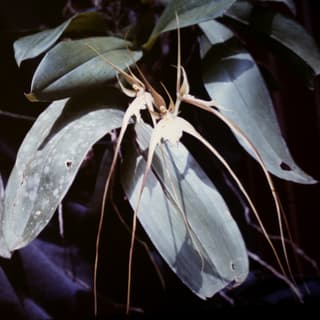
Spider Orchid
Brassia caudata
Brassia caudata, commonly known as the Spider Orchid, is a neotropical epiphytic orchid native to southern Mexico, Central America, the Caribbean, and northern South America. Its striking flowers feature long, spider-leg-like sepals and petals in yellow with brown markings, reaching up to 15 cm in length. It is a slow-growing evergreen perennial that blooms primarily in spring and summer.
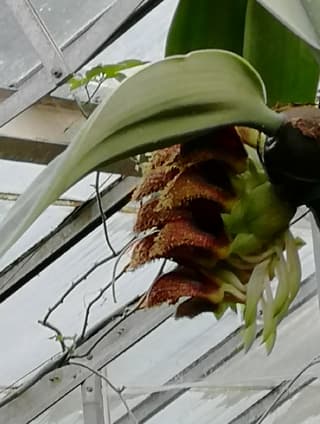
Stinking Orchid
Bulbophyllum phalaenopsis
Bulbophyllum phalaenopsis is one of the largest orchids in the Bulbophyllum genus, native to the tropical rainforests of New Guinea. It is notorious for its massive leaves, which can exceed 60 cm in length, and for its flowers that emit a powerful putrid odor — an evolutionary strategy to attract fly pollinators. Despite its unusual smell, it is a prized specimen among serious orchid collectors.
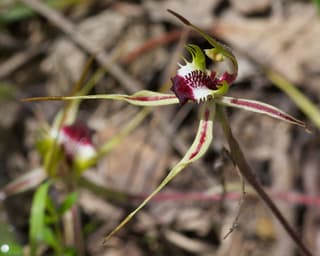
Small Spider-orchid
Caladenia parva
Caladenia parva is a small terrestrial orchid endemic to southeastern Australia, found in scattered areas of southern Victoria and the far southeast of South Australia. It is a deciduous perennial herb with a single underground tuber and a single narrow leaf 3 to 10 cm long, usually with small red spots at the base. Between September and November (southern spring), it produces one or two greenish flowers with red stripes on a 5 to 15 cm stem, featuring a greenish-white labellum with a curled dark red tip. It grows in open forests, woodlands, and coastal vegetation in well-drained sandy-clay soils.
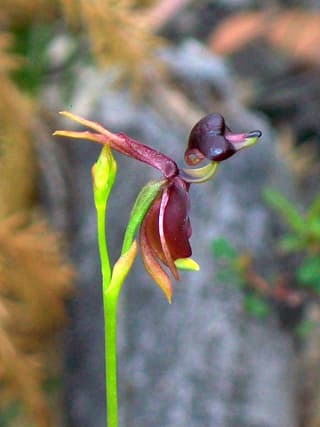
Flying Duck Orchid
Caleana major
The Flying Duck Orchid (Caleana major) is one of the most extraordinary flowering plants in the world. Native to eastern and southern Australia, this small terrestrial orchid produces remarkable reddish-brown flowers whose labellum bears a striking resemblance to a duck in flight. It grows 20–40 cm tall and flowers from spring through summer. Pollination occurs via male sawflies that are deceived into pseudocopulation with the duck-shaped labellum.
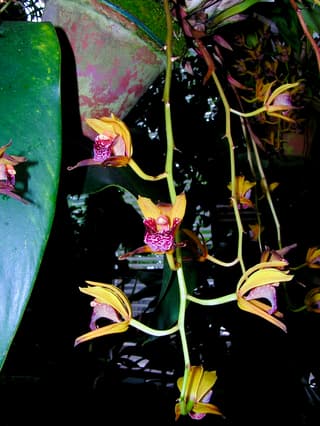
Devon's Cymbidium
Cymbidium devonianum
Devon's Cymbidium (Cymbidium devonianum) is an epiphytic orchid native to the Himalayan foothills of Nepal, northeast India, Bhutan, and Myanmar. It is prized for its striking pendant flower spikes bearing 15–35 blooms in yellow-green with purple-red markings, making it one of the most distinctive species in the Cymbidium genus.
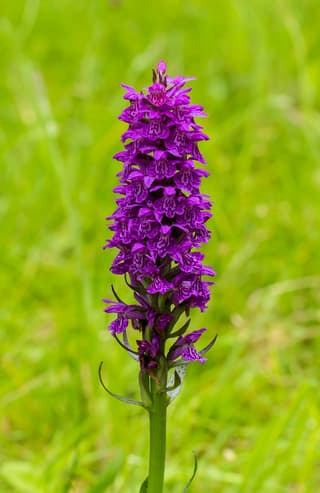
Heath Spotted Orchid
Dactylorhiza maculata
Dactylorhiza maculata, the heath spotted orchid, is a terrestrial tuberous perennial orchid native to Europe. It thrives in heathlands, damp meadows, bogs, and marshes, producing dense spikes of pale pink to deep purple flowers with characteristic dark markings on the labellum. Its leaves are distinctively spotted.
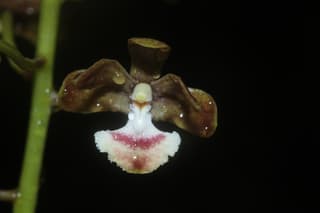
Virot's Dendrobium
Dendrobium virotii
Dendrobium virotii is a rare endemic orchid from New Caledonia, first described by Guillaumin in 1941. A medium-sized epiphyte, it grows on tree trunks in montane rainforests and scrubland at elevations from sea level to 1,000 meters. Its slightly zigzag, branching stems carry elliptic, clasping leaves, and in late spring it produces small racemes of 6 to 22 delicate flowers.
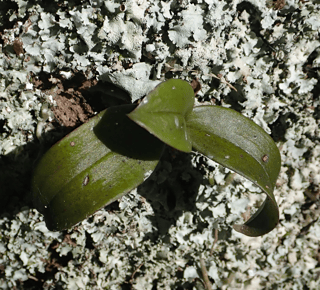
Green Fleshy Tree Orchid
Drymoanthus adversus
Drymoanthus adversus, commonly known as the Green Fleshy Tree Orchid, is a miniature epiphytic orchid endemic to New Zealand. It grows attached to tree trunks and branches in coastal to montane forests, forming compact tufts of dark green, fleshy leaves sometimes spotted with purple. In spring and early summer it produces small racemes of greenish-white flowers flecked with red.
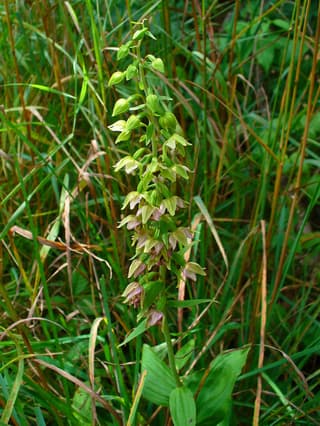
Broad-leaved Helleborine
Epipactis helleborine
Epipactis helleborine, commonly known as the broad-leaved helleborine, is a terrestrial orchid native to Europe and Asia. It grows in woodland settings, relying on mycorrhizal fungi for germination and survival. Its tall stems bear broad, ribbed leaves and a drooping raceme of greenish-purple flowers that bloom in summer.
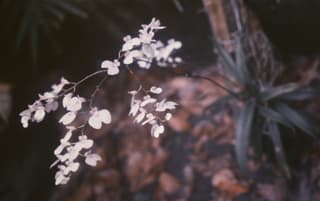
Delicate violet orchid
Ionopsis utricularioides
Ionopsis utricularioides is a small epiphytic orchid native to the Neotropics, from Florida and the Caribbean through Central and South America. It forms compact fans of stiff leaves and sends up airy, branched sprays of many small white-to-violet flowers, each with a broad, veined lower lip.
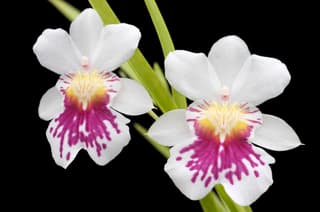
Pansy Orchid
Miltoniopsis phalaenopsis
Miltoniopsis phalaenopsis, commonly known as the Pansy Orchid, is a cool-growing epiphytic orchid native to the cloud forests of the Colombian Andes. Its large, flat blooms closely resemble garden pansies and come in shades of white, yellow, pink, red and purple with distinctive waterfall patterning. It is considered one of the most beautiful orchids in cultivation but requires cool temperatures and high humidity.
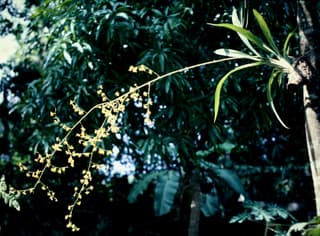
Bauer's Dancing Lady Orchid
Oncidium baueri
Oncidium baueri is an epiphytic orchid native to South America, celebrated for its graceful sprays of yellow and brown dancing-lady flowers that sway gently in the breeze. First described by Lindley in 1833, it is widely prized in orchid collections worldwide for its reliable flowering and elegant form.
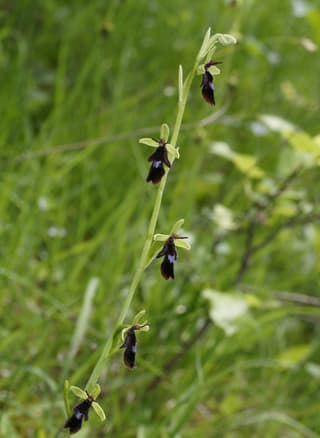
Fly Orchid
Ophrys insectifera
Ophrys insectifera, commonly known as the fly orchid, is a European terrestrial species notable for its pollination strategy. Its flowers have evolved to visually and chemically mimic the females of certain wasp and fly species, tricking males into performing pseudocopulation, which ensures pollen transfer. It is a small plant with a rosette of basal leaves and a slender inflorescence.
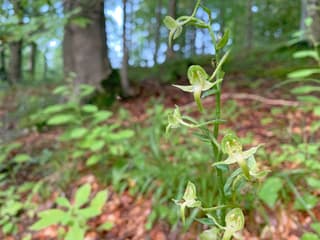
Greater Butterfly-orchid
Platanthera chlorantha
The Greater Butterfly-orchid (Platanthera chlorantha) is a tuberous orchid native to European forests, calcareous meadows, and marshy areas. Growing 30-60 cm tall, it features two shiny, elliptical basal leaves and smaller, oblong stem leaves. Its greenish-white, vanilla-scented flowers are arranged in a sparse inflorescence and feature a long spur adapted for pollination by nocturnal moths, such as noctuids and hawkmoths. Unlike the closely related Platanthera bifolia, its pollinaria attach between the pollinator's eyes rather than to the proboscis. The plant is specialized for calcareous and neutral soils and depends on mycorrhizal fungi for both germination and growth.
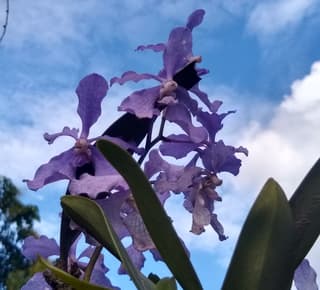
Vanda Orchid
Vanda
Orchids of the genus Vanda are tropical epiphytes known for their striking aerial roots and vibrant flowers, including the rare natural blue. Unlike other orchids, they are not typically grown in dense potting media, preferring hanging baskets that allow their roots to be exposed to air and light.
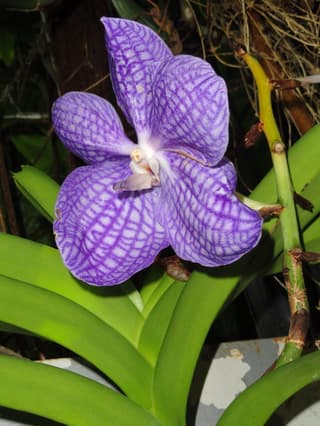
Blue Vanda Orchid
Vanda coerulea
Vanda coerulea, commonly known as the Blue Vanda Orchid, is one of the most celebrated and rare orchids in the world. Native to the forests of Northeast India, Myanmar, and Thailand, it produces breathtaking tessellated violet-blue flowers in autumn. Now critically endangered in the wild due to over-collection, it is a protected species and a symbol of botanical conservation.
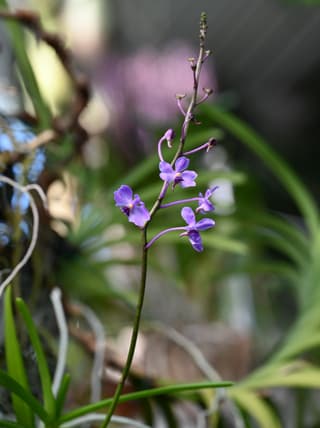
Blue Vanda
Vanda coerulescens
Vanda coerulescens is a miniature epiphytic orchid native to the highland forests of Myanmar, China, and Thailand. Celebrated for its delicate pale blue-violet fragrant flowers, it is one of the rarest naturally blue orchids in the world. Each inflorescence bears 15 or more blooms about 1 inch across, with a pleasant fragrance and long-lasting display.
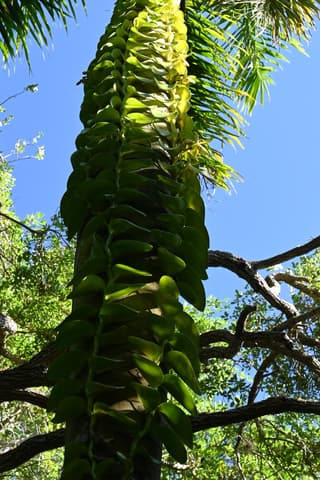
Vanilla Orchid
Vanilla planifolia
Vanilla planifolia is a species of perennial climbing orchid, native to Mexico and Central America, famous for being the primary source of natural vanilla essence. It features succulent stems and bright green, leathery leaves. Its greenish-yellow flowers are ephemeral, lasting only a single day, and in commercial cultivation outside its natural habitat, they require hand-pollination to produce the valuable pods.
Hard Care Orchids
Our selection of 18 hard orchids combines the characteristics of this category with specific care needs. For enthusiasts seeking a challenge.
Why Choose Hard Orchids?
Combining the beauty of orchids with hard difficulty level lets you enjoy this category while developing your gardening skills. Each plant was selected to offer the best characteristics of the category at the care level you are looking for.