Complete Plant Guide
Explore plants by difficulty, season and more. Find the perfect plant for you.
Difficulty
Categories
Plants by City
🗺️ Plants by City3940 plants found
Showing 1-36 of 3940
String of Dolphins
× Bacurio delphinatifolius
The String of Dolphins is a rare and charming succulent hybrid between Senecio rowleyanus and Senecio articulatus. It is famous for its unique, curved leaves that remarkably resemble jumping dolphins. As a trailing plant, it creates a beautiful cascading effect, making it a favorite for hanging baskets. It produces small, white, cinnamon-scented flowers during the spring.
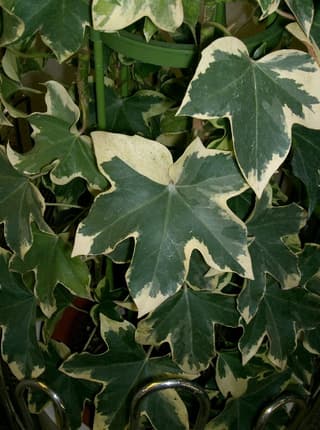
Tree Ivy
× Fatshedera lizei
× Fatshedera lizei is a unique intergeneric hybrid created by crossing Fatsia japonica 'Moserii' and Hedera helix (English ivy), first bred by the French nursery Lizé Frères in Nantes around 1910. Belonging to the Araliaceae family, the plant combines the large, glossy, dark green five-lobed leaves of the Fatsia with the semi-climbing, shrubby growth habit of the ivy. Unlike ivy, it lacks aerial rootlets and therefore requires support (such as a moss pole or trellis) to grow vertically, to which it must be tied. In autumn, it produces spherical panicles of small greenish-white, sterile flowers at the tips of the shoots. It is a moderately hardy evergreen plant suitable for both indoors and (in milder USDA zones 7b–10b) gardens in shady to semi-shady locations.
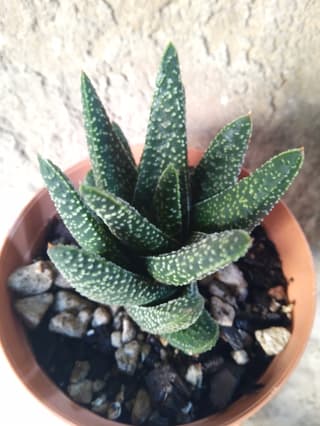
Gasteraloe (hybrid genus)
× Gasteraloe
Gasteraloe is an intergeneric hybrid nothogenus of succulents created by crossing Gasteria and Aloe, belonging to the family Asphodelaceae. Plants form compact rosettes with thick, often spotted or banded leaves, and produce tubular flowers in orange, red, or pink during spring and summer. They thrive indoors and outdoors in warm climates (USDA zones 9–11).
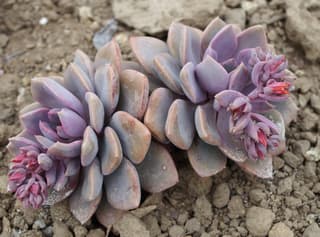
Graptoveria
× Graptoveria
Graptoveria is an intergeneric hybrid succulent genus created by crossing plants from Graptopetalum and Echeveria, two rosette-forming genera native to Mexico and Central America. The result is a compact, symmetrical rosette of thick, fleshy leaves in shades of blue-green, lavender, dusty pink, or silvery white, often covered in a soft powdery bloom (farina) that reflects sunlight and helps the plant conserve moisture. Popular cultivars include 'Fred Ives', 'Moonglow', 'Debbie', and 'Bashful'. Like its parent genera, Graptoveria is an easy-care, drought-tolerant succulent well suited to sunny windowsills, rock gardens, and container displays in warm, dry climates.
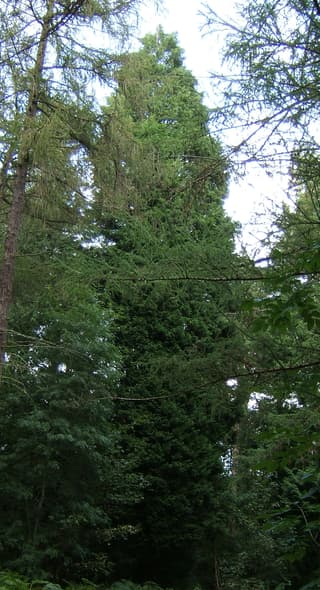
Leyland Cypress
× Hesperotropsis leylandii
The Leyland Cypress (× Hesperotropsis leylandii) is a fast-growing evergreen coniferous hybrid belonging to the cypress family (Cupressaceae), originating from a cross between the Monterey Cypress (Cupressus macrocarpa) and the Nootka Cypress (Cupressus nootkatensis). Due to its dense, columnar-pyramidal, dark green foliage, it is one of the world's most popular hedging and windbreak plants. It can grow up to one meter per year and can reach a height of 20 meters under favorable conditions.
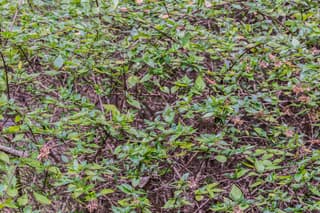
Glossy Abelia
Abelia × grandiflora
Glossy Abelia (Abelia x grandiflora) is a hybrid evergreen to semi-evergreen shrub prized for its small, glossy dark green leaves and abundant clusters of white to pale pink, bell shaped flowers that bloom from late spring through fall. Born from a cross between Abelia chinensis and Abelia uniflora, this compact, arching shrub typically reaches one to two and a half meters tall with a similar spread. It is widely used as an informal hedge, foundation planting, or specimen shrub, and its long bloom season makes it a magnet for bees, butterflies, and hummingbirds. In cooler climates the foliage can take on reddish purple tones and drop partially in winter, while in warmer zones it stays evergreen year round.
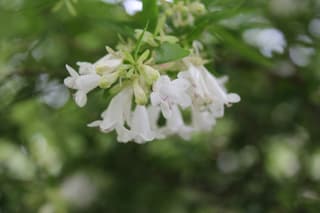
Glossy Abelia
Abelia x grandiflora
Glossy Abelia (Abelia x grandiflora) is a semi-evergreen ornamental shrub prized for its long-lasting display of fragrant, pink-tinged white bell-shaped flowers from late spring through fall. A hybrid of Asian species developed in the 19th century, it features attractive glossy foliage that turns bronze-red in winter. Highly adaptable and low-maintenance, it is widely used in hedges, borders, and pollinator gardens.
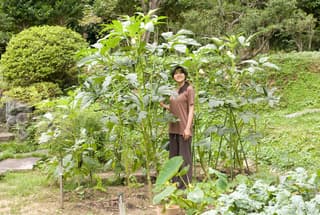
Okra
Abelmoschus esculentus
Okra (Abelmoschus esculentus) is an annual vegetable in the Malvaceae family, native to tropical regions of Africa. It is cultivated for its green, elongated, and mucilaginous fruits, which are harvested while still immature for culinary use. It is a robust, fast-growing plant that requires full sun and a warm climate to fruit well, and it is very sensitive to frost.
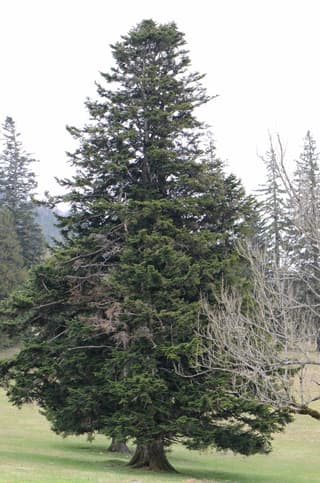
Fir
Abies
Abies is a genus of some 48-56 evergreen conifers in the pine family (Pinaceae), native to mountainous regions of Europe, Asia, and North and Central America. True firs form a distinctive pyramidal crown with flat, single needles that show two white stripes on their underside, and produce upright barrel-shaped cones that disintegrate on the tree at maturity rather than falling whole.
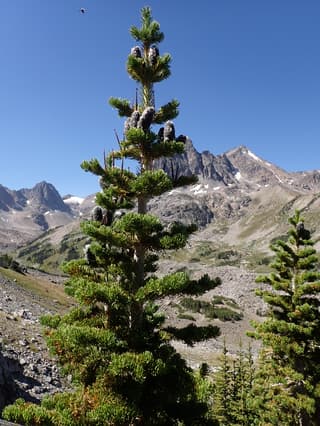
Subalpine Fir
Abies lasiocarpa
The Subalpine Fir (Abies lasiocarpa) is a majestic coniferous tree native to the subalpine forests and mountainous regions of western North America, where it grows at elevations from 600 to 3,700 m. This slow-growing tree, with a narrow, conical crown, reaches a height of 15–27 m and a width of 3–6 m. It is characterized by smooth, silvery-gray bark with resin blisters on young specimens, and soft, spirally arranged needles with a striking silvery-blue-gray coloration. It is one of the most resilient cold-loving conifers, capable of surviving frosts down to –29 °C, and forms a typical mountain forest alongside dwarf pine and spruce. Due to its elegant habit, it is valued as an ornamental tree for large gardens and parks.
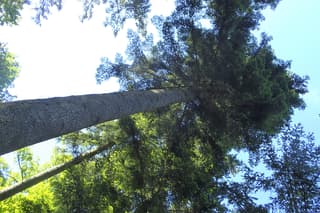
Nordmann fir
Abies nordmanniana
The Nordmann fir (Abies nordmanniana) is a large, majestic conifer native to the mountain forests of the Caucasus, northeastern Turkey, and Georgia. The tree has a graceful, broad pyramidal crown with horizontally spreading branches that grow in tiers. The glossy, dark green needles are soft and non-prickly, featuring two prominent white stripes on the underside. In the wild, the Nordmann fir can reach heights of up to 50 meters; in gardens and parks, it typically reaches a height of 9 to 15 meters. The tree is best known as a Christmas tree because its needles are very slow to drop.
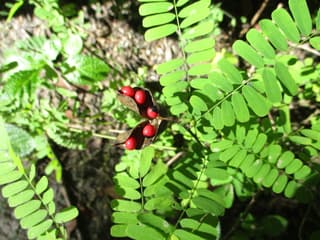
Rosary Pea
Abrus precatorius
The Rosary Pea (Abrus precatorius) is a perennial, woody climbing vine from the legume family (Fabaceae) that can reach heights of 6 to 10 meters. The alternate, pinnately compound leaves grow 5 to 15 cm long, while the small butterfly-like flowers appear in summer in shades of white, pink, to purple. The leathery pods contain 2 to 7 strikingly shiny, red-and-black colored seeds, which were traditionally used to make necklaces and rosaries. Originally likely native to India, the species is now widespread throughout the tropics as a neophyte. Warning: All parts of the plant, especially the seeds, contain the highly toxic abrin – even a single damaged seed coat can be fatal to humans and animals.
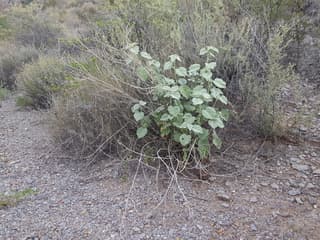
Abutilon Hybrid
Abutilon
Abutilon is a large genus of roughly 150 to 180 species of evergreen and semi-evergreen shrubs and small trees in the mallow family (Malvaceae), native to tropical and subtropical regions worldwide with the greatest diversity in South America. The name most commonly refers to garden hybrids collectively known as Abutilon x hybridum, prized for their maple-like, lobed leaves and pendulous, bell- or lantern-shaped flowers that bloom in shades of white, yellow, orange, pink and red from spring through fall. Fast-growing and easy to shape, Abutilon works equally well as a patio shrub, a trained standard, or a bright-window houseplant, and its nectar-rich flowers are a magnet for hummingbirds.
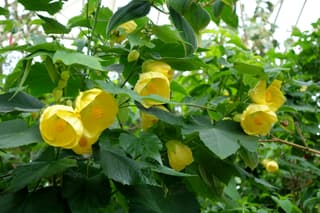
Flowering Maple
Abutilon hybridum
Abutilon hybridum, commonly known as flowering maple, is an ornamental shrub from the Malvaceae family, native to South America. Its pendulous bell-shaped flowers in shades of red, yellow, orange, and pink resemble small lanterns, making it a highly decorative plant for both indoor and outdoor settings.
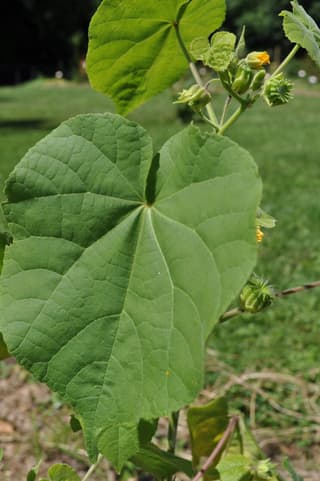
velvetleaf
Abutilon theophrasti
Abutilon theophrasti is a fast-growing annual in the mallow family (Malvaceae), native to central and east Asia and now a widespread agricultural weed across North America, Europe and beyond. It has large, heart-shaped, velvety leaves, sturdy hairy stems reaching up to 2.5 m, and yellow five-petaled flowers in summer followed by distinctive ring-shaped seed capsules. Seeds can remain viable in soil for decades, making it a persistent weed of corn, soybean and cotton fields.
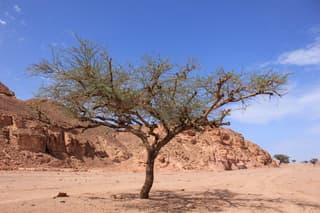
Wattle
Acacia
Acacia is a large genus of roughly 1,000+ species of shrubs and trees in the pea family (Fabaceae), commonly known as wattles (especially in Australia, where most species are native) or thorntrees in Africa. This profile represents general care guidance for the genus as a whole; individual species vary widely in size, hardiness, and specific needs, so always check the requirements for your particular Acacia species.
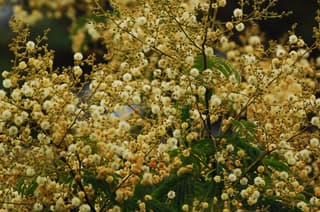
Silver Wattle
Acacia dealbata
Acacia dealbata, commonly known as silver wattle or mimosa, is a fast-growing evergreen tree native to southeastern Australia and Tasmania. Introduced to Europe in the 19th century, it is now widely naturalized along Mediterranean coasts, particularly in the French Riviera and Liguria. It is distinguished by its light silvery-green foliage and fragrant, bright yellow globular flower clusters that appear between February and March, before most other spring blooms. In the wild, it can reach 10-15 meters in height, while in pots it remains more compact, around 2 meters. It is the symbolic plant for International Women's Day in Italy. In several Mediterranean regions, it is considered a potentially invasive species due to its rapid spread via seeds and root suckers.
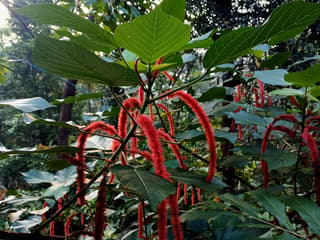
Copperleaf / Chenille Plant (genus)
Acalypha
The Acalypha genus (family Euphorbiaceae) encompasses fast-growing tropical and subtropical ornamental shrubs popular worldwide. Key species include A. hispida (chenille plant / red-hot cattail), prized for its dramatic drooping red catkins; A. wilkesiana (copperleaf / Jacob's coat), beloved for striking multicolored foliage in shades of bronze, red, and green; and A. reptans (trailing copperleaf), ideal for hanging baskets. All are vigorous, rewarding plants for warm climates and bright indoor spaces.
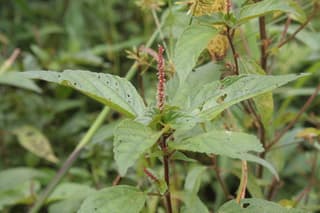
Asian Copperleaf
Acalypha australis
Acalypha australis, commonly known as Asian copperleaf, is a herbaceous annual plant in the spurge family (Euphorbiaceae), native to eastern Asia including China, Japan, Korea, and neighboring regions. It typically grows 20 to 50 cm tall, with oblong to lanceolate leaves that often show a coppery or reddish tint on new growth. Small greenish flowers appear in slender axillary spikes from summer into fall. Though frequently regarded as a weed in gardens and disturbed areas, it has a long history of use as a potherb and in traditional Chinese medicine.
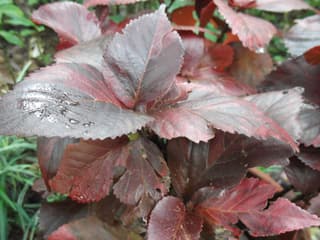
Jacob's Coat
Acalypha wilkesiana
Acalypha wilkesiana, commonly known as Jacob's Coat or Copperleaf, is a fast-growing tropical evergreen shrub from the Euphorbiaceae family. Native to the Pacific Islands (Fiji and neighboring South Pacific islands), it is prized for its strikingly colorful foliage that comes in mottled combinations of green, purple, yellow, orange, copper, crimson, pink, and white. The heart-shaped serrated leaves can reach 10-20 cm in length. It is widely used as an ornamental hedge or accent plant in tropical and subtropical gardens.
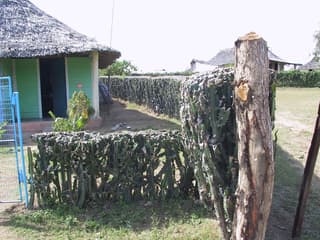
Fairy Castle Cactus
Acanthocereus tetragonus
Acanthocereus tetragonus 'Fairy Castle' is a dwarf, branching variant of the cactus native to the Americas. Its five-sided stems have short spines and grow in dense clusters, creating a silhouette reminiscent of a castle with multiple medieval towers. It is a slow-growing plant, extremely popular for interior decoration due to its sculptural appearance and ease of maintenance.
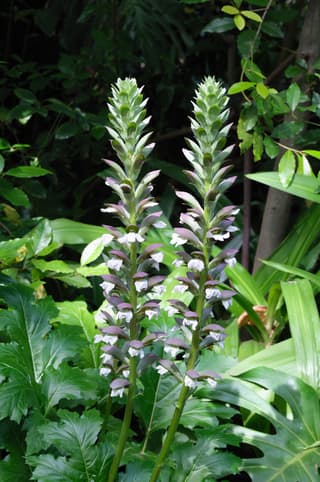
Bear's Breeches
Acanthus mollis
Acanthus mollis, commonly known as Bear's Breeches, is a bold architectural perennial native to the Mediterranean. It is prized for its dramatic, deeply lobed glossy green leaves and tall spikes of white and purple flowers that bloom in late spring to midsummer. Its striking foliage inspired the iconic leaf motif on Corinthian columns.
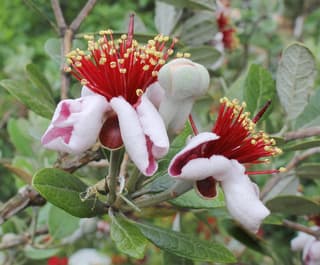
Pineapple Guava
Acca sellowiana
Acca sellowiana, commonly known as pineapple guava or feijoa, is an evergreen shrub native to southern Brazil and Uruguay. Belonging to the Myrtaceae family, it produces aromatic fruits with a flavor reminiscent of pineapple, strawberry, and guava. Its ornamental flowers feature white petals with striking red stamens — and are entirely edible.
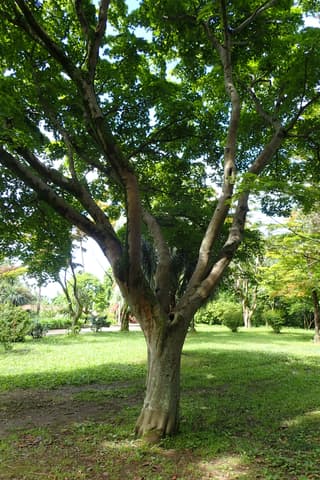
Maple
Acer
The genus Acer, commonly known as maple, encompasses more than 130 species of deciduous trees and shrubs distributed throughout the Northern Hemisphere. Famous for the exuberance of its autumn foliage, the maple is cultivated for both its ornamental value and its fine wood. The Japanese species Acer palmatum is especially prized in gardens and bonsai, while Acer saccharum provides the famous sap for maple syrup.

Field Maple
Acer campestre
The Field Maple (Acer campestre) is a medium-sized deciduous tree native to Europe, Southwest Asia, and North Africa. It is Denmark's only native maple and thrives in forest edges, hedges, and open landscapes. The Field Maple is recognized by its characteristic bark with corky ridges and five-lobed leaves that turn golden yellow and orange-red in autumn. The tree is extremely hardy, tolerates pollution and wind, and is particularly well-suited as a hedge and avenue plant. It grows up to 15–25 meters and lives for many hundreds of years.
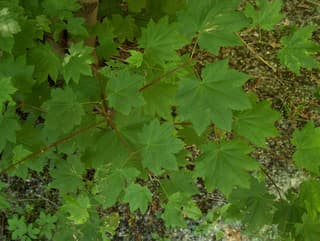
Vine maple
Acer circinatum
Acer circinatum is a small deciduous maple native to north-western North America, from southern British Columbia to northern California, mostly west of the Cascades. It grows in the understory of conifer forests, along stream banks and in clearings, from sea level to about 750 m. In shade it forms a multi-stemmed shrub with twisting, arching branches that may touch the ground and root, forming thickets (hence "vine maple"); in sun it grows as a single-stemmed small tree of 3 to 7.5 m. The leaves are almost round, with 7 to 9 lobes. In spring it bears small clusters of flowers with deep red sepals and greenish-white petals, followed by red samaras. In autumn the leaves turn yellow, orange or red, more intensely the more sun they get.
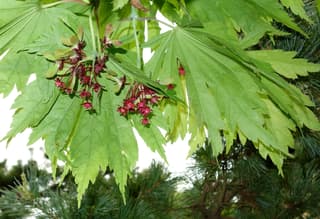
Fullmoon Maple
Acer japonicum
The Fullmoon Maple (Acer japonicum) is a small-to-medium deciduous tree native to the mountain woodlands of Japan and Korea, prized for its rounded, moon-shaped leaves with 7-11 soft lobes. In spring it bears clusters of small purplish-red flowers before the foliage unfurls, and in autumn its canopy turns brilliant shades of gold, orange, and crimson. Slow-growing and elegant, it is a signature specimen tree in Japanese-style gardens.
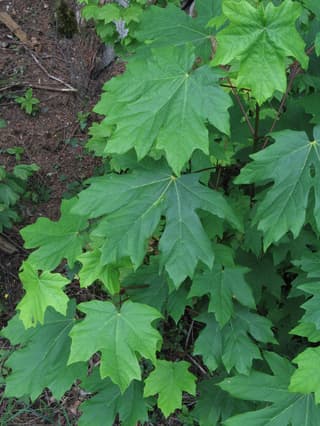
Bigleaf maple
Acer macrophyllum
The Bigleaf maple (Acer macrophyllum) is a large deciduous tree native to the western coast of North America, from southern Alaska to California, where it often grows along streams and in moist forests up to 450 m in altitude. It is the maple with the largest leaves in the world, reaching up to 15-30 cm in width and divided into five deep palmate lobes, which turn spectacular golden and yellow hues in autumn. In spring, it produces hanging clusters of small, inconspicuous greenish-yellow flowers that appear before the leaves. It can reach considerable heights in the wild, with record specimens exceeding 40 meters.
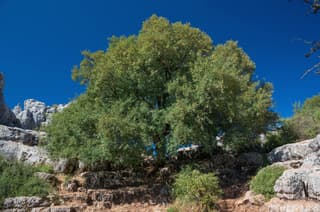
Montpellier maple
Acer monspessulanum
The Montpellier maple (Acer monspessulanum) is a small to medium-sized deciduous tree native to the Mediterranean region, inhabiting rocky, dry habitats from southern France to North Africa and Western Asia. A member of the Sapindaceae family, it is distinguished by its three-lobed, leathery leaves that turn vibrant shades of yellow and orange in autumn. The tree is remarkably drought-tolerant and flourishes in well-drained, calcareous soils.
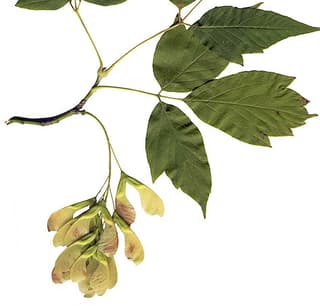
Boxelder
Acer negundo
Boxelder (Acer negundo) is a fast-growing, deciduous tree native to North America, belonging to the family Sapindaceae. It can reach up to 21 meters (70 feet) in height and is renowned for its exceptional cold hardiness and adaptability to a wide range of soil types and climatic conditions. The tree features pinnately compound leaves with 3 to 5 leaflets and produces inconspicuous green-yellow flowers in spring before the leaves emerge. It is dioecious, with male and female flowers on separate trees.
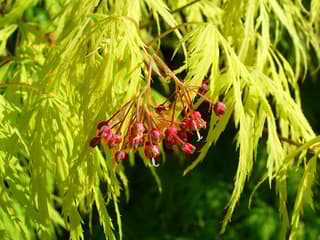
Japanese Maple
Acer palmatum
The Japanese Maple (Acer palmatum) is an ornamental tree native to Japan, China, and Korea, celebrated for the spectacular beauty of its foliage, which transforms through the seasons — from deep green in spring to vivid shades of red, orange, and yellow in autumn. With an elegant habit and deeply lobed palmate leaves, it is one of the most beloved ornamental trees in Asian-style gardens, contemplation gardens, and as a bonsai subject.
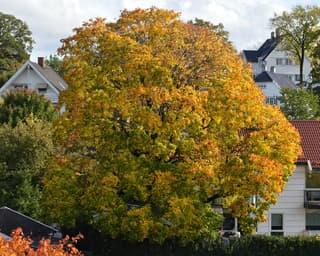
Norway Maple
Acer platanoides
The Norway Maple (Acer platanoides) is a large deciduous tree native to Europe and western Asia, widely planted as a shade and street tree. It features broad, palmate leaves, small yellow-green spring flowers, and vibrant yellow to orange autumn foliage. Extremely hardy and adaptable, it tolerates a wide range of soils, pollution, and urban conditions.
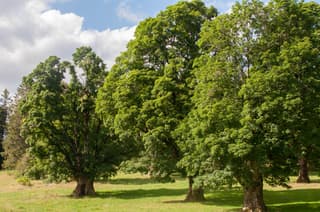
Sycamore Maple
Acer pseudoplatanus
Acer pseudoplatanus is a large, fast-growing deciduous tree native to central and southern Europe and southwestern Asia, now widely naturalized across the UK and North America. It forms a broad, dome-shaped crown with five-lobed, dark green leaves and produces hanging racemes of small yellow-green flowers in spring, followed by winged seeds (samaras) in autumn. It tolerates wind, salt spray, pollution and poor soils better than almost any other broadleaf tree, making it a popular choice for exposed sites, parks and shelterbelts. Note: the seeds and spring seedlings contain hypoglycin A, a toxin linked to atypical myopathy, a serious and often fatal muscle disease in grazing horses, so caution is advised when planting near pastures or paddocks.
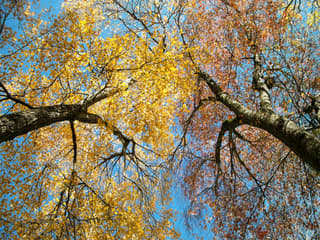
Red Maple
Acer rubrum
Acer rubrum, commonly known as the Red Maple, is one of the most abundant and widespread deciduous trees in eastern North America. Celebrated for its spectacular crimson, orange, and yellow autumn foliage, it is a fast-growing landscape tree valued for shade, wildlife habitat, and ornamental beauty.
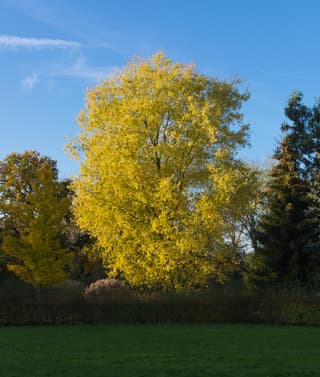
Silver Maple
Acer saccharinum
The Silver Maple (Acer saccharinum) is a fast-growing deciduous tree native to eastern and central North America. Named for the silvery underside of its leaves, it is widely planted as a shade and ornamental tree. It thrives along rivers and wetlands but adapts well to drier conditions.
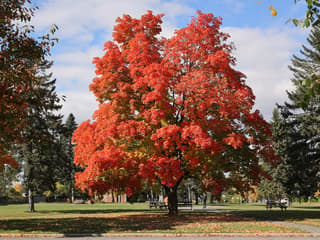
sugar maple
Acer saccharum
The Sugar Maple is a large, long-lived deciduous tree native to the hardwood forests of eastern North America. It is most famous for its brilliant autumn foliage, which ranges from bright yellow to fluorescent orange and deep red. Beyond its beauty, it is the primary source of maple syrup, produced from its sweet sap during the late winter and early spring thaw.
Find the Perfect Plant
Our plant guide helps you find ideal species for your experience level and time of year.
Browse by Difficulty, Season & More
Use the filters below to narrow this catalog by care difficulty, season, environment, or search directly by name. Each filter leads to a focused list tailored to your specific growing conditions.