Can Alocasia Tolerate Cold? Winter Care for Alocasia
Alocasia cannot tolerate frost and only overwinters dormant above 10 °C (50 °F). Learn when to bring your pot indoors, why it drops leaves without dying, and what to do with garden taro.
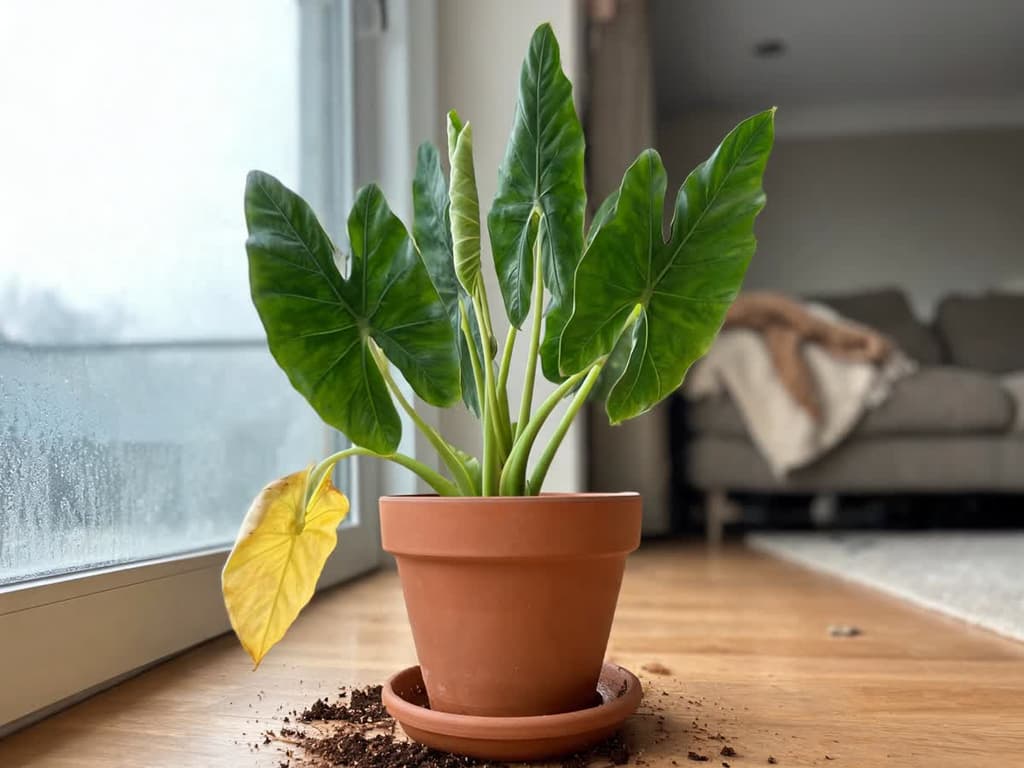
Alocasia tolerates cold only above 10 °C (50 °F) and does not tolerate frost: freezing temperatures kill its leaves, and in a pot, they can kill the entire plant. The Royal Horticultural Society (RHS) is the British gardening society. For alocasia in winter, the RHS recommends a cool, drier spot, but always above 10 °C (50 °F). Above 10 °C (50 °F), the plant enters dormancy: it stops growing until warmth returns.
The elephant ear that genuinely tolerates cold is a different plant: taro (Colocasia esculenta), also called inhame in south-central Brazil. Planted in the garden, taro loses its leaves to frost and resprouts from its tuber, the thick base buried in the ground. Potted alocasia spends winter indoors, while garden taro can spend winter underground.
Quick summary:
The winter limit for alocasia is 10 °C (50 °F), according to the RHS. 'Polly', one of the best-selling alocasias according to the RHS, requires air above 15.5 °C (60 °F), according to NC State Extension.
With air above 10 °C (50 °F), losing leaves in winter is dormancy, not death. The plant resprouts from its rhizome (the thick stem at the base, level with the soil) if it feels firm when pressed.
Taro planted in the ground survives buried in regions with lows around −12 °C (10 °F) (zone 8 or warmer). To achieve this, cover the ground with a thick layer of mulch, such as straw or dry leaves (Clemson). In pots, soil freezes much faster.
Can alocasia tolerate cold?
Alocasia tolerates cold above 10 °C, and below that the leaves weaken. Alocasia, taro, and taioba weaken when the temperature stays below 10 °C for several days, according to the University of Wisconsin (Wisconsin Horticulture). The RHS uses the same number as the winter minimum during dormancy (RHS).
NC State Extension is the extension service of North Carolina State University. It places the genus Alocasia (all alocasia species) in zones 10a to 12b of the American cold hardiness map (NC State). This map divides regions by the lowest temperature winter typically reaches. In zone 10a, this low stays between −1 and 2 °C: frost is rare and light.
To keep growing leaves, alocasia needs warmer air than it does during dormancy. NC State calls for temperatures above 15.5 °C (60 °F) for the hybrid 'Polly' (NC State). Between 10 and 15.5 °C (50 and 60 °F), 'Polly' and other alocasias survive in dormancy, the state the RHS describes. Below 10 °C (50 °F) for several days, the foliage weakens.
Alocasia, taro, or taioba: which elephant ear tolerates cold
In Brazil, the name elephant ear refers to at least three large-leaved plants from the same family: alocasia, taro, and taioba. Each tolerates different cold levels. The quickest way to tell taro apart from the other two is to look at where the stalk attaches to the leaf. In taro, it emerges from the center of the underside. In alocasia and taioba, it emerges from the edge.
plant | how to recognize | cold tolerance | source |
|---|---|---|---|
Potted alocasia (Alocasia) | petiole attaches at the leaf margin, in the V-shaped notch between the lobes; upright leaf | dormancy above 10 °C (50 °F); no frost | RHS, NC State |
'Polly' (Alocasia × amazonica) | dark green leaf with white veins | air above 15.5 °C (60 °F) | NC State |
Giant alocasia planted in the ground | same petiole at the margin; large leaf | frost kills leaves; resprouts from the base in zones 8a or warmer (around −12 °C / 10 °F) | UF/IFAS |
Taro or yam (Colocasia esculenta) | petiole attaches in the middle of the underside; drooping leaf | buried tuber tolerates zones 8a or warmer (around −12 °C / 10 °F) | NC State, Clemson |
Taioba (Xanthosoma) | petiole at margin; arrowhead-shaped leaf | no dedicated figure; most elephant ears only tolerate zones 8a or warmer | Wisconsin |
NC State and UF/IFAS appear to disagree: one places alocasia in zone 10a or warmer, while the other says that giant alocasia resprouts from the base starting in zone 8a. There is no contradiction. NC State describes the genus, which includes potted hybrids. The University of Florida (UF/IFAS) describes alocasias planted in the garden, with the root protected by the soil (UF/IFAS). For potted alocasia, follow the safer limit, 10 °C (50 °F), because potting soil cools down much faster than soil in a garden bed.
The succulent sold as elephant ear, in the genus Kalanchoe, belongs to a different family and is not part of this table. A dinner-plate-sized leaf growing alone in a flowerbed might belong to another family, such as Gunnera, which has its own winter requirements. If you are unsure which plant you have, take a photo of the leaf. The Bloom app (available for iOS) identifies the species before you decide whether to leave it outside.
When to bring potted alocasia indoors
Bring your potted alocasia indoors when nighttime temperatures start dropping below 10 °C (50 °F). Three US university extensions specify different threshold temperatures for bringing the plant inside:
The University of Maryland advises planning to bring them indoors when night temperatures drop to the 10 to 13 °C (50 to 55 °F) range (UMD Extension).
Iowa State advises bringing non-tuber-forming elephant ears indoors before night temperatures drop below 7 °C (Iowa State).
Wisconsin recommends bringing them indoors before temperatures reach the −1 to 4 °C (30 to 40 °F) range.
None of the cited sources measure this exact threshold specifically for potted alocasia. Use 10 °C (50 °F), as it is the dormancy minimum for the RHS and the point below which Wisconsin states the plant weakens. If the leaves have already softened after a cold night outside, bring the pot inside that same day.
The pot leaves the root exposed to the cold on all sides. Clemson, a South Carolina university, warns that a potted tuber freezes more easily than one buried in a garden bed (Clemson HGIC). For this reason, a potted alocasia on the porch faces more risk on the same cold night than one planted in the ground.
In Brazil, frost is most common from April to September and strongest in June and July. The risk increases with altitude and distance south, according to an Embrapa study (Embrapa/Tazzo et al., 2024). In an apartment, the coldest spot in the house on a winter night is the window glass. On these nights, move the pot away from the windowpane toward the middle of the room, and return it to the window in the morning.
Alocasia losing leaves in winter: dormancy or rot
An alocasia losing leaves in winter is usually dormant rather than diseased, provided the air stays above 10 °C (50 °F). The RHS notes that in a cooler, drier winter, alocasia may shed some of its foliage without cause for concern. New leaves return when it resumes active growth. The University of Maryland goes further: in low or no light, a dormant tropical plant loses all its leaves, and that is also completely normal.
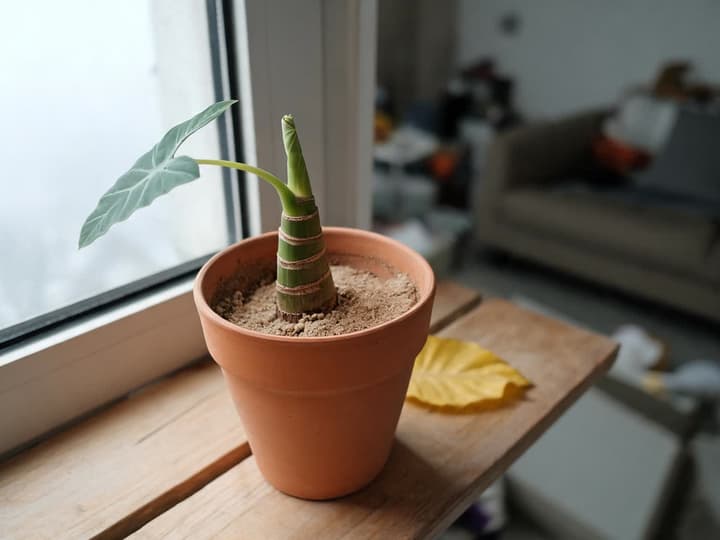
A simple test distinguishes dormancy from rot: checking the rhizome. Squeeze the base of the petioles right at soil level. A firm rhizome indicates a dormant plant, even if it has dropped every leaf. A soft, mushy rhizome indicates root rot, which typically stems from cold, waterlogged soil.
Do not cut all the leaves off the alocasia to protect it from the cold. Moving the pot out of the cold is what protects the plant. A leaf that still has green parts continues sending nutrients back to the plant (Illinois Extension). Cut only leaves that are already entirely yellow or brown, close to the base, as the RHS advises. Wear gloves, because the sap irritates the skin.
Yellow leaves outside of cold weather, on a plant that keeps growing, have other causes. The pattern of yellowing on the leaf separates overwatering, lack of light, and nutrient deficiency. The guide on yellow leaves on plants shows how to read each pattern.
How to care for alocasia indoors during winter
Winter care for alocasia involves five rules, all tailored to a plant that is barely growing:
Keep the pot near the brightest window, without touching the windowpane on cold nights and without direct midday sun on the leaves. The RHS recommends bright, indirect light year-round. In Brazil and the rest of the Southern Hemisphere, the window that receives the most light in winter is north-facing. If the home is dark, the University of Maryland suggests supplementing with artificial light.
Keep the room above 10 °C (50 °F), or above 15.5 °C (60 °F) if you have 'Polly', and away from cold drafts. In an apartment, cold drafts usually seep from exterior doors and windows left open at night.
Water minimally. The RHS states that overwatering during dormancy causes root rot. Water only when the top 3 cm (1 in) of soil dries out completely. If the plant has dropped its leaves, use small amounts of water per session, just enough to moisten the soil, and empty the drainage saucer after ten minutes.
Do not fertilize until new leaves emerge. A resting plant cannot use fertilizer. The University of Maryland advises waiting for new growth before resuming fertilization.
Do not repot during cold months. Wait for new leaves to appear, indicating that the plant has resumed active growth: the RHS recommends repotting during this active phase.
None of the sources cited here provide a fixed winter watering interval. The timing depends on room temperature, pot size, and the remaining foliage count. Always check the soil with your finger before each watering instead of relying on a calendar schedule.
Dry air from heating and spider mites on alocasia
Heaters and warm air conditioners dry out indoor air. Alocasia wilts whenever leaves lose moisture faster than roots can draw it up. The RHS describes this mechanism for tropical plants kept in low-humidity environments. The earliest symptom is usually dry, brown leaf tips.
Move the pot away from direct airflow coming from heating units. To raise humidity around the foliage, the RHS lists three options: a steamy bathroom, misting the leaves, and using a pebble tray with water. The tray sits beneath the pot, keeping the bottom of the container elevated above the water line. Misting wets foliage for only a few minutes, whereas a pebble tray continuously releases vapor throughout the day.
NC State records alocasia as a plant prone to spider mites, tiny pests that suck sap from the leaf. Check the underside of the leaves at every watering. The University of Maryland advises looking for fine webbing and yellow stippling on the leaf, the two signs of spider mites. If you find both signs, wipe both sides of each leaf with a damp cloth and check again at the next watering.
Taro and yam in the garden: leave in the ground or dig up
Clemson considers taro hardy in zone 8 of the American map and in warmer zones, with lows near −12 °C. In these regions, leave the tuber in the ground. In the fall, cover the bed with a thick layer of mulch, such as straw or dry leaves. After frost burns the taro leaves, cut the foliage down to the ground.
The taro profile in our species catalog summarizes plant care:
Where winter temperatures drop below −12 °C (10 °F), dig up the tuber. If your taro is potted, remove the tuber from the container. The four sources in the table below outline the same process: wait for frost to kill the leaves, then cut away the foliage. Allow the tuber to cure in an airy location from several days (Clemson) up to 2 weeks (Iowa State). Then pack it into dry peat moss (a decomposed moss sold at garden centers) or dry sawdust. Storage temperature is where recommendations differ:
source | tuber storage temperature |
|---|---|
Clemson | 7 to 13 °C (45 to 55 °F) |
Iowa State, 2021 | 13 to 16 °C (55 to 60 °F), slightly warmer than most bulbs |
Iowa State, FAQs | 21 to 24 °C (70 to 75 °F) |
Penn State | around 21 °C (70 °F), warmer than most bulbs |
All four keep the tuber well above 0 °C, without freezing. Use the 13 to 16 °C range from Iowa State in 2021. It sits in the middle of the others and corresponds to a cool indoor room (Iowa State). Check the tubers once a month: the University of Maryland instructs not to let them dry out completely and to discard any that have rotted.
Wisconsin notes the pink-stemmed 'Pink China' taro as one of the most cold-hardy cultivars, with survival reports in zone 6b, where lows drop near −20 °C (−4 °F), though only in sheltered microclimates. These are anecdotal reports rather than scientific trials, so garden mulching remains mandatory for it.
Are alocasia and taro toxic to pets?
Yes. Both plants contain calcium oxalate crystals (microscopic needles that irritate the mouth and skin) in all their tissues, according to NC State. Chewing the foliage causes burning pain, oral swelling, and heavy drooling. Taro loses this toxicity only when cooked thoroughly. The RHS advises wearing gloves when cutting alocasia foliage, as its sap causes skin irritation.
Frequently asked questions
Can I mist alocasia leaves in winter?
Yes, but the effect lasts only a few minutes. The RHS includes leaf misting among its techniques for raising humidity for tropical plants. The other two methods are steamy bathrooms and pebble trays filled with water. During winter with the heating running, a pebble tray beneath the pot emits moisture all day, whereas misting dissipates quickly.
Should I cut off all alocasia leaves in winter?
No. Removing foliage does not protect alocasia from cold, and any leaf retaining green tissue continues supplying the plant with nutrients. Cut away only leaves that have turned entirely yellow or brown, severing them at the base while wearing protective gloves. Protecting the plant comes down to keeping the pot above 10 °C (50 °F) and watering minimally.
Can alocasia stay outside in winter?
Only where nighttime temperatures remain reliably above 10 °C (50 °F). Sustained temperatures below that threshold weaken foliage (Wisconsin), and frost will destroy leaves completely. Soil inside pots freezes much faster than garden soil (Clemson). Wherever frost occurs, move the pot indoors before the first night dipping below 10 °C (50 °F).
When does alocasia resume growth after winter?
When warmer temperatures and brighter light return. You will spot a new leaf emerging tightly furled from the center of the pot. Once this happens, resume watering whenever the top 3 cm (1 in) of soil dries and restart feeding, following Wisconsin guidance for the resumption of growth. As long as the rhizome remains firm, the plant can resprout even after dropping all its foliage.
Conclusion
Alocasia only tolerates cold above 10 °C (50 °F) and cannot survive frost. Keep it indoors during winter near your brightest window, water minimally, and hold off on fertilizer. Fallen foliage during this period reflects natural dormancy as long as the rhizome stays firm. Garden taro is the elephant ear that remains outside, safely buried and mulched. Where winter lows dip below −12 °C (10 °F), dig up the tuber and store it in dry peat moss between 13 and 16 °C (55 and 60 °F).
Before deciding whether to bring your plant inside, mulch it, or lift it from the ground, verify which elephant ear variety you have. A quick photo of the leaf settles it:
Alocasia shares the same winter need for bright light and humid air with other indoor houseplants:
Sources
Royal Horticultural Society (RHS), How to grow alocasias.
NC State Extension Gardener Plant Toolbox, Alocasia, Alocasia × mortfontanensis, and Colocasia esculenta.
Wisconsin Horticulture, Division of Extension, University of Wisconsin-Madison, Elephant Ears (Colocasia, Alocasia, and Xanthosoma).
University of Florida IFAS Extension, FPS-33, Alocasia spp.
Clemson Cooperative Extension, Home & Garden Information Center, Fun with Elephant Ears in the Garden.
Iowa State University Extension, How to Overwinter Tender Perennials (2021) and How do I over-winter elephant's ear?.
Penn State Extension, Tropical Plants to Overwinter.
University of Maryland Extension, Overwintering Tropical Plants.
Illinois Extension, Yellow leaves can indicate plant problems.
Tazzo et al., Caminhos de Geografia 25(101), 2024, Alice/Embrapa repository.
Related articles

How to Care for Hibiscus: Sun, Watering, Fertilizer, and Pruning for Flowers
How to care for hibiscus: 6 hours of direct sun, evenly moist soil without waterlogging, half-strength fertilizer in spring and summer, and pruning in early spring. Find out why the flower lasts one day and why buds drop before opening.

Do Ferns Like Sun or Shade? It Depends on the Type
Ferns prefer bright shade: plenty of light, but no direct sun on their fronds. Tuberous sword fern is the exception that handles sun. Here is the ideal light for each type, where to place pots, and how fronds show too much or too little light.

African Violet Yellow Leaves: Causes and What to Do
Yellow leaves on an African violet usually stem from overwatering, and the first place to check is the center of the plant. Losing one lower leaf at a time is normal. Identify whether age, watering, cold water, sunlight, cold drafts, or fertilizer is the culprit based on the yellowing pattern, and see what to do today.