Amaryllis in Glass Without Soil: Water, Wax, or Potting Mix?
Amaryllis in glass without soil blooms using the bulb's reserves. See how high the water goes, what to do with waxed bulbs, how to treat soft bulbs, and which potting mix to use.
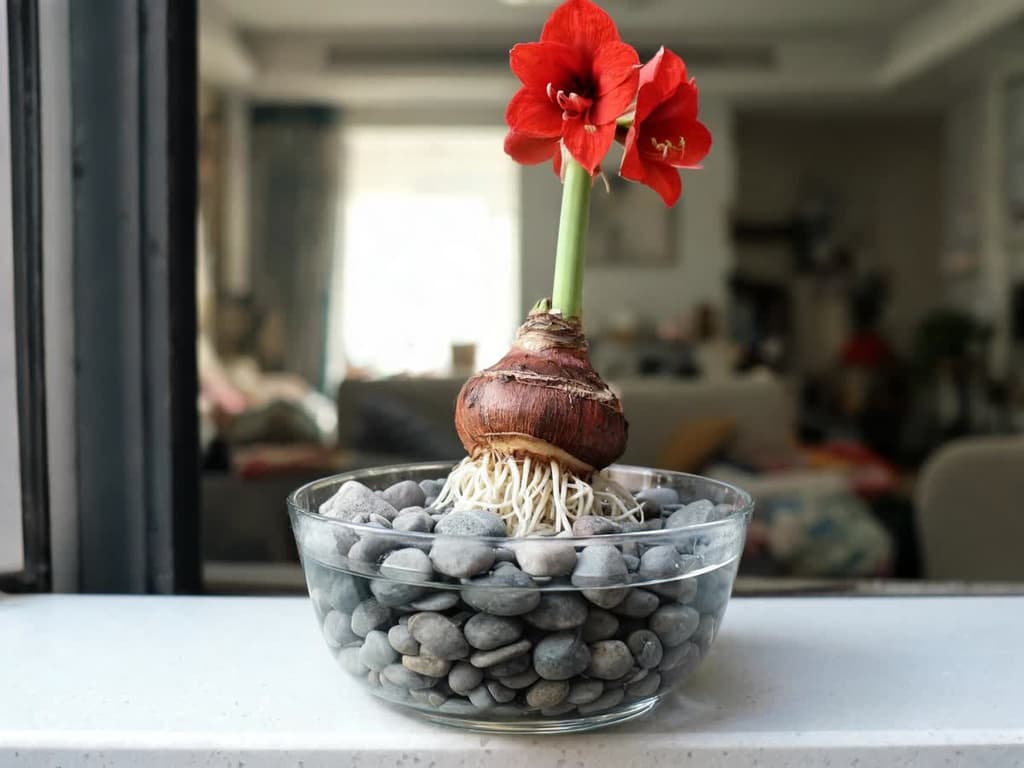
The amaryllis (Hippeastrum) in glass without soil blooms using the food reserves stored in the bulb. In glass with water, the water touches only the roots and sits 3 to 6 mm below the base of the bulb. A bulb covered in wax receives no water at all. Both methods carry a cost: without soil, the bulb spends its reserves on the flower and cannot rebuild them.
If your bulb arrived in a tall glass vase and is putting out white roots, add water until it touches the roots, without wetting the base. After the flower fades, plant the bulb in a pot with well-draining potting mix (soil formulated specifically for containers). In a pot, the bulb gathers the reserves it needs to bloom again in subsequent years.
Quick summary:
Glass with water: water touches only the roots; the base of the bulb sits 3 to 6 mm above it (University of Kentucky).
Glass with stones: 5 to 7.5 cm of stones at the bottom, and water just touching the roots (University of Vermont).
Waxed bulb: no water and no soil; blooms once using its reserves (Iowa State).
Soft bulb: squeeze the base. A soft, sunken, or dark base indicates rot, and the bulb goes in the trash.
To keep the bulb: a pot with a drainage hole that is 2.5 to 5 cm wider than the bulb, filled with a light potting mix. One-third to one-half of the bulb stays above the soil line.
Method | What the bulb receives | Watering rule | After blooming | Source |
|---|---|---|---|---|
Glass with water | Only water on the roots | Level 3 to 6 mm below the base | Moves to a pot with potting mix | University of Kentucky, Clemson |
Glass with stones | Water among the stones | Water just touching the roots | Moves to a pot with potting mix | University of Vermont |
Waxed bulb | Nothing | Do not water | Discard or attempt to save | Iowa State |
Pot with potting mix | Water and nutrients | Water the potting mix, without wetting the top of the bulb | Stays in the pot | Iowa State, Michigan State |
Amaryllis in glass with water: keep the level below the bulb
For amaryllis in glass with water, the base of the bulb never sits in the water. The University of Kentucky recommends resting the bulb 3 to 6 mm (1/8 to 1/4 inch) above the water. The roots grow down into the water as the bulb wakes up. The German magazine Mein Schöner Garten warns that keeping the base in water causes it to rot.
To set up amaryllis in glass:
Glass: use a glass vase with a narrow neck that holds the bulb upright. Kentucky accepts any glass vessel with a neck that supports the bulb.
Bulb: rest the bulb on the opening of the glass, pointed end up.
Water: fill to 3 to 6 mm below the base of the bulb.
Maintenance: once the flower opens, top up the water every 2 to 3 days, always keeping it just below the base (University of Kentucky).
Light: to help the flower last longer, move the glass away from direct sun, drafts, and heat vents (University of Kentucky).
Stem: turn the glass every few days so the stem grows straight (Mein Schöner Garten).
The distance between the bulb and the water varies from source to source. Mein Schöner Garten mentions about 1 cm. A German forum account started with the base 0.5 cm in the water, and the roots rotted. This guide follows the University of Kentucky (3 to 6 mm), which is a university extension service. The instructions the forum author followed directed lowering the water to 1 cm below the bulb once the roots emerged.
Glass with stones or clay pebbles
Glass with stones gives the bulb more stability. The University of Vermont advises placing 2 to 3 inches (5 to 7.5 cm) of stones or glass marbles at the bottom. The bulb rests on top. Fill with water until it touches the roots, without covering the bulb. Kentucky nests the bulb into the top layer of stones and keeps the water below the base.
Expanded clay pebbles (the clay balls sold for drainage) or glass marbles can replace stones, according to Mein Schöner Garten. The base of the bulb still remains above the water. Mein Schöner Garten notes that in hydroculture (growing exclusively with water and pebbles, without soil), the pebbles can cover the entire bulb. No university extension recommends burying the whole bulb. Keep at least the top half of the bulb exposed.
Waxed amaryllis: blooms once using the bulb's reserves
Waxed amaryllis, also called a waxed bulb, is a bulb covered in colored wax that blooms without soil and without water. NC State Extension explains that the wax seals moisture and nutrients inside the bulb. According to Iowa State, stalks appear in 4 to 6 weeks, sometimes sooner.
To care for a waxed amaryllis:
Place the bulb in bright, indirect light.
Do not water. Iowa State states that a waxed bulb needs neither water nor soil.
Rotate the bulb every few days so the stalk grows straight.
When buying, avoid a bulb with an already open flower or a dry stalk. It may not even bloom at home or produce a much shorter flower (Iowa State).
Waxed bulbs usually come without roots. North Dakota State University (NDSU) explains that growers trim off the roots to stimulate blooming. Without roots, transitioning the bulb into soil is more difficult.
Can a waxed amaryllis be planted after blooming?
The waxed amaryllis can go into soil after flowering, but it might not bloom again. Iowa State treats the waxed bulb as single-use and advises discarding the bulb after the flower. The same university publishes how to try to save the waxed bulb:
Wait for the last stalk to dry up. Leaves will begin to emerge slowly.
Carefully peel off the wax, taking care not to break the small roots at the base. They are sometimes trapped in the wax.
Inspect the bulb. Discard any bulb with soft, sunken, or dark spots.
Pot the bulb securely in a container 2.5 to 5 cm (1 to 2 inches) wider than the bulb itself. Keep one-third to one-half of the bulb above the soil line.
NC State Extension suggests another start: leave the unwaxed bulb in a shallow dish of water until it grows roots, and only then pot it. Sources disagree on the fate of the waxed bulb. A German bulb shop advises throwing it away, and a German florist says it cannot be planted. Iowa State and NC State show that you can try with a firm bulb. This guide follows the two extension services, without promising a flower the following year.
The cost of blooming without soil
Without soil, the amaryllis bulb expends its stored food reserves on the flower and cannot replace them. Iowa State describes this effect on waxed bulbs: after blooming, the wax shell ends up larger than the bulb because the bulb has shrunk. A shrunken bulb needs sunlight and fertilizer while it carries leaves to grow back and bloom again.
The bulb in glass with water faces the same problem. Clemson University states that a bulb forced in water usually will not bloom again. For this reason, growers typically discard it or plant it in soil after it flowers. Mein Schöner Garten recommends forcing the same bulb in water only once in its lifetime.
Sometimes, a rescued bulb produces healthy foliage but fails to bloom the following year. Iowa State explains that it has simply not rebuilt enough reserves yet. Continue caring for the leaves, and flowers may return the next season.
Soft amaryllis bulb or mold in glass
Squeeze the base of an amaryllis bulb kept in glass. A firm base can still be saved. A soft, sunken, or blackened base signals rot, and Iowa State advises discarding the bulb. NC State adds a bad odor to the list of discard signs. Mold accompanied by a foul smell at the base calls for the same test: squeeze the base.
None of the sources detail how to salvage a firm bulb whose base sat submerged in water. The safest approach combines their recommendations:
Remove the bulb from the glass and let the base air-dry in a well-ventilated spot out of direct sunlight until it feels dry to the touch.
Thoroughly clean the glass vase and stones, then refill with fresh water. Mein Schöner Garten directs changing the water whenever it turns cloudy.
Return the bulb to the glass, keeping the water level 3 to 6 mm below the base (University of Kentucky).
Bacterial soft rot is one of the causes that leave amaryllis bulbs soft and foul-smelling.
The page on amaryllis rot brings together the signs of rot in the bulb and roots. To identify which disease attacked the bulb, Bloom (available for iOS) provides a photo diagnosis on the Premium plan.
Amaryllis leaning in glass under a heavy stem
If the flower stalk leans over while the bulb stays firm, the weight of the blossoms is the cause. Glass lacks soil to anchor the roots, and a blooming stalk is heavy. The University of Maryland advises staking the stalk with a soft tie. Mein Schöner Garten recommends a heavy glass container that provides a counterweight to the stalk.
A stalk that tips over along with a soft bulb points to rot. Discard the bulb if the base is soft, sunken, or dark.
Moving from glass to a pot after blooming
Transition amaryllis from glass into a pot as soon as the blossoms fade. Mein Schöner Garten and Clemson both direct moving forced bulbs into soil after flowering. Remove the bulb from the glass without damaging leaves or roots (Mein Schöner Garten).
Cut the stalk: cut the spent stalk 2.5 to 5 cm (1 to 2 inches) above the bulb and keep the leaves (Iowa State).
Remove the bulb from the glass: ease the bulb out gently. Water-grown roots are fragile.
Pot up: add a layer of potting mix to the bottom of the container, center the bulb, and fill in around the roots. Leave one-third to one-half of the bulb exposed above the soil.
Water: soak thoroughly once until water runs out the drainage hole. After that, water only when the surface of the mix feels nearly dry (Iowa State). Watering needs shift with each bulb stage, and the guide on how to water amaryllis breaks down how much to provide throughout each phase.
Sunlight: place the pot on a windowsill that receives direct sun (Clemson). The foliage manufactures food reserves for the next bloom cycle (Iowa State).
In a pot, the bulb moves through its natural sequence of flowers, foliage, and dormancy. The guide on how to care for amaryllis explains lighting, feeding, and dormancy across every season.
Potting mix for container amaryllis
Potting mix for potted amaryllis needs to be lightweight and drain quickly. Michigan State University recommends, in an article republished by HortiDaily, a soilless mix of peat moss (dark, fluffy plant material sold in bags) and perlite. The University of Maryland calls for a soilless potting mix for houseplants. Clemson also recommends peat moss and perlite.
None of these sources give the proportions for the mix. In Brazil, the simplest option is ready-to-use potting mix with perlite. Perlite is an expanded, white, lightweight volcanic rock that creates space for air in the soil. Mix the perlite into the potting mix gradually and test it by watering: water should drain through the hole as soon as you finish watering.
Moisten the potting mix before planting. Michigan State notes that bone-dry potting medium repels water. All three sources specify a soilless mix, so keep regular garden soil out of the container.
A trial from Bangladesh compared potting mixes for amaryllis. The study, published in the International Journal of Applied Sciences and Biotechnology (2016), used 30 cm pots, with fertilizer, on a research farm. A 50-50 mix of rice hull and manure produced the largest bulb: 76 mm in diameter. The longest-lasting flower came from equal parts soil, rice hull, manure, and coco coir. This is a bulb production trial: it serves as a clue, not a recipe for an indoor pot.
Containers for amaryllis: snug, heavy, and well-draining
Amaryllis blooms best in a slightly snug pot, according to the University of Maryland. Iowa State recommends a container 2.5 to 5 cm (1 to 2 inches) wider than the bulb, with a drainage hole at the base. You can use clay, ceramic, or plastic pots.
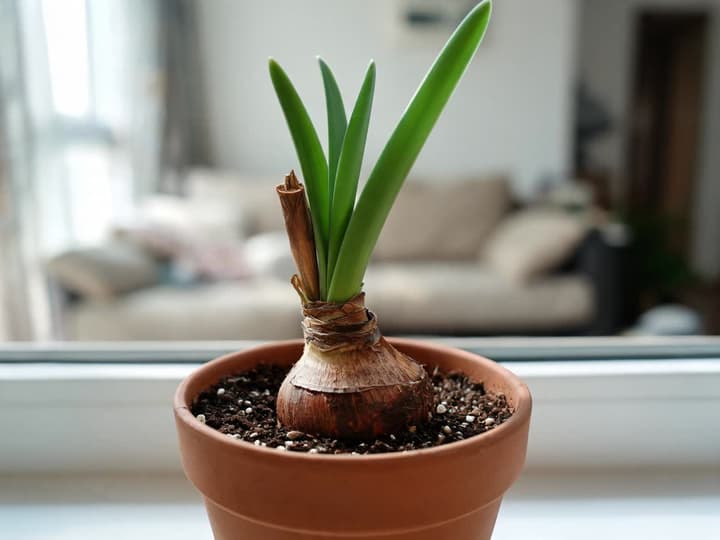
The flowering stalk can easily tip over a lightweight pot. The Chicago Botanic Garden recommends a heavy pot, wider than it is tall. UF/IFAS offers another solution: a 5 to 7.5 cm (2 to 3 inch) layer of gravel at the bottom to add weight.
Sources disagree on the layer of stones at the bottom of the pot. Washington State University states that it hinders water drainage. A trial published in PLOS ONE in 2025 measured that it helps water drain, but without a plant in the pot. Since no one has tested this with a plant, use gravel only for weight and rely on the drainage hole and light potting medium for drainage.
Gift kits frequently include a compressed coco coir disc that yields too little medium for the bulb, according to Iowa State. If the kit's pot lacks a drainage hole, transfer the bulb to a pot that has one, or drill a hole through the bottom.
How much of the bulb stays above the soil
Leave one-third to one-half of the bulb exposed above the soil line, keeping the neck (the narrow top section) completely uncovered. Iowa State directs keeping the top half out of the soil. UF/IFAS recommends keeping one-fourth to one-third exposed to prevent water from entering the top of the bulb. Clemson suggests leaving one-third to one-half exposed to help prevent red blotch, a fungal disease. This guide follows Clemson's range, which encompasses Iowa State's recommendation and provides the underlying reason.
Frequently asked questions
How long does amaryllis live in glass without soil?
Amaryllis blooms in glass without soil for as long as the bulb's reserves last, after which the bulb is depleted. A waxed bulb sends up flower stalks within 4 to 6 weeks, according to Iowa State. Once the blooms fade, bulbs kept in water or wax have largely exhausted their energy. To keep growing for years to come, the bulb must move into a pot with potting mix and receive direct sunlight on its foliage.
Does amaryllis in glass need fertilizer?
Amaryllis forced in glass does not need fertilizer until the flower fades, according to Mein Schöner Garten. The bulb already contains the reserves needed to flower, as demonstrated by waxed bulbs that bloom with zero water and soil (Iowa State). Clemson notes that fertilizing a leafless bulb can kill its roots. Begin feeding only after the bulb is potted and producing leaves, using diluted fertilizer (Iowa State).
Can I leave amaryllis in glass after it blooms?
You can, but the bulb weakens and rarely blooms again. Clemson states that a bulb that flowered in water generally does not bloom another time. Iowa State explains that without water and soil, the plant can barely replace the reserves spent on the flower. To keep the plant, move the bulb to a pot with potting mix right after flowering.
What is the best soil for amaryllis?
The best soil for amaryllis is a lightweight, soilless potting mix that drains quickly. Michigan State University and Clemson recommend peat moss and perlite. In Brazil, use commercial potting mix and add perlite until water drains quickly through the hole. Plant in a pot with drainage holes, leaving one-third to one-half of the bulb exposed above the soil.
Conclusion
Amaryllis grown in glass without soil blooms entirely on the reserves stored inside the bulb. In glass vases, water should sit 3 to 6 mm below the base and touch only the roots. Waxed bulbs receive no water whatsoever. After flowering, gently squeeze the base of the bulb. If it is firm, transfer it to a snug pot with drainage holes and lightweight potting mix, leaving one-third to one-half exposed. If it is soft, toss it in the trash.
Related articles
How to Care for Hibiscus: Sun, Watering, Fertilizer, and Pruning for Flowers
How to care for hibiscus: 6 hours of direct sun, evenly moist soil without waterlogging, half-strength fertilizer in spring and summer, and pruning in early spring. Find out why the flower lasts one day and why buds drop before opening.

Do Ferns Like Sun or Shade? It Depends on the Type
Ferns prefer bright shade: plenty of light, but no direct sun on their fronds. Tuberous sword fern is the exception that handles sun. Here is the ideal light for each type, where to place pots, and how fronds show too much or too little light.

African Violet Yellow Leaves: Causes and What to Do
Yellow leaves on an African violet usually stem from overwatering, and the first place to check is the center of the plant. Losing one lower leaf at a time is normal. Identify whether age, watering, cold water, sunlight, cold drafts, or fertilizer is the culprit based on the yellowing pattern, and see what to do today.