How to Make Amaryllis Bloom Again: The Bulb Cycle
Amaryllis blooms again using the energy stored in the bulb after flowering. Learn what to do with the scape and leaves, how long dormancy lasts, and the care calendar for Brazil.
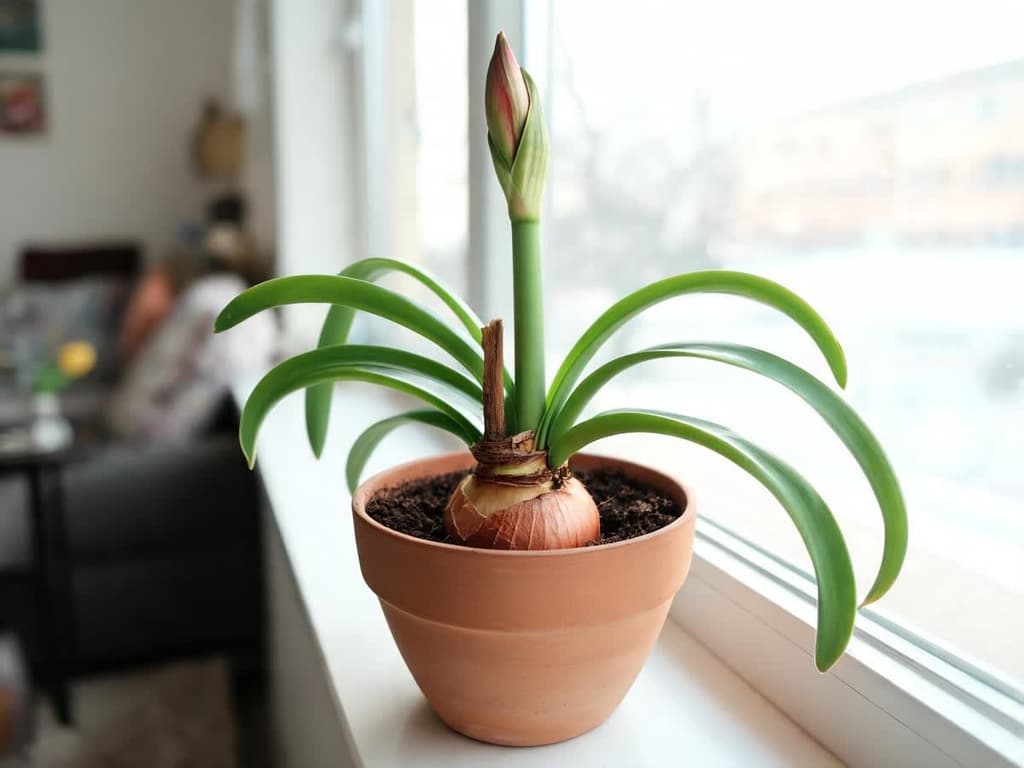
To make amaryllis bloom again, the work begins when the flower fades. Next year's flower comes from the energy reserves stored by the bulb during the months when it only has leaves. Cut the flower scape, keep the leaves growing in full sun, and fertilize every 2 to 4 weeks.
After that, give the bulb an 8 to 10-week rest in a cool place, at 50–55 °F (10–13 °C). The rest period is the phase when the bulb stops growing and receives almost no water. At the end of the rest period, water the bulb and move the pot to a bright, warm place: the new scape usually blooms in 4 to 8 weeks. In Brazil, amaryllis blooms naturally in the spring, from September to November.
Quick summary:
After flowering, cut only the flower scape, 1 to 2 inches (2.5–5 cm) above the bulb. Leave the green leaves intact: they recharge the bulb, according to Iowa State University.
The dormancy most recommended by university extensions (gardening advisory services of US universities) is 8 to 10 weeks at 50–55 °F (10–13 °C). In a 2008 study, bulbs stored at 70 °F (21 °C) or warmer failed to produce good quality plants.
An amaryllis that only produces leaves is almost always getting too little light or has depleted its bulb reserves. A firm bulb can bloom the following year: do not throw it away.
Amaryllis is toxic to dogs and cats, according to the ASPCA.
Can an amaryllis that only produced leaves be saved?
It can, if the bulb is firm. An amaryllis that produces leaves but no flowers usually ran out of bulb reserves in the previous season, according to Iowa State University. Sometimes the reason is different: the bulb did not go through cold dormancy. The leaves manufacture the food that the bulb stores. A year of leaves only, with plenty of light and fertilizer, is the year the bulb recovers.
Squeeze the bulb with your fingers before deciding. A firm bulb with dry outer tunics is alive. A soft, sunken bulb or one with dark spots is rotted and belongs in the trash, according to the same university. If in doubt, keep the bulb in its pot with the leaves in the sun and wait for the next season.
A waxed bulb (sold coated in colored wax without soil) is the hardest case. The wax prevents the bulb from absorbing water or nutrients. Because of this, it expends its reserves on the flower and shrinks, according to Iowa State University and NC State Extension. It only has a chance if you carefully remove the wax and plant the bulb in potting soil. Even then, it may spend an entire year only producing leaves.
Which amaryllis is yours: Hippeastrum or Amaryllis belladonna
The name amaryllis applies to two different plants. The potted amaryllis, sold as a bulb and given as a gift, is a Hippeastrum, a plant native to South and Central America, according to NC State Extension. The other is Amaryllis belladonna, from South Africa, a garden and full-sun plant.
This guide covers Hippeastrum. Its flowers appear in clusters of 2 to 6 at the top of a hollow, leafless scape. The leaves are long, smooth, and strap-shaped.
The 4-stage amaryllis bulb cycle
Amaryllis blooms using the energy the bulb stored during the previous season. After blooming, the leaves grow and replenish the bulb's reserves. A rest period with little water follows, and the next flower scape emerges when the plant receives water and warmth again.
The cultivation sources cited here come from the Northern Hemisphere. The months in the table are already inverted for Brazil, where winter runs from June to August.
Phase | What the bulb does | What you do | How long it lasts | When, in Brazil |
|---|---|---|---|---|
Flower | Expends its energy on the scape and flowers | Water when the soil begins to dry out, keeping direct sun off the flowers | 3 to 4 weeks | September to November |
Leaves | Produces and stores energy reserves | Full sun, regular watering, and fertilizer every 2 to 4 weeks until February | 5 to 7 months | November to April |
Dormancy | Stops growing | Little to no water, cool location, no fertilizer | 8 to 10 weeks | May or June to July |
Regrowth | Sends out roots, leaves, and a new scape | Water, light, and warmth | 4 to 8 weeks until blooming | August to September |
Iowa State University estimates 6 to 8 weeks from planting to bloom for bulbs produced in the Netherlands. For those grown in South Africa, it takes 3 to 5 weeks. The 4 to 8-week range in the table is standard for a bulb ending its dormancy.
After flowering: cut the scape and leave the foliage
When the last flower on the scape withers, cut the flower scape with a clean knife or pruners, 1 to 2 inches (2.5–5 cm) above the bulb. This is the guideline from Iowa State University. The RHS (Royal Horticultural Society, the UK's horticultural organization) instructs cutting the scape down to its base. The University of Wisconsin–Madison and the NYBG prefer removing only the faded flowers and leaving the scape until it turns yellow. This guide follows Iowa State, a university extension: cut at 1 to 2 inches (2.5–5 cm) and do not damage the leaves.
Remove faded flowers promptly, because a pollinated flower produces a seed pod. The NYBG (New York Botanical Garden) notes that seed production consumes the plant's energy. UF/IFAS, the University of Florida extension, warns that allowing the seed pod to develop can greatly reduce blooming the following year.
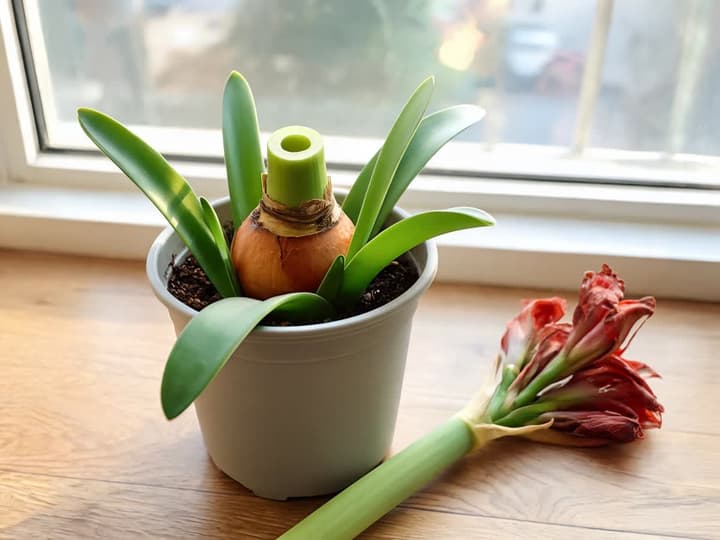
Do not cut the green leaves. Move the pot to the brightest spot in the house, with direct sun for part of the day. According to the University of Maryland Extension, strong light is the most important factor for amaryllis to bloom again every year. In Brazil, the window that gets the most sun faces north.
Water when the surface of the potting soil is nearly dry. Fertilize every 2 to 4 weeks with a balanced liquid fertilizer (with equal parts nitrogen, phosphorus, and potassium) at half strength, as recommended by Iowa State. The RHS advises weekly fertilizer, the University of Wisconsin–Madison suggests monthly, and the NYBG recommends a quarter strength every 2 weeks. This guide follows the Iowa State range, which falls in the middle. The NYBG suggests switching in midsummer to a fertilizer rich in potassium, the same kind recommended for tomatoes.
The pot can spend the summer outdoors, provided you acclimate the plant to the sun gradually. Iowa State recommends 7 to 10 days for this transition, starting in the shade.
Amaryllis dormancy: duration, temperature, and whether it is mandatory
The rest period, also called dormancy, is the phase when the bulb stops growing and receives almost no water. The most common recommendation among university extensions is 8 to 10 weeks at 50–55 °F (10–13 °C). This is the figure given by Iowa State University and NC State Extension; the RHS suggests around 55 °F (13 °C) for the same duration.
The sources do not agree on every detail:
Source | Dormancy length | Temperature | Darkness required? |
|---|---|---|---|
Iowa State University | 8 to 10 weeks, minimum | 50–55 °F (10–13 °C) | Cool, somewhat dark location |
NC State Extension | 8 to 10 weeks | 50–55 °F (10–13 °C) | Somewhat dark |
RHS | 8 to 10 weeks | Around 55 °F (13 °C) | Green dormancy: bright spot. Dry dormancy, 1 to 2 months: light is not necessary |
University of Maryland Extension | 6 to 8 weeks | 40–50 °F (4–10 °C) | Light does not matter |
UF/IFAS (Florida) | 6 to 8 weeks | Dry, shaded location, temperature not specified | Shade |
NYBG | 8 to 10 weeks | 55–60 °F (13–16 °C) | Not specified |
This guide follows 8 to 10 weeks at 50–55 °F (10–13 °C). It is the range repeated by three institutions, and it falls within what the 2008 study confirmed (41 to 55 °F / 5 to 13 °C). Kuehny and Miller stored dry bulbs of three cultivars at 41, 48, 55, 70, and 84 °F (5, 9, 13, 21, and 29 °C). The study appeared in the journal Acta Horticulturae in 2008. Bulbs stored at 41 or 48 °F (5 or 9 °C) produced good quality plants across all three cultivars, and those at 55 °F (13 °C) succeeded in two cultivars. Those at 70 and 84 °F (21 and 29 °C) failed to produce good quality plants in any variety. The bulbs tested in this study were commercial, dry, leafless bulbs.
Complete darkness is not mandatory. The RHS conducts evergreen dormancy in a bright location and notes that light is unnecessary during dry dormancy. The University of Maryland states that light does not matter during this phase.
Is dormancy mandatory to get an amaryllis to bloom?
It is not mandatory for the large bulbs sold today, according to the NYBG and the University of Wisconsin–Madison Extension: these hybrids can bloom while kept evergreen. Iowa State, NC State, and the University of Maryland state the opposite: the bulb needs a cold rest period. This guide advises inducing dormancy because it fixes the blooming schedule and represents the most reliable method. Without a cool environment, an evergreen plant can still flower, though without a predictable date. For both sources, dormancy serves to time the flowering window.
In a Dutch study by Doorduin published in 1990, floral buds initiated inside the bulb continuously throughout the year, independent of the season. In 2002, Doorduin and Verkerke cultivated bulbs at temperatures between 59 and 77 °F (15 to 25 °C). At 59 and 63 °F (15 and 17 °C), flowering occurred prematurely, while the best floral development occurred at 73 °F (23 °C). According to these studies, flower initiation happens inside the bulb throughout the year regardless of a rest period. Bulb temperature simply controls when the flower scape elongates.
In practice, there are two ways to manage dormancy, both described by Iowa State University:
Dry dormancy. Withhold water completely, wait for the leaves to turn yellow, and cut off the dried foliage. Leave the pot for 8 to 10 weeks in a location held at 50–55 °F (10–13 °C).
Green dormancy. Keep the plant with its leaves in a bright location at 50–55 °F (10–13 °C) with minimal water for the same 8 to 10 weeks. The RHS also describes this method, calling it semi-dormancy: growth largely stops, but the foliage remains intact.
To make a cactus bloom, desert cacti also require a cool, dry, bright winter rest. With amaryllis, the difference is that the plant can drop all its leaves without it being a sign of disease.
What if winters are not cold where you live?
In much of Brazil, no spot in the house drops near 55 °F (13 °C) during winter. In that scenario, induce dry dormancy in the coolest, shadiest place you have for 8 to 10 weeks. UF/IFAS in Florida conducts dormancy with dry bulbs in the shade for 6 to 8 weeks without specifying a temperature.
Do not store the potted plant in the refrigerator. None of the consulted university extensions recommends placing a potted bulb in a fridge. The 41 to 48 °F (5 to 9 °C) temperatures in the 2008 study were tested exclusively on dry commercial bulbs stripped of soil and foliage.
Regrowth: when the amaryllis scape emerges
After 8 to 10 weeks of rest, water the bulb and place the pot in a bright spot kept at 70–75 °F (21–24 °C). This is the instruction from Iowa State. Keep the soil evenly moist without waterlogging until active growth resumes. If you chose green dormancy, cut back the old leaves to 4 inches (10 cm) above the bulb neck. Then scrape off and replace the top 1 to 2 inches (2.5–5 cm) of soil with fresh potting mix, as recommended by the RHS.
The scape usually emerges before the leaves, but foliage can appear first. The University of Wisconsin–Madison estimates 4 to 6 weeks between the end of dormancy and blooming. Once the flower opens, moving it to a cooler spot at 59–64 °F (15–18 °C), according to the RHS, extends bloom longevity.
Amaryllis blooms best when slightly root-bound, according to the University of Maryland. Use a pot that is 1 to 2 inches (2.5–5 cm) wider than the bulb, as advised by Iowa State, and leave the upper half of the bulb exposed above the soil line. The RHS repots every 2 to 3 years after flowering concludes.
Why amaryllis fails to bloom: 7 causes
The first two causes are the ones most frequently cited by university extensions.
1. Too little light during the leafing phase
Thin, elongated, floppy foliage indicates inadequate light, according to the University of Maryland. Without sufficient light, the bulb weakens and may fail to bloom the following year. UF/IFAS identifies heavy shade as a primary cause of poor blooming. Solution: move the pot to your sunniest window as soon as flowering ends.
Low light stress produces distinct symptoms on the foliage:
2. Exhausted bulb reserves
A bulb that shrank after blooming, or that spent the summer with sparse leaves, did not store enough nutrients. Iowa State notes that the bulb only blooms when it manufactures and accumulates sufficient carbohydrates (the sugars and starches produced by the foliage). Solution: provide brighter light and fertilizer throughout spring and summer, and exercise patience for a full season.
3. Rest period that was too short, too warm, or skipped entirely
A plant kept evergreen in a warm environment all year may flower erratically or not at all. Bulbs kept at 70 °F (21 °C) or warmer produced inferior plants in the 2008 study. Solution: provide 8 to 10 weeks around 50–55 °F (10–13 °C), kept dry or with minimal moisture.
4. Foliage dried off prematurely
Trimming foliage or stopping irrigation before leaves turn yellow naturally deprives the bulb of critical recharge time. The RHS cites drying the bulb off prematurely and underwatering the previous summer as major reasons for missed blooms. UF/IFAS warns against digging up bulbs before the foliage has yellowed completely.
5. Too much nitrogen fertilizer
Overly rich soil, excess nitrogen, or overwatering encourages amaryllis to produce excessive foliage at the expense of bulb development and flower production, according to UF/IFAS. Solution: apply a balanced fertilizer at half strength, switching midsummer to a potassium-rich fertilizer. Overfertilization also manifests on the foliage:
6. Waxed bulb
A waxed bulb blooms once using the stored reserves it arrived with. Deprived of soil and moisture, it cannot replenish these reserves, according to Iowa State. Solution: peel off the wax without damaging any roots, pot it up, and care for it like a standard bulb, expecting that its first year may yield only leaves.
7. Immature bulb or offset
An offset (a bulblet growing attached to the main bulb) requires time to reach blooming size. The RHS estimates 3 to 4 years for an offset to flower. UF/IFAS states it can take up to 2 years when the offset has already reached one-fourth to one-third the size of the parent bulb. Allow 2 years in that case, and 3 to 4 years for smaller offsets. A 2025 review of amaryllis research notes that bulbs with a diameter of 3.1 inches (8 cm) or wider bloom much more reliably.
If none of the 7 causes fits and the bulb feels squishy or shows lesions, the issue may be pathological. The guide on slow amaryllis growth breaks down causes based on symptoms found on the bulb and foliage.
Calendar for amaryllis to bloom in Brazil
The calendar below follows the natural blooming of amaryllis, which is in spring, according to UF/IFAS. Northern hemisphere sources begin dormancy in September for blooms by Christmas. This calendar does not copy those dates: it is based on the natural spring blooming in Brazil.
Month | What to do |
|---|---|
September to November | Bloom. Water when soil begins to dry; remove the scape when the last blossom wilts |
November to February | Leaves in full sun, regular watering, and fertilizer every 2 to 4 weeks; in January, switch to a potassium-rich fertilizer |
March and April | Stop fertilizing and stretch the intervals between waterings until leaves yellow; then withhold water completely |
May or June to July | Dormancy for 8 to 10 weeks in the coolest part of the house, with little or no water |
August | Regrowth: top-dress with fresh potting mix, provide water, light, and warmth |
The specific months shift based on when your bulb initially flowered. Calculate forward from your bloom period: roughly 5 to 7 months of leaf growth, 8 to 10 weeks of dormancy, and 4 to 8 weeks until new blooms arrive.
Frequently asked questions
How many times a year does an amaryllis bloom?
Amaryllis blooms once a year, though a large bulb can produce more than one flower scape. The University of Wisconsin–Madison explains that these scapes can emerge simultaneously or in succession. According to Iowa State, the largest bulbs typically send up 2 or 3 scapes. Each scape bears 2 to 6 individual flowers.
When should you cut back amaryllis leaves?
Cut back amaryllis leaves only after they yellow or wither naturally at the start of dormancy. While green, they manufacture reserves for the upcoming bloom. During evergreen dormancy, the RHS advises cutting old foliage back to 4 inches (10 cm) above the bulb neck at the conclusion of the rest period. The neck is the tapered top of the bulb.
Is amaryllis toxic to cats and dogs?
Yes. Amaryllis is toxic to dogs, cats, and horses, according to the ASPCA, due to lycorine and other alkaloids. Iowa State confirms that the bulb and foliage of Hippeastrum are poisonous. Clinical signs include vomiting, diarrhea, abdominal pain, hypersalivation, loss of appetite, lethargy, and tremors. Keep the pot and any dormant resting bulbs out of reach of pets.
The amaryllis scape bent or snapped: can it be saved?
A broken scape cannot reattach or mend itself. Cut the scape cleanly and place the flowers in a vase of water, as recommended by Janet Carson of the University of Arkansas Cooperative Extension. The bulb will remain healthy. A scape that is simply leaning without breaking needs mechanical support. Insert a stake alongside the bulb without piercing the bulb tissues, and secure the stem with a soft tie, as directed by the University of Maryland. To encourage straight growth on the next scape, rotate the pot slightly at each watering. Iowa State advises rotating daily during rapid scape extension, and the RHS recommends staking large-flowered varieties.
Can you make a waxed amaryllis bulb bloom again?
Sometimes. Iowa State University does not generally advise keeping waxed bulbs, but notes that they can bloom again with proper rehabilitation. Peel the wax off without snapping the roots, discard the bulb if soft or blackened, and plant it like a normal bulb. Expect the first year to produce strictly leaves.
Conclusion
To make amaryllis bloom again, allow the foliage to grow in direct sun after flowering finishes. Next, provide the bulb with a cool dormancy period of 8 to 10 weeks. Cut back the scape, keep the leaves fed in direct sun, and taper watering once they turn yellow. If your plant only grew foliage this season, test the bulb: if it is firm, it simply needs another season to replenish its energy.
If you are unsure whether your plant is a Hippeastrum or an Amaryllis belladonna, Bloom (available for iOS) can identify it from a photo.
Potted amaryllis performs exceptionally well indoors near a sunny window:
Sources
Iowa State University Extension and Outreach. Why won't my amaryllis bloom?; What should I do with my amaryllis after it blooms?; All about amaryllis; Can I get my waxed amaryllis bulb to rebloom?
NC State Extension. Hippeastrum; What to do with your wax-dipped amaryllis after the holidays
University of Maryland Extension. Amaryllis care
UF/IFAS Extension. Amaryllis (EP060)
University of Wisconsin–Madison Extension. Amaryllis, Hippeastrum
NYBG Mertz Library. My Hippeastrum has finished flowering but has no leaves
Carson, J. In the garden. University of Arkansas Cooperative Extension, Arkansas Democrat-Gazette, 12/31/2016.
ASPCA. Amaryllis
Kuehny, J. S.; Miller, W. B. Storage duration and temperature affect dormancy of Hippeastrum. Acta Horticulturae 766, 2008.
Doorduin, J. C.; Verkerke, W. Effects of bulb temperature on development of Hippeastrum. Acta Horticulturae 570, 2002.
Doorduin, J. C. Growth and development of Hippeastrum grown in glasshouses. Acta Horticulturae 266, 1990.
Shao, L. et al. From bulb development to postharvest treatments: advances in Hippeastrum spp. research and industry applications. Ornamental Plant Research 5: e026, 2025.
Related articles

How to Care for Hibiscus: Sun, Watering, Fertilizer, and Pruning for Flowers
How to care for hibiscus: 6 hours of direct sun, evenly moist soil without waterlogging, half-strength fertilizer in spring and summer, and pruning in early spring. Find out why the flower lasts one day and why buds drop before opening.

Do Ferns Like Sun or Shade? It Depends on the Type
Ferns prefer bright shade: plenty of light, but no direct sun on their fronds. Tuberous sword fern is the exception that handles sun. Here is the ideal light for each type, where to place pots, and how fronds show too much or too little light.

African Violet Yellow Leaves: Causes and What to Do
Yellow leaves on an African violet usually stem from overwatering, and the first place to check is the center of the plant. Losing one lower leaf at a time is normal. Identify whether age, watering, cold water, sunlight, cold drafts, or fertilizer is the culprit based on the yellowing pattern, and see what to do today.