Anthurium with yellow leaves: when it is normal and when it is the roots
One bottom leaf yellowing at a time, with new leaves emerging at the top, is an anthurium shedding old foliage. A V-shaped yellow margin, brown tips, or wilting call for action. Here is the test to pinpoint each cause.
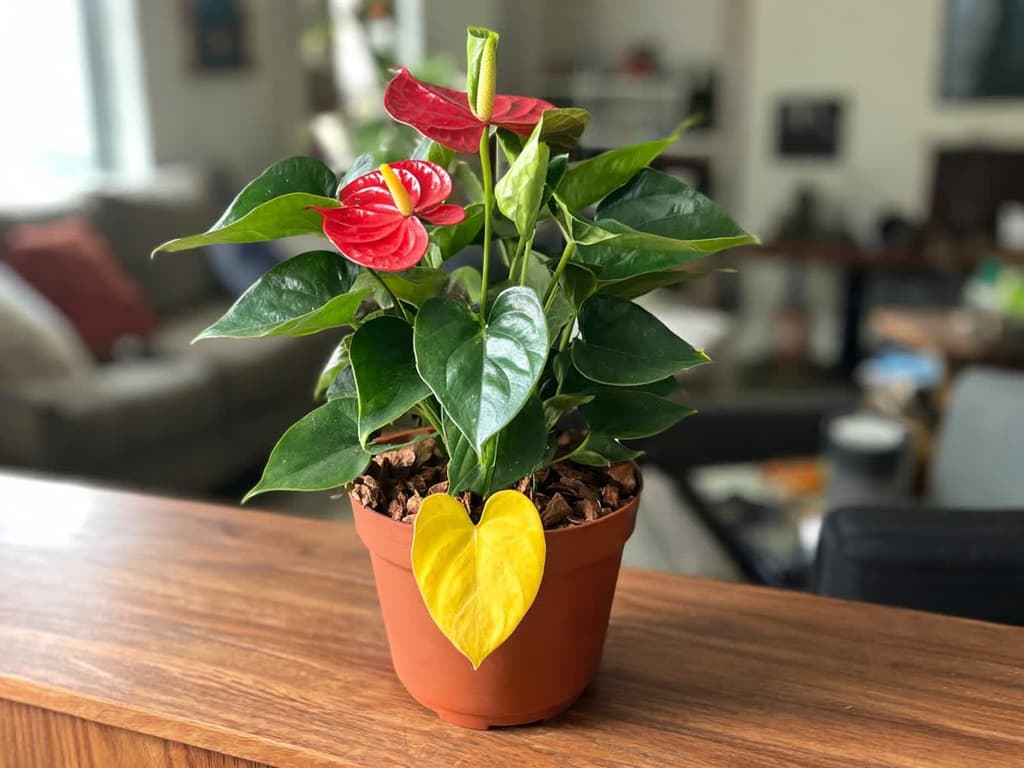
An anthurium with yellow leaves is not always sick. If only one lower leaf turns yellow at a time, the plant is simply shedding its oldest leaf. The top continues to put out new, green leaves. Signs that require action: several leaves yellowing in the same week, new leaves emerging already yellow, a V-shaped yellow margin, or a wilted plant in moist soil.
What decides the cause is where the yellow appears: on which leaf, on which part of the leaf, and alongside what other symptom.
Quick summary:
One or two old leaves yellowing on a growing plant is normal leaf shedding, and calls for no change in care (Iowa State Extension).
A lower yellow leaf with a brown tip is a sign of too much fertilizer. An old yellow leaf with rotted roots is a sign of overwatering (UF/IFAS EP159).
A yellow, water-soaked margin that turns into a dry, V-shaped lesion is the sign of bacterial blight. This disease spreads from anthurium to peace lily and dumb cane (UF/IFAS PP292).
Pale foliage caused by too much light is often mistaken for a lack of fertilizer (UF/IFAS EP159).
Prune the leaf only when it is 100% yellow, and disinfect the scissor blades before moving on to another plant.
Anthurium yellow leaf diagnosis in a table
First look at which leaf turned yellow, then check the pattern of the yellowing, and only then adjust watering or fertilizer.
What you see | Where it appears | One-minute test | Probable cause | What to do |
|---|---|---|---|---|
One yellow leaf at a time, yellow all over | Oldest leaf, at the base | Is there a firm, green new leaf emerging at the top? | Natural leaf turnover (normal) | Nothing. Prune when it is 100% yellow |
Yellow leaf with a dry, brown tip | Lower leaves | Is there a white crust on the soil or the rim of the pot? | Too much fertilizer | Flush the potting soil with water and stop fertilizing for 8 weeks |
Limp, yellow leaf, drooping plant | Old leaves first, then the rest | Is the soil moist 1 inch below the surface? Are the roots dark? | Overwatering and root rot | Take the plant out of the pot and inspect the roots |
Water-soaked yellow edge turning into a dry V-shaped lesion | Along the edge of any leaf | Does the spot start at the margin and point toward the center of the blade? | Bacterial blight | Isolate the plant, prune affected leaves, keep foliage dry |
General yellowing, bronze veins, wilted plant in moist soil | Entire plant | Held up to the light, are the veins brown? | Bacterial wilt | Discard the plant and the soil |
Entire leaf pale, or faded center with a brown tip | Side facing the window | Does direct sunlight hit the leaf at any time of day? | Too much light | Move away from the window or hang a sheer curtain |
Yellowing between veins, veins remain green | Old leaves | Are light and watering correct, and has the plant gone months without fertilizer? | Magnesium deficiency | Fertilizer that supplies magnesium |
Scattered tiny yellowish specks | Any leaf | Is there fine webbing on the underside of the leaf? | Spider mites | Treat as a pest issue |
Irregular yellowish speckles, no webbing | Any leaf | Is the underside of the leaf clean? | Manganese deficiency | Fertilizer containing micronutrients |
Three rows of the table come from Table 3 of University of Florida (UF/IFAS) publication EP159, written for potted anthurium growers: too much fertilizer, too much water, and too much light. It also identifies yellowing between veins as magnesium deficiency and irregular spots as manganese deficiency (UF/IFAS EP159). The two diseases come from publication PP292 by the same university (UF/IFAS PP292).
Bottom leaves turning yellow one at a time: almost always normal
Every leaf has a lifespan. The University of Wisconsin Extension explains that potted plants periodically replace old leaves that no longer produce much with new leaves (Wisconsin Extension). Iowa State considers it normal when a few leaves drop: they are old leaves from the interior of an otherwise healthy-looking plant.
On an anthurium, leaf turnover follows an easy-to-spot pattern. The new leaf emerges from the center at the top of the stem, while the oldest sits at the base, right by the soil. As the plant grows, that bottom leaf slowly turns entirely yellow, without spots and without going soft.
The test that confirms this is the new leaf. Is there a firm, green new leaf emerging at the top? And is the yellowing limited to just one or two leaves at the base? Then do not change your watering or fertilizer routine.
Altering your watering schedule because of a single old leaf usually makes things worse. Watering less, then more, and then less again creates the exact problem you were trying to prevent. The roots spend weeks alternating between bone-dry and waterlogged. Water when the top 1 inch of potting mix is dry, regardless of how many yellow leaves you see.
Yellow bottom leaf with a brown tip: it is fertilizer, not water
A yellow bottom leaf with a dry, brown tip points to fertilizer salts accumulated in the potting soil. The UF/IFAS troubleshooting table separates the two cases by the sign that accompanies the yellowing. "Yellow bottom leaf with a brown tip" is too much fertilizer. "Yellow old leaf with damaged roots" is too much water (UF/IFAS EP159).
The third sign is visible without unpotting the plant. A white or off-white crust appears on the soil surface or around the rim of a clay pot.
UF/IFAS recommends flushing the soil, checking the roots, and reducing fertilizer. At home, that translates to three steps:
Flush the potting soil: water slowly with plenty of water, let it drain completely through the drainage holes, and pour out whatever collects in the saucer.
Take the plant out of its pot and check the roots. Excess salts can also burn roots, and burned roots require a different approach.
Stop fertilizing for 8 weeks, then resume at a lower dose.
For indoor plants, the UF/IFAS publication recommends minimal feeding: once a month, with nitrogen at 50 ppm (parts per million).
Yellow, wilted anthurium in moist soil
Yellow, drooping leaves when the soil is still wet can be deceptive: it looks like thirst, you water, and the plant declines further. Two causes produce this picture, and what sets them apart is the root system and the leaf veins.
Root rot. The anthurium (Anthurium andraeanum) lives attached to a tree trunk in its native forest (NC State Extension). Its roots need air. In ordinary, fine potting soil, they run out of oxygen and rot.
Florist anthuriums often arrive in a plastic nursery pot set inside a cachepot with no drainage holes. Runoff sits at the bottom of the cachepot, keeping the roots submerged. Take the inner pot out of the cachepot 15 minutes after watering and pour away any standing water.
To verify, slide the plant out of its pot. Healthy roots are firm and cream-colored. Rotted roots are dark, mushy, and the outer sheath slides right off in your hand. If at least a third of the root system remains firm, the plant can still be saved. The step-by-step guide to trimming rotted roots and repotting is in the guide on how to care for an anthurium.
Bacterial wilt. The bacterium Ralstonia solanacearum spreads through the internal water-conducting channels inside the plant and clogs them. The first sign is yellow leaves. Later, the veins of the leaf and stem turn brown or bronze, and the plant wilts even in moist soil (UF/IFAS PP292).
Hold a yellow leaf up to the light. If the veins are brown and the roots show no sign of rot, suspect bacterial wilt. PP292 directs discarding the plant along with its potting soil, as the bacterium can survive in the mix for years. Do not reuse that soil. Scrub the pot thoroughly and soak it in disinfectant before using it again.
V-shaped yellow margin: the aroid bacterium
Bacterial blight begins as a water-soaked, yellow spot on the leaf margin. The spot grows in a V-shape toward the center of the leaf, then dries out and dies. The disease is caused by the bacterium Xanthomonas axonopodis pv. dieffenbachiae (UF/IFAS PP292).
The bacterium enters through pores located along the leaf margin. At night, the potting mix stays warm and wet, and the air turns humid. During this time, the plant releases water droplets through these pores, a phenomenon called guttation. The bacterium feeds on this water and enters through the margin. In Brazil, the combination of waterlogged soil and warm nights occurs in the summer, from December to March.
The same strain of Xanthomonas attacks most aroids, the family to which anthuriums belong. PP292 lists dumb cane (Dieffenbachia), aglaonema, and peace lily. These plants often share the same shelf as an anthurium. An infected plant can show no symptoms for months, spreading the pathogen to its neighbors in the meantime.
What to do at home, adapted from UF/IFAS recommendations for growers:
Move your anthurium away from other aroids as long as any leaf shows a new lesion.
Prune leaves with V-shaped lesions at the base of the petiole. Dip the shears in disinfectant before and after every cut, and before working on any other plant.
Water the soil, not the leaves. The bacterium spreads via water sitting on the foliage, and PP292 advises keeping leaves dry.
Avoid waterlogged soil: water only when the top 1 inch has dried out.
For growers, PP292 directs discarding the infected plant as soon as it is found. At home, with one or two affected leaves, you can try the steps above. If the leaves begin to turn bronze and the plant wilts, the bacterium has already taken over the entire plant, and the only option is to discard the plant and the potting soil. PP292 also lists copper-based products as effective against Xanthomonas, always at the label rate.
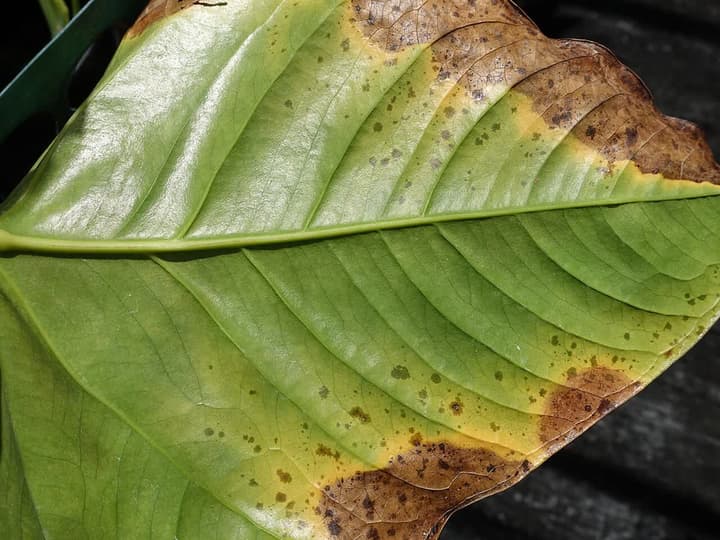
Pale or bleached leaves: too much light, not a lack of fertilizer
An anthurium leaf that turns completely yellowish-green without any spots may be getting too much light. UF/IFAS warns that light levels above the commercial production range turn leaves pale. According to the publication, this "is often misdiagnosed as nutrient deficiency" (UF/IFAS EP159). In this case, fertilizing does not solve the problem and builds up salt in the potting soil.
In Florida, commercial production ranges from 1,000 to 2,500 foot-candles (about 10,000 to 27,000 lux). To achieve this, greenhouses filter out 80% to 90% of direct sun. Direct sunlight through an unshaded window easily exceeds that range. In a home, excess light shows two signs according to the same UF/IFAS table:
Bleached leaf center with brown tips: too much light.
Broad, dry, straw-colored patch: sunburn, which does not recover.
In Brazil, a north-facing window receives direct sun for more hours. A west-facing window receives strong afternoon sun. An anthurium placed right against one of these windows needs a sheer curtain or more distance from the glass. The Dutch growers' association Anthurium Info suggests moving the plant about 1 meter away from the window when the leaves turn yellow from the sun (Anthurium Info).
The test before altering your fertilizer is to see whether the yellowing is stronger on the side facing the window. If new leaves emerge pale even on the shaded side, and the plant sits far from bright light, look for a different cause. The general breakdown of which nutrient deficiency yellows new growth versus old leaves is covered in our guide on yellow leaves on houseplants.
Cold damage: the yellowing that appears in winter
An anthurium suffers damage below 13 °C. According to UF/IFAS, damage can be "visible or invisible," and growth slows even after temperatures return to normal (UF/IFAS EP159). The publication does not describe the appearance of a cold-damaged leaf. Because of this, there is no yellowing pattern that proves cold was the cause.
The clue is the date. In Brazil, winter runs from June to August, and overnight temperatures in the South and Southeast frequently drop below 55 °F (13 °C). Near the glass, the air cools down more than in the middle of the room. The danger zones are the gap between the window and the curtain, the balcony, and the air conditioner vent. Iowa State recommends keeping tropical plants away from drafts caused by doors, windows, and air vents (Iowa State Extension).
Did the yellowing appear all at once right after a cold snap, while roots remain firm? Move the pot away from cold glass and wait for fresh leaves to grow. Plants drink less during cold weather: keep watering only when the top 1 inch is dry.
Yellow speckles and fine webbing on the underside of the leaf
Pale or yellowish speckles scattered across the leaf, with a fine web on the underside, indicate spider mites. Spider mites, aphids, scales, and mealybugs are the pests that NC State recommends monitoring on anthurium (NC State Extension). Use your phone camera zoomed in on the underside of the leaf to see the dots.
Against spider mites, apply insecticidal soap to the underside of the leaves and repeat every 4 to 7 days, because the effect is short-lived (Colorado State Extension). The dosage and step-by-step instructions for each pest are in spider mites and scale insects on houseplants. The sign that the treatment worked is new leaves emerging clean.
Should you cut off yellow anthurium leaves?
Cut the anthurium leaf when it is 100% yellow. The UF/IFAS troubleshooting guide recommends removing the yellow leaf (UF/IFAS EP159). A leaf that still has green parts continues to produce food for the plant, so you can wait.
Cut the leaf stalk close to the base, near the stem, without damaging any new leaf emerging nearby. Use clean shears with a disinfected blade. For anthuriums, a disinfected blade serves an extra purpose. According to PP292, bacterial blight spreads when removing old leaves using the same blade across multiple plants (UF/IFAS PP292).
Cutting off a yellow leaf will not kill your anthurium. A leaf that has turned 100% yellow no longer photosynthesizes, and the plant will keep pushing out new growth from the top.
When your leaf's pattern does not match any row in the table, a clear close-up photo helps compare it against diagnosed cases. The Bloom app diagnoses plant diseases directly from a photo.
Frequently asked questions
Can a yellow anthurium leaf turn green again?
No. Once a leaf turns completely yellow, it has lost its chlorophyll, the green pigment, and cannot recover. The sign that the underlying issue is fixed is when the next new leaf emerges firm and green. A slightly faded leaf caught early on may regain color once conditions are corrected.
Why are the bottom leaves on my anthurium turning yellow?
If it is just one leaf at a time and a new leaf is emerging at the top, it is the natural shedding of the oldest foliage. If the yellow lower leaf has a brown tip, it points to excess fertilizer. If the soil is moist and the plant droops, it indicates overwatering and potential root rot.
Can a wilted anthurium with yellow leaves still be saved?
Most of the time, yes. Slide the plant out of its pot: if at least a third of the root system remains firm and cream-colored, trim away rotted sections and repot into an airy mix. If the leaf veins are brown while the roots look intact, suspect bacterial wilt, in which case the plant must be discarded.
Overwatering or underwatering: how can you tell?
Stick your finger into the potting mix. Wet soil 1 inch down paired with soft, limp yellow leaves points to overwatering. Dry soil paired with dry, brittle yellow leaves points to underwatering. When in doubt, wait a day and recheck the soil before watering.
Your first step with your anthurium
Count the yellow leaves and inspect the crown of the plant. A single yellow leaf at the base alongside a new leaf emerging requires nothing more than sanitized shears. Any other pattern corresponds to a specific row in the table, complete with the quick test to confirm the cause before adjusting water or fertilizer.
For complete care instructions covering light, watering, and the right potting mix, see our guide on how to care for an anthurium. To compare your foliage against other symptoms, what is wrong with my plant organizes plant issues by visible signs. Bloom is available for iPhone.
Related articles
How to Care for a Maidenhair Fern: Light, Water, and Revival Tips
Learn how to care for a maidenhair fern indoors: bright indirect light, consistently moist soil, high humidity, and how to revive it if it dries out completely.
How to Propagate Spider Plants: Root the Pup Before Cutting
The safest spider plant cutting comes from a pup still attached to the mother plant: rest the plantlet on soil in a small pot, wait for roots to establish, and only then cut the stolon. Learn when the pup is ready, whether rooting in water is worth it, how to divide the clump, and why plants fail to produce babies.
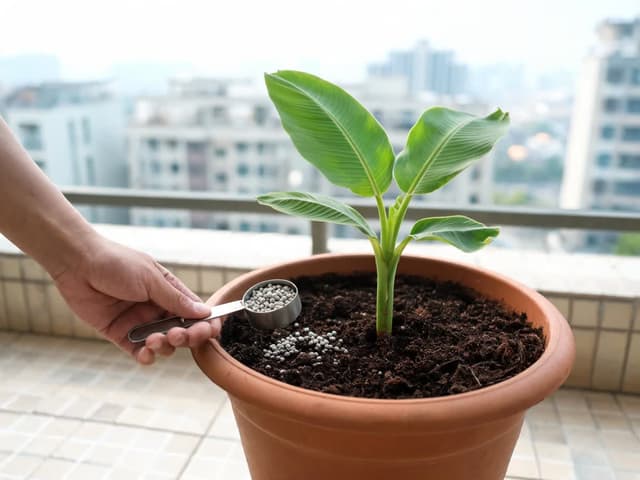
Banana plant fertilizer: fertilizing potted and backyard plants
Banana plant fertilizer needs more potassium than nitrogen, in a 3-1-6 ratio. For a potted plant on a balcony, use the label dose in spring and summer. In the backyard, fertilize every 2 months, adjusting the amount by mat age. Learn the formula, timing in Brazil, and signs of deficiency or excess.