Brown Tips and Leaves on Anthurium: When It Is a Disease and What to Do
Dry brown tips on an anthurium are rarely a disease: they usually stem from dry air, fertilizer salt, or uneven watering. Brown spots with a yellow halo or a wet look are a different story. Here is the test for each cause and how to trim the leaf.
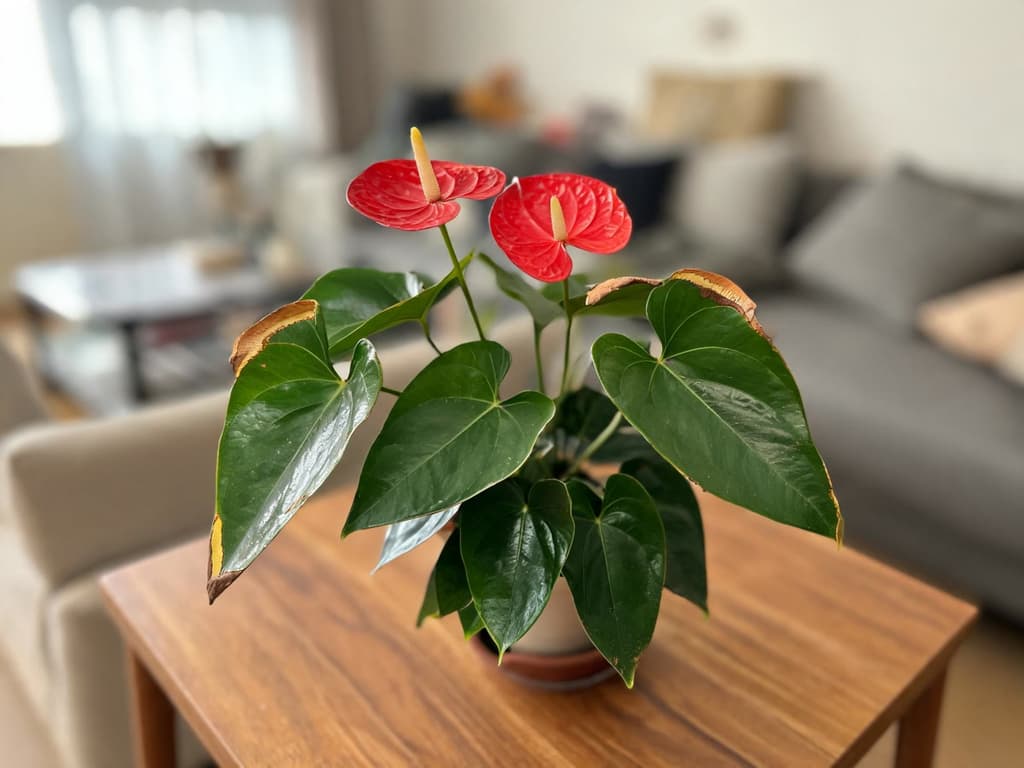
An anthurium with dry brown tips is almost never sick. Most of the time, the dry tip comes from dry air, fertilizer salt accumulated in the potting soil, or inconsistent watering. A true disease has a different pattern: a brown spot with a yellow halo or a water-soaked look. It starts at the margin and spreads toward the center of the leaf.
The first test takes 10 seconds. Run your finger over the brown section. If it feels dry, thin, and brittle like paper, the cause is care-related. If it feels soft, dark, or is surrounded by a yellow halo advancing inward, the cause is a disease or root issue.
Quick summary:
Dry air is the most common cause of brown tips on houseplants, according to the Iowa State Extension. Anthuriums prefer relative humidity between 60% and 80% (NC State Extension).
Brown tips with yellow lower leaves signal too much fertilizer. The University of Florida advises flushing the potting soil and reducing fertilizer (UF/IFAS EP159).
A yellow, water-soaked spot on the margin that turns into a dry, V-shaped lesion is anthurium blight, caused by Xanthomonas (UF/IFAS PP292).
A soft, brown leaf with moist soil points to root or stem base rot, not a lack of water.
The brown tip will not turn green again. Cut within the brown area, following the shape of the leaf, without cutting into green tissue.
Anthurium brown leaf diagnosis in a table
First check whether the brown patch is dry or wet, then see where it appears, and only then adjust watering or fertilizer.
What you see | Where it appears | Quick test | Likely cause | What to do |
|---|---|---|---|---|
Dry, light brown tip with a thin yellow band | Tip and margins of several leaves | Is the air in the house dry, or is the plant near an air conditioner? | Dry air or inconsistent watering | Group plants together, use a humidifier, and always water using the same soil test |
Brown tip and yellow lower leaves | Older leaves | Is there a white crust on the soil or on the rim of the pot? | Accumulated fertilizer salt | Leach the potting soil and stop fertilizing for 8 weeks |
Brown tip and faded leaf center | Leaves facing the window | Does direct sun hit the plant at any time of day? | Too much light | Move away from the glass or hang a sheer curtain |
Large, dry, straw-colored patch | Side facing the window | Did the patch appear after a day of intense sun? | Sunburn | Change location; the burn mark will not fade |
Yellow, water-soaked marginal spot that turns into a brown V | Margin of any leaf | Does the underside of the spot look greasy and dark green? | Bacterial blight (Xanthomonas) | Isolate the plant, cut off the entire leaf, and keep the foliage dry |
Dark brown or black and soft, wilted plant | Leaves and base of the stem | Is the soil moist 2 to 3 cm below the surface? | Root or stem rot | Remove from the pot and inspect the roots |
Lower leaf drying out entirely, one at a time | Oldest leaf, close to the soil | Is a new leaf emerging at the top? | Leaf turnover (normal) | Cut off once it dries completely |
Spathe (the red "flower") turning dark | The oldest spathe | Has it been open for more than 4 weeks? | Aging flower (normal) | Cut the flower stalk at the base |
Leaves turning brown all at once after a cold night | Leaves near the windowpane | Did the temperature in the room drop below 13 °C? | Cold damage | Move away from the window and drafty vents |
The University of Florida (UF/IFAS) troubleshooting table separates brown tips into four cases based on the accompanying symptom. With yellow lower leaves, it is too much fertilizer. With a bleached leaf center, it is too much light. With damaged roots and stalled growth, it is underwatering. A wide, dry, straw-colored patch is sunburn (UF/IFAS EP159).
Dry brown tips on an anthurium: dry air, inconsistent watering, or fertilizer salt
A dry, brittle tip separated from the green tissue by a thin yellow band comes from care practices, not disease. Iowa State lists low air humidity, irregular watering, and salt accumulation in the soil as causes of this pattern in houseplants. Water quality affects some species, but Iowa State does not include anthurium among them.
Dry air: the most common cause
The anthurium (Anthurium andraeanum) comes from the rainforests of Colombia and Ecuador and needs humidity between 60% and 80% (NC State Extension). Indoors, the air often drops below that. Iowa State calls low humidity "the most common reason" for brown tips on houseplants.
In Brazil, the air is driest in the winter, from June to August. Winter is the least rainy period in the Southeast, the Central-West, and parts of the North and Northeast (INMET). Air conditioning dries out the air year-round, and a plant placed against an air vent suffers the most.
To raise humidity around your anthurium, Iowa State suggests three methods suitable for a potted plant in a living room:
group several pots together in the same corner;
run a room humidifier;
set the pot on a tray filled with pebbles and water, ensuring the bottom of the pot does not touch the water.
Also move the pot away from air-conditioning vents, which blow dry air straight onto the leaves.
Misting anthurium leaves: sources disagree
On an anthurium, misting the leaves to counter dry air carries a risk. Two French gardening guides tell you to mist the foliage regularly, Le Parisien and the one from the Bergamotte shop. The University of Florida recommends misting an indoor anthurium, but only to remove dust and raise humidity "temporarily" (UF/IFAS EP159).
Against bacterial blight, the same university advises the opposite: keep the leaves dry, because the bacteria swim through water standing on the leaf (UF/IFAS PP292). NC State also links leaf spot on anthuriums to wet leaves and poor air circulation. I side with UF/IFAS (PP292) and NC State, university extension services that carry more weight than store or newspaper guides: raise the air humidity without wetting the leaf. If your anthurium already has any spot with a yellow halo, do not mist it.
Inconsistent watering
Underwatering, then overwatering, then underwatering again will also scorch leaf tips. Iowa State notes that soil left dry for too long between waterings causes brown tips and margins. UF/IFAS links underwatering to scorched tips, damaged roots, and stalled growth.
The solution is to use the same check before every watering. Stick your finger into the soil and water when the top 2 to 3 cm are dry. The guide on how to care for an anthurium explains why this plant prefers quick-draining soil mixed with pine bark.
Fertilizer salt accumulated in the potting soil
Too much fertilizer leaves salt in the potting soil, and the salt burns the tip and margin of the leaf. UF/IFAS writes that excess fertilizer indoors accumulates salt and causes "marginal or tip burn" (UF/IFAS EP159). The two confirming signs are yellow lower leaves and a white crust on the soil or on the rim of the clay pot.
The dosage the university recommends for indoor anthuriums is modest: once a month. The fertilizer is a 20-20-20 formula (equal parts nitrogen, phosphorus, and potassium), diluted to 50 ppm of nitrogen (50 milligrams per liter of water). One French guide, from the Bergamotte shop, advises fertilizing once a week during spring and summer. On a plant grown outside a greenhouse, that frequency builds up salts much faster.
To remove the salts, UF/IFAS instructs growers to leach the soil, inspect the roots, and reduce fertilizer. In practice:
Carry the pot to the sink or shower.
Water slowly with twice the volume of the pot, across two or three passes, until water drains freely from the drainage hole.
Let it drain completely before setting the pot back onto its saucer.
Hold off on fertilizer for 8 weeks, then resume at the 50 ppm rate once a month.
How to work out the dose from the label, and how to flush the salt from any pot, is in how to fertilize without getting the dose wrong.
What about tap water?
Three out of four French anthurium care guides I checked blame hard water with high lime content for brown tips. I found no studies demonstrating this in anthuriums. Iowa State lists plants sensitive to chlorine and fluoride in tap water: spider plant, dracaena, ti plant, prayer plant, and calathea. Anthurium is not on that list. Because no study has measured this effect on anthuriums, address dry air and fertilizer first, as both have documented sources.
Brown spot with a yellow halo: anthurium bacterial blight
A yellow spot with a water-soaked look on the leaf margin, which grows in a V-shape toward the center, is bacterial blight. Later, the spot dries and turns brown. The disease is also called bacterial leaf blight. The cause is the bacterium Xanthomonas axonopodis pv. dieffenbachiae. UF/IFAS states that this bacterial blight is probably the most serious disease of anthurium (UF/IFAS PP292).
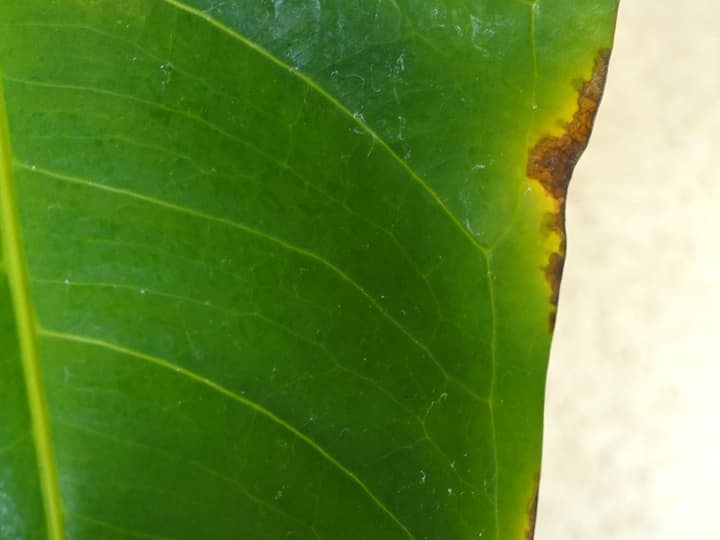
Three signs distinguish bacterial blight from simple tip drying caused by poor care:
A water-soaked appearance at the start. The plant protection service of Réunion Island (a French territory in the Indian Ocean) describes greasy, dark green spots, more visible on the underside of the leaf, near the margin (SPV Réunion).
A yellow halo surrounding the brown area that expands inward.
A V-shape, with the tip of the V pointing toward the midrib.
The bacterium enters through the pores along the leaf edge. At night, with the potting soil warm and wet, the plant releases water droplets through these pores. The bacterium feeds on this water. According to the Réunion service, the disease progresses faster between 25 °C and 28 °C, with relative humidity between 60% and 90%. In Brazil, this combination appears in summer, from December to March.
Steps to take at home, adapted from UF/IFAS recommendations for commercial growers:
Move the anthurium away from other aroids, its plant family. The same bacterium attacks dumb cane, aglaonema, and peace lily.
Cut off the entire leaf displaying the V-shaped spot right at the base of the stem. Dip the blade into disinfectant before and after making the cut.
Water the soil rather than the foliage, and stop misting the plant while any new spots are active.
Water only when the top 2 to 3 cm of soil dry out, keeping the soil from remaining waterlogged overnight.
Growers discard infected plants as soon as they find them, and PP292 lists copper-based products as effective at label rates. At home, with one or two affected leaves, you can try the four steps above. If several leaves turn bronze and the plant wilts, the bacteria have taken over the entire plant. In that case, discard the plant and the potting soil. The same bacteria and the same management steps appear in the guide on brown spots on dumb cane, a plant from the same family that is often placed near anthuriums indoors.
Are round spots on an anthurium leaf fungal?
A circular brown spot with a yellow halo can also point to a fungal infection. One French guide, from the Planète Agrobio store, attributes this type of spot to anthracnose. UF/IFAS disagrees: on anthuriums, the anthracnose fungus (Colletotrichum gloeosporioides) is "highly specific" and attacks only the spadix, the yellow center spike of the flower. The disease turns the spadix dark.
Fungal leaf spots do occur on anthuriums, and NC State links them to wet foliage and poor air circulation. To the naked eye, nobody can reliably tell a fungal spot from a bacterial spot. Management at home remains identical: remove the affected leaf, keep the foliage dry, and leave space between pots.
Soft brown leaves: root or stem base rot
A soft, dark brown leaf, with a drooping plant and moist soil, indicates a root system that stopped taking up water. UF/IFAS describes anthurium root fungi (Phytophthora and Pythium) this way: the plant wilts even with moist soil and the root sheds its outer layer. In severe cases, black to brown spots appear on the leaves (UF/IFAS PP292).
To confirm, pull the plant from its pot and wash the root system. Healthy roots are firm and cream-colored. Rotted roots are dark, mushy, and shed their outer layer when pulled, leaving only a thin string behind.
Three scenarios can happen, and only the first two are salvageable:
Rotted roots, with at least one-third firm root: cut off all the mushy parts and repot in aerated soil with pine bark. Follow the step-by-step instructions in the guide on how to care for anthuriums.
Soft, dark stem base, with a firm top and aerial roots above the mushy part: cut the top right below these roots and plant it as a new cutting, following the guide on how to propagate anthuriums. The cut must pass only through clean, firm tissue. None of the sources I checked measured how many cuttings take in this rescue, but it is the option that saves the healthy part.
Brown or bronze veins with firm roots: this indicates bacterial wilt. UF/IFAS recommends discarding both the plant and the soil because the bacteria persist in the growing medium. Do not take cuttings from this plant, as the infection spreads through propagation material.
Straw-colored dry patch facing the window: sunburn
A broad, dry, straw-colored patch on the side of the leaf facing the window indicates sunburn, according to the UF/IFAS diagnosis chart. NC State also warns that direct sun scorches anthurium foliage. A faded leaf center accompanied by brown tips marks the preceding stage: too much light, without actual scorching yet.
In Brazil, a north-facing window gets direct sun for more hours. A west-facing window gets the harsh afternoon sun. Move the anthurium away from the glass or put up a sheer curtain. The sunburn mark will not go away, but the next leaf that emerges comes out clean.
Lower leaves drying up and brown spathes: when it is normal
The oldest leaf, close to the soil, dries up and turns entirely brown, one leaf at a time, and that is normal. The sign that everything is fine is a new leaf emerging at the top, green and firm. If the bottom leaf turns yellow before drying out, the guide on yellow leaves on anthuriums separates natural leaf replacement from other causes.
The spathe, the red heart-shaped part, also darkens with age. Each spathe lasts up to 4 weeks (NC State Extension). After that, it turns green or brown and you can cut it at the base of the stem. The right time to cut is explained in how to make an anthurium bloom.
Cold damage: brown leaves following a chilly night
Anthuriums suffer damage below 55 °F (13 °C), and UF/IFAS states that this damage can be visible or invisible (UF/IFAS EP159). Leaves that darken all at once, right after a cold snap, on a plant resting against window glass, point to cold damage.
In Brazil, the risk runs from June to August, especially in the South and Southeast. Iowa State warns against leaving the plant between the window and the curtain. In that gap, the temperature changes sharply from day to night. Move the pot away from glass, doors, and air-conditioning vents.
Should I trim brown tips off an anthurium?
You can trim brown tips off an anthurium, and doing so will not harm the plant as long as you cut only into dead tissue. Dried-out brown tissue is dead and cannot turn green again. Iowa State notes that trimming only improves appearance temporarily: if the underlying cause persists, the tip will turn brown again.
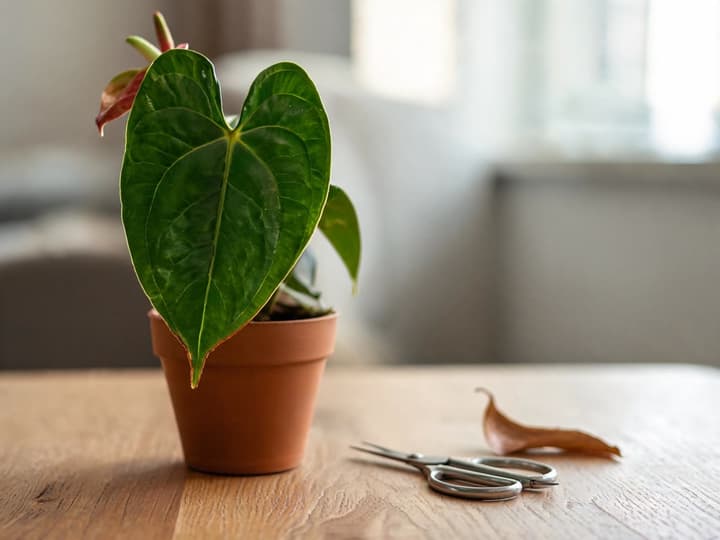
How to trim dry tips:
Disinfect your scissor blades before starting and between different plants.
Cut within the brown section, following the natural contour of the leaf tip so it stays pointed.
Leave a thin margin of brown tissue, about 1 mm wide, along the edge. UF/IFAS explains that blight bacteria enter through leaf wounds caused by pruning, and cutting into green tissue creates an entry path.
If the brown area covers more than half the leaf, trimming the tip leaves an awkward stub: remove the entire petiole at the base. Leaves showing bacterial blight lesions must always be removed entirely, never just trimmed at the tip. Anthurium sap irritates skin in some individuals, and NC State lists the plant as a cause of contact dermatitis (skin irritation triggered by handling the plant): wear gloves if your skin is sensitive.
When the brown pattern does not match any entry on the chart, a clear close-up photo helps compare it against verified cases. Bloom (available for iOS) diagnoses plant diseases directly from a photo of the leaf.
Frequently asked questions
Will brown tips on an anthurium turn green again?
No. Brown tissue is dead and cannot recover its color. You will know you corrected the issue when the next new leaf unfurls without brown tips. You can trim dry tips by cutting within the brown tissue, following the shape of the leaf, and leaving a thin brown border along the cut.
Are brown tips on an anthurium caused by too little or too much water?
That depends on the texture. Dry, brittle tips paired with dry soil in the top 2 to 3 cm indicate underwatering or dry air. Dark brown, limp leaves on a drooping plant with moist soil point to overwatering and root rot. Check the soil with your finger before changing your watering routine.
Should I mist my anthurium to stop leaves from turning brown?
It is not the best approach. The University of Florida notes that misting raises humidity only briefly. The same institution advises keeping leaves dry to prevent bacterial blight. To boost ambient humidity, group plants together, run a humidifier, or place the pot on a pebble tray with water.
Do brown spots on an anthurium spread to other plants?
Dry tips caused by low humidity, sun exposure, or fertilizer do not spread. Bacterial blight does: the bacteria travel through water splashed onto leaves or on unsterilized pruning shears, infecting other aroids like dumb cane and peace lily. Isolate an anthurium with V-shaped spots from your other plants until new leaves emerge clean.
What to do today with your anthurium showing brown tips
Run your finger over the brown patch. Dry with a thin yellow border: increase the humidity, water using the 2 to 3 cm test, and flush the soil if there is a white crust. Soft, dark, and sitting in wet soil: remove the plant from the pot and check the roots. With a yellow halo spreading inward: separate the plant from the others and cut off the entire leaf with sterilized shears. To compare with other symptoms, the page on dry tips on anthurium and the guide on what's wrong with my plant organize causes by sign.
Related articles

How to Care for Hibiscus: Sun, Watering, Fertilizer, and Pruning for Flowers
How to care for hibiscus: 6 hours of direct sun, evenly moist soil without waterlogging, half-strength fertilizer in spring and summer, and pruning in early spring. Find out why the flower lasts one day and why buds drop before opening.

Do Ferns Like Sun or Shade? It Depends on the Type
Ferns prefer bright shade: plenty of light, but no direct sun on their fronds. Tuberous sword fern is the exception that handles sun. Here is the ideal light for each type, where to place pots, and how fronds show too much or too little light.

African Violet Yellow Leaves: Causes and What to Do
Yellow leaves on an African violet usually stem from overwatering, and the first place to check is the center of the plant. Losing one lower leaf at a time is normal. Identify whether age, watering, cold water, sunlight, cold drafts, or fertilizer is the culprit based on the yellowing pattern, and see what to do today.